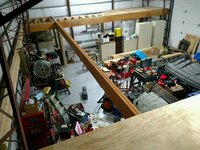
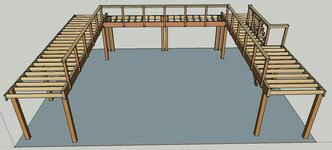
28' across and 8-10' out from the back wall link to my build in in my sig dont want to hijack this thread
No problem with hijacking, if it's OK with the OP.
I took a look at your build, and you have concrete block walls 11'-4" tall. Not sure of the roof pitch, but it's steep enough to get some decent storage above a mezzanine.
I'm going to assume a couple of things just for the sake of preliminarily designing this.
First, you could support the mezzanine on wood columns, but with those nice block walls, I wouldn't. I would use the block walls for support.
I'm assuming a clear span for the beam, so no column in the center, or anywhere. This will give you a nice clean installation, with the mezzanine deck just floating in air.
Also, I would assume that the minimum clearance under the beam should be at least 7'-0".
Did you have the cores of the block filled with loose fill insulation? Or did you have vertical reinforcing steel installed and the cores poured solid anywhere?
So the beam has a span of 26'-8" (28' width of the building minus the wall thicknesses. But remember that the beam needs additional length for bearing, so total length will be 27'-1" (see below).
For the beam in the front, I would use a concrete saw, and cut pockets in the block at the desired height and grout the cores of the block below that solid, for bearing. You will need a minimum of 1 1/2" of bearing on each end, but I would give it at least 2" or 2 1/2", which would make the beam 27'-1" long. There should be enough room in the core of the block, to push the beam in the wall at one end at a slight angle, then rotate it horizontally and push it into the other pocket. I might not grout the pockets solid, rather leave room for expansion and contraction.
I don't like wood in contact with concrete, so I would investigate methods to protect the wood from moisture migration from the block. Maybe just wrap the end with Visqueen or coat the wood with something. I don't know.
In the back, against the block wall, you can anchor a ledger to the block. Depending on the type of fasteners, and how closely they are spaced, will determine the size of ledger board needed. It can even be 2 pieces of dimensional lumber, even 2x6's, to match the joists. Remember that a ledger is a beam, and must be sized based on span, loads, etc. And fastening method must be carefully chosen.
Speaking of joists, I would use 2x6's spaced at 16"o.c. If using the typical hem-fir that big box stores sell, they will span 9'-1" with the typical house floor loading of 40# live load and 10# dead load that we have been talking about. Your span, if you build a 10' deep mezzanine will be 9'-7", so you won't meet quite the load capacity, but for this type of storage area, unless you are loading it up with engine blocks, it should be OK. If you're worried, use a stronger wood, like Douglas fir-larch, or a slightly better grade.
Decking should be the usual 3/4" T&G plywood run perpendicular to the joists and staggered, screwed and glued. You will need blocking for the joists and I would put it where joints occur.
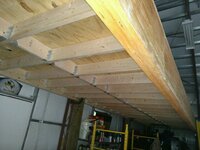
So let's size this main beam. It will be a 2 ply LVL (2 LVL's fastened together in place. You may have some difficulty placing them, because while you can put the first LVL in the one pocket, if the pockets are fairly tight, you will need to also put the second one in that pocket before you can push them into the pocket and rotate them over to the opposite pocket and insert them. It will take some help.
If the mezzanine is 10' deep and we are using 40#LL and 10#DL the contributing area is 5SFx40#=200#/LF LL and 250#/LF total load. For a 1.9E LVL and a deflection limited to L/360, you need a 2 ply beam where each ply supports 100#LL and 125# total load. 1 3/4"x18" deep LVL's will do this, but they are capable of way more capacity than that, IE 121# and 173#. Plus they are unreasonably deep.
So there are 2 alternate solutions.
One is to go with 3 plys. Then each ply needs 67# and 84# respectively. 16" deep LVL's are 85 and 120, still way over capacity and too deep.
Let's look at 3 ply in 14". The support 57# and 78# for a 27" span. But our span is 4" shorter, so interpolating between 27 and 26' spans maybe 59 and 81 is closer to capacity.
So we aren't getting quite the 40# LL or 50# total load capacity, but there's a bit of fat in the 10#DL, and you don't really have the headroom to load that space to the max. At 40#/SF, you would have 10,664# total live load capacity. And that is with a deflection of .88 of an inch totally loaded.
If you remember to load the mezzanine uniformly, I would go with three 14" deep LVL's. Might have to cut the pockets a little wider to jockey them in individually.
Also note that if you go 8' deep instead of 10', the numbers all change and either capacity goes up or sizes required, go down.
That's the thing with all this. You can juggle things around, changing sizes and strength characteristics and material types, to accommodate just exactly what you need and want to do.
One more thing. Sometimes I will let the joists drop down from the top edge of the beam, to create a little toe kick up on the mezzanine, so things aren't easily pushed over the edge. It also increases headroom in the mezzanine a little.
Got it?
Bill
PS: This is all a process anyone can do. You have to examine and analyze everything. You need to be a bit OCD and follow loads from point of origin to the earth. Start with what you will use it for. Be careful about connections, triangulate where possible and choose the most appropriate material and method. In this case, if loads are heavier or lighter, then adjust. If depth of the beam is more critical, look to steel. If a post in the middle of span is not a big deal, you can cut initial costs and reduce beam depth. Lots of ways to skin a cat. First define what kind of cat it is. And think of how you are going to physically build it, as you go through the process. Longer and deeper beams are heavier. Might need help.


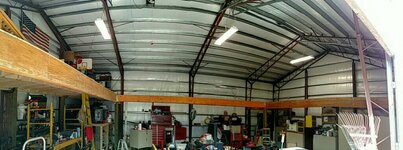
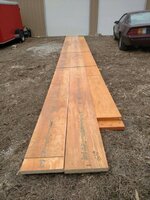

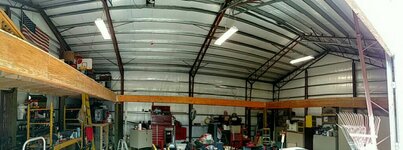
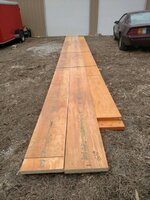





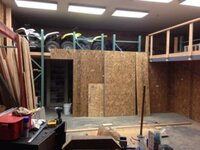

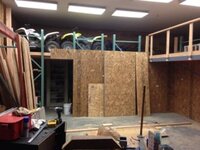

 hell no but I will PM you with what my idea is
  but dam I like your thinking