To avoid these ads, REGISTER NOW!

How to test for leaks on a Mini-Split with Low Side Gauge Only

mpire

Well-known member
Joined
Nov 21, 2008
Messages
1,856
Location
Florida
So I had another thread where my mini-split was leaking and I patched it up.

So now I am looking at the unit and wondering how to check for leaks using the gauge on the low pressure port. There isn't a high pressure port, so I can't use a gauge on that one.

Everything seems to be running just fine two days later, but I would like a more analytical checking program.

As far as pressures go, with the compressor off, the pressures on the low side are around 225.

403ce88e-03a5-492a-b880-b04bd96bf525_zpszfl8lhzk.jpg


With the compressor running it varies between 80 and 110 depending on how fast the compressor is spinning.

f1a7d22e-567e-4ca2-9c34-72e1da4a848f_zps4ldlmcum.jpg


If I had a refrigerant leak, would the pressure be dropping below 220 when the system is off?

So far so good, but I am trying to keep up and log the system to see if I still have a slow leak or not.
 
To avoid these ads, REGISTER NOW!

zmaxmotorsports

Well-known member
Joined
Jan 11, 2013
Messages
11,948
Location
South of omaha
I normally dump 300psi of nitrogen in a system after fixing a leak and let it sit,If theres a leak you will know about it.:lol:
Then I just vacuam it down and recharge system.;)
Your best best bet in your situation is to just keep an eye on how it operates,the pressure in a running system will vary.;)
 

BD1

Well-known member
Joined
Mar 18, 2007
Messages
4,602
Location
north side
You could add a schrader fitting on the high side. As for testing that 410A *****. We test at 600 PSI and use a micron gauge.
 

theoldwizard1

Well-known member
Joined
Feb 22, 2011
Messages
43,180
Location
SE MI
I normally dump 300psi of nitrogen in a system after fixing a leak and let it sit,If there's a leak you will know about it.:lol:
Then I just vacuum it down and recharge system.;)

I assume, you remove any remaining refrigerant before adding the nitrogen.
 

brewchief

Well-known member
Joined
Sep 20, 2008
Messages
2,370
Location
Michigan
Pressure will be related to temperature as long as there is any liquid refrigerant in the system, the system will quit cooling properly before you see a difference in the at rest pressure.
 
OP
M

mpire

Well-known member
Joined
Nov 21, 2008
Messages
1,856
Location
Florida
In this instance I had a slow leak and hired a professional who evacuated the system and then charged it up with nitrogen only to tell me that it had a leak and that he couldn't/wouldn't fix it. I ended up repairing the leak myself and due to the new policy at the AC company that pulling a vacuum would cost a minimum of $500 I am no longer going to be employing them for basic services. This is a company I have used for over a decade with a knowledgeable HVAC tech that has given me excellent service. I just refuse to be ripped off for pulling a vacuum.

That being said, obtaining a nitrogen tank and required gauges and fitting to do a one time pressure test did not make financial sense. The 150psi nitrogen charge hissed for about a week so I don't think it was a fast leak.

That being said, I have another 10 lbs of 410a so I can recharge if necessary, but I was hoping to have a way to verify if I had turned my slow leak into an extremely slow leak, or if I had actually fixed it. It would make me feel better at least.

Oh well.
 
OP
M

mpire

Well-known member
Joined
Nov 21, 2008
Messages
1,856
Location
Florida
Pressure will be related to temperature as long as there is any liquid refrigerant in the system, the system will quit cooling properly before you see a difference in the at rest pressure.
Do you think the low pressure numbers change while the compressor is running if there was a leak?
*over time measuring at the same ambient outside temperatures.
 
Last edited:

LS6 Tommy

Well-known member
Joined
Dec 27, 2013
Messages
26,162
Location
Northern NJ
As far as pressures go, with the compressor off, the pressures on the low side are around 225.

403ce88e-03a5-492a-b880-b04bd96bf525_zpszfl8lhzk.jpg


If the system is has not been running (compressor is not hot) and it's roughly 75*, you're looking OK, but only as a VERY rough indicator if the charge is holding. Unfortunately, you really can't rely on static pressures for troubleshooting.


With the compressor running it varies between 80 and 110 depending on how fast the compressor is spinning.

f1a7d22e-567e-4ca2-9c34-72e1da4a848f_zps4ldlmcum.jpg


I'd like to see the suction side be a little higher. What was the return air temp at that time?

If I had a refrigerant leak, would the pressure be dropping below 220 when the system is off?

Tommy
 
Last edited:
OP
M

mpire

Well-known member
Joined
Nov 21, 2008
Messages
1,856
Location
Florida
The gauge drops to 80 when the compressor starts spinning up and then moves back up to around 95-100.
 

bazar01

Well-known member
Joined
Jan 30, 2009
Messages
326
Location
Leesburg, GA
System looks under charged.
At suction pressure of 80 psi, the suction temp is about 22F.
Indoor coil will likely freeze up.

With the compressor running it varies between 80 and 110 depending on how fast the compressor is spinning.

f1a7d22e-567e-4ca2-9c34-72e1da4a848f_zps4ldlmcum.jpg
 

Tim The Tool Man

Well-known member
Joined
Mar 1, 2012
Messages
1,520
Location
Lehigh Valley, PA
You really want to be careful here. Having your system discharge and then only adding coolant is not a good idea. The oil in the system. not unlike break fluid, loves moisture. Having the system open to the atmosphere invites H2O. Having moisture in the system can and will lead to all sorts of problems down the road. The proper procedure is to first charge the system to 600 psi with nitrogen and asses the leak repairs. Give it some time. Next it needs to be brought to a vacuum to boil any moister out of the oil. This can take quite a while. Finally you will need to add the correct amount of 410 back into the system. This is done with a special scale that will weigh out the correct amount of refrigerant. Also if you had oil leak out your going to want to **** some fresh oil into the system. Finally, I do believe there is a pretty hefty fine if you are caught adding or removing refrigerant to or from any home HVAC system without a licence...
 

brewchief

Well-known member
Joined
Sep 20, 2008
Messages
2,370
Location
Michigan
You really want to be careful here. Having your system discharge and then only adding coolant is not a good idea. The oil in the system. not unlike break fluid, loves moisture. Having the system open to the atmosphere invites H2O. Having moisture in the system can and will lead to all sorts of problems down the road. The proper procedure is to first charge the system to 600 psi with nitrogen and asses the leak repairs. Give it some time. Next it needs to be brought to a vacuum to boil any moister out of the oil. This can take quite a while. Finally you will need to add the correct amount of 410 back into the system. This is done with a special scale that will weigh out the correct amount of refrigerant. Also if you had oil leak out your going to want to **** some fresh oil into the system. Finally, I do believe there is a pretty hefty fine if you are caught adding or removing refrigerant to or from any home HVAC system without a licence...

Vacuum will not pull moisture out of the POE oil, only way to get it out is with filter dryers.
 
To avoid these ads, REGISTER NOW!

BD1

Well-known member
Joined
Mar 18, 2007
Messages
4,602
Location
north side
410 A ***** as far as I am concerned. I believe 410 A is composed of three different blended refrigerants. Some manufacturers state that if you lose more than half of the system charge ALL must be removed and NEW 410A installed. Supposedly , it has to do with the oil in the refrigerants which are blended.
 
OP
M

mpire

Well-known member
Joined
Nov 21, 2008
Messages
1,856
Location
Florida
The EPA does not require a certification or license to use R410a. I checked.

I had a professional who threw his hands up in the air and gave up. I would much rather have paid him $300 and had him fix it then charge me $100 to do nothing.

System was evacuated before it was charged.

System is charged by weight with the factory recommended amount of refrigerant.

I would much rather have not had to deal with this mess. Same guy installed the thing that I called to fix the leak. That being said, I am just trying to get some piece of mind that I did the right thing.

Its not like I had a better option. I wasn't about to buy a new AC system over a pinhole leak in the evaporator.
 

mik386

Well-known member
Joined
Dec 29, 2010
Messages
62
Location
Northeast Ct.
R 410a is made up of a blend of two different refrigerants. When you have a leak they do not leak out at the same rate. This is called temperature glide. So it is possible to have an unbalanced mixture of the two refrigerants in the remaining charge. The proper way to charge a ductless split is to recover the remaining refrigerant and then leak check the system and vacuum to at least 500 microns. Then weigh in the proper amount of 410a according to the data plate. This is a job for a pro with the right equipment. Good luck
 

PoorOwner

Well-known member
Joined
Feb 10, 2007
Messages
5,032
Location
CA
Seems like you would see the leak at the repair if it was not holding.

As stated already. You can't read the operating pressure because the compressor works at variable speed as needed.
 

Jackfre

Well-known member
Joined
Dec 26, 2010
Messages
4,411
Location
N CA
BD1, 410A in conjunction with the inverter technology took mini-splits from a high efficiency of 13-14 seer to up to 36 seer. The combination also allowed very low temp operation for heat pumps. Yes, as you know, it has particular requirements, but the 410A/inverter package has transformed the industry. I like mine!
 

Big Daddy Chop Shop

Well-known member
Joined
Jan 13, 2016
Messages
233
Location
Hope, Indiana
System off pressure tell you virtually nothing except if it is flat or not. Sorry. The gauge alone when running tells you a bit more, but still not enough. To properly charge a unit, you need to check superheat and subcooling both. Superheat is the difference in the actual suction line temp compared with the pressure converted to temperature from the gauge with a P/T chart. Subcooling is the same principle but using the liquid line.

If you can only do superheat on a system like this (small residential unit) you can get it close enough.

Proper leak checking and evacuation is as follows:

1.After recovering the remaining R410a- it must be disposed of, as an azeotropic blend, the gases do not leak a the same rate (as discussed). Can only be used for leak checking as a trace gas.
2. Repair leak, purging nitrogen thru if brazing. Install new liquid line drier.
3. Add a small amount of the recovered 410a as a trace to the system, and run the pressure up to near the evaporator test pressure with Nitrogen.
4. Use electronic leak detector to verify repairs.
5. Blow off trace gas and N2 mixture
6. Pressurize system with straight N2, let stand overnight (optional if in a time crunch)
7. Evacuate to 300 microns, allow to stand and not rise over 500 (preferably for 24 hours, not always possible). This removes contaminates, non- condensables, and moisture. Remove schraders and use 3/8 minimum hoses to speed evacuation. POE is highly hydroscopic as discussed.
8. If the system will not pull down and leaks are not present break vacuum with nitrogen and pull again. Repeat as needed.
9. Charge the system with Liquid only! Never charge vapor with a blended refrigerant.
10. Verify superheat and subcooling.

Yes, it is a LOT of work. Can you "get by" doing it another way? Yep. There are always right ways and "getting by. Honestly, all repairs of this sort are best handled by a pro. The pressures R410a runs at are no joke. Lose a line at 500 PSI blowing high pressure, hot gas and oil is no joke, even a few pounds of it.


I hope this helps.
 

LS6 Tommy

Well-known member
Joined
Dec 27, 2013
Messages
26,162
Location
Northern NJ
Big Daddy nailed it, although I'm not sure if I should find it funny or ironic that he knows 410a so well but his shop is "heated with corn"... :lol_hitti

Tommy
 

brewchief

Well-known member
Joined
Sep 20, 2008
Messages
2,370
Location
Michigan
System off pressure tell you virtually nothing except if it is flat or not. Sorry. The gauge alone when running tells you a bit more, but still not enough. To properly charge a unit, you need to check superheat and subcooling both. Superheat is the difference in the actual suction line temp compared with the pressure converted to temperature from the gauge with a P/T chart. Subcooling is the same principle but using the liquid line.

If you can only do superheat on a system like this (small residential unit) you can get it close enough.

Proper leak checking and evacuation is as follows:

1.After recovering the remaining R410a- it must be disposed of, as an azeotropic blend, the gases do not leak a the same rate (as discussed). Can only be used for leak checking as a trace gas.
2. Repair leak, purging nitrogen thru if brazing. Install new liquid line drier.
3. Add a small amount of the recovered 410a as a trace to the system, and run the pressure up to near the evaporator test pressure with Nitrogen.
4. Use electronic leak detector to verify repairs.
5. Blow off trace gas and N2 mixture
6. Pressurize system with straight N2, let stand overnight (optional if in a time crunch)
7. Evacuate to 300 microns, allow to stand and not rise over 500 (preferably for 24 hours, not always possible). This removes contaminates, non- condensables, and moisture. Remove schraders and use 3/8 minimum hoses to speed evacuation. POE is highly hydroscopic as discussed.
8. If the system will not pull down and leaks are not present break vacuum with nitrogen and pull again. Repeat as needed.
9. Charge the system with Liquid only! Never charge vapor with a blended refrigerant.
10. Verify superheat and subcooling.

Yes, it is a LOT of work. Can you "get by" doing it another way? Yep. There are always right ways and "getting by. Honestly, all repairs of this sort are best handled by a pro. The pressures R410a runs at are no joke. Lose a line at 500 PSI blowing high pressure, hot gas and oil is no joke, even a few pounds of it.


I hope this helps.

I agree with your evacuation but you cannot charge a mini split by superheat or subcooling, you have to weigh in the charge and adjust for lineset length. They are a TXV unit so superheat doesn't work and there is no liquid line port so no way to measure subcooling, if you have reason to believe the charge is off all you can do is recover what's in it and start fresh.
 

monkeyspanners

Well-known member
Joined
May 28, 2013
Messages
419
Location
Oxford, UK
Stop fitting your gauge to it or you will mess the charge up, the 20g or 30g you can lose will soon make the system run like it has a leak.

If you are worried about your repair leaking, turn the system off and test the repair with some soapy water.
 
OP
M

mpire

Well-known member
Joined
Nov 21, 2008
Messages
1,856
Location
Florida
Just to follow up on this topic, I have been worrying about the compressor oil loss during the multiple stages of evacuating the system. I assume that all that mist blowing out the lines when the nitrogen was purged was probably all the oil that I am losing. I doubt the system lost much oil from the pinhole leak at the highest point in the system.

So after doing some research I am going to add some oil back to the system.

The LG compressor uses PVE oil, which is apparently pretty hard to source. I can't find any locally, so I am searching the interwebs.

I found some over at supply house for $45 plus $5 shipping.

4319-14-1.jpg


However, this is the downside. Once opened this oil is essentially a one time use because it will absorb air from the atmosphere. I am tempted to put it into a mason jar and then vacuum seal the jar to make it last. Seems a little silly.

My whole system holds a total of 320 cc or 10.8 oz of PVE oil.

The smallest can I have found is 32 oz or 950cc of oil.

I am not sure about the quantity to replace. Would half be too much? So around 5 oz?

Let me know what you think.

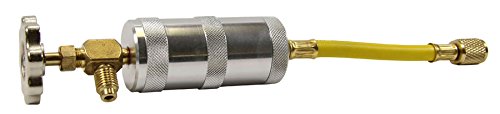
Also, I found an inexpensive oil injector on Amazon. Its $25 and has a 2 oz capacity.

31Zbd1E9uAL.jpg
 

brewchief

Well-known member
Joined
Sep 20, 2008
Messages
2,370
Location
Michigan
I'd surprised if it lost more than an once, I would do nothing, you can add a ton of lineset to those without adding oil so it ends up spread out through out the system without any issues.

Sent from my XT1254 using Tapatalk
 

Big Daddy Chop Shop

Well-known member
Joined
Jan 13, 2016
Messages
233
Location
Hope, Indiana
Just to follow up on this topic, I have been worrying about the compressor oil loss during the multiple stages of evacuating the system. I assume that all that mist blowing out the lines when the nitrogen was purged was probably all the oil that I am losing. I doubt the system lost much oil from the pinhole leak at the highest point in the system.

So after doing some research I am going to add some oil back to the system.

The LG compressor uses PVE oil, which is apparently pretty hard to source. I can't find any locally, so I am searching the interwebs.

I found some over at supply house for $45 plus $5 shipping.

4319-14-1.jpg


However, this is the downside. Once opened this oil is essentially a one time use because it will absorb air from the atmosphere. I am tempted to put it into a mason jar and then vacuum seal the jar to make it last. Seems a little silly.

My whole system holds a total of 320 cc or 10.8 oz of PVE oil.

The smallest can I have found is 32 oz or 950cc of oil.

I am not sure about the quantity to replace. Would half be too much? So around 5 oz?

Let me know what you think.

Also, I found an inexpensive oil injector on Amazon. Its $25 and has a 2 oz capacity.

31Zbd1E9uAL.jpg


No. NO. Its a one shot deal. Is your system worth $45? If you use an injector, get a quality tool, but here is my question, how do you know how much oil you lost?


Stop fitting your gauge to it or you will mess the charge up, the 20g or 30g you can lose will soon make the system run like it has a leak.

If you are worried about your repair leaking, turn the system off and test the repair with some soapy water.

Agreed on the gauge- leave it alone! these are critical charge! The best way to leak check is an electronic. Soapbubbles have a place, but not warm soapy water. Sorry. A little dawn (yes, the brand matters) and water. stream spray it so bubbles only appear if you have a leak.

I agree with your evacuation but you cannot charge a mini split by superheat or subcooling, you have to weigh in the charge and adjust for lineset length. They are a TXV unit so superheat doesn't work and there is no liquid line port so no way to measure subcooling, if you have reason to believe the charge is off all you can do is recover what's in it and start fresh.

Some have a liquid port, and some of the old ones use a fixed orphice. I did not look up his model. Assuming you are correct about those 2, you are correct. However, if the TXV is working correctly, how is is adjusting flow rate? Yep, superheat. So that will tell you if you are in the ballpark.
 

Big Daddy Chop Shop

Well-known member
Joined
Jan 13, 2016
Messages
233
Location
Hope, Indiana
Big Daddy nailed it, although I'm not sure if I should find it funny or ironic that he knows 410a so well but his shop is "heated with corn"... :lol_hitti

Tommy

LOL, in my house, I have a Heat pump with Fossil fuel kit, 90% furnace on one end, and other end has 90%, straight AC, baseboard throughout, big honkin wood burning fireplace in the middle. I like options. Pulling an AC together for the shop current shop, but yes, it is heated with corn. Will have an LP stove with the central AC if all works out.

House was built by my former boss, he was obviously in the trade too, lol!
 
OP
M

mpire

Well-known member
Joined
Nov 21, 2008
Messages
1,856
Location
Florida
I'd surprised if it lost more than an once, I would do nothing, you can add a ton of lineset to those without adding oil so it ends up spread out through out the system without any issues.

This makes a lot of sense.

No. NO. Its a one shot deal. Is your system worth $45? If you use an injector, get a quality tool

Do you have a recommendation on an oil injector? What do you mean about a one shot deal?

How do you know how much oil you lost?

I have no idea how much was lost. In total it was filled and evacuated about 3 times with about 100-150 psi of Nitrogen. The valve was opened up completely and the nitrogen was just spraying into the air it would get cloudy a few times as it blew out oil along with the nitrogen.

Agreed on the gauge- leave it alone! these are critical charge!

I haven't hooked up the gauge since the recharge. I recharged the system with 35 oz of R410a by weight according to the label on the compressor. I got an 11 lb tank, but I wouldn't know how much to add if I was losing refrigerant so I am taking the wait and see if it stops cooling approach.

The best way to leak check is an electronic. Soapbubbles have a place, but not warm soapy water. Sorry. A little dawn (yes, the brand matters) and water. stream spray it so bubbles only appear if you have a leak.

I am 50% confident that it is good to go. I also have a cheap electronic leak sniffer thing and even though its not super accurate it definitely detected the leak when I got close enough to it.

I will probably take the cover off again and do another check this weekend to see if it has developed any new leaks. So far its still cooling just fine.
 

Big Daddy Chop Shop

Well-known member
Joined
Jan 13, 2016
Messages
233
Location
Hope, Indiana
This makes a lot of sense.


Do you have a recommendation on an oil injector? What do you mean about a one shot deal?

Yellow Jackets are the ones we use.. The oil can not be saved. Period. Open it, use it, toss the rest.


I have no idea how much was lost. In total it was filled and evacuated about 3 times with about 100-150 psi of Nitrogen. The valve was opened up completely and the nitrogen was just spraying into the air it would get cloudy a few times as it blew out oil along with the nitrogen.


Honestly, you have 2 options. Run it as is (probably ok) or remove the compressor, drain it, reinstall it and add the correct oil charge. This assumes there is very little oil out in the system (likely very little)

I haven't hooked up the gauge since the recharge. I recharged the system with 35 oz of R410a by weight according to the label on the compressor. I got an 11 lb tank, but I wouldn't know how much to add if I was losing refrigerant so I am taking the wait and see if it stops cooling approach.


I am 50% confident that it is good to go. I also have a cheap electronic leak sniffer thing and even though its not super accurate it definitely detected the leak when I got close enough to it.

I will probably take the cover off again and do another check this weekend to see if it has developed any new leaks. So far its still cooling just fine.

If it is cooling, you see no frost, and the run times seem reasonable, you are probably fine.
 
To avoid these ads, REGISTER NOW!
Top Bottom