To avoid these ads, REGISTER NOW!

Soldering iron question

ajchien

Well-known member
Joined
Sep 3, 2010
Messages
2,652
Location
Los Angeles, stuck on the 60 freeway.
I'm not good at soldering, maybe need to once in a while. Always owned cheaper models, currently a weller 25w with the led lights and interchangeable screwed on tips that I got at Home Depot for about $20 a year ago.

I was having a terrible time last evening, and finally Finished up repairing a circuit board for a swimming pool chlorinator board today.

What got me finished was a digital thermometer. My tip only reached 170F degrees, just too cold to melt my lead free solder. However, the sides of the shaft of my tip reached 300F, which once I figured that out, I used the sides of the shaft to easily finish up.

Is there something wrong with my tips, or do I need to upgrade this iron to something better? I've always heard that I should stay below 30w when I do circuit boards, so as to not damage other components....

Anyone got recommendations?
 
To avoid these ads, REGISTER NOW!

srvctec

Well-known member
Joined
Aug 23, 2014
Messages
83
Location
Central Kansas
Make sure the tip is tight and the threads are clean. If really dirty or loose, heat won't transfer efficiently.

_____________________________


"It's time to be CORRECT, NOT politically correct."


-The Truth
 

Kevin54

MEMBER EMERITUS
Joined
Jan 12, 2005
Messages
29,341
Location
Urbana, Ohio
If you are doing soldering boards, or very much wiring at all, I would invest in a soldering station. You can control your temps this way. With that type of iron it is way easier to control where you want your solder to go without heating up a lot of other components and so on.

th
 

iron block

Well-known member
Joined
Jun 22, 2015
Messages
264
Location
Bay Area, CA
I'm with Kevin and Davefr: a quality soldering station is the way to go. Once you have used one, you will look at your old iron as the equivalent of a cheap imported adjustable wrench -- adequate for a few basic jobs, but not something you really want to spend a lot of time wrestling with.

If you can't find that Hakko on sale, and you are not in a hurry, keep an eye out on CL for a Weller WTCPT in the fifty buck range. They pretty much last forever, so a well-used one can be a bargain.
 

theoldwizard1

Well-known member
Joined
Feb 22, 2011
Messages
43,246
Location
SE MI
Besides proper temperature control having enough power to do the job is important ! Most Weller stations are >40W. As soon as you touch the tip to something, the temp will go down. How far it goes down and how fast it recover is the key !
 

kblee27

Well-known member
Joined
Aug 27, 2015
Messages
317
Location
Singapore
When I need to solder something, I always reach for the temperature controlled Weller DC soldering station. It heats up much faster than AC type.

It can do delicate pcb soldering as well as thick ground cables and tracks which needs higher temperature.

Work area temperature must be hot enough to eliminate cold joints, but not too hot as to burn the tracks or electronics components. Use flux liberally as it cleans up the joints.

After usage, make sure the tip is always kept clean, shiny with solder.
Use a wet sponge to wipe before it cools down completely.
Never use abrasive material on the tip.
 

TerryH

Well-known member
Joined
Dec 8, 2012
Messages
2,248
Location
Springdale, AR
A little money spent on a decent soldering station is a wise investment. I bought an Aouye 937+ and I love it. Amazing how much difference there is in a station and a basic soldering iron or gun.
 

cheechi

Well-known member
Joined
Feb 29, 2012
Messages
4,384
Location
Triad, NC
I own a FX888D, a very basic Weller pencil, a bit nicer 40W, a gun type Weller, and at least one more maybe an 80W pencil. And a portasol style. You can get everything done with the most basic pencil out there, if you practice and take good care of it. However that being said, once you get a soldering station you will never turn back. Most people who tell you not to get a more powerful iron are either telling you because
a) they're right you probably don't need more. Even though it's nice it's not really a necessity
b) usually the more powerful one you decide on is the one you borrow from someone and like
c) nobody seems to want to be the guy to recommend one that you can really do some severe damage.

You need one of these. You need to use the sponge properly. You need to tin the tip properly. You might want to buy a new tip for that one at this point, though maybe just a thorough cleaning is all that's needed. Difficult to tell with the info provided.

For circuit boards (most of what I work on is surface mounted components on boards) the most important thing is controlling the heat you apply. The hardest part of working on circuit boards is properly and cleanly desoldering whatever is broken without burning up or through things nearby. Desoldering is a whole different animal, and it's understandable if you choose to get either a different tip (wide or chisel) or different iron entirely for the desoldering work. I have a bulb type sucker (not integrated to an iron just a cheapo), desoldering braid, and flux paste which I use each depending on the situation to make sure things are clean.

Remember heat rises. Ideally you can get the iron under what you're working on, let the solder flow down onto your iron, either hit the sponge to let the solder bead up on the sponge and off the iron and repeat until it's off, or if you can get the braid in there see what it will wick.

Anyway once you get things nice and clean, you have got almost all the hard work out of the way. From my own experience, it sounds like this sort of thing is how your tip got into this condition.
 

kwschumm

Well-known member
Joined
Feb 13, 2016
Messages
1,220
Location
Olympia, WA
Depends on what the need is. For circuit boards I use a Metcal soldering station, for medium stuff like small motor connections I use a Weller station (both temperature controlled) and for heavier stuff like brass and piano wire I use an ancient Ungar pencil with a heavy iron tip. For desoldering I use a Hakko desoldering station. Forget solder guns, they **** under all conditions.
 

MFolks

Well-known member
Joined
Feb 3, 2013
Messages
1,045
Location
Springfield Mo.
Some soldering procedures,and tools needed for reliable soldered joints


1. A 25 Watt soldering iron or one that the wattage can be adjusted.

2. Rosin core solder.

3. Rosin flux or soldering paste (Never use solder or soldering paste designed for plumbing work, as it contains an acid that will corrode the electrical joint, ruining it).

4. 91% rubbing Alcohol, or 70%. The lower percentage will clean up flux residue, but not as good as the higher percentage stuff. Acetone will also remove soldered flux residue, but it’s flamable(easy to ignite).

5. A cut down ½” paint brush, or acid brush for scrubbing the repaired solder joint.

6. Clean rags or paper towels.

7. A damp sponge to keep the soldering iron tip clean.

8. Some “Solder Wick” a braided bare copper wire designed to collect heated excess solder, aiding in joint preperation, available at electronic supply stores.

9. Some wooden toothpicks.

10. Small Hemostats or clip on heatsinks.

A. Before soldering, “Tin” the soldering iron tip by plugging it in or turning the iron on, allowing it to get to operating temperature(2-3 minutes).

B. Unroll about 3” of solder from the roll of rosin core solder & then using a clean rag or paper towel moistened with Alcohol, wipe the unrolled solder, removing the finger print oils that will create a poor solder joint.

C. Apply a small amount of solder to the now heated soldering iron tip, wiping the excess off with the wet sponge or rag, keeping a thin layer of solder on the soldering iron.

D. The soldering iron is now ready for use, but before applying the heated tip to a wire, wipe the tip on the damp sponge or rag, this removes any oxidized solder and makes for a much better connection.

E. If the joint to be repaired is grey in color or appears “Crumbled”, apply some rosin soldering paste or flux to the joint with a small toothpick of screwdriver, and then apply the soldering iron tip for a few seconds.

G. The fluxed joint should clean up, allowing for a better connection. If no luck, use the solder wick to remove all traces of the old solder by apply in it between the soldering iron tip and the bad joint.

H. Hemostats and clip on heatsinks will be used to prevent the wire insulation from burning, overheating & pulling away from the connection.

I. Apply a small amount of flux to the joint to be repaired & then a very short duration of heated soldering iron tip & solder(like a few seconds or so).

J. Clean off the repaired joint with the brush & rubbing Alcohol, the newly repaired joint should appear clean and bright, almost as if it were polished, with no voids or holes.

This comes from my years at General Dynamics/Convair (1983-1993)
When I built, wired and assembled test equipment and electrical cables for the Tomahawk and later the Advanced Cruise missile.

The company had a week long soldering school, instructing you how to hand solder to Mil-Specs.
 

Xicaque

Well-known member
Joined
Jun 24, 2012
Messages
463
Location
I move every 2.5-3 yrs. No choice.
If you are doing soldering boards, or very much wiring at all, I would invest in a soldering station. You can control your temps this way. With that type of iron it is way easier to control where you want your solder to go without heating up a lot of other components and so on.


th


This ^^^^^^

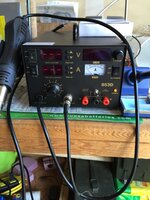
Look at fleabay for one. Got this one for 76 American and free shipping. Very happy with it. There are reviews on YouTube.

1c722b96479361e847577969a649ed10.jpg


Sent from my iPhone using Tapatalk
 

rharman

Well-known member
Joined
Apr 22, 2012
Messages
8,898
Location
SoCal
This ^^^^^^

Look at fleabay for one. Got this one for 76 American and free shipping. Very happy with it. There are reviews on YouTube.

1c722b96479361e847577969a649ed10.jpg


Sent from my iPhone using Tapatalk

My gawd. What type of advanced degree do you need to work that thing? :bounce:
 
To avoid these ads, REGISTER NOW!

GirchyGirchy

Well-known member
Joined
Nov 14, 2011
Messages
9,948
Location
Central Indiana
The 25W should work just fine for what you're doing...assuming it's getting to temp, which yours is not. Check the tip to make sure it's tight and clean.

You don't need a solder station, just an iron that works properly.
 

Davefr

Well-known member
Joined
Jan 7, 2010
Messages
11,847
Location
OR
There are a couple other "must haves" regardless of the iron you use:

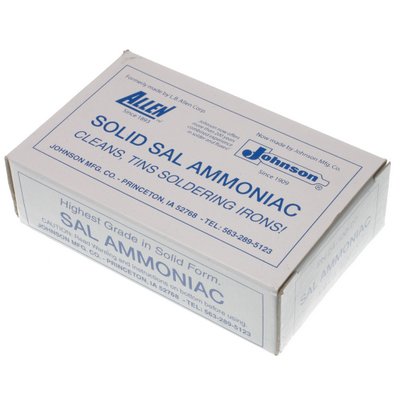
1. Sal Ammoniac block to clean a black oxidized tip that no longer transfer heat efficiently. (don't use abrasives!!)

415WjcylX7L.jpg


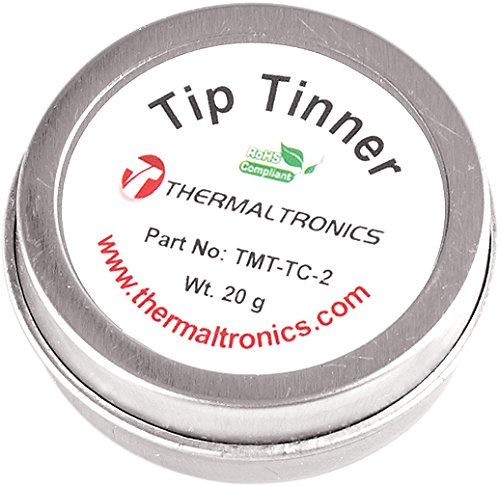
2. Tip Tinner. Efficiently tins tips to like new condition.

51iwt8SloPL.jpg


When you turn the iron off, coat the tip with solder as a barrier to oxidation.
 

pozidriv

Well-known member
Joined
Oct 22, 2014
Messages
343
Location
Belgium
Any particular reason why you're using lead-free solder? If you are a beginner, I'd start using good quality leaded solder. Guaranteed better results!
 

Two Speed

Well-known member
Joined
Sep 20, 2014
Messages
1,287
Location
Ontario Canada
Pencil Irons: Get at least a 75W or 100W. The smaller irons where fine when all you need to solder components to a single sided board. With multilayer boards, or thicker wire, the heat will be removed from the iron faster than it can keep up and you'll never get a good solder joint.

Yes, a temp controlled station is the cats ***, for the workbench. But it can be impractical at times to tote around. If I'm out on the road, 100W pencil iron is my iron of choice. Gets good and hot, and will tackle anything I throw at it.

Alex.
 

Mechanical Noise

Well-known member
Joined
Apr 25, 2014
Messages
2,635
Location
Southeast of O'Hare
300 degrees F still isn't hot enough to melt normal solder. If you're using an infrared type thermometer, you're probably mixing in the background temp.

25 W is marginal, but workable, for single sided circuit boards. I mostly used a 40W iron before I got my soldering station. Good advice from others, double check both ends of your tip.

63/37 tin/lead solder is usually the best choice for solder, 60/40 is a good second choice.
 

CoogarXR

Well-known member
Joined
Jan 11, 2016
Messages
6,867
Location
Ohio
Forget solder guns, they **** under all conditions.

I used to think that, but I prefer my big ol' gun when doing automotive wiring outdoors. Specifically installing trailer harnesses in frigid temperatures. None of my irons would get hot enough in the freezing weather, hehe. The ol' gun will!

I suppose you could use crimp-connectors, but for my personal vehicles, I solder 'em.
 

TomB19

Well-known member
Joined
Jan 1, 2015
Messages
547
Location
Regina, SK, Canada
I own a FX888D, a very basic Weller pencil...

That is a Hakko model. If purchased through eBay, there is nearly a 100% chance you have a knock-off. Even if it's a knock off, these are a great little solder station.

To the OP:

Your solder station will be fine. Upgrade if you wish but you don't need to. Personally, I just upgraded to a solder station with a smoke absorbed because solder smoke burns my eyes. I set aside a 40 year old Ungar solder station that is working perfectly. It's not important a solder station be new or high end.

There is no upper power limit to working on circuit boards, if you have a temperature controlled station. The wattage limit only applies if it's a simple iron without temperature control.

Remember: The lower the power, the more efficient you will have to be.

Keep your tip clean. Use brass wool to clean your tip frequently.

Use a chisel tip. Pencil tips are ****. I literally am not aware of a use for a pencil tip iron. Get a 2mm chisel tip and use the flat face to apply heat to a joint.

Be careful when you clean your tips. They have a coating which helps the performance. If you clean the tip with emery or a file, the coating will be gone and it will take forever to get hot. Use brass wool.

Use isopropyl alcohol to clean your circuit boards.

If you have a hard time melting old solder, flow a tiny bit of fresh solder into it. That will melt the whole joint so you can use your solder sucker or braid to remove the old solder.

Remember: clean, clean, clean.

Lastly. Use good solder. Get some real Kester and don't look back. It will melt consistently and flow evenly.
 
Last edited:

kwschumm

Well-known member
Joined
Feb 13, 2016
Messages
1,220
Location
Olympia, WA
Use isopropyl alcohol to clean your circuit boards.

When using isopropyl alcohol on circuit boards get the 99% stuff. A lot of it is only 70% alcohol and I've had it leave a white residue on boards that is a pain to remove.
 

dutchgray

Well-known member
Joined
Sep 28, 2014
Messages
6,469
Location
Dorset. England.
300 degrees F still isn't hot enough to melt normal solder. If you're using an infrared type thermometer, you're probably mixing in the background temp.

25 W is marginal, but workable, for single sided circuit boards. I mostly used a 40W iron before I got my soldering station. Good advice from others, double check both ends of your tip.

63/37 tin/lead solder is usually the best choice for solder, 60/40 is a good second choice.

In my Weller station I use a No7 tip for 60/40 and a No8 for lead free, I believe the number refers to X100 degrees F
You want plenty of heat in the iron so you can get the joint done quickly.
 

kt425

New member
Joined
Sep 12, 2014
Messages
2
I would first recommend cleaning the tip or replacing it. However, if you are still having temperature control issues, I would recommend getting a temperature controlled station like this Quick Analog Solder Station. It's reasonably priced and then you can set what temperature you would like the tip to be at.
 

KMdef9

Well-known member
Joined
May 2, 2016
Messages
713
Location
The Motorcity
Solder stations with temp control are a must, as many others have pointed out. And obviously so is maintenance on the tips.

For all other non-board soldering, I have butane powered solder guns from Weller. Work much faster than a station does, but there's a learning curve for the temp settings on them. I've actually used the gas ones to remove stubborn solder on boards.

On another note, if your just doing wire repair, crimps work great. Have less resistance than solder (which rarely matters), require less wire to work with (most of the time), are great for tight situations (no risk of burning or igniting) and get the job done faster.
 

cheechi

Well-known member
Joined
Feb 29, 2012
Messages
4,384
Location
Triad, NC
That is a Hakko model. If purchased through eBay, there is nearly a 100% chance you have a knock-off. Even if it's a knock off, these are a great little solder station.
No my Hakko is 100% genuine. Got it from Fry's. I also own a very basic Weller pencil, and so on. You see, that was a list of different irons.
 
To avoid these ads, REGISTER NOW!
Top Bottom