I was involved in one for a while, it was primarily geared toward urban apartment dwellers who had no space, or people that didn't have a garage or shop to work in, or worked on big projects that took up a lot of space. Or had specialized needs (they originally had a awesome forge and foundry set-up).... and they were pretty centrally located.
That's definitely where the idea came from. I see it as a good way to combine forces with like-minded people to make better projects, or to make projects in better ways.
... monthly member PLUS pay an hourly use fee for the "shop floor", plus for time on whatever equipment you used. You also had to reserve a time block on equipment, and you could get bumped off that slot by a board member or their friends
...
I started to get jaded with it when they started doing "quarterly dues increases" and "increased usage fees" ...
No. Just ... no. That sounds like a 'bad management' problem more than anything.
I had a great experience with TechShops when they were in Raliegh. I was month to month (around $40ish). They ultimately closed their doors but I think there are others around the country. I used it while I waited to build my house and shop to practice TIG and MIG. They had an impressive metal shop as well as separate woodworking area.
TechShops are pretty much the same thing, but I believe they're a for-profit organization. I don't really care if it's for-profit or non-profit, but non-profit definitely opens doors to collaboration within the community a bit more.
Let's take this one thought at a time, shall we?
Obviously you and your team have put a great deal of thought and effort into putting together a business model that per your responses seems to be working out. I would imagine you guys have also given considerable thought to marketing the concept as well. With a nation wide structure there could be significant savings of insurance, legal fee's and partnerships with suppliers for consumables, equipment and material, etc.
That's the idea, but that level of management becomes unwieldy. In my experience, a Makerspace needs to be opportunistic. Some areas have a strong electronics community (first-person drone racing), some have a strong metal fabrication community, some love high-end woodworking, others are 3d printing evangelists, and some are only interested in art.
As for marketing, that's definitely our weakest link. Marketing requires planning, execution, and dedication. Those are all hard things to get out of a volunteer organization, and most Makerspaces suffer. Because of that, most of the target audience (let's be honest here, GJ is the perfect target audience) has no idea that these places exist, or how they operate.
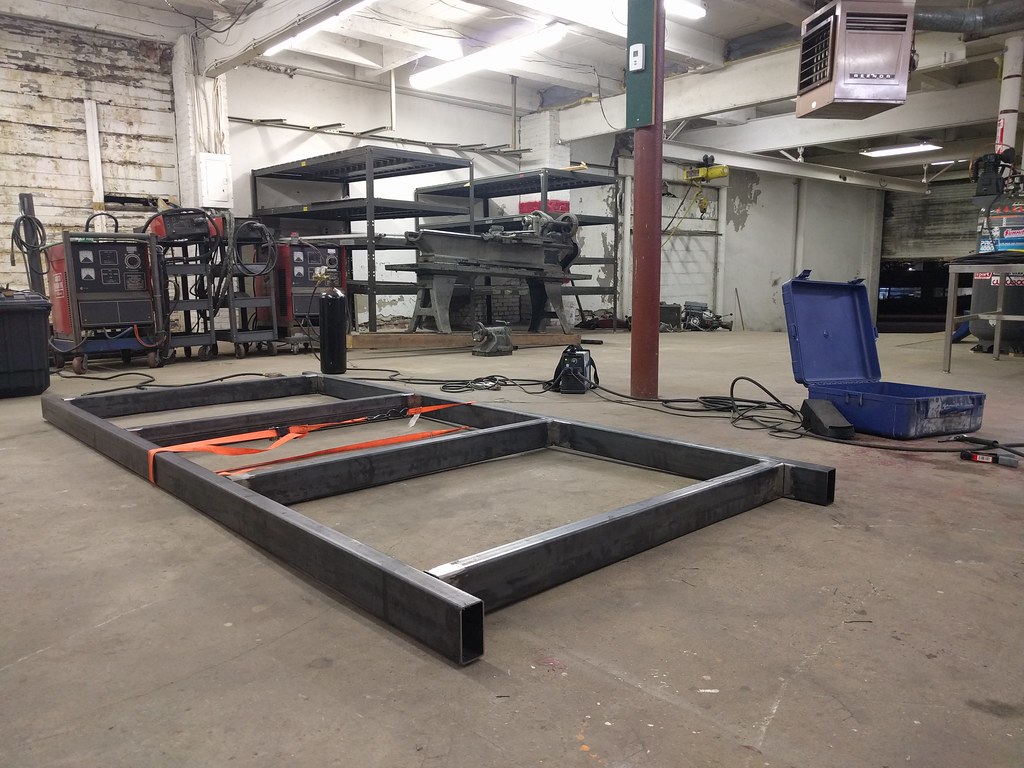
In our case, every member that joins brings along their own connections. Our local Miller rep is donating a couple of welders, we're working with our Matheson rep to get deep discounts on consumables/gas, the local Woodworker's guild has donated a whole bunch of equipment, Autodesk purchased a 3d printer for us, and a local metal supplier has offered us a 25% discount (they already have great prices), along with free delivery. The landlord has donated time, 6 months rent-free, and a few key tools like the JET horizontal bandsaw and the two big MIG welders in the background of my first post.
As for legal fees and such, Devine Millimet is a local law firm that provides several pro bono services to local startups, and they've helped us to button up all of our paperwork so far.
If a Makerspace is going to work, it's all about community and having a strong, positive vision to provide value back to the community.
How is the board of directors elected and how is equipment procurement and repairs handled?. Lets say someone like myself comes to the table with a hundred grand worth of equipment and tooling where as the other "original" partners have much less invested in the program. Is there a hierarchy inherent to the net worth of the investment or is it truly shared?.
Again, this is handled on a case-by-case basis, so my experience is anecdotal.
Initially, I was a member of MakeIt Labs, but driving ~45 minutes there after work, working on my race car, then driving home every few nights was exhausting. I did the math, and realized I was wasting around 20 hours a month just driving there and back. Manchester seemed like a good area to have its own Makerspace, so I started asking around to see who else had started one. A few efforts had been started, but all had fizzled out. I collected the people who were still invested in it, and we formed a "Steering Committee" - effectively a Board of Directors whose only goal is to organize the election of a permanent Board of Directors.
From there, we did a lot of reading, and a lot of asking questions, and drafted a Charter, Bylaws, Articles of Incorporation, and started discussions with insurance brokers and building owners/managers. A year later, we were ready to sign a lease, and decided upon 36 Old Granite St, in Manchester NH. It's right in the center of our small City, next to the main event arena, and we could start moving equipment in.
At that point, we had invested something like $300 into the business as founding Board members. Equipment loans are complicated to maintain, and members bringing personal equipment in is just messy, so we decided that the Makerspace would own every piece of equipment that members could use. We donated some basic things, like some folding tables, cleaning supplies, a shop vac, etc. That stuff now belonged to the Makerspace. The landlord donated some equipment. One of the Board members negotiated an agreement with Autodesk to acquire a 3d printer and consumables, and we ended up with a TV and a 3d design computer in the deal.
By this point, we were still waiting for a Certificate of Occupancy from the City, which essentially states that we were open for business. It took nearly a year to get that, but when we finally did, we started to sign members up as quickly as possible.
As members signed up, they took on roles as Officers. One became the Metalworking Officer, another became the Woodworking Officer. Each Officer submitted a proposed plan for their workstation, and a list of tools they'd like. From those lists, we asked for equipment donations, and 'good things' started to roll in. With a single exception, all of those 'good things' belong to the Makerspace. No member or Board member has (or ever will) receive any compensation for any of this work or any of these donations. Seeing the Makerspace succeed, and having access to a better place overall, is enough that our contributions don't require any kind of direct compensation.
A few weeks ago, we saw how much had changed since initially forming the Board of Directors, and decided it was time to re-align the Board. I stepped down from my position as Chair and handed it off to another member who is at least as committed, and much more excited about leadership. The (then current) Board of Directors voted in the new Board of Directors with more clearly defined responsibilities. If you're really interested, all of our
Board Meeting Minutes are publicly available. Meetings are managed via Robert's Rules of Order, and we try to keep the meetings as short as possible, only bringing motions to the meeting when they're ready for a decision.
The simplicity and clarity of these decisions makes it easy for our Board to act decisively. For example, the landlord donated MIG welders that require 3phase power. We don't have enough 3phase power to go around, and Miller is willing to donate newer, more efficient, 230v welders. Therefore, we'll sell the big MIG units and invest the money from that into welding bench supplies, or welding screens, or consumables, or something else that benefits the Makerspace more than big industrial machinery that doesn't suit us. If the Makerspace didn't get a clear receipt of donation when they were dropped off, we'd be in a sticky situation where the landlord might have to take them back, or we'd be forced to dispose of them rather than sell them.
So, to directly answer your initial question that I've been dancing around:
No individual has any stake in the company. If the Makerspace dissolves, all of the equipment is donated to a similar non-profit Makerspace (or closest approximation) and nobody receives compensation.
Also how is the property leased (assumed), a LLC of the original investors or maybe a sole individual signs on the dotted line and crosses their fingers?. Guess I could go on and on with questions. I've always liked the idea, I gave something like this considerable thought before I closed my contracting business and sold my building. But what stopped it dead it its tracks was insurance, my agent had plenty of four letter words to describe my thought process.

Every State has specific laws regarding it. In our case, there are no investors, and never have been. There are representatives of the Organization (President, Vice President, and Treasurer) who sign documents as official representatives. A building is leased to the organization, not to individuals. The same is true for insurance, with the slight exception of NDO (directors and officers) insurance. That's another ball of wax entirely, and essentially offers protection for individual representatives from being prosecuted for faults with the organization.