To avoid these ads, REGISTER NOW!

New slab- want lift near the edge.

jav

Well-known member
Joined
Mar 5, 2010
Messages
108
Location
Massachusetts
OK- the new garage is going up. I haven't done the slab yet and I plan to install a 10k 2-post lift (base plate lift). I will want the lift placed near a wall- near the edge of the slab... which I know can be problematic so I want to discuss options other than moving the lift.

I believe the edge of slab distance requirements stem from the use of expansion anchors near a weak edge. And, I also believe some anchor mfg's specify a minimum distance between anchors for similar reasons- and I know some lifts have bolt holes very close together and can act as a "parting line".

One of my thoughts is to set a steel plate with welded nuts under the slab before pouring the slab (matched to lifts mounting holes) That plate would disperse the pull-out loads over a larger area than just the anchors AND it would completely eliminate the concentrated expansion loads of the anchors on the slab.

Thoughts?
 
To avoid these ads, REGISTER NOW!

Randy in Maine

Well-known member
Joined
Nov 21, 2010
Messages
2,176
Location
The Beach
More important is how thick the concrete is, what the psi of the crete is, rebar or not, things like that. Talk to the guys who know the lift.
 

bowhuntr311

Well-known member
Joined
Aug 3, 2016
Messages
135
Location
North Central Minnesota
Yeah I would talk to a lift company rep and ask someone directly what would be required. Then call your concrete guy and tell him what the rep said and see if they have any thing to say. I mentioned a lift to my concrete guy and he said he could easily just make that area of the slab thicker around the bases of the lift.
 

walrus

Well-known member
Joined
Nov 12, 2008
Messages
11,679
Location
Maine
OK- the new garage is going up. I haven't done the slab yet and I plan to install a 10k 2-post lift (base plate lift). I will want the lift placed near a wall- near the edge of the slab... which I know can be problematic so I want to discuss options other than moving the lift.

I believe the edge of slab distance requirements stem from the use of expansion anchors near a weak edge. And, I also believe some anchor mfg's specify a minimum distance between anchors for similar reasons- and I know some lifts have bolt holes very close together and can act as a "parting line".

One of my thoughts is to set a steel plate with welded nuts under the slab before pouring the slab (matched to lifts mounting holes) That plate would disperse the pull-out loads over a larger area than just the anchors AND it would completely eliminate the concentrated expansion loads of the anchors on the slab.

Thoughts?
First off what is near the edge of a slab, 1 foot, 6 inches? Second, no way would I have a lift so close to a wall I couldn't walk around the post easily
 

Falcon67

Well-known member
Joined
Jun 11, 2009
Messages
18,371
Location
Merkel, TX
If its close to the edge, and you're building on somewhat common expansive clay, you should consider a footer around the perimeter, which will add substantially to the slab stability and help with your anchoring. Look at what is done locally for larger outbuildings or house foundations.

Here, I used 12x12 footers with grade beams - when I set my lift, most if not all the anchors will go into a beam area around 12" thick that runs down the middle of the building. Cost to include such things was minimal in terms of labor (shovel) and concrete. The building hasn't moved a millimeter between drought and drought breaker type weather.
 
Last edited:

OldSoldier

Well-known member
Joined
Sep 14, 2011
Messages
131
Location
DFW
The slab is not down, now is the time that it is cheapest to get it right. Either extend the perimeter beam to make it a bit wider where you plan to put the lift's outside leg, or install suitable spot footings for both legs, and wet set the anchors using a template based off of the actual base plates (this is by far the best if you have the template or have the unit picked out). No need to mess with hammer drills if the concrete isn't down yet.
 

matt_i

Well-known member
Joined
Mar 14, 2008
Messages
10,728
Location
SE Michigan
One of my thoughts is to set a steel plate with welded nuts under the slab before pouring the slab (matched to lifts mounting holes) That plate would disperse the pull-out loads over a larger area than just the anchors AND it would completely eliminate the concentrated expansion loads of the anchors on the slab.

Thoughts?

To me this seems bulletproof, use Grade 5 hex bolts, weld the hex heads underneath thru-holes in 1/2" hot rolled steel plate. I would let that sit at the bottom of the slab on top of the gravel. Will need careful measurements of the bolts to get proper thread stickout, I'd recommend making a cross section drawing to be sure. That the bolt is going to clamp a distribution plate, a concrete slab and then the lift foot is the best use of a fastener, its greater than an epoxied anchor, its better than a wedge anchor by a mile. The concrete which normally restrains the anchor is like 4000psi, making a Grade 5 bolt fully functional, which is in the 80-100,000psi range is going to be a very big improvement.

Important is that it doesn't move during the pour, and that the threads don't get concrete on them. I think I'd lightly grease and then wrap the threads in duct or electrical tape.
 
Last edited:
OP
J

jav

Well-known member
Joined
Mar 5, 2010
Messages
108
Location
Massachusetts
Thanks for the replies guys. To answer some questions:

Concrete will be 4KPSI with fiber.
Slab will be 5" thick but where posts are, there's a deeper area (2.5'x13') that will be 6-7" thick with rebar - this is where I planned to set the steel plates
Distance of closest bolt hole to edge is 5.125".
Foundation is already in- slab being poured "inside" foundation walls.
Shop is 25x42- 1 post needs to be near wall - not worried about getting behind post.
One fear is I'm told lift bolt hole patterns aren't very precise and can vary 1/4-1/2" lift to lift?
My plan was to weld rebar connecting both plates so they stay in position during pour and to add reinforcement- then leave threaded rods screwed in that would extend to 1/2" below the top of the slab. I'd wrap the rod in pipe insulation to keep the bolts from adhering to the concrete and spot each rod on a ceiling template with a plumb bob. That way the slab can be power trowled flat and i'll just drill down 1/2" to the rods and unscrew them after slab sets up for a day.
 

kelpaso1

MEMBER EMERITUS
Joined
Sep 28, 2009
Messages
3,962
Location
New Brunswick
With the post only 6 inches from the wall you will have less than 2 feet between a vehicle and the wall. How do you plan on working on that side with that little space (removing tires, axles etc)?
 

lakeroadster

Well-known member
Joined
Jan 19, 2015
Messages
5,166
Location
Central Colorado
....Thoughts?

Follow the lift manufacturer's specifications. They likely have recommendations for the use of epoxy anchors also, which minimize slab loading.

As has been said before, you don't want the post that close to the wall anyway, due to ergonomic and working clearance reasons.
 

Falcon67

Well-known member
Joined
Jun 11, 2009
Messages
18,371
Location
Merkel, TX
With the post only 6 inches from the wall you will have less than 2 feet between a vehicle and the wall. How do you plan on working on that side with that little space (removing tires, axles etc)?

I think that depends on the vehicle? The lift I'm looking to buy is non-symmetrical with symmetrical arms, one post will sit 2' from the wall to clear a ceiling joist. Total estimated distance from the wall to the door skin of the 70 Mustang (centered between the lift posts) is 4 1/2'.
 
OP
J

jav

Well-known member
Joined
Mar 5, 2010
Messages
108
Location
Massachusetts
With the post only 6 inches from the wall you will have less than 2 feet between a vehicle and the wall. How do you plan on working on that side with that little space (removing tires, axles etc)?

Not sure how you came up with that... but by my numbers an average midsize car (6' wide) will be more than 3' from the wall.

Math:
LIFT= 11'-8" WIDE (140")
Base plate edge placed 5" from wall- mid point of lift is 75" from wall (140/2=70 + 5= 75)
72" wide car placed between posts leaves 39" (72/2=36 75-36= 39")
 
OP
J

jav

Well-known member
Joined
Mar 5, 2010
Messages
108
Location
Massachusetts
Follow the lift manufacturer's specifications. They likely have recommendations for the use of epoxy anchors also, which minimize slab loading.

As has been said before, you don't want the post that close to the wall anyway, due to ergonomic and working clearance reasons.

Lift mfg presumes use of expansion anchors. And yes- I'd love the lift in the middle of a larger area but this is what I have and the other area's are just as space critical which is why placing the lift near the wall makes the most sense for how I plan to use the shop.

BTW- I didn't see a spec on slab edge clearance on GS- installation directions... unless i missed it?
 

lakeroadster

Well-known member
Joined
Jan 19, 2015
Messages
5,166
Location
Central Colorado
Lift mfg presumes use of expansion anchors. And yes- I'd love the lift in the middle of a larger area but this is what I have and the other area's are just as space critical which is why placing the lift near the wall makes the most sense for how I plan to use the shop.

BTW- I didn't see a spec on slab edge clearance on GS- installation directions... unless i missed it?

I have a Rotary SPOA10. Rotary doesn't have epoxy anchors in their specifications either. I called them, they sent me their specifications.

Edge distance on my Rotary SPOA10 is 4-3/4".

Does your lift have an overhead cross bar arrangement?
 
OP
J

jav

Well-known member
Joined
Mar 5, 2010
Messages
108
Location
Massachusetts
I have a Rotary SPOA10. Rotary doesn't have epoxy anchors in their specifications either. I called them, they sent me their specifications.

Edge distance on my Rotary SPOA10 is 4-3/4".

Does your lift have an overhead cross bar arrangement?

I haven't bought my lift yet but I want a base plate lift (no overhead cross bar) because I have other things going on over the lift. I do know the overhead lifts cross bar greatly reduces slab/anchors stresses related to cantilevered loads but this isn't an option in my case.
 

wssix99

Well-known member
Joined
Mar 2, 2011
Messages
5,161
Location
Chicago, IL
OK- the new garage is going up. I haven't done the slab yet and I plan to install a 10k 2-post lift (base plate lift). I will want the lift placed near a wall- near the edge of the slab... which I know can be problematic so I want to discuss options other than moving the lift.

Just to make sure you are aware of them... Have you considered a moveable 4 post lift? Some you can put on casters move it away from the wall, when you need to, etc. You also wouldn't have to worry about anchoring this type of lift to your slab.


I believe the edge of slab distance requirements stem from the use of expansion anchors near a weak edge. And, I also believe some anchor mfg's specify a minimum distance between anchors for similar reasons- and I know some lifts have bolt holes very close together and can act as a "parting line".

That's one reason:
- Along the foundation, you are also more likely to see settlement of the base, like this: http://www.garagejournal.com/forum/showthread.php?t=95743
- The reduced work space is also a problem. Three feet may sound like a lot of room, but its not. (Your body holding taking off a wheel in front of it will use up that entire space. You should also allow room for future beer gut expansion.)
- You also loose lateral strength for the lift and will create a tendency for it to move/tip side-to-side. If you look at a cross section of your slab/lift system, you'll see that it forms an inverted "T" forward-to-back and side-to-side:
View media item 27697
^ If you are too close to the side of the wall, that cross section looks like an "L". "T"=strong "L"=not-so-strong


One of my thoughts is to set a steel plate with welded nuts under the slab before pouring the slab (matched to lifts mounting holes) That plate would disperse the pull-out loads over a larger area than just the anchors AND it would completely eliminate the concentrated expansion loads of the anchors on the slab.

This is not a good idea and could be weaker than individual bolts.

If you look at how the anchor bolt stresses the concrete, it does so along a cone radiating from the bottom of the bolt, where the wedge is:
images


The more surface area you have in those "cones", the greater pull out strength you have. If you put a plate underneath the slab, that fracture surface will look like an upside-down pyramid with the top cut off, radiating out from the edges of that plate. You'd have do do some math to figure out how those cones stack up against the fracture surface created by the plate and also make sure the plate is thick enough to withstand the forces on it. (I wouldn't get under a lift with something like this installed unless a very competent structural engineer stamped the calculations.)


The column of a lift is a vertical cantilevered beam.

If you don't use the manufacturers recommendations, you need to have it engineered...period.

Bill

^ Very wise advice. There are good reasons why the options considered in this thread aren't in the manufacturer's instructions!


Slab will be 5" thick but where posts are, there's a deeper area (2.5'x13') that will be 6-7" thick with rebar - this is where I planned to set the steel plates

This is going to cause your slab to crack - and in places that are very very bad for your lift. If a concrete professional told you that this was OK, then you have BIG worries.

Your slab should be a consistent cross section throughout. (Just like your lift instructions direct.) If you want to have different cross sections in your garage, you can do that, but they should be separated by an expansion/isolation joint. The bay that your lift in should be a consistent thickness and have the same reinforcing throughout. (You could get away with gradually thickening the slab over a distance - its more close/abrupt changes in thickness and any changes in reinforcing schemes that cause stressing and cracking.)

Concrete is a heterogeneous material (unlike homogeneous materials - steel, plaster, plastic, etc.) and is very complex. The fact that the concrete and reinforcing have different mechanical properties and the fact that the cement in the concrete will shrink (and cause shrinkage stresses) as it cures makes it necessary to follow some non-intuitive guidelines when building with it. Your lift instructions take these things in to account. Fortunately, all you need for a 2 post lift is a very simple, consistent, flat slab. You don't even need reinforcement! (Although you may find some manufacturers that recommend it for non-structural reasons.)


My plan was to weld rebar connecting both plates so they stay in position during pour and to add reinforcement- then leave threaded rods screwed in that would extend to 1/2" below the top of the slab. I'd wrap the rod in pipe insulation to keep the bolts from adhering to the concrete and spot each rod on a ceiling template with a plumb bob. That way the slab can be power trowled flat and i'll just drill down 1/2" to the rods and unscrew them after slab sets up for a day.

You'll see all sorts of wild stuff like this working successfully - but in a different application than yours. When you cut a hole in an existing slab and create a retrofit slab inside of it, you can go with different thicknesses and different/exotic reinforcing. For a new slab, a single consistent cross section will give you the best strength, reliability, and performance.


^ All of these points have been discussed in other threads, but if you want to understand them further, we can provide technical references to learn more.
 
Last edited:

matt_i

Well-known member
Joined
Mar 14, 2008
Messages
10,728
Location
SE Michigan
If you look at how the anchor bolt stresses the concrete, it does so along a cone radiating from the bottom of the bolt, where the wedge is:


The more surface area you have in those "cones", the greater pull out strength you have. If you put a plate underneath the slab, that fracture surface will look like an upside-down pyramid with the top cut off, radiating out from the edges of that plate. You'd have do do some math to figure out how those cones stack up against the fracture surface created by the plate and also make sure the plate is thick enough to withstand the forces on it. (I wouldn't get under a lift with something like this installed unless a very competent structural engineer stamped the calculations.)

First, that's an excellent .jpeg on the inverted cone.

I take issue with a wedge anchor being better than a thru-bolt with square or rounded under-washer for this simple principle. To pop the inverted cone out in a fail involves axial-up tension overcoming the radially-out compression. To break out a "standard cone" or pyramid or cylinder shape, its basically all compression and shear. Concrete is notoriously weak in tension.

I'd argue that breaking out a cylinder pulling from the under-surface is in some respects equal to a cratering fail like rolling a forklift tire over an unsupported void of equal surface area. Usually those don't happen in my experience unless you have a tired loaded up to north of 15,000 lbs, and are often in the range of 40k or more. Industrial floors are typically better and thicker, so... To have a single fastener able to do that is almost more than the 2 post lift can handle. Obviously my analysis is very high level, I'd be interested in a design done by a P.E. with some comments about decision making...

Why does nobody it...because of convenience...planning thru bolts is sooo high stakes, make a 1/4" misalignment any which way and its a complete jackhammer tear out and start over. Wedges are the easiest anchors of all, there's a steel guide bushing for the drill bit.
 
Last edited:

lakeroadster

Well-known member
Joined
Jan 19, 2015
Messages
5,166
Location
Central Colorado
Wedges are the easiest anchors of all, there's a steel guide bushing for the drill bit.

Easy.. but no the best. Correctly sized epoxied anchors are superior to wedge anchors.

Again, OP... contact your lift manufacturer and ask them what epoxy anchors they recommend.
 

matt_i

Well-known member
Joined
Mar 14, 2008
Messages
10,728
Location
SE Michigan
Nice job on the install. I admire your truck. I have its twin, down to the sunvisor, in rougher exterior but excellent mechanical shape. :thumbup:
 
To avoid these ads, REGISTER NOW!

RWorth

Well-known member
Joined
Aug 29, 2016
Messages
592
Location
Cape Cod , Mass.
Thanks for the replies guys. To answer some questions:

Concrete will be 4KPSI with fiber.
Slab will be 5" thick but where posts are, there's a deeper area (2.5'x13') that will be 6-7" thick with rebar - this is where I planned to set the steel plates
Distance of closest bolt hole to edge is 5.125".
Foundation is already in- slab being poured "inside" foundation walls.
Shop is 25x42- 1 post needs to be near wall - not worried about getting behind post.
One fear is I'm told lift bolt hole patterns aren't very precise and can vary 1/4-1/2" lift to lift?
My plan was to weld rebar connecting both plates so they stay in position during pour and to add reinforcement- then leave threaded rods screwed in that would extend to 1/2" below the top of the slab. I'd wrap the rod in pipe insulation to keep the bolts from adhering to the concrete and spot each rod on a ceiling template with a plumb bob. That way the slab can be power trowled flat and i'll just drill down 1/2" to the rods and unscrew them after slab sets up for a day.

couple of things, personally I think your lift is going to be a PITA to work on being that close to the wall, but if that is the way it has to be and you are worried about strength, you can build a bracket and bolt the top of the post to the wall as well as anchoring it, and it will be 10 times stronger.
 

AMCguy

Well-known member
Joined
Dec 23, 2009
Messages
2,022
Location
Sunshine Coast, BC Canada
If you haven't bought your lift yet, but want a baseplate style two post, consider a Hydra-Lift or a similar design. Mine will essentially lift a car and remain stable without even being bolted down.
 

Attachments

  • IMG_0322.jpg
    IMG_0322.jpg
    131.1 KB · Views: 73

wssix99

Well-known member
Joined
Mar 2, 2011
Messages
5,161
Location
Chicago, IL
I take issue with a wedge anchor being better than a thru-bolt with square or rounded under-washer for this simple principle.

My intent was not to imply this but to point out that a wedge anchor can/"could" be superior from a strength perspective. One just needs to do the math to figure out if this is the case. (Typically on this site, we'd say "consult an engineer" instead of "do the math". That's probably reasonable guidance since there are so many variables associated with doing these calculations for a lift mounting that covering all the bases would be far beyond what could be done in a discussion thread.)

Another point is that my comments were regarding having a single plate underneath the post and not individual under-washers. Assuming the under-washers are strong enough for the stresses they would see, (similar to the design of a "J" bolt) then the stresses on the concrete should be less than what the wedge anchors would impart on the slab. Attaching all of the bolts to a single plate underneath the slab changes things a good deal. Again, one would have to do the math; but depending on the specific specifications and variables, an under-plate could be much weaker than individual under-washers.


To pop the inverted cone out in a fail involves axial-up tension overcoming the radially-out compression. To break out a "standard cone" or pyramid or cylinder shape, its basically all compression and shear. Concrete is notoriously weak in tension.

The under-washer bolt or even under-plate failure mode would also be the same pyramid/cone "punch-out" failure, with the concrete seeing tensile forces. Even though the bottom washer or plate is "pushing" on the concrete, there is nothing to restrain that force on the top of the slab and create any actual compression.


I'd be interested in a design done by a P.E. with some comments about decision making...

If you've seen posts by Ironcrow on these topics, he's done some really good research in to the industry specs and guidelines that lift engineers design and build these things to. It's great "bait" to lure in the outside experts, but we haven't seen any P.E. lift engineers chime in yet to discuss design strategy. :)


Why does nobody it...because of convenience...planning thru bolts is sooo high stakes, make a 1/4" misalignment any which way and its a complete jackhammer tear out and start over. Wedges are the easiest anchors of all, there's a steel guide bushing for the drill bit.

I expect your earlier comments about the anchors being less critical to this system are correct with regard to how lift engineers instruct these to be installed. I would think that the integrity of the concrete and slab underneath is more critical to the strength/stability of the entire system vs. the holding power of a single anchor.
 

lakeroadster

Well-known member
Joined
Jan 19, 2015
Messages
5,166
Location
Central Colorado
.... you are worried about strength, you can build a bracket and bolt the top of the post to the wall as well as anchoring it, and it will be 10 times stronger.

:lol_hitti A comedy of errors.

Lift falls, vehicle falls, building falls.

That is some truly horrible advice.. :wtf:
 

493 scamp

Well-known member
Joined
Aug 9, 2012
Messages
284
Location
Kirkwood,Illinois
If you extended the slab outside the building a couple feet the lift wouldn't be close to the edge. I worked at a shop that had an interior wall about a foot from the column,I hated working on it, I wear a 2xl shirt so it was hard to set the arms and no room for battery chargers,prybars,or roll around carts,a/c equip,creeper seat,and cherry picker.
 

RWorth

Well-known member
Joined
Aug 29, 2016
Messages
592
Location
Cape Cod , Mass.
It's amazing how you can condemn my lift without ever seeing it, and I fail to see how attaching the top will make it weaker than just bolting it to the floor. But I guess I'm not an engineer. I have been a mechanic for 50 years though, and done a lot of work with both wood and metal and have never had a failure. At 63 I guess I'm just an accident waiting to happen.
 

sberry

Banned
Joined
Jun 18, 2005
Messages
35,747
Location
Brethren, Michigan
Run a piece of rebar along the outside edge to keep it from cracking, say a number 4 or better. Should take 1 piece of additional rod along the edge.
 

lakeroadster

Well-known member
Joined
Jan 19, 2015
Messages
5,166
Location
Central Colorado
couple of things, personally I think your lift is going to be a PITA to work on being that close to the wall, but if that is the way it has to be and you are worried about strength, you can build a bracket and bolt the top of the post to the wall as well as anchoring it, and it will be 10 times stronger.

:lol_hitti A comedy of errors.

Lift falls, vehicle falls, building falls.

That is some truly horrible advice.. :wtf:

Actually no, it's not.
Holding onto the top of the column like he described would have a mechanical advantage.

Maybe, depends on how you engineer it and how the modifications work together as a system...

May not be so advantageous to introduce loads into the lift that it was never designed for.

May not be so advantageous to introduce loads into the building that it was never designed for.
 

lakeroadster

Well-known member
Joined
Jan 19, 2015
Messages
5,166
Location
Central Colorado
I haven't bought my lift yet but I want a base plate lift (no overhead cross bar) because I have other things going on over the lift. I do know the overhead lifts cross bar greatly reduces slab/anchors stresses related to cantilevered loads but this isn't an option in my case.

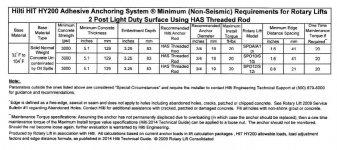
PO... did you ever contact the manufacturer? If you use epoxied anchors, based on what Rotary specifies for their lifts, the minimum edge distance is 1.6".
 

Attachments

  • Rotary Spec for Hilti HY200 Epoxy.jpg
    Rotary Spec for Hilti HY200 Epoxy.jpg
    97.8 KB · Views: 48
OP
J

jav

Well-known member
Joined
Mar 5, 2010
Messages
108
Location
Massachusetts
PO... did you ever contact the manufacturer? If you use epoxied anchors, based on what Rotary specifies for their lifts, the minimum edge distance is 1.6".

been a while- yes- I did... a couple of them actually. Epoxy is an option and will likely be how I go only because I'm pouring soon and haven't decided on lift or exact placement yet.
 

RWorth

Well-known member
Joined
Aug 29, 2016
Messages
592
Location
Cape Cod , Mass.
Maybe, depends on how you engineer it and how the modifications work together as a system...

May not be so advantageous to introduce loads into the lift that it was never designed for.

May not be so advantageous to introduce loads into the building that it was never designed for.

Didn't an engineer design the Tacoma Narrows Bridge? That worked out well for ya.:D
 

wssix99

Well-known member
Joined
Mar 2, 2011
Messages
5,161
Location
Chicago, IL
Didn't an engineer design the Tacoma Narrows Bridge? That worked out well for ya.:D

When this was engineered, scientists thought that people could drink radium laced water to cure what ailed them...

The I-35 bridge here as well.

When this was engineered, scientists thought that people could smoke cigarettes to protect one's throat...

^ Fortunately, no one had 2 post lifts back then.

I fail to see how the lack of scientific or engineering understanding/knowledge 40-80 years ago would validate doing something patently foolish or uninformed now.

The ancient engineers at least ran the calculations, tried, and did he math with their lacking knowledge or missed figures. Here - we're not even talking about trying to do that. Some are suggesting that the OP should copy shade tree engineering that is pulled out of thin air (or possibly a ****) and slapped on the side of the wall or in the ground.
 

RWorth

Well-known member
Joined
Aug 29, 2016
Messages
592
Location
Cape Cod , Mass.
Keep in mind mechanics couldn't make a living if engineers designed things that didn't break. You can't learn everything out of a book, sometimes you actually have to get out in the field to see how things work in real life. I find common sense to be just as important as education.
 

lakeroadster

Well-known member
Joined
Jan 19, 2015
Messages
5,166
Location
Central Colorado
You can't learn everything out of a book, sometimes you actually have to get out in the field to see how things work in real life. I find common sense to be just as important as education.

So true.

You are suggesting bolting the top of a 2 post lift to a wall, yet you have not seen the lift, or the wall.

That is not common sense, it is bad advice.
 
Last edited:

RWorth

Well-known member
Joined
Aug 29, 2016
Messages
592
Location
Cape Cod , Mass.
So true.

You are suggesting bolting the top of a 2 post lift to a wall, yet you have not seen the lift, or the wall.

That is not common sense, it is bad advice.

Sorry, don't know what I was thinking, I'm going to go out and pull the top brackets off my lift to make it stronger. thanks.
 

wssix99

Well-known member
Joined
Mar 2, 2011
Messages
5,161
Location
Chicago, IL
Keep in mind mechanics couldn't make a living if engineers designed things that didn't break. You can't learn everything out of a book, sometimes you actually have to get out in the field to see how things work in real life. I find common sense to be just as important as education.

Are you saying that anyone who beats their chest and calls themselves a "mechanic" has license to make stuff up, and then recommend to others that they do the same? (Because some of that is what was going on up above. ^)

The points made above weren't about mechanical knowledge. They were warning people about making "stuff" up that in areas where they don't have a full body of experience or were considering all the variables involved.

Mechanics (like engineers, doctors, welders, teachers, and any other skilled profession) have to go to school, learn, and apprentice. Mechanics operate within their field of knowledge and experience. If someone goes outside those bounds, they aren't a mechanic - they are a hack.


I support everyone's right to go off, be inventive/innovative, create new things, and maybe even kill themselves in the process.
patriot.gif

I do not agree that other people should be pulled in these directions without knowing what they are getting in to. (Even if the people suggesting them weren't originally aware.) Debate and suggestions are always good, but chest beating that one has a certain credential or experience is not very useful. On the internet, we can be anything. Those types of arguments to do something are really lame considering the vast amount of resources/information available to people on the internet.
 
Last edited:
To avoid these ads, REGISTER NOW!
Top Bottom