OK- the new garage is going up. I haven't done the slab yet and I plan to install a 10k 2-post lift (base plate lift). I will want the lift placed near a wall- near the edge of the slab... which I know can be problematic so I want to discuss options other than moving the lift.
Just to make sure you are aware of them... Have you considered a moveable 4 post lift? Some you can put on casters move it away from the wall, when you need to, etc. You also wouldn't have to worry about anchoring this type of lift to your slab.
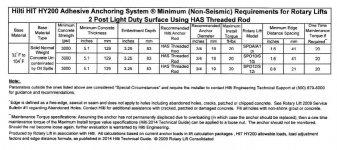
I believe the edge of slab distance requirements stem from the use of expansion anchors near a weak edge. And, I also believe some anchor mfg's specify a minimum distance between anchors for similar reasons- and I know some lifts have bolt holes very close together and can act as a "parting line".
That's one reason:
- Along the foundation, you are also more likely to see settlement of the base, like this:
http://www.garagejournal.com/forum/showthread.php?t=95743
- The reduced work space is also a problem. Three feet may sound like a lot of room, but its not. (Your body holding taking off a wheel in front of it will use up that entire space. You should also allow room for future beer gut expansion.)
- You also loose lateral strength for the lift and will create a tendency for it to move/tip side-to-side. If you look at a cross section of your slab/lift system, you'll see that it forms an inverted "T" forward-to-back and side-to-side:
View media item 27697
^ If you are too close to the side of the wall, that cross section looks like an "L". "T"=strong "L"=not-so-strong
One of my thoughts is to set a steel plate with welded nuts under the slab before pouring the slab (matched to lifts mounting holes) That plate would disperse the pull-out loads over a larger area than just the anchors AND it would completely eliminate the concentrated expansion loads of the anchors on the slab.
This is not a good idea and could be weaker than individual bolts.
If you look at how the anchor bolt stresses the concrete, it does so along a cone radiating from the bottom of the bolt, where the wedge is:
The more surface area you have in those "cones", the greater pull out strength you have. If you put a plate underneath the slab, that fracture surface will look like an upside-down pyramid with the top cut off, radiating out from the edges of that plate. You'd have do do some math to figure out how those cones stack up against the fracture surface created by the plate and also make sure the plate is thick enough to withstand the forces on it. (I wouldn't get under a lift with something like this installed unless a very competent structural engineer stamped the calculations.)
The column of a lift is a vertical cantilevered beam.
If you don't use the manufacturers recommendations, you need to have it engineered...period.
Bill
^ Very wise advice. There are good reasons why the options considered in this thread aren't in the manufacturer's instructions!
Slab will be 5" thick but where posts are, there's a deeper area (2.5'x13') that will be 6-7" thick with rebar - this is where I planned to set the steel plates
This is going to cause your slab to crack - and in places that are very very bad for your lift. If a concrete professional told you that this was OK, then you have BIG worries.
Your slab should be a consistent cross section throughout. (Just like your lift instructions direct.) If you want to have different cross sections in your garage, you can do that, but they should be separated by an expansion/isolation joint. The bay that your lift in should be a consistent thickness and have the same reinforcing throughout. (You could get away with gradually thickening the slab over a distance - its more close/abrupt changes in thickness and any changes in reinforcing schemes that cause stressing and cracking.)
Concrete is a heterogeneous material (unlike homogeneous materials - steel, plaster, plastic, etc.) and is very complex. The fact that the concrete and reinforcing have different mechanical properties and the fact that the cement in the concrete will shrink (and cause shrinkage stresses) as it cures makes it necessary to follow some non-intuitive guidelines when building with it. Your lift instructions take these things in to account. Fortunately, all you need for a 2 post lift is a very simple, consistent, flat slab. You don't even need reinforcement! (Although you may find some manufacturers that recommend it for non-structural reasons.)
My plan was to weld rebar connecting both plates so they stay in position during pour and to add reinforcement- then leave threaded rods screwed in that would extend to 1/2" below the top of the slab. I'd wrap the rod in pipe insulation to keep the bolts from adhering to the concrete and spot each rod on a ceiling template with a plumb bob. That way the slab can be power trowled flat and i'll just drill down 1/2" to the rods and unscrew them after slab sets up for a day.
You'll see all sorts of wild stuff like this working successfully - but in a
different application than yours. When you cut a hole in an existing slab and create a
retrofit slab inside of it, you can go with different thicknesses and different/exotic reinforcing. For a new slab, a single consistent cross section will give you the best strength, reliability, and performance.
^ All of these points have been discussed in other threads, but if you want to understand them further, we can provide technical references to learn more.



 A comedy of errors.