To avoid these ads, REGISTER NOW!

"Post and Beam" Concrete Footings?

duwem

Well-known member
Joined
Aug 28, 2013
Messages
451
Location
Eastern WI
Google is not helping me much on this one.

My shop is going to need some retaining walls since I'm building into a hill. And it freezes up here in WI.

Original plan was 8' tall retaining walls sitting on a 12" wide, 4' deep footing, 100' long.

Well, with the wall, the footings and the floor, it was $28,000 in concrete. OUCH.

Builder mentioned that instead of the 12" thick, 4' deep footing they could do a post and beam style and potentially save $10,000 due to less labor and concrete.

My understanding is they auger (I'm guessing 4' deep) every 8' and then also have a 12x12' trench connecting them all (maybe with some forms and other stuff?) and then pour it that way?

Anyone have any experience with this or reasons to steer away?

Attached are some images showing the shed plans and the original footings.


To avoid these ads, REGISTER NOW!

pmiranda

Well-known member
Joined
Jul 15, 2008
Messages
1,504
Location
Austin, TX
I'm guessing they put alot of reinforcing steel in those beams? I'd be curious to see the numbers but apparently steel is cheaper than labor and concrete there?
Or maybe the original design was just overkill and this is a more efficient way to carry necessary load?
The retaining wall can't be too different between the two schemes so the difference must be in supporting the rest of the building, right?
 

KELLHAMMER

Well-known member
Joined
Nov 20, 2006
Messages
222
Location
south eastern pennsylvania
You would wise to have a wall like that designed by a structural engineer.
I use retaining wall designs my practice all the time. I wouldn't trust any design a builder is recommending. Since they typically have no idea about the forces involved in such a design. Not to mention I get calls all the time about failing walls that were under designed by contractors. Believe me, it is cheaper to do right the first time. Plus, if you are going to be obtaining a building permit for this job any wall retaining 4 feet or greater requires and engineers seal in my area. Maybe not in your area, but the physic's are still the same.
 
Last edited:

willymakeit

Well-known member
Joined
Apr 27, 2009
Messages
1,243
Location
Springfield Mo.
They use post and beam in high expansive soils. The posts [piers] are drilled to a specified depth determined by bottom bearing conditions and friction loads [sides of piers].
The piers carry the loads with the grade beams spanning the opening. There is a lot of steel factored in. In high expansive the beams are poured on cardboard forms that allow the soil to expand/contract underneath without lifting building.
Depending on your areas frost/freeze line you may need to consider frost jacking.
I would consult with a local engineer.
 
OP
D

duwem

Well-known member
Joined
Aug 28, 2013
Messages
451
Location
Eastern WI
The sales guy is going to have their engineers review it.

Soil is very sandy where they walls are going.

I have heard of grade beam like what is shown on those 2 center walls on the drawing I have attached.
 

Flatland Dave

Well-known member
Joined
Jan 1, 2010
Messages
1,363
Location
SoDak
I have something very similar. Well, about the same method. I didn't want posts in the ground, so we went this way. So far so good.. Obviously bolt setting is critical. but we only had to really change one set of brackets that hold the posts.I also believe my trench was deeper, and insulated with foam board.
 

wssix99

Well-known member
Joined
Mar 2, 2011
Messages
5,161
Location
Chicago, IL
Anyone have any experience with this or reasons to steer away?

My wife built a good number of houses here in Chicago with this type of foundation and she tells me that they have performed really well. We are actually across the street from a row of 7 of these houses and they are all still standing straight and square after 20 years!

Her words of wisdom are:
- Special care needs to be taken to keep cold away from the foundations so the ground doesn't freeze and cause the grade beams to heave.
- Special care needs to be taken to keep water away from the foundations so (just in case) if the ground does end up freezing, the heaving isn't as bad.
- You'll need to insulate the grade beams well with foam and also put in wing insulation to have an effective shallow foundation insulation system:

34a47b5520bed054a3c6bb897437a35d.jpg


^ So, that's from "the boss" who is an expert on this type of installation.

My curiosity is with the continuous foundations in the middle of your structure. (I've never seen this type of plan before.) It looks like the engineer has a floating slab with a continuous thickened area for bearing walls to sit on to support the walls and ceiling above. I'd think that the outer foundations (supporting the outer edges of the trusses) could move differentially from those thickened slab areas. This would be even more of a concern if you go with grade beams.

I'd also worry that these thickened, continuous sections in the middle of the slab could encourage cracking of the slab. I'd think regular post/deep foundations with normal slab penetrations would be easier to control and may even cost less in concrete. (I would guess that they would drive up the structural cost.)
 
OP
D

duwem

Well-known member
Joined
Aug 28, 2013
Messages
451
Location
Eastern WI
Thanks for the post. Builder is going to do an updated plan and send that to me. I will post it up for review on here.
 
OP
D

duwem

Well-known member
Joined
Aug 28, 2013
Messages
451
Location
Eastern WI
Shed guy came back. Different plan for the concrete. 5' wide footer with lots of rebar to hold up the retaining wall. Then thickened edge slab with thickened areas where the center walls go.

$6k cheaper than the previous method. Also said it was cheaper to eliminate the step downs in the side walls because its easier to form and pour at the same height. But then there is more concrete to deal with on the inside for finishing off.

What you guys think?


readhead

Well-known member
Joined
Dec 8, 2012
Messages
6,181
Location
Durango, Co.
Is it practical to excavate farther back? I erected a building for a job with a similar design several years ago. With the low roof coming down so close to the ground there was a problem with snow and ice buildup and constant water leakage. If this is your only option then pay very close attention to details.
 
OP
D

duwem

Well-known member
Joined
Aug 28, 2013
Messages
451
Location
Eastern WI
Yes, some, I can take down a few of these pines and lower the ground level, will want to do that to channel water away from the walls too.


bullnerd

Well-known member
Joined
Sep 17, 2012
Messages
5,690
Location
Jersey
I think fine homebuilding just did an article on that type of foundation with the wide shallow footers. Like WSSIX mentioned(actually his wife, LOL) careful attention to insulation is the key I think.

I have no experience with a retaining wall being part of the building, but IMO, I would never do it. Id rather have a separate wall and a space to the building.

Good luck, looks like a really nice building!
 

wssix99

Well-known member
Joined
Mar 2, 2011
Messages
5,161
Location
Chicago, IL
I think fine homebuilding just did an article on that type of foundation with the wide shallow footers. Like WSSIX mentioned(actually his wife, LOL) careful attention to insulation is the key I think.

Don't LOL the wife... She's battle/construction tested - she strikes first and asks questions later.

^ I'll ask her about the plan and see what she thinks later.
 

wssix99

Well-known member
Joined
Mar 2, 2011
Messages
5,161
Location
Chicago, IL
What is the 4 X 4 foundation in the middle of the building for??? Thinking ahead to slab finishing:

With so many thickened elements in the slab, they are gong to act as anchors as things contract, so placement of expansion and saw cut joints will be critical. I highly recommend planning these out now. The thickened rows in the middle of the slab and that 4 X 4 foundation will need be the central drivers of that placement.

The two aprons should be isolated with full expansion joints.

Are car lifts or other machinery planned for the shop that can't be attached to the floor near saw cut joints?
 

machsnell

Well-known member
Joined
Jun 12, 2010
Messages
942
Location
Northern Virginia
Yes, some, I can take down a few of these pines and lower the ground level, will want to do that to channel water away from the walls too.


Did you cut all of that with the tractor? If so good job but it must have been painful.

Comments above about the expansion and contraction joints is spot on. They will need to be laid put ahead of time to work with beams.

Insulation on exterior and interior are key as noted above.

Also backfill the wall within a foot of finish grade and pressure will be minimized.

What is height of wall above grade?

Sent from my SM-G900V using Tapatalk
 
To avoid these ads, REGISTER NOW!

CNGsaves

Well-known member
Joined
Sep 26, 2012
Messages
13,233
Location
KS and OK
Beautiful lot OP . . . that's going to be Awesome building !! :thumbup:

Your soil looks pretty much to be sand . . . that likely gives you more flexibility and more forgiveness no matter what you do. Doubt that you'll have "stranded" water problem with pressure against side of wall. However, I'd still put in french drain system on that hillside so water can get away, in worst case scenario. With that sand, you better put multiple "layers of sock" to prevent soil/sand infiltration into the drainage system. Good luck.
 

matt_i

Well-known member
Joined
Mar 14, 2008
Messages
10,730
Location
SE Michigan
Agreed on the point to pour the inner pad footings (or grade beam) separately as monolith block and let the floor float around it as a second pour. One reason is then you can saw cut the slab right up to the monolith and not worry about the change in depth imparting weird stresses to it, and not worry about sawing a weak point right thru the grade beam every 10-12ft.

Another way to view this...a heavy industrial building has big concrete monoliths under each building column which are done first. Then the floor is poured later on. The two concrete placements touch but aren't structurally connected.

As other posters have suggested, I'd attempt to get soil (however sandy) away from the sidewall of your building, even if you have to relocate the building a few feet out. Obviously have to manage stormwater rolling down the steep hill. But then it saves the big heavy pour, the basement-style outflow management and the wall water/damp-proofing.
 
Last edited:

Radix2

Well-known member
Joined
May 28, 2014
Messages
1,853
Location
the thumb!, MI
What they are calling a grade beam sounds like a "frost protected shallow foundation?"

Have you read about the proper construction of those? It is a viable alternative, but they need to get the details right. And That is where many builders miss.

Really follow up on the plan for that integral retaining wall. An engineered design or review is essential.

I was shocked at how many structural errors my very experienced builder fell into when encountering nonstandard building features.
 
Last edited:

wssix99

Well-known member
Joined
Mar 2, 2011
Messages
5,161
Location
Chicago, IL
Your soil looks pretty much to be sand . . . that likely gives you more flexibility and more forgiveness no matter what you do.

This is a little bit of a worry for the area of the building away from the retaining wall. Mother nature does a really poor job of compressing sand naturally, so I'd want to either have a compaction test done (by an engineer) before moving forward or confirm with someone close buy that they put a big building on a thickened edge slab nearby on the same soil.
 

wssix99

Well-known member
Joined
Mar 2, 2011
Messages
5,161
Location
Chicago, IL
What you guys think?


I consulted with "the boss" on this ^. Here are our thoughts:

- It looks like the latest design is a thickened edge slab and not a "grade beam". (The grade beams we are used to are actual beams that span smaller caisson footings spaced out along the edge of the foundation.) This should be fine as it matches up well to the thickened "footings" in the middle of the building for the lean-to's.

- If going with this construction, we would not let it freeze - ever. So, the shell would need to be up and the heat on before the first frost or construction should wait until the spring. Our worry is that the area with the retaining wall will not freeze but the downhill area will. So, if the building is put up in the winter, it will likely experience movement in the spring as the ground thaws.

- Along with the above point, the heat would need to be on right-away. We think this design is heat-critical and requires a heated space all winter long. (If not, then we think it best to have all the walls sitting on deep foundations going below the frost lines.) Some folks will put in the PEX for radiant and save the actual boiler for a future budget item - so this is design is probably not a good candidate for that strategy. Since the ground cover of the uphill section will keep the slab warm, the slab will likely move differentially compared to the downhill section if the floor/building were unheated. Even if the retaining wall was not there, there would probably still be odd differential movement in an unheated version of this building as the outer portions of the slab froze and heaved before the inside sections supporting the lean-to sections and roof.

- It looks like some footings are sitting on insulation and others are not. That would be something to check/confirm with the engineer. My expectation is that you would want insulation everywhere except for under those footings and thickened sections.

- The boss recommends the side (horizontal) skirt of insulation around the perimeter be 24". If you go longer than that, it won't hurt but it will cost some extra money. (Given that the stuff comes in 4X8 sheets, 24" is probably a good number.) We aren't sure what the financial return would be on going over 24".

- Since you are using a shallow foundation/thickened edge on the downhill section of the building, the strength of the sandy soil is more of a concern here. I would definitely get it tested and compare notes with your engineer. If mother nature hasn't compacted that sand well over time, then your current design may not hold up to gravity and normal vibrations. (You could be put in a situation where you need to consider going back to the deep foundation in that area or removing some material and compacting it under that foundation.
 
OP
D

duwem

Well-known member
Joined
Aug 28, 2013
Messages
451
Location
Eastern WI
I don't plan to heat it for year(s).

No wonder this shed still hasn't been started, just in a downward spiral of negative progress...

But these guys have been in business for 30 years so maybe I should just "give them my money" and get er dun?
 

Radix2

Well-known member
Joined
May 28, 2014
Messages
1,853
Location
the thumb!, MI
Here is one of many publications on first protected shallow foundations. They have designs for both heated and unheated buildings. They are commonly used in very cold climates in Northern Europe.

The key is proper execution.

If you are knowledgeable and committed, you can make it happen. If you are concerned about doing that, I would save and build a normal deep foundation that the contractors are used to. I would still though have the retaining wall reviewed unless the builder brings you a engineer stamped plan for that detail.

I discount from experience builders claims of "doing it for years" for the simple reason that they get away with all sorts of stuff that leads to leaking, rotting, cracking, etc. in a few short years while they seem to pride themselves on the fact that their stuff hasn't simply collapsed.

http://www.buildingfoundation.umn.edu/MHFAfrostFoundation.htm
 

wssix99

Well-known member
Joined
Mar 2, 2011
Messages
5,161
Location
Chicago, IL
Here is one of many publications on first protected shallow foundations. They have designs for both heated and unheated buildings. They are commonly used in very cold climates in Northern Europe.

The key is proper execution.

If you are knowledgeable and committed, you can make it happen. If you are concerned about doing that, I would save and build a normal deep foundation that the contractors are used to. I would still though have the retaining wall reviewed unless the builder brings you a engineer stamped plan for that detail.

I discount from experience builders claims of "doing it for years" for the simple reason that they get away with all sorts of stuff that leads to leaking, rotting, cracking, etc. in a few short years while they seem to pride themselves on the fact that their stuff hasn't simply collapsed.

http://www.buildingfoundation.umn.edu/MHFAfrostFoundation.htm

Thanks for posting this! This is very informative. -> Another reason to love Minnesota. (Beyond their State Fair that puts all others to shame.)

A quick look at the unheated foundations calls for a LOT of insulation. At that point, one could just pay for the deep footings!
 
Last edited:

wssix99

Well-known member
Joined
Mar 2, 2011
Messages
5,161
Location
Chicago, IL
I don't plan to heat it for year(s).

No wonder this shed still hasn't been started, just in a downward spiral of negative progress...

But these guys have been in business for 30 years so maybe I should just "give them my money" and get er dun?

Sorry for the bad news. I would suggest having this conversation with your engineer (about not having a heated space for a while) and see what their opinion is.

I think the thickened slabs work fine when all edges move together in a freezing environment. Your structure is so complex, that all of these internal and external areas are going to freeze at different times and move differentially and at different times.

In building my house/castle, I've learned that there is no problem that a big pile of money can't solve... (I feel your pain. My 10 car barn had to be trimmed down to a simple 6 car garage and we still went over budget.) Deeper foundations (interior and exterior) or heating to 40 degrees with the frost protected foundation will allow you to fully control your heaving risk. (Per Radix2's post above, you could also do an unheated frost-protected foundation, but I'd still think that risky - even if the extra insulation is affordable. You'd be praying that the summer heat holds on underneath the building until spring.)
 

doge

Well-known member
Joined
Aug 21, 2015
Messages
70
Location
Norcal
Ask your structural engineer about geosynthetics to reduce the forces on your wall

Sent from my SAMSUNG-SM-G900A using Tapatalk
 
OP
D

duwem

Well-known member
Joined
Aug 28, 2013
Messages
451
Location
Eastern WI
I don't have an engineer, just the shed builders claim they use their own. I am an engineer (maybe why this is all so difficult) but I don't understand concrete or frost)

Thanks for the links, I will read them.
 
Last edited:

wssix99

Well-known member
Joined
Mar 2, 2011
Messages
5,161
Location
Chicago, IL
but I don't understand concrete or frost

Please excuse me if you have this part down:

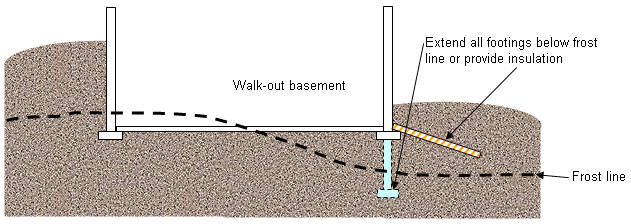
The main thing we are worried about is the "frost line." That is the layer of dirt where the ground never freezes because its kept warm by the center of the earth and stored heat from the summer months.

footing-depth.jpg


http://www.renovation-headquarters.com/foundations-14.html

^ As the dirt above that line freezes, the water in the pores of dirt turns to ice and the dirt/ice matrix increases in volume, causing it to "heave." (So, the problem is not so much with the dirt - but the water trapped in the dirt that turns to ice.) The trick is to get the foundations below the frost line so the dirt doesn't change in volume and the building doesn't move. If the foundations are above the line, things get tricky. (The link above describes your situation, except you have the interior footings, which makes your situation more challenging.)

Things getting tricky -> Some slabs with thickened edges can be placed above the frost line where they are all at a consistent level. The ground will heave, but the all the slab will heave together and the building will just move up and down.

When you have a situation like yours, where the frost line is at varying distances from your slab the building would move/heave in a wave form as the ground freezes at different times, varying with the distance between the frost line and foundation. This movement is a problem. You could build a separate retaining wall and move the whole building off to the side, away from the wall - this would give you a flat equidistant frost line under the foundation, but at that point, you'd probably be spending the same amount of money it would cost you to put in a deep foundation all the way around.
 
OP
D

duwem

Well-known member
Joined
Aug 28, 2013
Messages
451
Location
Eastern WI
Thanks. From what I'm understanding the slab itself has the 2" foam under it so that should stop frost from coming down from the top. The walls into the hill will be holding back dirt several feet deep so that should stop it and the concrete walls will have foam on the outside so that should stop it from driving horizontally into the hill. Where it's less than 4' of dirt high, one could put foam horizontally at the bottom. On the non hill sides one could put foam horizontally say 4' wide and extend that around the corners where the dirt is not as high on the walls.

With the thickened edges and center "beams" there would need to be extra thought on how the foam would be placed.
 

wssix99

Well-known member
Joined
Mar 2, 2011
Messages
5,161
Location
Chicago, IL
All the foam does is slow down the transfer of heat. It doesn't actually stop anything or act as a barrier.

So, the ground under the building will still freeze - it will just hit that freezing point a few weeks later than it would otherwise.

With 2" of foam, you still need a source of heat inside the building. That heat eventually makes its way down through the slab and through the foam (slowly) and in to the ground. That heat will eventually escape to the air (more slowly) around the horizontal wings of insulation, but during that time the heat has kept the ground underneath the building from freezing. (With a well insulated ceiling and walls in your building, most of your heat loss is going to be through our slab - which is what you would want with this type of construction.)

If you dig in to the documents Radix2 posted, you'll see that unheated buildings require up to 8" of insulation! That insulation will trap heat for longer and it will transfer much more slowly than the 2" insulation. This works in an unheated building by trapping the summer heat under the building, like a heat battery. By the time, the ground gets close to freezing (hopefully...) spring has arrived and starts adding heat again. The catch is that a really cold winter could upend things and the ground could still freeze.


Thanks. From what I'm understanding the slab itself has the 2" foam under it so that should stop frost from coming down from the top.

In an unheated building, this insulation isn't doing anything for you but when you have your radiant in - it will help keep most of your heat inside the building so you don't loose it to the ground at too fast of a rate.


With the thickened edges and center "beams" there would need to be extra thought on how the foam would be placed.

This is something to discuss with your engineer. Typically foam doesn't go underneath the foundations as it could compress due to the loads. (That movement is bad for the structure and compressed insulation doesn't have any value.)

Insulating the sides of the footers is probably a good idea. I just realized typing this that I totally forgot about that on my house. :( (That's probably why they sweat in the spring as warm humid air blows over them.)
 
To avoid these ads, REGISTER NOW!
Top Bottom