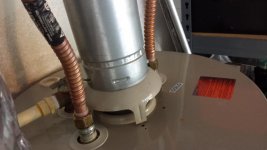
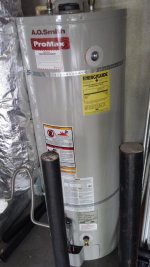
The t&p valve has a stem on it that goes into the tank to sense temperature, it needs to remain in the tank where it's at. It also should be piped down to within 3" of the floor.
A non OEM rod may not fit, the only option may be a factory part in this case.
Sent from my XT1254 using Tapatalk
Electric water heaters may use foam insulation, which may require a *********. Gas water heaters do not use foam insulation (the only ones I've ever seen use fiberglass), and there is no such thing as a fiberglass *********.
You cannot tell for sure that it is not a plug anode by counting the escutcheons on top. You need to remove the hex head screws that hold on the round sheet metal cover, lift off the cover, and look under the insulation (like you were told above). Plug anodes are frequently buried like this.
Long stem T&P valves exist that would be better than putting the original T&P valve on a coupling. Simply putting the original valve on a coupling would be almost like putting a plug in it's place (I suggest you watch Mythbusters for the outcome of that).
Long stem female T&P valves also exist, but are probably special order at all but the best plumbing supply houses. I had difficulty finding one when I installed my indirect tank that had a male fitting for the T&P valve.
Yes, the T&P valve should have a pipe running down towards the floor (exiting no more than 6" from the floor) with nothing in that pipe to block it's flow. Having it exit the top of the tank will make for a bad experience if it pops when someone is standing nearby. Also, you need to exercise this valve occasionally, and cannot do that when nothing it plumbed into it.
I would be willing to bet that "insulation hole" is the anode. It is just covered by insulation. That is how my Bradford White was exactly.
OP........assume your the purchaser, installer and know the history of the unit ?
........because many owners ( in your case a prior owner ?) would remove the anode all together to attempt to resolve a smell problem with the hot water.
OK.... Not my first rodeo with a water heater replacement but I've always seen a visible nut on top and/or the TPR was on the side. This one was just different than what I've seen in the past.
What started this whole thing was that I wanted to replace the hose bib drain with a ball valve and add a cleanout plug. So , I figured why not replace the anode just for GP?
Yes, I know the TPR needs to have the stem in the water and also the outlet plumbed down to near the floor or shelf. That is why I did NOT like the idea of the coupling - that would have been a VERY last resort. It is plumbed out a side wall vent along with the overflow pan drain and, as far as I know, is code compliant - at least it passed when we did our remodel 23 years ago. I wanted to plumb it into the overflow pan drain pipe at one time so I could just have one pipe exiting the garage but looked it up and found I could not do that as they want visibility. Why anyone would just screw it in and leave it unextended would be beyond me, but I'm sure it is done quite often. We've all seen hack jobs. And, yes I have exercised it.
Gas water heater and foam insulation. Yeah, fiberglass would not need a *********.
The "insulation (bung) hole" is just that. Too far out to go in the tank and I speared it down about 6" and hit nothing.
Yes, I am the original purchaser and also installed it.
So, I called AO Smith today to follow-up. Went over the whole deal. After some discussion, during which they said it should definitely have been under the hot outlet ******, they said they would send me an anode rod or even replace the whole appliance. When I asked "what about that knock out behind the flue?", the gal said (basically) "OMG, I didn't even see that or think about it. Yes, that is where the rod is. I'm so sorry I kept you on the phone so long." They also told me I could move the TPR to the side where there would be a knockout and plug. "All our tanks are built that way". Well... no knockout on the side of mine!
Got a bit of a laugh out of her when she asked if I had removed the vent stack. Yeah, when I was working on it. I told her I wouldn't run it that way (Duh!). She laughed and said she just wanted to be sure - said I'd be surprised at what they see. I told her I'm sure there are some very scary installations out there but mine was not one of them.
Tonight, I pried out the knockout. Had a bit of a fight with it - it was not very knockable outable. Guess what I found? Yep, buried in the foam was the anode rod just as a couple of you had mentioned. Why would they design it that way? It's like "remove the water heater from the anode rod" instead of the other way around.
Tomorrow or Sunday, I hope to have time to actually pull it out and see what condition it is in. The original is supposed to be aluminum. The Blue Lightning magnesium is a better rod but I've been told it is hit or miss as to whether it will stink up and discolor my water. Guess I'll find out.
Thanks for all the suggestions and comments. When I first read the one about popping off the whole top cover, I thought "Huh?" but it turns out that was basically the right answer except I had that knock out.
Mind boggling that they buried it like that.
MaxPower.... No gift for me... Nice offer though.