To avoid these ads, REGISTER NOW!

Where did my anode rod go??

rharman

Well-known member
Joined
Apr 22, 2012
Messages
8,894
Location
SoCal
I have a 50 gallon AO Smith gas fired water heater. Wanted to replace the anode rod as it's about 3-1/2 years old.

Should have been integral with the hot water outlet. Nothing there.

Looked at the cold inlet. Nothing. Checked under the TPR, still nothing.

Called AO Smith. Sent them pictures. They insist it should have been under the hot outlet. Absolutely zero evidence it ever was. They say it looks like a premature complete failure of the anode. There is no wire core, no nothing. The ******* don't look like there was anything attached. Very frustrating.

So, I tried to put in the Blue Lightning segmented rod I bought. Won't go in! There is a small lip at the bottom of the flange for the hot outlet. Most likely it's there as a rest for the heat trap.

So, I guess I have to put it in the TPR location and find a TPR with a female thread to go on the ******. Haven't found a TPR with 3/4" FIP for the base yet.

Such a simple task and it has turned into a royal pain.
 
To avoid these ads, REGISTER NOW!

CNGsaves

Well-known member
Joined
Sep 26, 2012
Messages
13,233
Location
KS and OK
Dig around up on top of heater. It's there. Either covered up with insulation, or a plug, but it's there. You'll see what looks like head of bolt, but it's your anode rod. It's not in either the cold or hot outlet, it has own threaded port in the top of the HWH.

You'll need a 1/2" breakover bar and cheater pipe to break it loose. Also may need a 2nd guy to hold the heater itself as you apply torque to the cheater pipe.

If your anode rod has been eaten up in 3 1/2 years, then likely need to change to different material for the rod.
 

K'ledgeBldr

Well-known member
Joined
Aug 22, 2011
Messages
1,925
Location
Johns Creek, GA
Well if "they" say it's under the outlet, it's under the outlet. This type of setup uses a segmented anode. It's totally conceivable that it's remnants are sitting at the bottom. The install could be anode first, then the connection ******- instead of anode "through" ******.
 

maxpower_hd

Well-known member
Joined
Apr 17, 2015
Messages
2,230
Location
Massachusetts
Not all of the AO Smith heaters have them in the hot water outlet. Some are also in the top of the tank like CNG said. In fact all the ones I have seen were. It could be under a metal or plastic cap, or it could be under the top cover itself and hidden by the insulation. That is how my last Bradford White was.

My last one was completely rotted. It was my third failed heater over what I considered a short period of time. And It was a US made Bradford White. I finally read about the anodes and dissected mine as to learn the fate of the unit and how they went in. Mine was no longer installed or had any water in it when I removed it. I used an impact gun to remove it because the breaker bar trick and me alone wasn't working at all. The anode was a complete failure with nothing left but there was about a three inch rusty rod about 1/4" or so in diameter I am guessing the anode used to be attached to. There was a cap and a hole on top where the head was but it was too narrow to fit a socket into so I had to remove the sheet metal screws and take the top cover right off.

I ended up buying a new 10 year Rheem heater. I removed the anode before I installed it. I again used an impact gun. I used anti seize on the threads and re-installed it. The 10 year anode is a lot thicker than the standard replacement ones. It is about a full one inch thick. Maybe more. Where all the replacement ones were about 3/4" thick.

I am not an expert but did a lot of research after I lost my third heater in my house, one in my mother's and one in my mother-in-law's and helped a friend with two. We all live in the same town with the same hard water issues. One of them was an AO Smith and it was in the top rather than the outlet. One was my Bradford white and the rest were all Kenmore. All were in the top.

Good luck.
 

chrispyny

Well-known member
Joined
Nov 7, 2013
Messages
467
Location
albany, ny
Off topic. I bought my home in 2012. It was built in 1971. My 40 gal hot water heater has a sharpie mark on it saying installed 11-1992. Haahha! It's 24 years old. Never skips a beat, heats water at any temp i set it at, and given my NG usage in comparison to my neighbors with similar sq footage and age that my power company sends me, it doesn't use much gas at all!
I thought many times of replacing it but, it's in the garage and if it springs a leak, the water will just run out the garage past the door!
I'll replace it ONLY when it fails! I hope to get 30 years out of it!

Back on topic, i considered removing the anode to check how it looks but i figured if i mess with it, i'm bound to get myself in trouble.
 

steveo1o9

Well-known member
Joined
Oct 10, 2016
Messages
603
Location
Eastern MD
Any chance the rod was removed before installation (assuming you didn't do the install)? If you have a softener it is common to remove the rod to prevent odors in the water.
 

rlitman

Well-known member
Joined
Oct 18, 2010
Messages
24,650
Location
Long Island
Dig around up on top of heater. It's there. Either covered up with insulation, or a plug, but it's there. You'll see what looks like head of bolt, but it's your anode rod. It's not in either the cold or hot outlet, it has own threaded port in the top of the HWH.

You'll need a 1/2" breakover bar and cheater pipe to break it loose. Also may need a 2nd guy to hold the heater itself as you apply torque to the cheater pipe.

If your anode rod has been eaten up in 3 1/2 years, then likely need to change to different material for the rod.

If it's a plug style rod, forget the breaker bar, cheater, and friend to hold the water heater from tipping. Get yourself a cheap 1-1/16" impact socket, and use an impact wrench. It's SO much easier! I'm never doing it the other way again.
 
OP
R

rharman

Well-known member
Joined
Apr 22, 2012
Messages
8,894
Location
SoCal
I installed it and did not remove the anode. I know better than that. I know about the soft water issue but running it with no rod? Does not seem like a good idea.

It is not the hex-head type. There are only three flanges on the top, none on the side. Hot, Cold, TPR. There is a cap on the extreme outer rim but that is a bung-hole for the insulation.

AO Smith parts pic shows it as part of the ****** - one piece, not segmented. I was going to replace it with a segmented Blue Lightning magnesium rod. The magnesium rod may cause odor/discoloration. Or, it may not.

Don't see any way it would/could have been under the *******. There would be no way to remove it.

I may have to just put the segmented rod in the TPR hole and add a coupling to attach the TPR. Not thrilled with that idea.

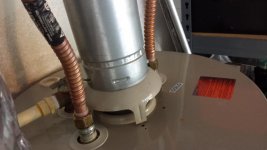
Calling them back tomorrow for a follow-up. I had sent them several pics and they escalated the inquiry. There is a knock-out looking portion of the top cap. You can see it in the pic behind the flue. Don't think it is big enough to get a 1-1/16" socket in though. I will ask them about it tomorrow.
 

Attachments

  • Top #2.jpg
    Top #2.jpg
    146 KB · Views: 543

brewchief01

Member
Joined
Nov 18, 2015
Messages
14
The t&p valve has a stem on it that goes into the tank to sense temperature, it needs to remain in the tank where it's at. It also should be piped down to within 3" of the floor.
A non OEM rod may not fit, the only option may be a factory part in this case.

Sent from my XT1254 using Tapatalk
 

rlitman

Well-known member
Joined
Oct 18, 2010
Messages
24,650
Location
Long Island
...It is not the hex-head type. There are only three flanges on the top, none on the side. Hot, Cold, TPR. There is a cap on the extreme outer rim but that is a bung-hole for the insulation...

Electric water heaters may use foam insulation, which may require a *********. Gas water heaters do not use foam insulation (the only ones I've ever seen use fiberglass), and there is no such thing as a fiberglass *********.

You cannot tell for sure that it is not a plug anode by counting the escutcheons on top. You need to remove the hex head screws that hold on the round sheet metal cover, lift off the cover, and look under the insulation (like you were told above). Plug anodes are frequently buried like this.
 

rlitman

Well-known member
Joined
Oct 18, 2010
Messages
24,650
Location
Long Island
The t&p valve has a stem on it that goes into the tank to sense temperature, it needs to remain in the tank where it's at. It also should be piped down to within 3" of the floor.
A non OEM rod may not fit, the only option may be a factory part in this case.

Long stem T&P valves exist that would be better than putting the original T&P valve on a coupling. Simply putting the original valve on a coupling would be almost like putting a plug in it's place (I suggest you watch Mythbusters for the outcome of that).
Long stem female T&P valves also exist, but are probably special order at all but the best plumbing supply houses. I had difficulty finding one when I installed my indirect tank that had a male fitting for the T&P valve.

Yes, the T&P valve should have a pipe running down towards the floor (exiting no more than 6" from the floor) with nothing in that pipe to block it's flow. Having it exit the top of the tank will make for a bad experience if it pops when someone is standing nearby. Also, you need to exercise this valve occasionally, and cannot do that when nothing it plumbed into it.
 

maxpower_hd

Well-known member
Joined
Apr 17, 2015
Messages
2,230
Location
Massachusetts
I would be willing to bet that "insulation hole" is the anode. It is just covered by insulation. That is how my Bradford White was exactly.
 

Showkey

"MEMBER EMERITUS"
Joined
Aug 9, 2014
Messages
8,638
Location
Wausau WI
OP........assume your the purchaser, installer and know the history of the unit ?

........because many owners ( in your case a prior owner ?) would remove the anode all together to attempt to resolve a smell problem with the hot water.
 

maxpower_hd

Well-known member
Joined
Apr 17, 2015
Messages
2,230
Location
Massachusetts
In fact...as a friendly wager...if you remove the metal cover and that is NOT the anode I would be willing to send you some kind of free gift. LOL
 

gungatim

Well-known member
Joined
Jan 8, 2013
Messages
8,101
Location
west mich
Electric water heaters may use foam insulation, which may require a *********. Gas water heaters do not use foam insulation (the only ones I've ever seen use fiberglass), and there is no such thing as a fiberglass *********.

You cannot tell for sure that it is not a plug anode by counting the escutcheons on top. You need to remove the hex head screws that hold on the round sheet metal cover, lift off the cover, and look under the insulation (like you were told above). Plug anodes are frequently buried like this.

every gas heater I have scrapped has foam. including the one I have in my home. I tried to pry the cover off and gauge out the foam to put a good aluminum rod in mine only to find there is not spot for one...
 
OP
R

rharman

Well-known member
Joined
Apr 22, 2012
Messages
8,894
Location
SoCal
The t&p valve has a stem on it that goes into the tank to sense temperature, it needs to remain in the tank where it's at. It also should be piped down to within 3" of the floor.
A non OEM rod may not fit, the only option may be a factory part in this case.

Sent from my XT1254 using Tapatalk

Electric water heaters may use foam insulation, which may require a *********. Gas water heaters do not use foam insulation (the only ones I've ever seen use fiberglass), and there is no such thing as a fiberglass *********.

You cannot tell for sure that it is not a plug anode by counting the escutcheons on top. You need to remove the hex head screws that hold on the round sheet metal cover, lift off the cover, and look under the insulation (like you were told above). Plug anodes are frequently buried like this.

Long stem T&P valves exist that would be better than putting the original T&P valve on a coupling. Simply putting the original valve on a coupling would be almost like putting a plug in it's place (I suggest you watch Mythbusters for the outcome of that).
Long stem female T&P valves also exist, but are probably special order at all but the best plumbing supply houses. I had difficulty finding one when I installed my indirect tank that had a male fitting for the T&P valve.

Yes, the T&P valve should have a pipe running down towards the floor (exiting no more than 6" from the floor) with nothing in that pipe to block it's flow. Having it exit the top of the tank will make for a bad experience if it pops when someone is standing nearby. Also, you need to exercise this valve occasionally, and cannot do that when nothing it plumbed into it.

I would be willing to bet that "insulation hole" is the anode. It is just covered by insulation. That is how my Bradford White was exactly.

OP........assume your the purchaser, installer and know the history of the unit ?

........because many owners ( in your case a prior owner ?) would remove the anode all together to attempt to resolve a smell problem with the hot water.


OK.... Not my first rodeo with a water heater replacement but I've always seen a visible nut on top and/or the TPR was on the side. This one was just different than what I've seen in the past.

What started this whole thing was that I wanted to replace the hose bib drain with a ball valve and add a cleanout plug. So , I figured why not replace the anode just for GP?

Yes, I know the TPR needs to have the stem in the water and also the outlet plumbed down to near the floor or shelf. That is why I did NOT like the idea of the coupling - that would have been a VERY last resort. It is plumbed out a side wall vent along with the overflow pan drain and, as far as I know, is code compliant - at least it passed when we did our remodel 23 years ago. I wanted to plumb it into the overflow pan drain pipe at one time so I could just have one pipe exiting the garage but looked it up and found I could not do that as they want visibility. Why anyone would just screw it in and leave it unextended would be beyond me, but I'm sure it is done quite often. We've all seen hack jobs. And, yes I have exercised it.

Gas water heater and foam insulation. Yeah, fiberglass would not need a *********.

The "insulation (bung) hole" is just that. Too far out to go in the tank and I speared it down about 6" and hit nothing.

Yes, I am the original purchaser and also installed it.

So, I called AO Smith today to follow-up. Went over the whole deal. After some discussion, during which they said it should definitely have been under the hot outlet ******, they said they would send me an anode rod or even replace the whole appliance. When I asked "what about that knock out behind the flue?", the gal said (basically) "OMG, I didn't even see that or think about it. Yes, that is where the rod is. I'm so sorry I kept you on the phone so long." They also told me I could move the TPR to the side where there would be a knockout and plug. "All our tanks are built that way". Well... no knockout on the side of mine!

Got a bit of a laugh out of her when she asked if I had removed the vent stack. Yeah, when I was working on it. I told her I wouldn't run it that way (Duh!). She laughed and said she just wanted to be sure - said I'd be surprised at what they see. I told her I'm sure there are some very scary installations out there but mine was not one of them.

Tonight, I pried out the knockout. Had a bit of a fight with it - it was not very knockable outable. Guess what I found? Yep, buried in the foam was the anode rod just as a couple of you had mentioned. Why would they design it that way? It's like "remove the water heater from the anode rod" instead of the other way around.

Tomorrow or Sunday, I hope to have time to actually pull it out and see what condition it is in. The original is supposed to be aluminum. The Blue Lightning magnesium is a better rod but I've been told it is hit or miss as to whether it will stink up and discolor my water. Guess I'll find out.

Thanks for all the suggestions and comments. When I first read the one about popping off the whole top cover, I thought "Huh?" but it turns out that was basically the right answer except I had that knock out.

Mind boggling that they buried it like that.

MaxPower.... No gift for me... Nice offer though. :beer:
 

redmondjp

Well-known member
Joined
Nov 25, 2014
Messages
2,318
Location
Redmond, WA
Mind boggling that they buried it like that.

Maybe 30+ years ago, but not these days. Probably 1 out of 100,000 customers ever bothers to either drain the tank or mess with the anode rod. Home inspectors recommend replacing water heaters every 5-8 years and the industry has cheapened their units to just about make it that long.

If the environmental movement really wanted to make a difference, they would make a ****** stink about disposable appliances, when they used to last 2-3 decades.
 
OP
R

rharman

Well-known member
Joined
Apr 22, 2012
Messages
8,894
Location
SoCal
I believe in maintenance - that's why I wanted to make it easier to drain. Getting tired of dragging a hose in to hook up.

I'll plumb the drain into the overflow pan line and just have to open the valve once in a while.

I'd like to get 10-12 years out of it.
 

wasfuzz

Well-known member
Joined
Nov 16, 2010
Messages
755
Location
Mn
Recently had a new water heater installed and i watched the tech pull the anode out and cut it down to a nub. I asked why? and he replied water in this area is so full of iron your water will stink. I said isn't that the idea of the anode to help element that smell? - he said normally - but not around here! I made sure it was noted on the paperwork I signed that it was removed and the owner called me and stated he would still honor the warranty and offered to put that in writing, which I accepted.
 
To avoid these ads, REGISTER NOW!
OP
R

rharman

Well-known member
Joined
Apr 22, 2012
Messages
8,894
Location
SoCal
There are different materials or combinations that might help with the smell. Hoping my magnesium rod doesn't cause a foul odor.
 

CNGsaves

Well-known member
Joined
Sep 26, 2012
Messages
13,233
Location
KS and OK
OP . . . . glad to hear you found the anode . . .
. . . . . while digging to the center of the Earth . . . oops . . . .HWH !!! :D

As mentioned above, best tool is cordless impact with impact socket, which I didn't have so had to use breakover bar and cheater pipe. Good luck.
 

PFSard

Well-known member
Joined
Sep 12, 2013
Messages
2,423
Location
Mesa, AZ
Off topic. I bought my home in 2012. It was built in 1971. My 40 gal hot water heater has a sharpie mark on it saying installed 11-1992. Haahha! It's 24 years old. Never skips a beat, heats water at any temp i set it at, and given my NG usage in comparison to my neighbors with similar sq footage and age that my power company sends me, it doesn't use much gas at all!
I thought many times of replacing it but, it's in the garage and if it springs a leak, the water will just run out the garage past the door!
I'll replace it ONLY when it fails! I hope to get 30 years out of it!

Back on topic, i considered removing the anode to check how it looks but i figured if i mess with it, i'm bound to get myself in trouble.

Not wanting to hijack the thread more, but .... Do you know the brand and model? The longest for me has been about 15 years.
 

rayra

Well-known member
Joined
Dec 1, 2014
Messages
4,724
Location
Escaped from Los Angeles
Off topic. I bought my home in 2012. It was built in 1971. My 40 gal hot water heater has a sharpie mark on it saying installed 11-1992. Haahha! It's 24 years old. Never skips a beat, heats water at any temp i set it at, and given my NG usage in comparison to my neighbors with similar sq footage and age that my power company sends me, it doesn't use much gas at all!
I thought many times of replacing it but, it's in the garage and if it springs a leak, the water will just run out the garage past the door!
I'll replace it ONLY when it fails! I hope to get 30 years out of it!

Back on topic, i considered removing the anode to check how it looks but i figured if i mess with it, i'm bound to get myself in trouble.

You realize of course that you've completely jinxed it now.
 
OP
R

rharman

Well-known member
Joined
Apr 22, 2012
Messages
8,894
Location
SoCal
OP . . . . glad to hear you found the anode . . .
. . . . . while digging to the center of the Earth . . . oops . . . .HWH !!! :D

As mentioned above, best tool is cordless impact with impact socket, which I didn't have so had to use breakover bar and cheater pipe. Good luck.

More like a friggin' "Where's Waldo" escapade.

Rainy lousy day today. Didn't get out to the garage to do anything.

I have a C-Man electric 1/2" impact that is about 40 years old. Built like a tank. I think that'll handle the removal.
 

maxpower_hd

Well-known member
Joined
Apr 17, 2015
Messages
2,230
Location
Massachusetts
Glad you finally found it. LOL

I used an air impact on mine. I don't have an electric one anymore. I lent it out to someone and never saw it again. Story for a different thread.
 
OP
R

rharman

Well-known member
Joined
Apr 22, 2012
Messages
8,894
Location
SoCal
There is no such thing!!!! as a hot water heater if the water is hot you don't need a heater

Yeah, that bugs me too.

4-day weekend coming up so I'll have time to do the replacement.

Also going to repipe the TPR discharge with CPVC. It's copper now but needs to be redone slightly as the TPR outlet rotated a bit more when I reinstalled. Probably because I use RectorSeal instead of teflon tape.

I can work with copper but I don't enjoy it. Fittings are way more expensive than I remember. Home Depot charges $1.25 for an ell and $2.25 for a 45° ell.:willy_nil
 

CNGsaves

Well-known member
Joined
Sep 26, 2012
Messages
13,233
Location
KS and OK
^ ^ ^ ^ Best prices I've found on copper fittings/pipe was Menards.

Not sure if any Menards stores in Cali ?? :dunno:
 
OP
R

rharman

Well-known member
Joined
Apr 22, 2012
Messages
8,894
Location
SoCal
^ ^ ^ ^ Best prices I've found on copper fittings/pipe was Menards.

Not sure if any Menards stores in Cali ?? :dunno:

883 miles away in Cheyenne, WY. Not too convenient...:lol_hitti

Home Depot website misled me. I thought CPVC was a stocked item. Have to order online and wait for it to get to the store.

So.... Copper it is. I just want this task done and of my list.
 
OP
R

rharman

Well-known member
Joined
Apr 22, 2012
Messages
8,894
Location
SoCal
It'll speed up the corrosion process if you don't have one. I spent good money on this WH. Want it to last.
 

brownbagg

Well-known member
Joined
Mar 20, 2006
Messages
5,208
883 miles away in Cheyenne, WY. Not too convenient...:lol_hitti

Home Depot website misled me. I thought CPVC was a stocked item. Have to order online and wait for it to get to the store.

So.... Copper it is. I just want this task done and of my list.

we convince my boss and engineer that CPVC glue was for copper pipe, that what the CP stood for
 

Dragster Racer

Well-known member
Joined
Feb 9, 2008
Messages
1,891
Location
Morrison, IL
Recently had a new water heater installed and i watched the tech pull the anode out and cut it down to a nub. I asked why? and he replied water in this area is so full of iron your water will stink. I said isn't that the idea of the anode to help element that smell? - he said normally - but not around here! I made sure it was noted on the paperwork I signed that it was removed and the owner called me and stated he would still honor the warranty and offered to put that in writing, which I accepted.

Mine lasted under two years before creating terrible sediment and smell. Talked to the supplier, and knocked the rod out of No more issues after 6 years total.
 
OP
R

rharman

Well-known member
Joined
Apr 22, 2012
Messages
8,894
Location
SoCal
Well, I'm not a chemical engineer or a metallurgist but I'll go out on a limb and assume they know better than you or I.

"When two metals are physically connected in water, one will corrode away to protect the other. When the tank is filled with water, an electrochemical process begins whereby sacrificial anodes are consumed to protect a small amount of exposed steel."


http://www.rheem.com/docs/FetchDocument.aspx?ID=aedbbc95-9a6b-4780-aa23-b0ed9abe41cd
 

sberry

Banned
Joined
Jun 18, 2005
Messages
35,747
Location
Brethren, Michigan
How has it been working out for you? I will agree that engineers typically know more than I do but here you are putting rods in hoping they don't smell to do what" Hope not to make it smell. I realize what the idea is and that the sacrificial will be well, sacrificial. The ones I have been lasting a long time been isolated with plastic pipe and only ground on the electrics is the egc.
What really makes most of these stink,,, and go to most country churches to see,,, where they miser out a little bit of water on occasion and in some instances sits all week hot with no use, I try to tell them to flush but they cant help themselves "saving" hot water.
I know one has 200 gallon, needs a common residential heater. I know 2 others I see regular stink terrible, one with brandy new heater. What keeps them clean the majority of the time is use, running a couple tanks a day they don't stink or corrode much.
They will accumulate lime. Got one in my folks from my first real job in about 80, have put 1/2 a dozen elements and cleanings to it. I have a replacement sitting next to it and thought at last cleanng may change it out but didn't, couple years ago.
My point is this has a lot of assumptions built in that don't "always" hold true. If it did I would have 6 units should have failed decades ago. One coming up on 40 years, several cycles a day, another from 60's I not exactly sure of but still has banded elements.
 
Last edited:

rlitman

Well-known member
Joined
Oct 18, 2010
Messages
24,650
Location
Long Island
...What really makes most of these stink,,, and go to most country churches to see,,, where they miser out a little bit of water on occasion and in some instances sits all week hot with no use, I try to tell them to flush but they cant help themselves "saving" hot water.
I know one has 200 gallon, needs a common residential heater. I know 2 others I see regular stink terrible, one with brandy new heater. What keeps them clean the majority of the time is use, running a couple tanks a day they don't stink or corrode much...

A shower here and there certainly flushes the worst out of the tank. But in many cases the miserly behavior is also due to turning the thermostat way too far down. Keep the water sufficiently hot, and it generally kills the bacteria.
 

Kenp

New member
Joined
Sep 8, 2019
Messages
3
Location
1st floor
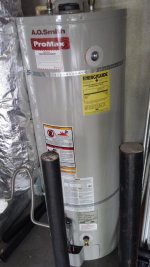
Hi. Can anybody confirm where my anode rod is?
I have the a o smith promax gcv 50 100series.
But i have little confidence in a o smith technical support.
I also suspecting the tpr was placed in lieu of the anode rod.
Also what is the right side thing of the WH for. I thought this is where the tpr was supposed to be.
Thanks in advance.
 

Attachments

  • 20190908_104803.jpg
    20190908_104803.jpg
    100.1 KB · Views: 110
  • 20190908_105717.jpg
    20190908_105717.jpg
    73.2 KB · Views: 106
To avoid these ads, REGISTER NOW!
Top Bottom