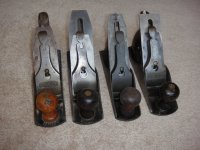
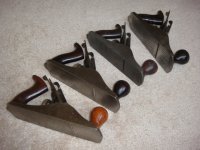
Thanks for all the nice words - I'll try to address all the questions asked:
farmerj - I'm happy that this plane brought joy to somebody else - my brother loved it. My father was so impressed, I took his #5 Type 13 for a restore next.
paulm12 - Wish my Shellac healed Rosewood....I have a bag of about 25 broken totes and a near equal amount of split knobs.
cope - The Type 11 was made during 1910-1918. That said, Stanley used up whatever parts they still had available, so sometimes you see parts that bleed into other types. I have a #5 1/2 and a #7 that are both early Type 9s - they both have type 8 parts and frog/receiver of the old style, yet these are assuredly produced in the Type 9 years. This was the case for WWII as well....planes came out of production with whatever would fit it seems.
Tombell - Nickel plated cam levers didn't show up until about 1925. oddly enough....you did see some nickle plating done on frog surfaces much earlier. I think I have a Type 8 that has a nickle plated frog mating surface.
Jimreed - The type 11s are definitely the most sought after, but honestly I've found that the slightly later types seem to have thicker, cleaner castings. My own planes are pre-type 11 (just because I found some really gorgeous examples over the years) but that frog adjustment screw is such a nice feature. I will take a look at the woodworking 101 thread...not that I need any more projects
 Cajun
Cajun - My list of planes to restore is now about 12 deep. I really, really understand, but like Jim said, you won't be disappointed with the work in the end.
Crackit, Roberts, & Zeke - I literally wrote a short book for my brother as part of the restoration project. I will give you guys the cliffs notes here.
I start by disassembling the planes, scrubbing down all parts with brillo pads and stiff brushes. I look for cracks & damage. I also inspect all the threads....that cast iron is soft and I do come across bad threads from time to time. Any questionable/damaged parts are tossed and replaced with good parts from my bucket. I've amassed a large collection of parts over the years from many different planes/types. I make sure to keep the correct type parts labeled so I'm not mixing the wrong types.
The frog and bed go into the electrolysis vat while the other parts go into the Evaporust vat. Everything is then lightly cleaned and inspected again after soaking for 4 hours to 48 hours. I often find bad stuff after things have been cleaned. Sometimes the originally japanning has to be hit with paint stripper. It can be really stubborn.
The cutting iron is lapped on diamond plates (or sandpaper on plate glass if really bad) and then sharpened to 30* using a MKII jig. I have progressive diamond plates and usually finish at 1200. The mating surfaces on the chip breaker and lever cap are also checked and lapped as needed.
Screws and other hardware are cleaned and polished. If there is bad mushrooming on anything, I replace it.
The rosewood tote & knob are hand sanded to 220, wiped with Acetone, and then Shellac'd a few times. I finish the pieces with hand rubbed wax. The feel this imparts is great - it's smooth but gives a nice grip.
I use what I see referred to as the "Cold Mix" recipe for japanning as I do not initially heat the ingredients. Powdered Asphaltum is mixed with REAL Turpentine (not the BORG Gum Spirits garbage) and Linseed Oil. Turpentine acts as the solvent for the Asphaltum and the oil is the plasticizer. I let this mixture sit for about 5 days until it forms a thick, greasy paint like mixture. The bed and frog get 4 really thin coats, letting each coat dry for about 24 hours. After the fourth coat I do a sequential baking, starting at 250 and working my way up to 450 over the course of about 2 hours. When the pieces come out, the exposed metal has been slightly oxidized and has a light brown color. The japanning also has a tendency to run a bit so I then spend several hours cleaning up the japanning that has run/bleed onto non japanned areas.
The hardest part of the whole japanning process is the application. it's hard to work with and readily dissolves the previous coat(s) if you make too many brush strokes over the same area. A good hair brush is key; I use a soft boar brush and the $20 was well worth the reduced frustration. The coats need to be really thin....when this stuff gets too thick it bubbles and does not cook correctly.
After the base has been japanned I use the diamond stones (or again sandpaper on plate glass) and lightly lap the sole and sides of the bed. This can be really time consuming, but I also don't kill myself getting this part perfect. Paul Sellers discusses the flatness of the sole and especially on the larger planes; it's not a huge deal if there is some irregularity. I use a couple of squares to check my work as I go along and pay a lot of attention to how much metal I remove. Post assembly I will check the bed again as it can change slightly after everything is tightened. I rarely see much difference.
I do a final cleanup of the cast iron parts, and buff the exposed metal. The bed, frog, and hardware gets a light oiling. The iron, chip breaker, and lever cap are waxed to prevent sawdust from sticking to these parts.
If anyone has any questions about the japanning, please ask. The learning curve was interesting/frustrating, but the end result is just so nice.
***I'd also like to point out here that nowhere do I mention "dremel", "bench grinder" or "wire wheel" anywhere. Those tools have no place in this restoration process, IMO.

 ) and the rosewood was refinished with a few coats of Shellac (mixed from flake, not a can). I don't use any power tools when refinishing these...it's all done with an assortment of files, sand paper, diamond stones, and other hand tools. I never remove more metal than needed, and any damaged parts are replaced with other originals. I also don't restore anything that doesn't need it. In the case of this plane, there wasn't a clean, unrusted part on the plane, so every part had to be cleaned and refinished. Since I was doing a lot of work anyways, I took the time to file/sand out most of the milling marks and areas of rough casting. It was a very time consuming ordeal but the end result was impressive.
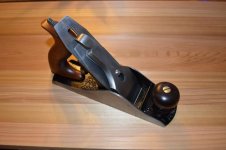


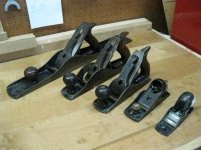
 for the information and the tip concerning the rabbet plane, which is a Stanley #10 (13" long). You are correct, they are all usable and I do keep them sharp. After seeing restorations from start to finish I always was wondering whether to mess with anything other than a cleaning, which is what I am going to do. My dad never really said much about them except care and sharpening. He would give me h377 for the way they are sitting in the photo, but that was brief and for the photo only. All are kept in a clean drawer on their side. I also have his Stanley #39, 3/8", rabbet palne. The big boy in the photo is a Bailey #7, the bench plane is a Bailey #3. Front knob on the #3 has a couple of small chips in the base.
 . Fine steel wool to polish