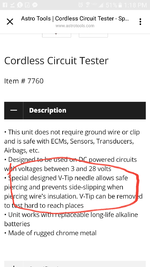
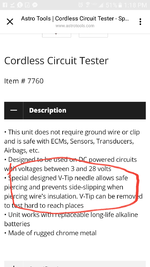
I just looked it up. The OTC test light uses a bulb that looks like a glass fuse and pulls 150 ma off a 12 volt battery.
Those are called incandescent "festoon" bulbs. The typically draw about 250 ma.
Over 90% of all automotive computer circuits turn the device on via the ground side
(ie. the device is feed 5V/12V through one wire and the computer provides the ground through another to turn it on).
So there is 2 things to check at the connector of the "device under test". Is there power on the power wire and is the computer switching the other wire. To see if the computer is capable of turning the device on, use your test light between these 2 wires.
Whether that is enough to simulate a low voltage situation caused by bad connections would depend on how much current the load in that circuit is supposed to draw.
Excellent point ! This is a case where you need a light that will draw more current. Depending on what the device is, you might need a 1A, 2A or even 5A test light. You might be able to find a festoon that will draw 1A
(so it would be about 10-15 ohms) but for more, smart mechanics grab a couple of stop/turn/tail light sockets out of a junk car. The 1157 is a dual element bulb which draws about 2A. If you put two bulbs in parallel, the would draw 4 A.
You had better have a good idea what the device should draw before sticking a 4A load on a computer circuit !
It is always hard to get a "good ground" for your test light especially when working under a car. Some people actually take a pair of cheap (HF) locking pliers and screw/rivet the end of their test light cable to the pliers. Not going to fall off.