This project did not proceed as I desired or anticipated. The lift is currently up and is functional. The video will come at a later date. I thought that I would give a quick update though to let you all know what happened.
During the install I got the first column set and plumb then noticed that the upper column had a very noticeable lean. The upper column is inverted and slid inside the lower column during shipping. I do not have pictures but I do have video of how severe the lean was. The upper column is shorter than four feet and in that distance is was out of plumb by an inch. The upper column is just a plate with an I-beam welded to it. Some inspection work pointed toward the assembly being welded crooked. The other upper column suffered from the same deficiency. It was at this time that I thought it would be prudent to call Worth and get some direction. I got Steve Prater on the phone and described the condition and he indicated that this was not an unusual condition. He seemed to blame it on a couple things like an old jig used for welding and the way the shipper lifts the package when in transport. The fix was simple though. He instructed me to shim the base of the upper column as needed to get it into a plumb condition. This is when the conversation took a different direction. I then asked him to send me an email detailing the discussion we just had as an addendum to the instructions. He then got very defensive and acted like I should just take his word for it. This position took me by surprise since the instruction say on the first page that unapproved materials would void the manufactures warranty. It was evident that Steve was not going to back up his verbal direction on paper so I decided to take another direction. In the past when in this position I typically send an email detailing the discussion and asking for any correction. If no reply is made you have proof that the other party conceded to some extent. Although this is not as good as getting formal written direction it is the best you can sometimes do with an uncooperative vendor.
The balance of the install went relatively smooth but I have several issues that I will discuss in the video. Two of the issues were of enough concern that I decided to get direction before I put the lift into service. The first one had to do with the carriages. The carriages are made of a piece of square tubing. The cables either attach to or pass though three of the four corners of this square tube. Although the instructions indicate that there should be a plate on top of the carriage with four holes, the lift I received did not have a plate but just a lug welded in three corners. The odd thing is that one of the lugs is in a corner that the cable does not attach or pass. This lead me to think that one lug was welded in the wrong position. This was the case for both carriages. In addition, the lugs are welded on a bit crooked. So crooked that you can see with your naked eye that the cable end stud does not follow the natural path of the cable. The second issue has to do with the hose connection at the pump. The supplied fittings and hoses did not facilitate installation in the natural/vertical direction because the hoses clashed with the oil tank/motor. I initially thought they may have changed pump vendor and maybe did not check to make sure the new assembly worked with the old hose routing. I was able to get the hoses attached by turning the tee at approximately 45 degrees but the hoses are really too short for this. I went ahead and used them in this position to bleed the air from the system and cycle the carriages up and down. I also tensioned the cable and timed them properly per the directions from Worth. This was actually easier than I anticipated. At this time I decided to go ahead and send Steve Prater an email to 1) Confirm that I properly followed his direction on shimming the upper columns, 2) Let him know about the issue with the hoses/fittings, and 3) Get his input on the issues outlined above with the carriages. Following is the text from the email. The pictures are attached and labeled just as I reference them:
Steve,
I want to touch base with you on three issues with regard to my new Worth 10000CF lift. I have attached pictures detailing my concerns and will reference them by number. If you need better pictures do not hesitate to request them.
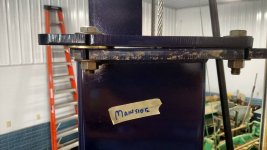
The first issue is the same one that we discussed on the phone last Thursday and has to do with the upper columns not being plumb even though the lower column was. I shimmed them as you instructed me and did not need as much shimming as I anticipated. I ended up placing one washer under both of the bolts on the side of the column that faces in. The washers are approximately 1/8" thick and you can see the details in pictures numbered one and two. Please confirm that I followed your instructions adequately.
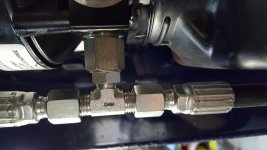
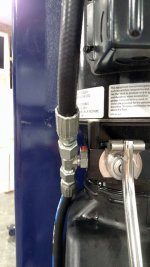
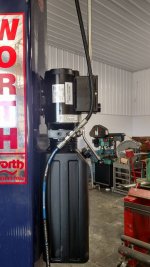
The second issue has to do with the attachment of the hydraulic lines to the pump. The supplied tee does not protrude past the motor and tank far enough to allow proper attachment of the hoses. This can be seen in the attached pictures three and four. To make the connection you see in the pictures I had to rotate the tee which meant that the hoses had to take an indirect route in which they are not really long enough for. Please advise a solution for this problem.
The third issue has to do with the carriages. Although the instructions indicate that there should be four holes on top of each carriage for the cable to connect and/or pass through, there are actually only three. Three lugs are all that are needed to facilitate the cable routing but there is actually one located in the corner where it is not required and the corner where the cable just passes through there is none. Please reference pictures five and six for details. This is the case for both carriages on my lift. In addition, the lugs where the cables terminate are welded on crooked enough to be noticeable with the naked eye. This means the cable end is slightly crooked and not pointed directly along the cables natural path. Please reference pictures seven, eight and nine for more detail. This is also the case on both carriages.
My lift is currently completely assembled and has been cycled without a load. I am going to wait for your response to the three issues above before I proceed to cycling the lift under load to complete the bleeding of the air from the hydraulic system and put it into service.
Regards,
Scott Matheny
I sent this email late on Sunday April 9th. After no response I called him on Tuesday, April 11th at 4:04 EST. I was told he was out and I asked them to let him know I was calling him with respect to my email. He called me back at 5:43 pm EST the same day. I will not get into the tone of the conversation but will say it was cordial and professional. In short his response was as follows:
1) The shimming looks good and is just as he described.
2) The hoses and fittings are what they have been using for a long time and I installed them just as needed and there is no problem with the way they are installed.
3) The carriages are built correctly. The extra lug in the unused position is for models that have cables that run along the floor. The angle to the lugs is intentional to prevent interference between the cables and the cylinder.
He also indicated that he did not see anything in the pictures that would preclude me from operating the lift with weight on it.
I have since operated the lift under load. I had a small car on it that weighed under 3k lbs.
My take on the three issues are as follows:
1) I wish the upper columns were better fabricated and did not lean. It is evident that Worth has no intent of doing anything about this and I am not sure that the shimming is an unreasonable fix. I do think that if shimming is the factory approved fix then they should issue an addendum to the instructions covering the modification.
2) The hoses/fittings are a cluster. In no way is this a reasonable installation. I will personally fix this issue with a different fitting combination or I may even run hard lines and shorten the hoses. It is not worth my time and/or frustration to argue this with Worth. The cost will be minimal and will take less time if I just do it myself.
3) I buy the explanation about the extra lug being for a different model. I am not convinced that the lugs being welded on crooked was intentional. Worth is on record knowing that the condition exists so that is good enough for me to feel comfortable using the equipment.
Additional Note: I do not want this post to come off as insinuating my Worth lift is junk. The construction is quite heavy and it functions well. I am not an expert on what is available so take this statement with that in mind, this lift is likely better than at least 75% of everything else available. please stay tuned for the video with all of the other details.
Regards,
Scott




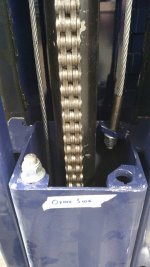

 I don't think it would be an issue to leave it as is But may as well correct it.