

You are using an out of date browser. It may not display this or other websites correctly.
You should upgrade or use an alternative browser.
You should upgrade or use an alternative browser.
The VISES of Garage Journal
- Thread starter mjozefow
- Start date


Thanks Guys, I'll try again tomorrow, I have bolted to the workpiece before. No mater what I try I get the same results. I will use a battery, get a better hookup and clean the new rebar for the next go around. How long should this take? 1/2 day yesterday and cooked all day today, getting bubbles. Could I be using to much washing soap? I'll keep playing. I have many vises to clean and this would speed up my restoring. It is just funny how I get the same results every time I try this method. I have a big plastic container that will fit my 8 inchers but gotta figure this out. Thanks guys.
Hi, Kevin,
If I may offer you a suggestion based in first-hand practical experience, it would be this......just bite the proverbial projectile, and invest in a good serviceable glass-blast cabinet. With any reasonable volume of work, your investment will quickly amortise itself.
Bringing parts such as vise castings to a clean surface for close inspection and refinishing is so much less foolishment and so much easier, quicker work with glass-blasting as to make it the only really practical metholology for restoring or refinishing those castings.
With an 'as found' old vise, for example, one disassembles it, drops the bits in a bucket of a cleaning solution, green, purple, whatever, and leaves it over-night. Then its taken out of the dope, blown dry, and blast-cleaned, after which its ready for inspection, masking, and painting. (sometimes, really well-congealed crud will need to be scraped/wire-brushed, and given a second bath in the dope, to be sure)
For all but the largest of vises, the actual blasting takes five to ten minutes, and surely (if done carefully) removes all old paint and rust, leaving the optimal surface for paint adhesion.
I've long since lost track of the numbers of old tools, vises, ornamental metal items, etc., of one sort or another, which have been cleaned in the blast rig I have here, over the years, but it has to be well into the thousands, by now.
I've had quite a few minimum-wage trainee helpers doing blast-cleaning, one time and another, all of whom came up on the learning-curve to do nice clean work within their first hour of operation.
Over the past decade, quite a few automotive machine shops have been closing down, as it has become less and less practical to rebuild tired engines on the current generation of little oriental cracker-box gerbil-cars, as time goes on. Calling some automotive shop suppliers in your area may well turn up a good deal on a serviceable used blast cabinet.
cheers
Carla
Last edited:
Reed 404-1/2 double swiveler on the 'bay BIN $159.95. local pickup Ohio http://www.ebay.com/itm/Reed-404-Vise-/282447018030?hash=item41c327782e:g:Io8AAOSw3xJVbhOH
Seller doesn't give any indication he knows about the swivel jaw......
That's been on CL for many months and maybe on eBay as well (can't recall). I keep wondering if there's something wrong with it, or people just don't know about swivel jaw vises.
I need advice. I picked up a Reed No. 1c. Where do I find out how old it is? I bought it to sell, but after working with it, I think I might keep it. If I do, I have to sell something else, probably my Craftsman 5191. I didn't think I'd ever sell the Craftsman, but the Reed is pretty stout. And it's a swivelin' b@stard to boot.
There isn't an easy way to tell with Reed like some others. The best you can do is sort of narrow it down by a process of elimination.
Check for patent dates on the side as that can help sometimes, but the vast majority of pictures I've seen of 1Cs have Pat Pending on them.
The earliest 1Cs would have non-replaceable jaws and then they switched to the replaceable kind like yours.
Either way, I think the 1C is as good a 3.5" bench vise as you can find.


meatsis
Well-known member
2 1/2" Mint Colombian. Got it just now!
Sent from my iPhone using Tapatalk
That looks identical to the one I sold you. Only that one has a swivel base

good score!
vintage nut
Well-known member
I'll second the bead blasting. I've got the worst cabinet you can get, the $200 harbor freight sort. And even that is fast and does a great job.
I keep two sorts of abrasive around. Fine crushed glass for general work on things that will be painted, as it's far faster. And medium glass beads for soft metal, or things that will later get polished
Sent from my MotoG3 using Tapatalk
I keep two sorts of abrasive around. Fine crushed glass for general work on things that will be painted, as it's far faster. And medium glass beads for soft metal, or things that will later get polished
Sent from my MotoG3 using Tapatalk
GETRIDAONE
Well-known member
2 1/2" Mint Colombian. Got it just now!
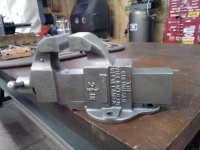
It must be 2 1/2" Columbian day, just cleaned this up one up a bit.
Attachments
tdcisco1
Well-known member
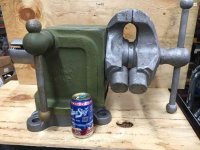
vises; ive dealt with this fellow, he is a hoot ! he does have quite a collection of vises though . lmao !!!
Look at what this goofball wrote to me in an eBay message.
Sent from my iPhone using Tapatalk

KMScott
Well-known member
Carla and Vintage, thanks for the replies but I have been around blast cabinets my whole career, just do not like the finish you get. Glass beads, Aluminum Oxide Walnuts etc, but not a expert on blasting media, maybe they have stuff that does not remove the black patina. Look at Drives Reed 4C, unless the photos are from a terrible camera it looks blasted even after he had someone re-finish it for him. Plus my 950 sq foot shop has no room for a dusty cabinet. I need a lathe first. Thanks again.
Oldie you are the best, thanks for the chuckle.
Running the electrolysis again with better hookups, just want to see a clean vise come out of it. Maybe my 1982 charger is shot. Seeing bubbles as I write.
Oldie you are the best, thanks for the chuckle.
Running the electrolysis again with better hookups, just want to see a clean vise come out of it. Maybe my 1982 charger is shot. Seeing bubbles as I write.
drivesitfar
Well-known member
Kevin: here's the link to the best HOMEMADE ELECTROLYSIS on GJ that many of the members input on and i just maybe asked almost every conceivable question in case you have any more questions.
http://www.garagejournal.com/forum/showthread.php?t=237752&highlight=homemade+electrolysis
sounds like you have it figured out now and if you need more help or advice maybe the answer is already on this thread. or you can PM Outlaw who seemed to have a lot of the answers.
My 4C was sandblasted by another member before he contacted me and asked what color paint i wanted it painted. i still like it's BLO look, but that EXTREME GREEN might be an option some day if and when i move.
ALL: interesting even the ads that seem over the top on Ebay have a decent seller just having fun in his own way. i'm guessing if he really wanted to sell it he'd put it at a decent price and disclose the welds and maybe he even got tired of the really terrible sellers that list broken or welded vises for too much money.
no vise purchases on my horizon today, but the day is young here out in PARADISE.
http://www.garagejournal.com/forum/showthread.php?t=237752&highlight=homemade+electrolysis
sounds like you have it figured out now and if you need more help or advice maybe the answer is already on this thread. or you can PM Outlaw who seemed to have a lot of the answers.
My 4C was sandblasted by another member before he contacted me and asked what color paint i wanted it painted. i still like it's BLO look, but that EXTREME GREEN might be an option some day if and when i move.
ALL: interesting even the ads that seem over the top on Ebay have a decent seller just having fun in his own way.
i'm guessing if he really wanted to sell it he'd put it at a decent price and disclose the welds and maybe he even got tired of the really terrible sellers that list broken or welded vises for too much money.no vise purchases on my horizon today, but the day is young here out in PARADISE.
I'll continue where I left off with the British vice manufacturers.
Note that many of them are steel instead of cast iron and have the quick release mechanism.
Again, NONE of these are mine and are just pictures I've hoovered up off the net while looking for some myself.
I was on about Parkinsons, they made vice's with their own name on them as well as Samsonia brand as well. Interestingly enough they spell vise the American way, despite being English where we spell it Vice.
No idea why but thats Yorkshiremen for you. Unfortunately I don't have sizes for quite a few of these, Ebay adverts often don't give jaw widths in the information.
Writing on one of those Parkinsons.

I found this earlier post in this thread, and my new vise appears to be a replica of Parkinsons No.6:
Attachments

vintage nut
Well-known member
How you've survived without a lathe is beyond me! I probably use the lathe 3-4x as often as the mill...
Blasting isn't the best if you want to do a bare finish... Although I've found finer glass beads don't really tend to mark up the cast much/at all
They are definitely slower than crushed glass or aluminum oxide though.
The odd time I do a bare finish I usually just wire wheel it
Sent from my MotoG3 using Tapatalk
Blasting isn't the best if you want to do a bare finish... Although I've found finer glass beads don't really tend to mark up the cast much/at all
They are definitely slower than crushed glass or aluminum oxide though.
The odd time I do a bare finish I usually just wire wheel it
Sent from my MotoG3 using Tapatalk
vintage nut
Well-known member
My vise cleaning approach is quite similar to Carla, apart from hosing the vise down with kerosene and then brake cleaner, and blowing dry with compressed air.
The little Morgan I did recently went from greasy to ready for paint in about 20 minutes.
I'll usually tape up the slide, and clean it up after with a scotchbright roloc on a die grinder. Saves having to risk taking any extra material off to have it look good.
Sent from my MotoG3 using Tapatalk
The little Morgan I did recently went from greasy to ready for paint in about 20 minutes.
I'll usually tape up the slide, and clean it up after with a scotchbright roloc on a die grinder. Saves having to risk taking any extra material off to have it look good.
Sent from my MotoG3 using Tapatalk
I found this earlier post in this thread, and my new vise appears to be a replica of Parkinsons No.6:
Or it could be Parkinsons No.7. My vise jaws are 4 1/2" wide. Actually it is great for an Indian company to be producing replicas of a vintage visemaker which went out of business in the late 1930s.
Duckslapper
Active member
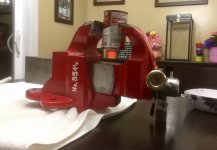
Picked up a Charles Parker 954 1/2 last week that had been residing in a Detroit Machine shop that was closing its doors. Cleaned it up over the weekend am looking forward to years of use.
Attachments


joe.striper
Well-known member
My vise cleaning approach is quite similar to Carla, apart from hosing the vise down with kerosene and then brake cleaner, and blowing dry with compressed air.
The little Morgan I did recently went from greasy to ready for paint in about 20 minutes.
I'll usually tape up the slide, and clean it up after with a scotchbright roloc on a die grinder. Saves having to risk taking any extra material off to have it look good.
Sent from my MotoG3 using Tapatalk
I built a 30 gal cast iron ceramic sink into my outside worktable. I just fill it with Simple Green and drop my stuff into it for 3-4 days. Paint and grease just literally fall off. It saves the patina. Fantastic stuff and I dont need gloves.
Veeps told me about this. Best tip ever!
trijeff
Well-known member
An anvil for a Reed? What do you guys think, is this factory or homemade? Looks cast is the only reason I ask, typically not the diy add-on one sees.
https://maine.craigslist.org/tls/6098191114.html


https://maine.craigslist.org/tls/6098191114.html
Attachments


drivesitfar
Well-known member
JOE: how many gallons of SG do you put in your tank/tub? how often do you change and or filter the SG? thanks
TJ: i've never seen one if that helps you. now i'll be looking for one and my guess it was somebody looking to protect the back of the slides from the workers that always used it as an anvil.
is the combo for sale?
FMC: to further our discussion of the Reed 4C vs. the Yost 34c i'd put the Yost in the same category as Joe's new Reed 4c and not the pre 1950's ones. the yost has a lot of similar traits to the Columbians. my yost is a solid vise and it will get used set up as my daily user where the helpers have access to a vise. hopefully it won't be abused by helpers, my kids or relatives that don't always respect a vise for what it was meant for.
TJ: i've never seen one if that helps you. now i'll be looking for one and my guess it was somebody looking to protect the back of the slides from the workers that always used it as an anvil.
is the combo for sale?
FMC: to further our discussion of the Reed 4C vs. the Yost 34c i'd put the Yost in the same category as Joe's new Reed 4c and not the pre 1950's ones. the yost has a lot of similar traits to the Columbians. my yost is a solid vise and it will get used set up as my daily user where the helpers have access to a vise. hopefully it won't be abused by helpers, my kids or relatives that don't always respect a vise for what it was meant for.
Picked up a Charles Parker 954 1/2 last week that had been residing in a Detroit Machine shop that was closing its doors. Cleaned it up over the weekend am looking forward to years of use.
Nice work! Love the candy apple red. Any reason you didn't paint the retaining clip?
An anvil for a Reed? What do you guys think, is this factory or homemade? Looks cast is the only reason I ask, typically not the diy add-on one sees.
I don't have any idea, but it's pretty cool either way!
KMScott
Well-known member
Hey kevin, i too used rebar as a sacrificial anode and i found out the rebar has to be clean of rust before using it, that way it has a clean fresh spot to attract the rust from the vise
Bcom, the rebar was brand new stuff, would the scaling cause me issues?
OK, gotta find some of the Simple Green Joe and Veeps uses. Home Depot has it, 6 hours in and vise is still rusty, that is 18 hours of bubbling.
Joe does the Simple Green de-rust the vise, just trying to save using the dremel wire wheels in the corners and hard to reach areas. If so then I am going to Home Depot tomorrow.
Vintage, thanks for the note on restoring vises. It takes me longer then 20 minutes to get a vise ready for painting but I am a slow mover.
Duckslapper
Active member
Nice work! Love the candy apple red. Any reason you didn't paint the retaining clip?
I didn't realize until I was reassembling the Vise yesterday that the retaining clip that came on the vise (that I did Paint) was not original. I fab'd the pictured one up to what I assume the original would have looked like from a few pictures I saw on here of other Chas. Parkers. It will get painted tonight; was just to nice yesterday not to take the little ones out fishing.
drivesitfar
Well-known member
Duck: your handle on your original parker looked ok other than a few dings (character marks) and it was straight, but it looks like you changed it or made a new one. did you cut of the original handle or just exchange the screw off another vise?
looks great and some of those retainers were made of bronze and if your is just shining it up might be an option, but yours looks like cast steel so painting might work just fine too.
fishing with the little ones sounds like fun. my parents used to take us to the U Fish ponds where they would pay a couple bucks and we'd get a fish or two or three guaranteed.
looks great and some of those retainers were made of bronze and if your is just shining it up might be an option, but yours looks like cast steel so painting might work just fine too.
fishing with the little ones sounds like fun. my parents used to take us to the U Fish ponds where they would pay a couple bucks and we'd get a fish or two or three guaranteed.
twertsy
Well-known member
Looks like there's some forged in info on it. Maybe even a patent date?An anvil for a Reed? What do you guys think, is this factory or homemade? Looks cast is the only reason I ask, typically not the diy add-on one sees.
https://maine.craigslist.org/tls/6098191114.html


Sent from my VS990 using Tapatalk
Attachments


jakemac
Well-known member
OK, gotta find some of the Simple Green Joe and Veeps uses. Home Depot has it, 6 hours in and vise is still rusty, that is 18 hours of bubbling.
Joe does the Simple Green de-rust the vise, just trying to save using the dremel wire wheels in the corners and hard to reach areas. If so then I am going to Home Depot tomorrow.
Kevin - No, Simple Green won't de-rust. Just de-grease and de-paint.
(and if you forget and leave it in for 3 months, it will de-chrome - don't ask how I know
 )
)I use a bucket of EvapoRust to derust to bare metal after the SG, then wire wheel it clean.
TSC often has Simple Green and EvapoRust priced less than HD or Lowes.
My local TrueValue sometimes has SG priced less than all of them.
Shop around if it's convenient.
Last edited:
jreb10
Well-known member
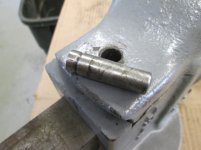
I have been looking for a swivel jaw vise for a couple of years now and my patience finally has been rewarded. I found a Desmond Stephan Simplex 43SJ on an online auction and won it for $55. I have always liked the Simplex vises.
It is in decent shape but certainly has been used. It has 4.75 inch jaws and weighs 66 lbs. The pin had not been removed for some time and was "painted in" as well as being stuck. Time, Kroil, heat, and a rigged up C-clamp pushed it out.


It is in decent shape but certainly has been used. It has 4.75 inch jaws and weighs 66 lbs. The pin had not been removed for some time and was "painted in" as well as being stuck. Time, Kroil, heat, and a rigged up C-clamp pushed it out.
dutchgray
Well-known member
Or it could be Parkinsons No.7. My vise jaws are 4 1/2" wide. Actually it is great for an Indian company to be producing replicas of a vintage visemaker which went out of business in the late 1930s.
Parkinsons were actually in business until 1984 ish (from memory might be a year or two out)
Although if they made vices until the end I dont know, they made other stuff also.
I have an ex military Samsonia that is stamped with the military stock no and the date 1966, it could have been made a bit earlier as the military only stamped dates on when they put the item into stock. Its however probably fair to say their best period was before WW2 .
I have posted this before but
View media item 63966View media item 63965Who wouldn't want to see the 9a
IHmachinery
Well-known member
I have been looking for a swivel jaw vise for a couple of years now and my patience finally has been rewarded. I found a Desmond Stephan Simplex 43SJ on an online auction and won it for $55. I have always liked the Simplex vises.
It is in decent shape but certainly has been used. It has 4.75 inch jaws and weighs 66 lbs. The pin had not been removed for some time and was "painted in" as well as being stuck. Time, Kroil, heat, and a rigged up C-clamp pushed it out.
Looks to be in great shape! That will be a great user!
Sent from my iPad using Tapatalk
PghJKB
Well-known member
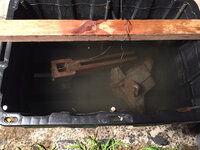
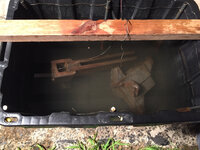
OK I need help. This is the third time I tried to have success at electrolysis with the same results. I used this website's description for creating my set up. http://antique-engines.com/electrol.asp
I welded up a 3/4 diameter rebar frame that fit in this trash can. I also welded a chain to the bar that hangs the workpiece. I used the washing soda recommended and about a cup per 5 gallons. This static support was in for 12 hours using my 200 amp charger at the highest setting. If this is my result then I am doing something wrong. The negative and positive connections do not touch each other. Can anyone see a problem with my setup? Is my battery charger no good, it charges my batteries fine. It did strip some paint off but left more rust then when I started. Thanks in advance.
Kevin
It looks to me like your rebar "cage" rests on the bottom of your tank. If so, as the newly formed iron oxide drops to the bottom of the tank, it will come into contact with your rebar cage. If there is enough iron oxide on the bottom, it will create a path for the current to travel over, bypassing the piece you are working on.
If the cage does sit on the bottom of the tank, try suspending it above the bottom over the sludge and see what happens.
JKB
Very nice vise! I have never seen another simplex swivel jaw.I have been looking for a swivel jaw vise for a couple of years now and my patience finally has been rewarded. I found a Desmond Stephan Simplex 43SJ on an online auction and won it for $55. I have always liked the Simplex vises.
It is in decent shape but certainly has been used. It has 4.75 inch jaws and weighs 66 lbs. The pin had not been removed for some time and was "painted in" as well as being stuck. Time, Kroil, heat, and a rigged up C-clamp pushed it out.
Sent from my XT1585 using Tapatalk
Parkinsons were actually in business until 1984 ish (from memory might be a year or two out)
Although if they made vices until the end I dont know, they made other stuff also.
I have an ex military Samsonia that is stamped with the military stock no and the date 1966, it could have been made a bit earlier as the military only stamped dates on when they put the item into stock. Its however probably fair to say their best period was before WW2 .
Thanks for the correction.
Well, the Parkinsons were certainly built to last. How much does the 9a weigh?
Wilton magnet scores again two days in a row.
The 1780 will be an interesting story when all is said and done
I forgot to snap a pic of the 9450 until I had already started to disassemble it for inspection. Other than needing swivel lock handles, a tweak to the handle and proper pins for the tail cap (had roll pins) it really just needs to be cleaned and lubed to go back to work. The jaws were machined smooth, but they aren't terribly hard to replace. It was mounted on a very small bench and with the smooth jaws I'm pretty sure it was used for light duty...hardly a dent or ding on it anywhere and the slide is really clean. 12-1-67 date code. I really like the looks of the 9450.


The 1780 will be an interesting story when all is said and done
I forgot to snap a pic of the 9450 until I had already started to disassemble it for inspection. Other than needing swivel lock handles, a tweak to the handle and proper pins for the tail cap (had roll pins) it really just needs to be cleaned and lubed to go back to work. The jaws were machined smooth, but they aren't terribly hard to replace. It was mounted on a very small bench and with the smooth jaws I'm pretty sure it was used for light duty...hardly a dent or ding on it anywhere and the slide is really clean. 12-1-67 date code. I really like the looks of the 9450.


bagged89s10
Well-known member
Have a look, if you'd like, at the Oliver page on Carl Matthews's Emmert vise web-site.
http://www.mprime.com/Emmert/oliver.htm
The dark green one at the top of the page, and in the three photos of it in different positions, is mine, the one I restored for my own use some 20-ish years ago. I really didn't like the relatively flimsy original tilt-bar assembly, so I made up stronger one, to safely carry the weight of a door, or similar heavy part, when the vise jaws were set horizontal.
The Oliver works called it their 'Model 1 patternmakers' vise'. You can find a catalogue page about it on the vintagemachinery.org internet site.
There are some detail changes in these over the years it was in production, but I don't know the time frame in which the changes were done, except as a rough guess.
The early ones (1920's, til ??) used a buttress thread on the main screw, and the front jaw swivelling point was carried on pins threaded into the beam. At a later point in time, (1940's??) the main screw was changed to a double-lead Acme form, and the swivel pins were retained by square head set-screws.
The later (mid to late 50's??) style of Oliver vise, which was continued in production when the vise line was bought by the Kindt-Collins Co., used a swivel system similar to the later production of the Emmert vise.
That vise is still in low-volume production today, by Conowingo Supply, a woodworking machinery dealer in Pennsylvania, under the 'Hopewell' name. You could buy a new one 'off the shelf' for a bit over $2K. I'd suspect he doesn't sell very many of them, these days.
Conowingo also makes some Oliver and Emmert vise parts, which are a bit costly, to put it mildly, but do make it readily possible to restore the old patternmakers' vises.
cheers
Carla
Tons of info in the links on my Oliver page: http://toolarchives.com/node/3392
Thanks for all the info.
FMC1959
Well-known member
I found this earlier post in this thread, and my new vise appears to be a replica of Parkinsons No.6:
Nice looking vise. Many on GJ are not fans of made in China or India. I have always felt that we (North America) get the cheap stuff imported because the manufacturer is looking for sell cheap and make profits, but both China and India have decent quality stuff available locally....we don't get it in NA because it would cost as much as the good stuff we already have.
I hope your vise performs and lasts like a Parkinson
I built a 30 gal cast iron ceramic sink into my outside worktable. I just fill it with Simple Green and drop my stuff into it for 3-4 days. Paint and grease just literally fall off. It saves the patina. Fantastic stuff and I dont need gloves.
Veeps told me about this. Best tip ever!
Joe (and bagged), simple green comes in ready to use as well as different concentrates that need to be mixed with water. What recipe are you using in your cast iron sink?
FMC1959
Well-known member
JOE: how many gallons of SG do you put in your tank/tub? how often do you change and or filter the SG? thanks
TJ: i've never seen one if that helps you. now i'll be looking for one and my guess it was somebody looking to protect the back of the slides from the workers that always used it as an anvil.
is the combo for sale?
FMC: to further our discussion of the Reed 4C vs. the Yost 34c i'd put the Yost in the same category as Joe's new Reed 4c and not the pre 1950's ones. the yost has a lot of similar traits to the Columbians. my yost is a solid vise and it will get used set up as my daily user where the helpers have access to a vise. hopefully it won't be abused by helpers, my kids or relatives that don't always respect a vise for what it was meant for.
Thanks for the info drives, I hope some day I can find a 4C.....or 3, 2, or 1 C, they are beauties
bagged89s10
Well-known member
Bcom, the rebar was brand new stuff, would the scaling cause me issues?
OK, gotta find some of the Simple Green Joe and Veeps uses. Home Depot has it, 6 hours in and vise is still rusty, that is 18 hours of bubbling.
Joe does the Simple Green de-rust the vise, just trying to save using the dremel wire wheels in the corners and hard to reach areas. If so then I am going to Home Depot tomorrow.
Vintage, thanks for the note on restoring vises. It takes me longer then 20 minutes to get a vise ready for painting but I am a slow mover.
Kevin. Simple green will only remove paint and grease. And electrolysis will only remove rust or rusty paint.
Is your electrolysis working now? I use cheap rebar tying wire and alligator style clips for my connections, and a cheap manual battery charger. I also have all my anodes connected on the outside of tank to make sure they have a good connection once the inside connections get rusty. Also bad or dirty/rusty connections will make electrolysis work really slow. I wire brush my rebar daily if the tank has something cooking. I've been meaning to get graphite for the anodes which is supposed to be better and stay cleaner. Some battery chargers auto shutoff if they don't sense a battery or they sense a short. The 2 I've used are in he attached images.



Attachments
-
 48d4cda942f3e10720b88c48bb1bce62.jpg795.4 KB · Views: 2
 -
 f0518ded09bc29fbe6efab15b4221333.jpg820.1 KB · Views: 1
 -
 053b95f6b6a50a85779eaa7928d5b227.jpg638.9 KB · Views: 0
 -
 d6c246849afe9b76bda36970411a37e1.jpg790.5 KB · Views: 0
 -
 d6ed1cdff3e32d168c2f58f373a8ae55.jpg675.2 KB · Views: 0
 -
 ba1b095325b4061ea3d379d1f430bdbe.jpg791.6 KB · Views: 0
 -
 0868eb1164921c9c7304addeab680c69.jpg786.9 KB · Views: 1
bagged89s10
Well-known member
Nice looking vise. Many on GJ are not fans of made in China or India. I have always felt that we (North America) get the cheap stuff imported because the manufacturer is looking for sell cheap and make profits, but both China and India have decent quality stuff available locally....we don't get it in NA because it would cost as much as the good stuff we already have.
I hope your vise performs and lasts like a Parkinson
Joe (and bagged), simple green comes in ready to use as well as different concentrates that need to be mixed with water. What recipe are you using in your cast iron sink?
Just regular simple green full strength, undiluted.
KMScott
Well-known member
Kevin
It looks to me like your rebar "cage" rests on the bottom of your tank. If so, as the newly formed iron oxide drops to the bottom of the tank, it will come into contact with your rebar cage. If there is enough iron oxide on the bottom, it will create a path for the current to travel over, bypassing the piece you are working on.
If the cage does sit on the bottom of the tank, try suspending it above the bottom over the sludge and see what happens.
JKB
Ok, this might be a issue, I will raise the bars above the bottom. I really think my charger is not working the best. I see veeps uses a 10 amp charger, mine I run wide open at 200 amps, should work. I'll try a different charger too. Thanks JKB
Kevin. Simple green will only remove paint and grease. And electrolysis will only remove rust or rusty paint.
Is your electrolysis working now? I use cheap rebar tying wire and alligator style clips for my connections, and a cheap manual battery charger. I also have all my anodes connected on the outside of tank to make sure they have a good connection once the inside connections get rusty. Also bad or dirty/rusty connections will make electrolysis work really slow. I wire brush my rebar daily if the tank has something cooking. I've been meaning to get graphite for the anodes which is supposed to be better and stay cleaner. Some battery chargers auto shutoff if they don't sense a battery or they sense a short. The 2 I've used are in he attached images.
Veeps, your setup looks great and wow such a small charger. I have yet to see a clean vise after the cleaning, and how long does it really take per electrolysis cook. I like how you connect each corner, I will keep trying.
I use aircraft stripper where it does not bother my skin, no gloves used and the paint is off in a short time. I will stay with stripper instead of the simple green for the paint removal and try to get my electrolysis to work for the rust. I work on vises and vise parts every day and have to be very efficient in my time, using a wire wheel is to slow, messy and a little dangerous with the bristles flying around. I will keep on trying to get the rust issue figured out because I think it should give me a clean rust free vise. Thanks guys.