jchetty
Well-known member
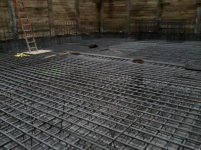
I'm one of the "overbuild" guys .
Looks good. I would rather "overbuild" than underbuild


I'm one of the "overbuild" guys .
I have noticed on a lot of these posts across all GJ posts that American reinforcement mesh is like chicken wire or coat hanger wire. In Australia the mesh consists of at least 1/4" wire and a grid of 6" ... that makes for a really high tensile strength. I just can't understand the light stuff that is used. Cheap cost i suppose.
I'm one of the "overbuild" guys .
I have noticed on a lot of these posts across all GJ posts that American reinforcement mesh is like chicken wire or coat hanger wire. In Australia the mesh consists of at least 1/4" wire and a grid of 6" ... that makes for a really high tensile strength. I just can't understand the light stuff that is used. Cheap cost i suppose.
I'm one of the "overbuild" guys .

You almost can't have too much of the stuff.
After reading the article posted a few days ago about the guy not having rerod in his footers and having them crack after only a week (Sorry if you're reading this) I posed the question to a coworker that does concrete side jobs about footers and pads.
Essentially, he seems to think that rerod or wire mesh doesn't help and isn't worth the money.....
Like this?
1" bar, 12" o/c IIRC.
I do that and rebar on 3' centers.
I also like to insulate under the concrete on top of 12" of clean rock.
The high density insulation I use is Perform guard - http://www.performguard.com/
They make an insulation board with buttons for hydronic tubing
I'm one of the "overbuild" guys .
Nice! Did you remove the wood stakes or are they left in the concrete?
Mesh may be ok in itself, but in reality not, cuz no matter what they do, it ends up at or near bottom of slab.
In most cases anyway.
No matter if they pull it up with a hook while you are watching.
Rebar should be placed on approved design "chairs", readily available where you buy the rebar, NOT on busted up chunks of brick or something else.
Look at slab designs on real live long term projects, often Government owned for example.
Always rebar.
Equally important at how rebar is bent and tied together like floor to footing or "beam" connections.
Must be done in CERTAIN SPECIFIC ways, not just what looks good to Grandma. Marc
I have noticed on a lot of these posts across all GJ posts that American reinforcement mesh is like chicken wire or coat hanger wire. In Australia the mesh consists of at least 1/4" wire and a grid of 6" ... that makes for a really high tensile strength. I just can't understand the light stuff that is used. Cheap cost i suppose.
After reading the article posted a few days ago about the guy not having rerod in his footers and having them crack after only a week (Sorry if you're reading this) I posed the question to a coworker that does concrete side jobs about footers and pads.
Essentially, he seems to think that rerod or wire mesh doesn't help and isn't worth the money.....
If the wire mats are on chairs at the proper spacing, the wire stays right where it should be.
If your concrete contractor is doing any of the following, get rid of him/her:
Placing rebar or wire ontop of broken bricks.
using "rolled" wire
using less than 6ga wire
"pouring" the concrete, as opposed to "placing it"
Does not have a vibratory on site.
Tells you concrete allways cracks
With the proper reinforcement (tied and on the correct chairs), concrete PLACED at the correct slump, The correct mix used, properly placed control joints,, concrete will not and will NEVER crack.
Slack
If the wire mats are on chairs at the proper spacing, the wire stays right where it should be.
If your concrete contractor is doing any of the following, get rid of him/her:
Placing rebar or wire ontop of broken bricks.
As I stated on page 1, there's nothing wrong with using bricks fro chairs under concrete......
using "rolled" wire
I hate rolled WWF, but will be the first to admit that it performs the same as sheet mesh, it's the same material afterall......
using less than 6ga wire
Not sure I've ever seen anything less than 6 ga.
in my career..........
"pouring" the concrete, as opposed to "placing it"
Mere semantics, I use the term"pour" all of the time and I likely place concrete tighter than 95% of my competition..........
Does not have a vibratory on site.
Tells you concrete allways cracks
Most concrete does usually crack, at least that containing TYpe I Portland cement, as it shrinks as it cures. The goal is to control where it cracks, which is where you draw a line between areal contractor and an internet "expert........
With the proper reinforcement (tied and on the correct chairs), concrete PLACED at the correct slump, The correct mix used, properly placed control joints,, concrete will not and will NEVER crack.
Slack
I read once 90% of the wire you put in concrete ends up on the bottom of what you are pouring .They step on it when you are pouring & don''t pull it up like you should..


I read once 90% of the wire you put in concrete ends up on the bottom of what you are pouring .They step on it when you are pouring & don''t pull it up like you should.. Also for thr guy that says they don't put steel in bridges & paving , don't know what he is talking about , I worked 41 years in construction . We done it all the time.
^^^Looks good!
Heavy gauge welded wire, plenty of support edge protection around poles, so why no plastic?
Many Contractors do not understand the purpose of the wire, and it is in their way, so it just sits on the bottom....unless there is a foreman on the crew who WILL make sure they pull it up....or an Inspector who requires them to pull it up