To avoid these ads, REGISTER NOW!

Correct way to pour concrete?

To avoid these ads, REGISTER NOW!

RobSmith

Banned
Joined
Feb 5, 2009
Messages
562
Location
NSW Australia
I have noticed on a lot of these posts across all GJ posts that American reinforcement mesh is like chicken wire or coat hanger wire. In Australia the mesh consists of at least 1/4" wire and a grid of 6" ... that makes for a really high tensile strength. I just can't understand the light stuff that is used. Cheap cost i suppose.
 

ssdave

Banned
Joined
Apr 11, 2015
Messages
2,913
Location
Eastern Oregon
I have noticed on a lot of these posts across all GJ posts that American reinforcement mesh is like chicken wire or coat hanger wire. In Australia the mesh consists of at least 1/4" wire and a grid of 6" ... that makes for a really high tensile strength. I just can't understand the light stuff that is used. Cheap cost i suppose.

Not sure why the reluctance to use that type of reinforcement here. In theory, the lighter wire and close spacing is much better reinforcement than rebar of bigger diameter at wider spacing. I think a lot of the reluctance comes from the difficulty of storing and handling the sheets of mesh. Bar is easier. In concrete design classes, we were taught that remesh could be used in the same weight as rebar, but it was superior because of better distribution.

As an engineer that has spent nearly 30 years designing and detailing concrete, I have a hard time understanding the reluctance to using rebar in concrete. It works so much better and lasts so much longer that there's no comparison. Or those that put in rebar, but at huge spacing. Putting in #3 bar at 40" spacing in a slab is almost like leaving it out.

In a footing, regardless of whether it's a shed, garage, or house, I'd put in a minimum of 1 rebar, I prefer 2. I'd put rebar in the stem wall, at 12" spacing preferably, but at least at 18" o.c.. In a floor slab, I would put at least #3 bar at 18" o.c. And, block it up off the bottom, don't try to lift it. Broken concrete pieces are fine, although wired on concrete dobies or chairs are best. My preference in slabs is to put in the #3 bar, and then wire welded wire mesh to it. The bar can be dobied up to make sure the mesh gets where it should be. In that case, I'd put the bar at wider spacing, as the mesh is the primary reinforcement. Lifting bar or mesh in a slab is a waste of time, it doesn't work, no matter what your concrete guy tells you.

Mono footing/stem walls are a good foundation, if they are wide enough. Except for a garden shed, I'd never use an 8 or 6 inch footing unless they were on solid bedrock. I'd go with 12" minimum, if the soil is good enough to support the calculated loads.

If I were forced to go with a 6 or 8 inch mono footing/stemwall, I'd put in #4 bar at 8" spacing for the lower 24" of the wall, to spread out the load over local failure points. I'd also try to spread out the bottom 4" of the footing to 12" width to aid in getting the load spread out a bit more. That's not too hard to do if you're doing a trench and earth forming, it, just widen the bottom of the trench. Or, if you're forming it, hold the forms up 4", and let the bottom concrete spread out.
 

GMCGarage

Well-known member
Joined
Jan 31, 2017
Messages
1,264
I have noticed on a lot of these posts across all GJ posts that American reinforcement mesh is like chicken wire or coat hanger wire. In Australia the mesh consists of at least 1/4" wire and a grid of 6" ... that makes for a really high tensile strength. I just can't understand the light stuff that is used. Cheap cost i suppose.

If its for crack control, lighter weights will work. If for tensile strength, then heavier is used.
 

Dick in Wisconsin

Well-known member
Joined
Mar 3, 2012
Messages
3,048
Location
Shawano, Wisconsin
After reading the article posted a few days ago about the guy not having rerod in his footers and having them crack after only a week (Sorry if you're reading this) I posed the question to a coworker that does concrete side jobs about footers and pads.

Essentially, he seems to think that rerod or wire mesh doesn't help and isn't worth the money.....

I don't think your co-worker has any idea what he talking about.

He is the kind of side job guy who gives side job guys the reputations some of them certainly don't deserve.
 

Tejay

Well-known member
Joined
Dec 29, 2014
Messages
105
At .30 cents a foot ish why cheap out ? Just silliness for a forever problem .
 

Diesel Dan

Well-known member
Joined
Jul 21, 2013
Messages
2,460
Location
TN
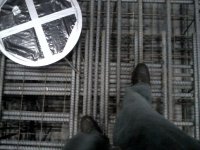
Bottom of a press pit about 18' below grade.
I was on top row, second row about 3' down. Slab was 4.5' thick.
 
To avoid these ads, REGISTER NOW!

slackdaddy1

Well-known member
Joined
Mar 15, 2014
Messages
476
Location
Southern MD
If the wire mats are on chairs at the proper spacing, the wire stays right where it should be.
If your concrete contractor is doing any of the following, get rid of him/her:

Placing rebar or wire ontop of broken bricks.
using "rolled" wire
using less than 6ga wire
"pouring" the concrete, as opposed to "placing it"
Does not have a vibratory on site.
Tells you concrete allways cracks

With the proper reinforcement (tied and on the correct chairs), concrete PLACED at the correct slump, The correct mix used, properly placed control joints,, concrete will not and will NEVER crack.

Slack

Mesh may be ok in itself, but in reality not, cuz no matter what they do, it ends up at or near bottom of slab.

In most cases anyway.

No matter if they pull it up with a hook while you are watching.

Rebar should be placed on approved design "chairs", readily available where you buy the rebar, NOT on busted up chunks of brick or something else.

Look at slab designs on real live long term projects, often Government owned for example.

Always rebar.

Equally important at how rebar is bent and tied together like floor to footing or "beam" connections.

Must be done in CERTAIN SPECIFIC ways, not just what looks good to Grandma. Marc
 

slackdaddy1

Well-known member
Joined
Mar 15, 2014
Messages
476
Location
Southern MD
because Americans are cheap and want the cheapest price, then whine that the end product fails.

I use 5' x 10" 4ga wire mats, they even have the "rebar texture" to the wire.
The heavy gauge wire mats are readily available in the USA,, but 99% are to cheap to use it, or the proper chairs to hold it in place.

I have noticed on a lot of these posts across all GJ posts that American reinforcement mesh is like chicken wire or coat hanger wire. In Australia the mesh consists of at least 1/4" wire and a grid of 6" ... that makes for a really high tensile strength. I just can't understand the light stuff that is used. Cheap cost i suppose.
 

slackdaddy1

Well-known member
Joined
Mar 15, 2014
Messages
476
Location
Southern MD
I feel very, very sorry for the people he has done work for,,, or maybe I don't.
I guess they got what they deserved.

After reading the article posted a few days ago about the guy not having rerod in his footers and having them crack after only a week (Sorry if you're reading this) I posed the question to a coworker that does concrete side jobs about footers and pads.

Essentially, he seems to think that rerod or wire mesh doesn't help and isn't worth the money.....
 

ms fowler

Well-known member
Joined
Jun 27, 2012
Messages
450
Location
Littlestown, PA _ 6 miles south of Gettysburg
If the wire mats are on chairs at the proper spacing, the wire stays right where it should be.
If your concrete contractor is doing any of the following, get rid of him/her:

Placing rebar or wire ontop of broken bricks.
using "rolled" wire
using less than 6ga wire
"pouring" the concrete, as opposed to "placing it"
Does not have a vibratory on site.
Tells you concrete allways cracks

With the proper reinforcement (tied and on the correct chairs), concrete PLACED at the correct slump, The correct mix used, properly placed control joints,, concrete will not and will NEVER crack.

Slack

I disagree only with the 'concrete never cracks" part.
In my experience concrete cracks. Sometimes, with the use of soft-cut control joints we can (maybe) influence it WHERE to crack. sometimes......maybe.
 

joes169

Well-known member
Joined
Sep 19, 2011
Messages
663
Location
WI
If the wire mats are on chairs at the proper spacing, the wire stays right where it should be.
If your concrete contractor is doing any of the following, get rid of him/her:

Placing rebar or wire ontop of broken bricks.

As I stated on page 1, there's nothing wrong with using bricks fro chairs under concrete......

using "rolled" wire

I hate rolled WWF, but will be the first to admit that it performs the same as sheet mesh, it's the same material afterall......

using less than 6ga wire

Not sure I've ever seen anything less than 6 ga.
in my career..........


"pouring" the concrete, as opposed to "placing it"

Mere semantics, I use the term"pour" all of the time and I likely place concrete tighter than 95% of my competition..........

Does not have a vibratory on site.
Tells you concrete allways cracks

Most concrete does usually crack, at least that containing TYpe I Portland cement, as it shrinks as it cures. The goal is to control where it cracks, which is where you draw a line between areal contractor and an internet "expert........

With the proper reinforcement (tied and on the correct chairs), concrete PLACED at the correct slump, The correct mix used, properly placed control joints,, concrete will not and will NEVER crack.

Slack

In a perfect world, concrete never cracks outside of a joint. In reality, it happens quite often...........
 

1jjpop

Well-known member
Joined
Nov 24, 2009
Messages
481
Location
Central Iowa
I read once 90% of the wire you put in concrete ends up on the bottom of what you are pouring .They step on it when you are pouring & don''t pull it up like you should.. Also for thr guy that says they don't put steel in bridges & paving , don't know what he is talking about , I worked 41 years in construction . We done it all the time.
 

Ole Slewfoot

Well-known member
Joined
Feb 22, 2016
Messages
5,098
Location
Freedom, CA
Look at earthquake death statistics. Places like Afghanistan, Nepal, India, etc where steel reinforcement isn't that widespread, a 6.6 results in a death toll in the thousands. Places like Japan and Chile will weather a 7.0 with a death toll below a dozen. California has a lot of quake related code, but we don't fare near as well as wither of those two. No warning sirens and few marked evac routes though.
 

lakeroadster

Well-known member
Joined
Jan 19, 2015
Messages
5,166
Location
Central Colorado
I read once 90% of the wire you put in concrete ends up on the bottom of what you are pouring .They step on it when you are pouring & don''t pull it up like you should..

Concrete Dobies make it easy to place the reinforcement in the correct location.

And if 6 gauge mesh or heavier is used it will flex and return to it's original location when stepped on during the pour.


Last edited:

Diesel Dan

Well-known member
Joined
Jul 21, 2013
Messages
2,460
Location
TN
^^^Looks good!
Heavy gauge welded wire, plenty of support edge protection around poles, so why no plastic?
 

ms fowler

Well-known member
Joined
Jun 27, 2012
Messages
450
Location
Littlestown, PA _ 6 miles south of Gettysburg
I read once 90% of the wire you put in concrete ends up on the bottom of what you are pouring .They step on it when you are pouring & don''t pull it up like you should.. Also for thr guy that says they don't put steel in bridges & paving , don't know what he is talking about , I worked 41 years in construction . We done it all the time.

This is sadly, mostly true. Many Contractors do not understand the purpose of the wire, and it is in their way, so it just sits on the bottom....unless there is a foreman on the crew who WILL make sure they pull it up....or an Inspector who requires them to pull it up.
I did inspections for a target Store some years ago. The crew was placing concrete for the loading dock, and using gas buggies to transport it across the slab, running over the wire and driving it into the subgrade. i told them to pull it up--they got belligerent, and refused. I took pictures. They removed the hardened concrete at the Owner's demand and did it all over again.
 

lakeroadster

Well-known member
Joined
Jan 19, 2015
Messages
5,166
Location
Central Colorado
^^^Looks good!
Heavy gauge welded wire, plenty of support edge protection around poles, so why no plastic?

Cactus growing in the yard.. arid climate.. simply not needed.

Many Contractors do not understand the purpose of the wire, and it is in their way, so it just sits on the bottom....unless there is a foreman on the crew who WILL make sure they pull it up....or an Inspector who requires them to pull it up
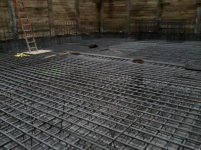
"Pulling it up" is a **** shoot.. you'll never really know where it ends up. Chairs or dobies is the best method.
 
Last edited:
To avoid these ads, REGISTER NOW!
Top Bottom