To avoid these ads, REGISTER NOW!

Bonded neutral/ground in new 200amp service?

STINEY

Well-known member
Joined
Jan 23, 2009
Messages
275
Location
Bucyrus Ohio
Been lurking around here for a couple years and gotten a lot of ideas from this group. Haven't posted much but now I need help.

In planning a new service install for our 150 year old house (and 100amp's for my shop :bounce: ) I was talked into stepping outside of my comfort zone.

I've installed new services before. No problems, cut & dried.

This time I was talked into a "Distribution Panel" with the meter box. Gives me a "disconnect" outside and saves some wire on the 200' run to the shop. (I was planning on coming off the basement panel with a 100amp breaker and running to the shop with that.)

Now what I'm confused about is whether the basement panel should be bonded or not? I've always understood that the first panel off the transformer is bonded and all others are not....... so with this distribution panel what is the correct way to do it?

There is a 8' copper ground rod in the basement connected to that panel, one at the pole connected to the meter part of that panel, and I had planned one at the shop to ground that panel, also planned the shop panel to be NOT bonded.

With this distribution panel, I'm second guessing myself. I hereby defer to higher powers..... help me... :bowdown:

(There is no inspector or zoning to work with here, by the way)

Thanks in advance!

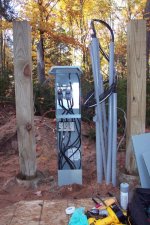
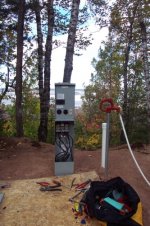
Here is a picture of the distribution panel and the basement service panel.

ywHvGK0.jpg


TxOo4Gs.jpg
 
Last edited:
To avoid these ads, REGISTER NOW!

mrb

Well-known member
Joined
Dec 31, 2008
Messages
3,734
your meter combo needs to contain the N-G bond. Everything downstream from there (including your basement panel) needs 4 wires, and the neutral and ground isolated.
 

FastEddieG

Well-known member
Joined
Jun 16, 2009
Messages
239
Location
Chicago suburbs, IL
Nice writeup OP. This will spark some constructive discussion.

your meter combo needs to contain the N-G bond. Everything downstream from there (including your basement panel) needs 4 wires, and the neutral and ground isolated.

Thanks for replying to the OP. Is this true also for a subpanel in an attached garage? I thought the EMT would act as "ground" in that instance, so you'd only need 3 wires (2 hot and 1 neutral). Thanks in advance.

-Ed
 

Ezzie

Well-known member
Joined
Oct 15, 2007
Messages
371
Location
Lake Chapala, Jalisco
Exception to the above - if the sub panel is installed in a seperate building that has livestock in it (such as a barn with cattle drinking from waterers, etc), they want the sub panel also grounded there with a rod, ground plate etc. and the ground/neutrals bonded there as well. At least that is the code in the jurisdiction I am in. In these runs typically no ground wire is used between the two buildings.

If it is a subpanel in the same building as the main service entrance/distribution panel then the ground and neutral at the sub panel are to remain isolated.
 

Charles (in GA)

Well-known member
Joined
Jan 11, 2006
Messages
12,489
Location
50 mi south of Atlanta
Nice writeup OP. This will spark some constructive discussion.


Thanks for replying to the OP. Is this true also for a subpanel in an attached garage? I thought the EMT would act as "ground" in that instance, so you'd only need 3 wires (2 hot and 1 neutral). Thanks in advance.

-Ed

I would not depend on the EMT as a ground for anything. Way too easy to become damaged or separated, connection loose, etc. Usually you connect EMT into a painted panelboard and few bother to bond the EMT or scrape it clean for a good connection. I doubt that the EMT as a ground would be acceptable for a feeder such as to a subpanel anyhow.

Charles
 

Falcon67

Well-known member
Joined
Jun 11, 2009
Messages
18,371
Location
Merkel, TX
>I would not depend on the EMT as a ground for anything.
X2. If I pull a run in conduit, I pull a bare copper. Not a 'spert, but I only consider conduit a protector. Our service entrance panels on the house have a bare copper running from the meter can to the grounding bus bar and the neutrals bonded to the panel.

Revised - I need to re-look for sure.
Some discussion here: http://ecmweb.com/grounding/electric_grounding_vs_bonding_5/
 
Last edited:

walrus

Well-known member
Joined
Nov 12, 2008
Messages
11,677
Location
Maine
EMT is fine as a ground. Many would argue it will clear a fault better than copper. Go on Mike Holts forum and you'll find plenty of electricians who use EMT as a ground on panels every day.
 

Aceman

Well-known member
Joined
Jan 28, 2007
Messages
2,513
Location
Eastern Oregon
In the OP's case he used PVC and not EMT, so he'll need a 4th wire to the basement panel. Keep everything seperated too, treat it like a subpanel.
 

lectricman

Member
Joined
Oct 24, 2009
Messages
11
Hi, your meter panel combo is a nice time saver as it has the disconnect and additional circuits for anything that u need to run outside the house, that meter combo does need to bond neutral and ground and any other panels need to have the neutral and ground bus isolated from each other ( and do not screw in the green bonding screw) Also conduit albeit emt or rigid is not your ground , u need to run your proper grounding conductors. New Jersey licensed electrician, remember electricity is not a hobby ,be safe....joe
 

tfi racing

Well-known member
Joined
Apr 19, 2008
Messages
2,907
Location
Cedar,BC
Falcon67;65392 If I pull a run in conduit said:
EMT as the ground is perfectly acceptable in many situations,however a bare copper conductor is not permitted in any conduit,it must be insulated- at least on this side of the border,your rules may vary,but I doubt it on this one.
 

hidollartoys

Well-known member
Joined
Jul 15, 2008
Messages
594
Location
K. C. Metro area
EMT as the ground is perfectly acceptable in many situations,however a bare copper conductor is not permitted in any conduit,it must be insulated- at least on this side of the border,your rules may vary,but I doubt it on this one.

Per 2005 NEC the "grounding" conductor is premitted to be bare, even in conduit.
 
OP
S

STINEY

Well-known member
Joined
Jan 23, 2009
Messages
275
Location
Bucyrus Ohio
My shop is actually 2 large barns joined together (weird but that's how it is). One is my shop and the other does have a waterer in it for the livestock.

I guess I don't understand the theory behind keeping the neutral/ground separate, unless a waterer is involved? Wouldn't a waterer be the same basic scenario as a faucet? The running water has a direct path to a heating element, even though it is in the water heater.

My logic says that the grounds in the house should be treated the same as in a barn with a waterer. Bonded with its own ground.

Seems this bonding is a technicality - is one way overkill and the other viewed as a cleaner install. Can it be cost, depending on the length of the run to a subpanel, installing a ground rod would certainly be cheaper than a ground run? Unless the run to a sub is only a couple feet, to gain more breaker space. I can see separating the neutrals/grounds for that.

Not being argumentative, just curious and wanting to learn!
 

mrb

Well-known member
Joined
Dec 31, 2008
Messages
3,734
the theory behind keeping N-G seperate is this: current flows on the neutral. the purpose of the ground is to provide a return path for fault current. During normal operation there is no current flowing on the ground. If you dont have seperate neutrals and grounds, you will have current flowing on every bonded metallic path between the two panels, plus if the neutral is lost things can become energized.
 

Falcon67

Well-known member
Joined
Jun 11, 2009
Messages
18,371
Location
Merkel, TX
I think (please correct) that the other issue would be a ground loop, where the ground at the service entrance and the one at the remote site would have some difference and that could induce current flow in the grounding conductors. I suspect that's at least part of the reason for the H-H-N-G cabling requirement from the service to a subpanel. Keep the neutral separate all the way back to the service so the current returns at the utility connection. Also - In order to induce enough current to trip a breaker, the fault has to hit a very low resistance path to ground. Lower than you, hopefully. Keeping the grounds tied together keeps them at the same potential and reduces the change that a person touching the metal parts of the system will be at a different potential and provide a path for current.

I think NEC 250.50 is the one, not sure.
 
Last edited:
OP
S

STINEY

Well-known member
Joined
Jan 23, 2009
Messages
275
Location
Bucyrus Ohio
Hey Falcon, are you on the BangShift forum too? Your avatar looks familiar.....


So it looks like I need to do some more digging and add a ground wire from the meter panel to the house AND to the shop. Great.

A local electrician was supposed to have done all this 6 months ago, to save me time. I ended up doing most of it myself anyways.....Grrrrr....he stopped at hanging the meter panel and trenching the wires. Now I get to pick up the slack.

Apparently he wasn't planning on doing things up to snuff.
 

Falcon67

Well-known member
Joined
Jun 11, 2009
Messages
18,371
Location
Merkel, TX
Hey Falcon, are you on the BangShift forum too? Your avatar looks familiar.....

Yep, me there too.

I did some more reading around the web - if I picked it up right, the older code allowed a separate building to be fed with three conductors provided there was no other conductive pathway between the buildings, like a water or gas line, telephone, network, etc. And I think this was for a service type feed - that is, the panel was fed right off the meter and not coming out of the main house panel like a sub panel. The remote was to be treated just like a service entrance, like it was getting a drop from the pole and a meter. The 2005 up I think includes the separate/extra grounding wire.
 
OP
S

STINEY

Well-known member
Joined
Jan 23, 2009
Messages
275
Location
Bucyrus Ohio
Groan...... the one other thing he did was drop a coaxial, phone, water, and 3-way wiring in the trench while it was open.

Prior to that there was only one plastic 1" water line connecting the shop & house.
 

lectricman

Member
Joined
Oct 24, 2009
Messages
11
the theory behind keeping N-G seperate is this: current flows on the neutral. the purpose of the ground is to provide a return path for fault current. During normal operation there is no current flowing on the ground. If you dont have seperate neutrals and grounds, you will have current flowing on every bonded metallic path between the two panels, plus if the neutral is lost things can become energized.

MRB is correct.if u do not separate the neutral and the ground ,your grounds can become hot.
 
OP
S

STINEY

Well-known member
Joined
Jan 23, 2009
Messages
275
Location
Bucyrus Ohio
MRB is correct.if u do not separate the neutral and the ground ,your grounds can become hot.

Again, not to be argumentative, but I don't get this.

Why would the same thing NOT happen if this were the only panel after the meter? Those neutrals & grounds are all bonded......what stops those grounds from potentially becoming hot when current is returning on the neutrals?
 

IBEW

Member
Joined
Mar 20, 2009
Messages
17
Hi Stiney
To make sure of anything electrical in your area. Call your electrical inspectors office and talk to them. They will tell you what to do for no charge. There are many different correct ways to do what your doing. You want the code correct and safest as well.
 
To avoid these ads, REGISTER NOW!
OP
S

STINEY

Well-known member
Joined
Jan 23, 2009
Messages
275
Location
Bucyrus Ohio
Again, not to be argumentative, but I don't get this.

Why would the same thing NOT happen if this were the only panel after the meter? Those neutrals & grounds are all bonded......what stops those grounds from potentially becoming hot when current is returning on the neutrals?

Looking back, this thread seemed to die just when it was getting to the good stuff?

Does anyone have an explanation for why a single panel is okay for bonded neutrals & grounds? According to the logic of having the return path go straight to the service, there should be no such thing as a bonded panel...

What am I missing?
 

keweenawbee

Well-known member
Joined
Jan 4, 2011
Messages
76
Location
MN,MI
Not sure if this is totally relevant but my inspector let me run a 100 amp "second service" off my 200 amp main breaker panel with my left-over aluminum triplex thereby saving me the cost of a direct burial separate ground wire. The triplex alum wire was too big to run into my breaker box directly so I put a big Midland junction box outside on the wall opposite and used the smaller equivalent copper into the breaker. I installed a pedestal style sub-panel mid-lot about 4 feet away from my steel cased wellhead that goes down about 30' to bedrock and bonded it to that. Can't imagine a better ground rod. There is a busway at the bottom of that pedestal with parallel connections for my future (I hope) cabin someday. I am feeding two RV pedestals down at the shoreline embankment area of the 30 and 50 amp variety. I had to pay for direct burial wire that normally the utility co would supply but I will only have a single meter and power invoice each month.
 

Attachments

  • copper_alu_junctionbox.jpg
    copper_alu_junctionbox.jpg
    136.2 KB · Views: 64
  • pedestal_subpanel.jpg
    pedestal_subpanel.jpg
    143 KB · Views: 58
  • shore_RV_pedestal.jpg
    shore_RV_pedestal.jpg
    121 KB · Views: 56
Last edited:

Aceman

Well-known member
Joined
Jan 28, 2007
Messages
2,513
Location
Eastern Oregon
Not sure if this is totally relevant but my inspector let me run a 100 amp "second service" off my 200 amp main breaker panel with my left-over aluminum triplex thereby saving me the cost of a direct burial separate ground wire. The triplex alum wire was too big to run into my breaker box directly so I put a big Midland junction box outside on the wall opposite and used the smaller equivalent copper into the breaker.

Is this triplex aerial wire? Does it have 2 insulated conductors and a bare messenger wire?
 

keweenawbee

Well-known member
Joined
Jan 4, 2011
Messages
76
Location
MN,MI
Maybe it is not exactly called triplex I can't remember. It was three individually insulated stranded aluminum conductors twisted around one another, and definitely purposed for direct burial. I believe the neutral wire may have been one size smaller, given the percentage of high current loads that only use the two hot legs. I remember that I used 2/2/3 for the branch that fed the RV pedestals but I can't remember the big wire, maybe a OO (ought, ought) I used my NEC handheld calculator for 100 amps given the footage at the time to order the wire from Graybar. My main buried branch wire was around 200' and another 200' to the pedestals. Been working great for three camping seasons, along with the freeze-less hydrants. An added bonus is that I can use the lowest hydrant to blow out and drain the entire garage water system (water heater, filters, pressure tank) w/o shocking my septic system.
 
Last edited:

keweenawbee

Well-known member
Joined
Jan 4, 2011
Messages
76
Location
MN,MI
BTW, if I recall the word bonding now refers to the panel manufacturer's included bonding screw that gives you a "listed" ground to neutral bond, over and above the long used practice of the installer's jumper bonding wire between the buses. You don't use the screw at sub panels. My inspector wanted to see it and because I couldn't find it I had to call him and tell him I had screwed it in (jeez).
 

mrb

Well-known member
Joined
Dec 31, 2008
Messages
3,734
Looking back, this thread seemed to die just when it was getting to the good stuff?

Does anyone have an explanation for why a single panel is okay for bonded neutrals & grounds? According to the logic of having the return path go straight to the service, there should be no such thing as a bonded panel...

What am I missing?

the purpose of the ground (which doesnt really have much to do with the required electrodes) is to provide a return path for fault current.

the purpose of the neutral is to return the current imbalance between the two (or three) phases back to the source transformer.

The main bonding jumper (the ONE place N=G are supposed to be bonded)provides the path for the fault current on the ground to get back to the source transformer, which results in excessive current flow that causes a protective device (circuit breaker) to open.

If you have a N-G bond downstream from your main bonding jumper a few different things will happen. Since current flows on all paths (ask MrMark about his water main), you will have current flowing on any available path between panels -not just on the neutral. In some circumstances (in the event of an open neutral) things that should be 'grounded' can develop a potential difference and cause a shock.

Also remember, ground rods are to dissipate static and induced currents from lightning strikes. They DO NOTHING for safety and will not cause a breaker to trip in the event of a fault (short circuit)
 

MrMark

Well-known member
Joined
Jan 25, 2010
Messages
4,626
Location
Southern Cal.
the purpose of the ground (which doesnt really have much to do with the required electrodes) is to provide a return path for fault current.

the purpose of the neutral is to return the current imbalance between the two (or three) phases back to the source transformer.

The main bonding jumper (the ONE place N=G are supposed to be bonded)provides the path for the fault current on the ground to get back to the source transformer, which results in excessive current flow that causes a protective device (circuit breaker) to open.

If you have a N-G bond downstream from your main bonding jumper a few different things will happen. Since current flows on all paths (ask MrMark about his water main), you will have current flowing on any available path between panels -not just on the neutral. In some circumstances (in the event of an open neutral) things that should be 'grounded' can develop a potential difference and cause a shock.

Also remember, ground rods are to dissipate static and induced currents from lightning strikes. They DO NOTHING for safety and will not cause a breaker to trip in the event of a fault (short circuit)

Good writeup. An early connection of neutral to ground (as at a subpanel or elsewhere in the system) not only energizes all the grounds between the early connection and the main panel (although you will not get shocked by touching them unless you open them up and become part of the circuit same as with neutral) but importantly it creates a disastrous open neutral scenario where an "upstream" (do I have this correct? lol) open neutral at the main will leave the ground and everything metal they are connected to "hot" - open circuit hot - waiting for someone to touch them to complete the circuit.

Edit: early bonding can also "mask" an open neutral between the early bonding and the main panel.
 
Last edited:

MrMark

Well-known member
Joined
Jan 25, 2010
Messages
4,626
Location
Southern Cal.
That water main is not carrying any more of my current (at least not until after the first jbar in the handhole) and the system is behaving normally. Who would have thought that you could put over 50 percent of your neutral current down the water main? And, have it be normal behavior. My theory is that the solder in the copper pipes is high resistance and that because I went directly from the N-G panel bond with #4 copper to the water entrance, avoiding intervening plumbing and solder joints, that my setup made a particularly low resistance (equally low as the Edison N wire) through the water main and some other guy's service N and back to the transformer.
 

MrMark

Well-known member
Joined
Jan 25, 2010
Messages
4,626
Location
Southern Cal.
Looking back, this thread seemed to die just when it was getting to the good stuff?

Does anyone have an explanation for why a single panel is okay for bonded neutrals & grounds? According to the logic of having the return path go straight to the service, there should be no such thing as a bonded panel...

What am I missing?

I think I know what your problem is: you think the ground wires are actually going to flow current through the ground, "the earth", right? Well, they are connected to the ground rods as is the N bus but very little, if any, CURRENT is flowing into the Earth as a path back to the transformer. The Earth is a very poor conductor back to the transformer compared to a wire. Very high impedance.

To summarize, the current seeks to return to its source, here the transformer, or it will not flow at all. The Earth is too big a resistance to flow enough current to trip a breaker in the case of a ground fault where the metal of something touchable has become energized.

The ground wires have to be connected to the N bus at the Main to give them a path on the Power Company's N wire to complete the circuit back to the transformer so that the breaker will trip in the case of a short. Otherwise, those ground wires can't do their job.

Did this clear that up?
 
Last edited:
OP
S

STINEY

Well-known member
Joined
Jan 23, 2009
Messages
275
Location
Bucyrus Ohio
I think I know what your problem is: you think the ground wires are actually going to flow current through the ground, "the earth", right? Well, they are connected to the ground rods as is the N bus but very little, if any, CURRENT is flowing into the Earth as a path back to the transformer. The Earth is a very poor conductor back to the transformer compared to a wire. Very high impedance.

To summarize, the current seeks to return to its source, here the transformer, or it will not flow at all. The Earth is too big a resistance to flow enough current to trip a breaker in the case of a ground fault where the metal of something touchable has become energized.

The ground wires have to be connected to the N bus at the Main to give them a path on the Power Company's N wire to complete the circuit back to the transformer so that the breaker will trip in the case of a short. Otherwise, those ground wires can't do their job.

Did this clear that up?

Yes, I think that makes sense. If all panels were bonded, the return current may try to head for another panel instead of back to the transformer; keeping the current flowing instead of tripping a breaker by going to ground?
 
OP
S

STINEY

Well-known member
Joined
Jan 23, 2009
Messages
275
Location
Bucyrus Ohio
In my setup, I have a mini-service panel outside right next to the meter box, which is directly off the transformer.

I then have two panels feeding from this mini-panel, in different buildings.

So each panel should have separate neutrals and grounds (not bonded).

And each panel should have its ground going to the mini-service panel ground, which is directly connected to the service neutral through a bonding bar.

Does this mean that neither of the two panels in the buildings should have a ground rod in the earth? Only ground rod in the earth would be at the mini-service panel at the meter?

Would a ground rod at the two panels be merely overkill, or just a really bad idea?
 

mrb

Well-known member
Joined
Dec 31, 2008
Messages
3,734
In my setup, I have a mini-service panel outside right next to the meter box, which is directly off the transformer.

I then have two panels feeding from this mini-panel, in different buildings.

So each panel should have separate neutrals and grounds (not bonded).

And each panel should have its ground going to the mini-service panel ground, which is directly connected to the service neutral through a bonding bar.

Does this mean that neither of the two panels in the buildings should have a ground rod in the earth? Only ground rod in the earth would be at the mini-service panel at the meter?

Would a ground rod at the two panels be merely overkill, or just a really bad idea?

every detached structure (even a panel on a pair of 4x4s) needs a grounding electrode which is typically either two 8ft ground rods 6ft apart or a Ufer ground. If you are installing a new footing with rebar in it, you HAVE to use a ufer ground -it is no longer optional.
 

keweenawbee

Well-known member
Joined
Jan 4, 2011
Messages
76
Location
MN,MI
Since a breaker in a sub panel relies on fault current to travel all the way back to the main panel on the ground wire and then travel the neutral on the feeder back to the sub panel it would be something I would test on occasion. Relying on ground rods a distance apart from one another with eddy currents and varying potentials between them would be unsafe. I have never heard of a master ground fault sensor for a subpanel, but for unattached structures with overheads or direct burials it might be a good idea.
Hey MRB, have you ever megged a ufer ground? You said "or" a ufer ground. So no ground rod is required bonded to the ufer slab? I was on a power line tower erection cleanup crew back in the day (up and back down each leg with a spud wrench installing lock washers) and our crew chief had to meg each tower.
 
Last edited:

mrb

Well-known member
Joined
Dec 31, 2008
Messages
3,734
Since a breaker in a sub panel relies on fault current to travel all the way back to the main panel on the ground wire and then travel the neutral on the feeder back to the sub panel it would be something I would test on occasion. Relying on two ground rods a distance apart from one another with eddy currents and varying potentials between them would be unsafe. I have never heard of a master ground fault sensor for a subpanel, but for unattached structures with overheads or direct burials it might be a good idea.

what are you talking about?

the fault current path is on the EGC to the service, across the bonding jumper, and out the utility neutral to the transformer.

What is this relying on ground rods? Ground rods dont have anything to do with clearing a fault. a 120v line connected directly to a ground rod will only flow ~ 9 amps and wont even trip a 15 amp breaker. Two ground rods 6ft apart is required by code unless you can prove (with a very expensive tester that costs more than several dozen ground rods) your earth resistance is less than 10 ohms.
 
OP
S

STINEY

Well-known member
Joined
Jan 23, 2009
Messages
275
Location
Bucyrus Ohio
And these last 2 replies contradict each other.

So which is it?

One set of grounds and one set of neutrals, bonded at the main service?

Or can each structure have its own ground? With unbonded neutrals.
 

mrb

Well-known member
Joined
Dec 31, 2008
Messages
3,734
And these last 2 replies contradict each other.

So which is it?

One set of grounds and one set of neutrals, bonded at the main service?

Or can each structure have its own ground? With unbonded neutrals.

Every structure requires a grounding electrode (again, two rods are required unless you can prove soil resistance of <10 ohms).

Everything downstream from your main bonding jumper (usually at the service) needs four wires (hot, hot, neutral, ground) serving it. Neutral and ground must be isolated EXCEPT for where they are bonded together at the service.

Remember, having the (required) ground rod does not give you the needed ground we're talking about here. The ground wire (called EGC -equipment grounding conductor) from your subpanel back to the service does.
 

mrb

Well-known member
Joined
Dec 31, 2008
Messages
3,734
Hey MRB, have you ever megged a ufer ground? You said "or" a ufer ground. So no ground rod is required bonded to the ufer slab? I was on a power line tower erection cleanup crew back in the day (up and back down each leg with a spud wrench installing lock washers) and our crew chief had to meg each tower.

If you have a ufer ground, no rod is required. The ufer is the required electrode.

I have not megged a ufer ground. Cant take soil resistance measurements with a megger afaik. Need something like a flule 1625, and at $2300.00 ill just drive the second rod.

I am speaking to NEC installations, utilities have their own set of rules and standards that are vastly different from what the rest of us have to do.
 

keweenawbee

Well-known member
Joined
Jan 4, 2011
Messages
76
Location
MN,MI
Sorry I forgot where the power is coming from duh. I was just saying in the case of a failed ground the fault current would attempt to bridge the anodes right? I do remember getting a tingle grabbing my camper door at a campground once where the local sparky had cross wired the hot and neutrals thereby energizing my frame(camper must have a jumper too?) I measured from the door button with the other probe stuck right into the dirt and got 120 volts just with my fluke mm. Thank the lord I had shoes on. (BTW, they had just added a new cabin and I was the first and only one to experience this as I alerted the management}
 
Last edited:
To avoid these ads, REGISTER NOW!
Top Bottom