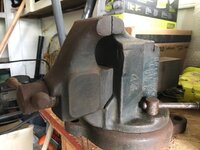
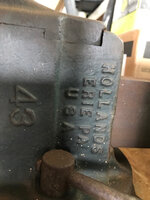
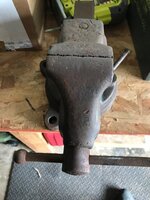
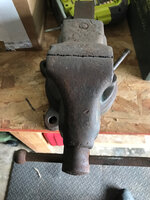
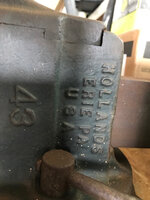
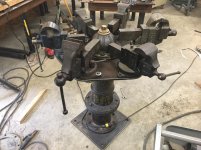
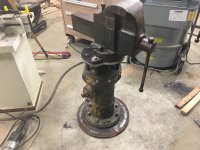
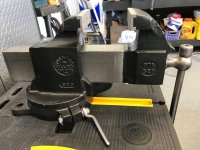
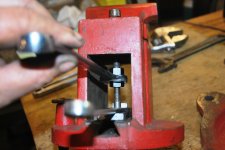
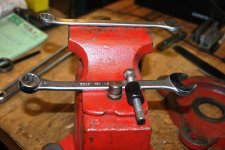
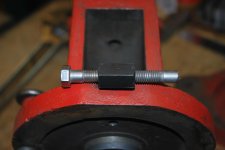
)Might have the opportunity to snag as many as 6 local fire hydrants for $25 each. Royce has built a couple really cool vise stands from hydrants, but I don't have those skills. Would anybody be interested?
(Note: I guess I'd have to figure out how to haul these things without a crane)
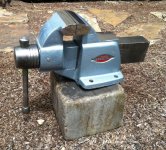
hydrant multi-vise stand

Suuuuuuuuuuuuuuuuuuuuck !
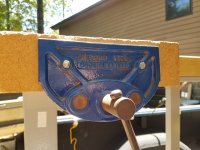
Finished up this Prentiss last week. I still need to take a crack at painting the lettering.
Worth Repeating!
Suuuuuuuuuuuuuuuuuuuuck !
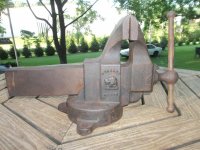
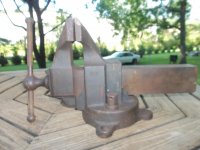
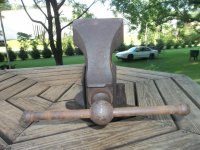
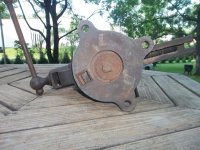
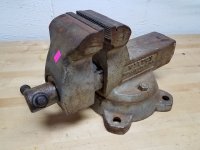
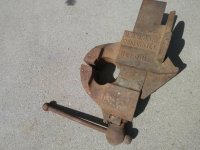
another one came in today for scrap. its pretty rusty but still seems to function ok. it don't appear to be cracked or broken anywhere. Morgan Chicago 140. hopefully the pics don't disappear like the last ones
![]()
![]()
![]()
![]()
![]()
Were most old USA made vises back in the day... the Rock Islands, Reeds, Wilburton, etc. made using drop forge alloy steel?

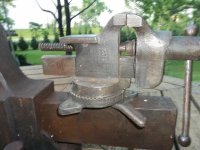
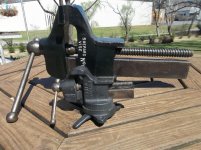
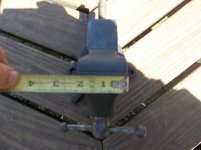
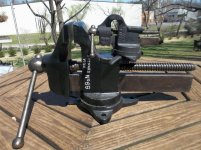
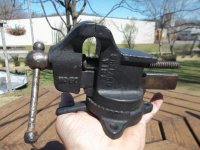
I acquired an antique jeweler's workbench this morning. This 2-inch vise with a swivel jaw was attached to it. No markings. Does anyone recognize it? Outlaw thinks it might be a Parker.
![]()
![]()
Honestly it does look welded to me and that's a common weak spot for all vise manufacturers.Do these look like broken and rewelded Parker vises? It is hard to tell from the marginal photos but it seems to look that way. If so, is this a common failure location on Parker vises?
If you mean with the hopes of revealing markings, drives, trust me, there are no markings on this vise. It's very clean. That patina you see is steel deep.I wouldn't ask you to remove any of that patina, but if you do and want to post pictures of the side of them that might help with the Parker ID.

Shiftless, Drives,
I already had the sliding jaw all the way off, and I inspected inside the slide shaft as well as I could without taking the base off the bench, which I am loathe to do. (I know, there should be no logical reason for it not going back on just fine with the same hardware etc, but I've been here before with other things and ruined them, so, I am hesitant to remove it right now.) I cleaned out the whole slide slot with a can of pressurized air and oil. There was no grime and no rust. The action on this thing was smooth as silk before I even did that. Anyway, I found a hole directly underneath the swivel jaw, where the knob is. Using a short arm hex key, I gingerly applied a little upwards pressure, with no effect.
You saw me say the jaw is moving, right? Slightly, but moving. I can rattle it in all directions by grabbing the jaw itself, or by grabbing the knob. I don't know how it could be rusted frozen but moving freely like that. It just won't lift more than a hair.
I guess I'll go try to find more info about the homemade tool on the Repair thread. What is the point of the tool? To clear an obstruction? Or just jostle the pin? Again, I am having a hard time understanding how the pin could be stuck if the jaw is rattling. But maybe I'm not understanding how the pin works.
I'll move this subject over there.