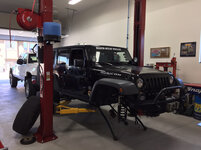
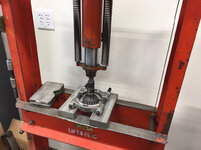
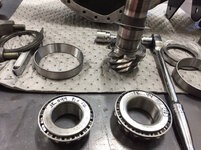
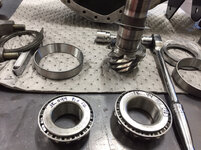
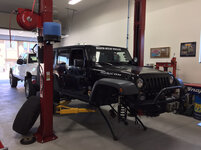
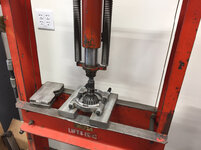
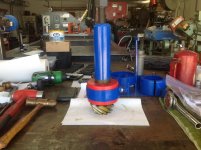
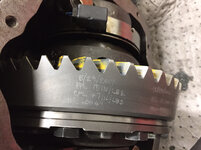
Few pictures from tonight's work. I was able to get the gears setup and ready for final assembly tomorrow night.
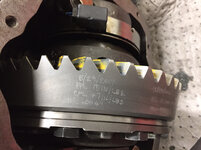
First attempt with same shims as my old housing. Pinion was a bit shallow.

Fifth time with drive and coast sides looking good. Ended up having to run about .005" more shims on pinion resulting in the pinion being deeper into the ring gear. I then adjusted the carrier shims to get my backlash to .007".

My notes.

Only took me five times together and apart adjusting shim thicknesses until I landed on the correct combination.
**Okay, on edit (now that I have some time) I will give a brief explanation/description of the procedure(s) that I use.
A couple of things to remember, first although a pinion depth tool is great to have, you can get just as good of results without it by using the tooth contact method. I have a nice pinion depth tool and find myself rarely using it.
I always try to shoot for pinion depth first then backlash before I worry about the "ideal" contact patch. What you want with pinion depth is to center the contact pattern between the face and root of the tooth, which would be top to bottom, rather than between the toe and heel. The face and root is what determines pinion depth. As you can see by my first picture above, the contact pattern is near the face, or top, of the tooth indicating that the pinion is too shallow and needs to be deeper towards the axle centerline.
When first setting up I use the OEM shim pack as a starting point. If I need to change, from there I will also make a large change (between approx. .010"-.015") and see where I land before going to small increments of .004"-.006" and less. This will help you determine where to start sneaking up on it. If you make a large change and still not centered then you will need to make more, if you make a large change and then go to the other extreme, at least you know you need to be somewhere in the middle and can then make smaller changes and sneak up on it.
Once pinion depth is reached then start dialing in the backlash which will take care of the toe to heel placement of the pattern. This is where experience comes into play on moving the ring gear side to side and knowing approx. how much it will change backlash readings. As a general rule I start with the formula that .010" in shim thickness one side or the other will change the backlash around .006"-.007" but each can be different.
One last note, when setting up used gears focus more on the coast side rather than the drive side for pattern. New gears I use both the drive and coast sides for references. Also keep in mind that the "ideal" pattern that you see in articles are hard (and in some instances impossible) to achieve so get your pinion depth set properly between the face and root most importantly then work on backlash which will center between toe and heel.
Lastly pinion bearing preload specifications. Each axle may have somewhat different spec's but as a general rule of thumb I use the specification of 15-18 in/lbs of rotating torque on new bearings and around 8-10 in/lbs. on used bearings. Carrier or side bearing preload is hard to measure on anything other than drop-in style carriers but must be tight enough to not have any slop side to side under heavy load or adverse wear and/or damage will occur. I insist on using a case spreader to spread the case a few thousandths then install the carrier with shims being snug then I know when I remove the case spreader the carrier preload is adequate. An OTC case spreader was one of the first major expense tools that I purchased about 25 years or so ago when I first started doing gear sets.
I hope this helps those of you who are contemplating tackling a gear installation.
Mike
Sent from my iPhone using Tapatalk