To avoid these ads, REGISTER NOW!

Show me your ANVIL

G-ManBart

Well-known member
Joined
Jan 24, 2015
Messages
2,059
Location
Michigan
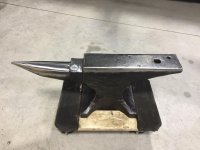
Scored two anvils this week!

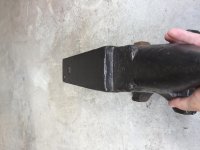
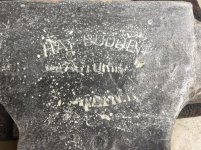
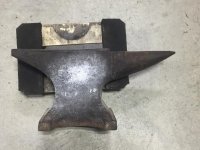
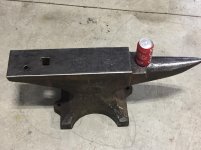
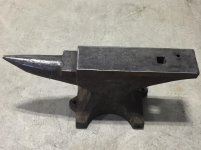
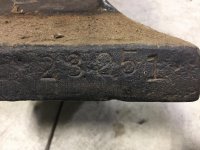
On the first one, the serial number is hard to read, but it's a pre-1900 Hay Budden that weighs 160lbs on the bathroom scale. The edges are nearly perfect...just one or two small chips, and the face is dead flat. It's got some minor pitting on the face, but it's very shallow. The ring is the loudest I've noted of the three H-B I've had so far, and the rebound is excellent. I managed to get it at a very reasonable price and it was only about 20 minutes from home, so it was a great deal in general. The guy selling it said it was his grandfather's anvil, but he has no use for it and his shop is pretty small, so space is at a premium.

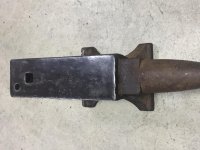
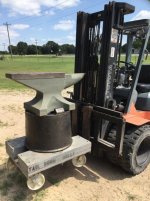
The second is a 200lb Fisher on a heavy steel stand. It was at an auction a few hours away, so I haven't picked up yet. I was lucky that a friend lives nearby, and he checked it over for me, gave me dimensions, etc. It came from a General Mills plant that shut down, and they were auctioning off everything. There's so much stuff the pickup window doesn't open for another week and it's open for a month! It appears to have 1886 cast in under the heel, and Fisher cast their dates in after 1880, so it makes sense....can't wait to see it in person and get some of the two coats of paint off it!

Here they are:
 

Attachments

  • IMG_4683.jpg
    IMG_4683.jpg
    145 KB · Views: 70
  • IMG_4684.jpg
    IMG_4684.jpg
    140.8 KB · Views: 47
  • IMG_4687.jpg
    IMG_4687.jpg
    150.3 KB · Views: 54
  • LOT1438-5.jpg
    LOT1438-5.jpg
    143.4 KB · Views: 75
Last edited:
To avoid these ads, REGISTER NOW!

G-ManBart

Well-known member
Joined
Jan 24, 2015
Messages
2,059
Location
Michigan
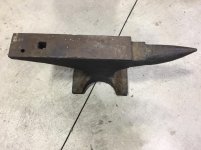
Make it three anvils this week....

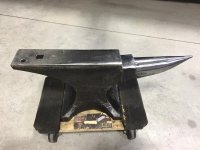
181lb Peter Wright that, if Anvils in America is correct, and I read it properly, puts this anvil between 1852 and 1860. It's got a little bit of sway, but not bad, and the edges are nearly pristine.
 

Attachments

  • IMG_4714.jpg
    IMG_4714.jpg
    144.5 KB · Views: 44
  • IMG_4712.jpg
    IMG_4712.jpg
    156 KB · Views: 44
  • IMG_4719.jpg
    IMG_4719.jpg
    143.1 KB · Views: 46
  • IMG_4716.jpg
    IMG_4716.jpg
    144.4 KB · Views: 40

sandman54

Well-known member
Joined
Jul 19, 2013
Messages
242
Location
Ft Worth Texas
Here are a Swedish, American, and a German anvil out of my collection. The Swedish and the American are on German bases. Sandman:rocker:
 

Attachments

  • 96.jpg
    96.jpg
    109.6 KB · Views: 131
  • 97.jpg
    97.jpg
    113 KB · Views: 116
  • 98.jpg
    98.jpg
    93.1 KB · Views: 105

sandman54

Well-known member
Joined
Jul 19, 2013
Messages
242
Location
Ft Worth Texas
Hello Trijeff, the horn less step is around 15th or early 16th century just a master piece. One of my favorites. glad u enjoyed Sandman
 

trijeff

Well-known member
Joined
Jan 21, 2015
Messages
1,359
Location
Northern Cali
Here's an oldie but a goddie Sandman ... 7-3/4" jaws 202# ... really wish I would have kept this one31faf0f5f9137844a7f8a8baceb2cac9.jpg
 

Attachments

  • 31faf0f5f9137844a7f8a8baceb2cac9.jpg
    31faf0f5f9137844a7f8a8baceb2cac9.jpg
    68.3 KB · Views: 5

G-ManBart

Well-known member
Joined
Jan 24, 2015
Messages
2,059
Location
Michigan
Hey where is everybody at? i am in withdrawel for some pics of anvils and leg vises!!! Sandman

I just got home with this minty 1939 Fisher that weighs 300lbs. It's not one of the monsters you've been posting, but it's super clean....dead flat and nearly perfect edges.
 

Attachments

  • IMG_4844.jpg
    IMG_4844.jpg
    136.6 KB · Views: 43
  • IMG_4843.jpg
    IMG_4843.jpg
    134.5 KB · Views: 42

Ggg

Well-known member
Joined
Mar 17, 2008
Messages
230
Location
N.W. IL.
A while back I came across this anvil that had a large chunk broken off the top. The missing chunk was approximately 1/4 of the surface area of the top, and fairly deep.
Fast forward a year or so, someone took the anvil to a grinding shop and had the top Blanchard ground down to remove the missing chunk making the top one flat surface again. I purchased the anvil hoping I could get it restored for use. I'm sure the amount that had to be ground off was close to 1/2" if my memory is correct.
My concern is that the surface is now down to soft material.
 

Attachments

  • IMG_4470.jpg
    IMG_4470.jpg
    146.7 KB · Views: 71
  • IMG_4471.jpg
    IMG_4471.jpg
    138 KB · Views: 65
Last edited:

trijeff

Well-known member
Joined
Jan 21, 2015
Messages
1,359
Location
Northern Cali
If it's truly 1/2" then my guess is the plate is gone ... since ground so finely, perhaps see if a local outfit will help you forge weld a new plate? Lot of effort and likely expense involved imo. Coming from a one anvil total rookie btw.
 

G-ManBart

Well-known member
Joined
Jan 24, 2015
Messages
2,059
Location
Michigan
A while back I came across this anvil that had a large chunk broken off the top. The missing chunk was approximately 1/4 of the surface area of the top, and fairly deep.
Fast forward a year or so, someone took the anvil to a grinding shop and had the top Blanchard ground down to remove the missing chunk making the top one flat surface again. I purchased the anvil hoping I could get it restored for use. I'm sure the amount that had to be ground off was close to 1/2" if my memory is correct.
My concern is that the surface is now down to soft material.

That is a very early Fisher anvil which has a cast iron body and a forge welded tool steel top plate. I'm pretty confident of that because of the shape, and the semi-circle cutout on the rear foot....I'm pretty sure only Fisher had that and it was only on their earlier anvils. The earliest Fishers didn't have the raised eagle logo, or the name cast into the foot, but going off the shape, and the rear cutout, that's almost certainly what you have.

Forge welding a new tool steel top plate to a cast iron body requires a lot of expertise, and I'm not sure anybody is doing that these days. I've seen some folks replacing top plates, but I think those were on wrought iron body anvils. The trick is that the two metals require different amounts of heat to forge weld, so they need to be brought up to temperature independently, then quickly forge welded by about five guys with sledge hammers and a flatter....hard work.

At 1/2" gone there probably isn't any of the tool steel left, but it's hard to say for sure. As suggested, a rebound test will give you an idea of how hard the face is now, but it sounds like even if the surface is hard, it won't be thick enough to withstand actual use.

If there are any active blacksmith groups in your area you might be able to inquire about hammer in days when they might have anvil repair offered....worth a shot.
 

Ggg

Well-known member
Joined
Mar 17, 2008
Messages
230
Location
N.W. IL.
What grade tool steel did they use? I would assume an air cooled one such as A2, or even D2.
Rebound test- how large of a ball bearing?
G-man thank you for the info on the mfg.
 
Last edited:

G-ManBart

Well-known member
Joined
Jan 24, 2015
Messages
2,059
Location
Michigan
What grade tool steel did they use? I would assume an air cooled one such as A2, or even D2.
Rebound test- how large of a ball bearing?
G-man thank you for the info on the mfg.

I have read that Fisher used W2 tool steel for their top plates and horns. That came from the head of the Fisher-Norris museum. It makes sense because water quenching was common practice for many/most anvil manufacturers. Many of the factories were along rivers for that very reason, and to provide power in the very early days.

I like a 1" ball bearing. Drop it from 10" and see how high it returns. 6" of rebound would be a low number and 9" a very high number.
 

sandman54

Well-known member
Joined
Jul 19, 2013
Messages
242
Location
Ft Worth Texas
Thanks for the pic of the large leg vise, i have a good time running them down they are getting harder to find and exspensive! thanks and have a nice day Trijeff Sandman
 

Lump

Well-known member
Joined
Mar 16, 2009
Messages
3,405
Location
Jamestown, Ohio
I am going to an auction near my home this weekend, and interested in all your opinions about a couple items there, which I plan to bid on. First is a Peter Wright anvil, 149 LBs.


FULL DISCLOSURE: I already have a Peter Wright, about the same weight, in great condition. It was left to me by my dad, and I will never sell it. But if this one goes for a reasonable price, I will grab it. The estate belonged to a friend of mine, who is now battling cancer, so it would be nice to have. But I don't want to overpay, when I don't really need it.

Second item I need your advice on is a post vise. I've bought and sold a lot of these things in the past, but I am struck by the amazing condition of this one. It looks better than any leg vise I can recall ever seeing. What are your opinions?


Paul in MN

Member
Joined
Oct 5, 2017
Messages
18
Location
Plymouth, Minnesota
Anvils are very useful tools. I belong to a blacksmith group and consider myself to be a novice. It is often accepted that the height of the top surface of the anvil is about even with your 1st knuckle of your hammering hand. Greater height reduces your hammer swing. Secondly, a good hardwood (like oak) "stump" is a better base than a fabricated metal stand. It gives stability to the anvil and adsorbs some of the ring. We reduce the ring even further by placing 2" to 3" diam ceramic magnets on the anvil body. The constant ringing damages your hearing. The top surface of most anvils can be damaged by heavy hitting on hard metal which is cold. The edge corners of the top are often chipped out when working with cold iron. A good anvil is made to be used with hot iron and will last for more than 100 years. A badly damaged anvil gains its second life as a boat anchor. To each their own....
 
To avoid these ads, REGISTER NOW!

Paul in MN

Member
Joined
Oct 5, 2017
Messages
18
Location
Plymouth, Minnesota
Anvils are very useful tools. I belong to a blacksmith group and consider myself to be a novice. It is often accepted that the height of the top surface of the anvil is about even with your 1st knuckle of your hammering hand. Greater height reduces your hammer swing. Secondly, a good hardwood (like oak) "stump" is a better base than a fabricated metal stand. It gives stability to the anvil and adsorbs some of the ring. We reduce the ring even further by placing 2" to 3" diam ceramic magnets on the anvil body. The constant ringing damages your hearing. The top surface of most anvils can be damaged by heavy hitting on hard metal which is cold. The edge corners of the top are often chipped out when working with cold iron. A good anvil is made to be used with hot iron and will last for more than 100 years. A badly damaged anvil gains its second life as a boat anchor. To each their own....
 

drivesitfar

Well-known member
Joined
Oct 23, 2013
Messages
36,006
Location
Pacific Northwest
LUMP: looks like your friend has/had some old very usable tools in his shop. you've already posted the 6 inch old Wilton Bullet and now this old Anvil. it's not in super shape, but far from the worst one i've seen either. as anvils go i'd buy up most any of them if they are not priced like gold cause they are like candy to the new blacksmith and steampunk crowd. i'm not a fan of the hoarders, but they have their purpose and are saving these old gems for future generations and providing some business for the companies that make new anvils.

it looks like this one has a weld across the mid section which i think Trenton anvils did, but you might want to get access to the ANVILS OF AMERICA book to maybe dig in to what other companies made their anvils that way if there are no markings on it. i like the 149 pound weight which is almost idea for most of us home hobbyists cause we can actually move it around.

Paul: nice post that looks almost like it was copied and pasted out of a book and just wondering who you intended it for or were you just stating some facts?

CAP:
i had to laugh and fully agree unless of course you need an anchor for your ROW BOAT.

cheers
 

G-ManBart

Well-known member
Joined
Jan 24, 2015
Messages
2,059
Location
Michigan
Secondly, a good hardwood (like oak) "stump" is a better base than a fabricated metal stand. It gives stability to the anvil and adsorbs some of the ring.

I'm a novice as well, but I don't like anvils on stumps anywhere near as much as on good fabricated metal stands.

I have two anvils on fabricated stands...one is a 130lb Kohlswa and the other is a 200lb Fisher. Both are far more stable than 130lb and 200lb anvils I've used on stumps.

The same is true of the blacksmith shop where I've been taking lessons. They have a few on stumps, and a few on fabricated stands, and those on fabricated stands are more stable....I've gone back and forth to compare.

The 130lb Kohlswa was fairly loud before I mounted it on the stand, and it's actually pretty quiet now. It's louder than the Fisher, but not much...and Fishers are quiet compared to anything but a Vulcan.

I sold the 300lb Fisher (a few posts back) to the shop where I'm taking lessons. They made a hybrid stand for it....large beam sections bolted together sitting on a steel plate, and short, steel legs. Even with a heavy sledge it stays rock solid. If it was on a stump I know it would be bouncing around somewhat.
 

Attachments

  • IMG_4870.jpg
    IMG_4870.jpg
    142.2 KB · Views: 72

G-ManBart

Well-known member
Joined
Jan 24, 2015
Messages
2,059
Location
Michigan
Scored a sweet 100lb Trenton (1917 production) that cleaned up nicely.
 

Attachments

  • IMG_4943.jpg
    IMG_4943.jpg
    140 KB · Views: 54
  • IMG_4941.jpg
    IMG_4941.jpg
    138.8 KB · Views: 48

Paul in MN

Member
Joined
Oct 5, 2017
Messages
18
Location
Plymouth, Minnesota
Drivesitfar,

Thanks for the complement on my writing style (or was it maybe too bookish?) Whatever... My bad, I thought I was responding to the first post in this 44 page thread, and I was confused by my lack of familiarity with this website (newbie!). I tried to eliminate (cancel) my post, but someone had already made a response to my boat anchor wise crack, so it wouldn't cancel. Hey, I never said that a bad anvil makes a good boat anchor, and I appreciate the response to my tongue-in-cheek suggestion. As to my reminder that a good anvil can be damaged, I'll stand by that statement. I have seen my own sons doing it to my anvil. Fortunately, I bought an already damaged anvil that I let the sons beat on when they need to beat on something. I have both coal and propane fired forges in the shop, but they just don't want to take the time to properly heat their work. My better anvil is a Trenton, similar to G-Man Bart's pictured anvil above this thread. His is just a lot prettier than mine.
 

drivesitfar

Well-known member
Joined
Oct 23, 2013
Messages
36,006
Location
Pacific Northwest
PAUL: no need to delete your post. we get a fair amount of spammers that like to cut and paste pages from books so just checking since you didn't address a name. once i saw you are a retired school teacher (I think that's what was in your profile) then i understood, but still didn't know who you meant it for.

just posting up good information is great so keep doing so as you wish. or if you'd like to use the Quote button that will bring up the post you are referring to or like i do i just put in a name or handle so i can multy-quote.

i agree with everything you said and figured the boat anchor was a bit of a joke.

WELCOME TO GJ and glad to have another good guy that wants to help teach the kids a thing or two while you are still learning more yourself. :bowdown:

GMAN: so do you like buying/owning anvils or vises or both?
 

Paul in MN

Member
Joined
Oct 5, 2017
Messages
18
Location
Plymouth, Minnesota
Drivesitfar,

Wow, you are quick to respond, and thanks for the encouragement. I thought in my original "anvil" post that I was responding to the many posts on page 1 of this thread. Later, I found those posts to have been made in 2009. So I am learning this system. I participate in "Yesterday's Tractors" forum, and it works by making a response to a posting by placing the response directly beneath that post. So I got fooled by 2 different systems. So I am learning (but at my age, the learning curve is pretty low, hugging the X axis). Thanks for being supportive.
 

drivesitfar

Well-known member
Joined
Oct 23, 2013
Messages
36,006
Location
Pacific Northwest
PAUL: I just happened to be online cause it's raining 2.5 inches here in the Seattle area today. yes it does rain here and a "BIG SURPRISE".

if you want a few tips the mods are very helpful or you can PM me with your questions or email address and i'll lend you a few to help you. i think i'm on about 4,000 threads and i can usually check to see if there is a new post i want to respond to by clicking on the CP in the black line just below GJ's logo at the top of the page.

post up a few pictures of your anvils if you might have any and a lot of the guys that think hitting cold steel on an anvil is ok need to hear more posts like yours about chipping off the edges.

cheers
 

Craptain

Well-known member
Joined
Apr 18, 2013
Messages
4,028
Location
Tampa Bay FL
Paul, my reply was also tongue in cheek. Hang around this forum long and you will see that a sense of humor, along with perhaps, a thick skin is advantageous. Welcome, and feel free to add to the knowledge base anytime. That after all is why most of us ended up here.

Sent from my SM-G930T using Tapatalk
 

G-ManBart

Well-known member
Joined
Jan 24, 2015
Messages
2,059
Location
Michigan
GMAN: so do you like buying/owning anvils or vises or both?

Both, but I'm not really a collector. I like fixing vises and using anvils. It's fun to find them and I've sold a few to help pay for the couple I'm keeping, but that's about it. I'm not a big fan of hoarding, and I'm not a big fan of people blindly flipping things, so I'm sort of walking a line in the middle.
 

G-ManBart

Well-known member
Joined
Jan 24, 2015
Messages
2,059
Location
Michigan
Picked up a 1915-1916 vintage 168# Arm & Hammer last night. It's got a bit of chipping in one section, but far enough back they won't be an issue. I'll dress those chips lightly, smooth and polish the horn a bit and she'll be ready to go back to work!
 

Attachments

  • IMG_4972.jpg
    IMG_4972.jpg
    144.7 KB · Views: 29
  • IMG_4974.jpg
    IMG_4974.jpg
    135.6 KB · Views: 31
  • IMG_4971.jpg
    IMG_4971.jpg
    145.8 KB · Views: 35
  • IMG_4973.jpg
    IMG_4973.jpg
    140.7 KB · Views: 35

Paul in MN

Member
Joined
Oct 5, 2017
Messages
18
Location
Plymouth, Minnesota
G-Man Bart,

That is a nice find!

I do have some questions about weight and possible repair of the chips.

I have some recollection about the weight being stamped with 3 numbers representing some weights in units different than pounds. Something about English (not US) system weight units. Is that used only on the anvils made in England, or is it much more universal?

Guys in our Blacksmithing Guild have been experimenting with repairing chipped edges with various welding techniques. I have not tried this yet, but may do so in the future. There is the idea that the anvil should be preheated (like in a wood fire) to about 400* and then welded with a 70 or 80 series wire or rod (maybe 7018). And then cooled slowly by being covered with vermiculite or maybe wood ashes. My only experience with preheating something large was working with 4140 2" X 6" cross section fork lift forks. I used a large propane weed burner type torch on the top end of that fork and heated at full blast for more than 45 minutes and got close to 400* (Infrared Thermometer). Point being that it took far more heat than I expected. Thus I'd expect preheating an anvil might take 2 to 6 hours of being in a wood fire (and then how do you lift such a heavy thing out of the fire to do the welding??).

Very few anvils are in perfect condition, so making repairs can be a worthwhile endeavor. If anyone can add their experiences to this thread, it might help others decide on whether repairing an abused anvil can be successful, or if it should be relegated to the poor quality row boat "anchor" pile .
 

Outlawmws

Well-known member
Joined
Aug 9, 2011
Messages
39,176
Location
The Badlands
G-man, the 168 number probably represents the english method:

1st character: Hudredweight or 112 lbs. 112 x 1 112
2nd character: tenths of a hundredweight 11.2 x 6 67.2
3rd character: Pounds 1 X 8 8

So I get 112+67+8 = 187 lbs?
 

G-ManBart

Well-known member
Joined
Jan 24, 2015
Messages
2,059
Location
Michigan
G-Man Bart,

That is a nice find!

I do have some questions about weight and possible repair of the chips.

I have some recollection about the weight being stamped with 3 numbers representing some weights in units different than pounds. Something about English (not US) system weight units. Is that used only on the anvils made in England, or is it much more universal?

Guys in our Blacksmithing Guild have been experimenting with repairing chipped edges with various welding techniques. I have not tried this yet, but may do so in the future. There is the idea that the anvil should be preheated (like in a wood fire) to about 400* and then welded with a 70 or 80 series wire or rod (maybe 7018). And then cooled slowly by being covered with vermiculite or maybe wood ashes. My only experience with preheating something large was working with 4140 2" X 6" cross section fork lift forks. I used a large propane weed burner type torch on the top end of that fork and heated at full blast for more than 45 minutes and got close to 400* (Infrared Thermometer). Point being that it took far more heat than I expected. Thus I'd expect preheating an anvil might take 2 to 6 hours of being in a wood fire (and then how do you lift such a heavy thing out of the fire to do the welding??).

Very few anvils are in perfect condition, so making repairs can be a worthwhile endeavor. If anyone can add their experiences to this thread, it might help others decide on whether repairing an abused anvil can be successful, or if it should be relegated to the poor quality row boat "anchor" pile .

Hey Paul,

Only anvils of British origin use the system you're referring to, which is called the hundredweight system. 1 hundredweight is 112lbs. So, when you look at the three digits, you multiply the first digit by 112lbs. The next digit is one quarter hundredweight (28lbs). This number will never be higher than three because four would increase the first digit by one. The last digit is straight pounds.

I have a 305lb Peter Wright which is marked 2 - 2 - 25, so it works out to be 224+56+25 = 305.

All American anvils that I'm aware of used straight pounds although I believe some anvils made overseas for American anvil brands early on might have had hundredweight markings.

The following are general guidelines: Fisher and Vulcan frequently shortened the weight by one digit, so 15 would be 150lbs or 20 would be 200lbs. Fisher put the weight on the right front foot. Vulcan put it on the rear foot under the horn. They could work in predictable increments because casting the body was much more consistent than forging the body (no two were identical). Hay-Budden and Arm & Hammer normally put the weight under the logo which was on the side facing you with the horn pointed to the right. Trenton put the weight on the front foot to the left of the serial number. There were other brands like Columbian (no weight that I've seen on them) and American (weight under the logo) but they aren't common at all.

Anvil repair is a hot topic with many blacksmithing enthusiasts and seems to be one way to start an argument very quickly! I've used an anvil that had the edges built up with a welder and then ground smooth...it seemed to work fine, had good rebound, and has lasted for years this way. I'm not sure what rod was used, but I have seen mention of "anvil facing rod" that might be made by Eutectic as a hard facing rod for various applications. On the flip side, I've seen people say hard facing rod isn't the right choice as it will be too hard and just chip again. Needless to say, I'm barely knowledgeable, much less an expert.

I honestly think that with the right filler rod, TIG might be the best choice for building up chips that are big enough they need to be repaired. You can keep the heat limited almost entirely to the steel plate, and have less chance of annealing the rest of the face, or softening the weld between the face and the body. It would be a slow process, but slow is okay if it works well.

More often than not, dressing a chip to remove the sharp edges and simply working around it is probably the best way to go...but the idea of perfect edges is hard to ignore :D
 

G-ManBart

Well-known member
Joined
Jan 24, 2015
Messages
2,059
Location
Michigan
G-man, the 168 number probably represents the english method:

1st character: Hudredweight or 112 lbs. 112 x 1 112
2nd character: tenths of a hundredweight 11.2 x 6 67.2
3rd character: Pounds 1 X 8 8

So I get 112+67+8 = 187 lbs?

As I said in the previous post, Arm & Hammer, and all the other U.S. anvil manufactures I'm aware of used straight pounds. Also, in the hundredweight system the second digit is 1/4 hundredweight, which equals 28lbs. That digit will never be higher than 3 because 4 would mean the first digit should be one higher.
 

Black Frog

Well-known member
Joined
Sep 27, 2011
Messages
134
Nice find G-Man. Along with Trenton logo stamp and serial #'s, I've also been tracking A&H's since they too switched their logo stamp styles several times during their production. Yours is the 4th style of stamp that they used.
 

Paul in MN

Member
Joined
Oct 5, 2017
Messages
18
Location
Plymouth, Minnesota
G-Man,

Thanks for the information. Now I am just a little bit smarter, but maybe I lose more each day than I gain?? (Just ask my wife....)

My better anvil is a Trenton, I'll look for the numbers on it. I suspect that it is somewhere near 85 lbs. It was formerly in a school shop and shows signs of abuse from its first life. But when I bought it, I only paid $35... one of the best $35 I have ever spent.

How's this for tragic stupidity? An older shop at the Univ of MN was being closed out, and the pencil pushing bean counters decided that there was no need to salvage (or sell) approx 20 anvils that had been at student work stations, as that part of the curriculum had long faded from the course offerings. They were tossed into a dumpster. My son was witness to this idiocy. He later became manager of that shop.
 

Dragfluid

ALLIANCE MEMBER
Joined
Sep 15, 2013
Messages
17,513
Location
Pillager, MN
G-Man,

Thanks for the information. Now I am just a little bit smarter, but maybe I lose more each day than I gain?? (Just ask my wife....)

My better anvil is a Trenton, I'll look for the numbers on it. I suspect that it is somewhere near 85 lbs. It was formerly in a school shop and shows signs of abuse from its first life. But when I bought it, I only paid $35... one of the best $35 I have ever spent.

How's this for tragic stupidity? An older shop at the Univ of MN was being closed out, and the pencil pushing bean counters decided that there was no need to salvage (or sell) approx 20 anvils that had been at student work stations, as that part of the curriculum had long faded from the course offerings. They were tossed into a dumpster. My son was witness to this idiocy. He later became manager of that shop.

OMG!
Our tax dollars hardly at work.:wtf::wtf:
 
To avoid these ads, REGISTER NOW!
Top Bottom