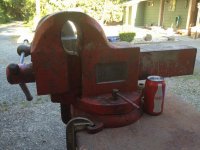
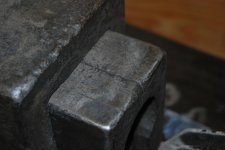
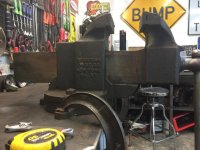
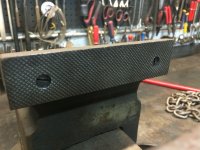
It is my opinion when Prentiss and Reeds are cast the molten material meets at the center of the square slider causing what we call in Plastic Injection Molding a knit line. The material has a cold spot and does not mix like it should. That is why in my opinion you see splits in this area, pounding on it only helps in releasing the stresses. The Parker split because the steel bars were cast in to close to the top surface. Rileysan can comment on this because this is what he does. In Plastic Injection Molding the gate location ( Where the mold is filled) is very important because of this issue.
My employer doesn't cast anything in gray iron - we cast chrome iron, steel, and manganese alloy steel. I am not a metallurgist (though I work with, and share my office with one), I am a foundry sand & molding expert.
What I know about gray iron is taken from AFS (American Foundry Society) cast metal defects classes I have taken over the years so can only speculate why that area of a slide is has a tendency to crack.
The idea of a knit line isn't a bad thought. In metal casting, we would call it a fold. Very much like taffy being gently folded together, but not mixing.
Gray iron is "very fluid" compared to other ferrous alloys, and can be poured well above freezing temperature without affecting the grain structure. Gray iron also remains "liquidus" longer than any other ferrous alloy and is notorious for finding weak spots in a mold and running out before it freezes.
The most likely orientation of the dynamic jaw in a mold would be exactly as it sits assembled on your bench, meaning the top of the dynamic jaw would be the last spot to receive metal since molds are designed to be filled from the bottom up.
Here's a common design: Pouring cup on top. Sprue fills a runner that feeds gates into the part being poured.

If the liquid were freezing off too soon, the top of the jaw would be incomplete or full of voids. All this is to basically say that it is highly unlikely for a knit line to take place.
I think there are two possible things that could contribute to this problem. The first takes place in the the hollow of the slide.
Dynamic jaws and slides are not cast as a solid piece, then machined. The void in the center of a slide comes from a sand "core" that is placed in the mold. A core is used to reduce the amount of metal needed to fill a mold and to reduce the amount of machining that is needed to finish a product. This is called "yield" - the ratio between the weight of metal melted vs the weight of the finished product. It is a very important cost saving metric.
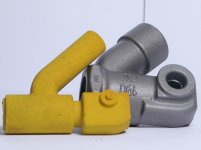
One of the most common casting defects within a casting happens when a core is made from inferior materials, the sand recipe is mixed incorrectly, or both.
All foundry sand will experience "thermal expansion". Silica sand, the most commonly used foundry sand, can expand up to 2% when heated. To counteract thermal expansion, additives are mixed in with the sand that will burn off when the molten metal is added to the mold - allowing the core sand to expand without fracturing the casting. If the ratio is wrong (it's easy to do with automated mixing systems), the end result will look something like this picture of Chris Farley.
Knowing what goes into carbon testing of molding sand, I wouldn't be the least bit surprised if this was the culprit. In fact, I would bet on it. The technology used to test for carbonaceous material in sand has changed dramatically in the past 20 years (meaning: it's a hell of a lot easier than is used to be). Thermal expansion of a core could easily create micro-fractures in the slide which would be extremely difficult to detect. This scenario seems the most plausible to me.
The other potential issue has to do with the alloy content of the metal, but since I'm not a metallurgist, I can't talk intelligently about the topic, so I'll leave that alone.
Hope this sheds some light on the topic!
Brian


 versa) both of which are in excellent shape is a reasonable and equitable trade?
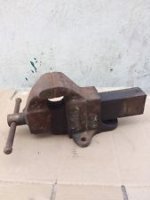
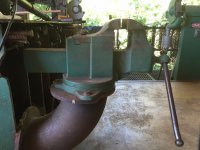











 , but no cracks.