To avoid these ads, REGISTER NOW!

Old compressor tank - hydro or not?

sberry

Banned
Joined
Jun 18, 2005
Messages
35,747
Location
Brethren, Michigan
So yours rusted thru in 30 years with daily draining. Mine is 45 and drained occasionally, how long should it last? I was gone a couple times, I think it had 5 gallons in it. Several times a gallon. Some of them had a dip tube which was basically a valve with internal hose that laid on the bottom, they never would get the water out and froze off in the winter. The plus was there wasn't water in a sump which could freeze pipe.
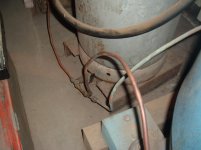
I drain more if we are running them a lot, can go a month or more without it too. I only had to make one flare, found ready made used tubing to plumb 3 vessels to a common line thru the wall.
 

Attachments

  • comp drain.jpg
    comp drain.jpg
    136.7 KB · Views: 27
To avoid these ads, REGISTER NOW!

lakeroadster

Well-known member
Joined
Jan 19, 2015
Messages
5,166
Location
Central Colorado
how long should it last? .

Location, usage, maintenance.

Mojave desert pretty dry air

These places.... not so dry.... Average relative humidity (%) for the most humid cities

City.................. Humidity
New Orleans, Louisiana 75.9
Jacksonville, Florida 75.8
Houston, Texas 74.7
Orlando, Florida 74.1
Tampa, Florida 74.1
San Francisco, California 73.7
Seattle, Washington 73.3
Miami, Florida 73.2
Portland, Oregon 73.2
Rochester, New York 72.6
 

lakeroadster

Well-known member
Joined
Jan 19, 2015
Messages
5,166
Location
Central Colorado
Jeez, with the kind of fear and death talked about in this thread, i'm amazed anyone will dare to have an air compressor.

It can't be that common to have a catastrophic failure. I haven't ever met or talked to anyone who had one.

A quick scan of the mlive.com (website search for all michigan newspapers) shows ZERO stories about tank explosions. It goes back quite a few years.

Perhaps the thread title drew mainly those with tank explosion experience?

Not trying to belittle anyone here, and i certainly fully understand the stored energy of the tank, but i don't think it's that common.

What i was really looking for was some data points on other's experiences and how likely a problem would be.

Consensus in this thread seems to indicate put my coffee down, back away slowly from the tank and call the bomb squad (said in jest).

It's serious.. deadly serious.
https://sites.google.com/site/metropolitanforensics/cause-of-explosion-of-air-compressor-tanks

If your not willing to spend the coin to get a thickness meter (rent or purchase) and inspect the thickness of the shell, or if you feel you aren't qualified to do such an inspection (a man needs to know his limitations) you should throw the tank away and buy a new ASME tank

Doing a hydrotest still doesn't tell you if that tank is safe to use, it merely tells you it will hold pressure. It could still be corroded such that once you put it in service it could fail.

This fellas air tank worked great, held pressure, no issues at all, right up until it exploded.....

 
Last edited:
OP
8

86turbodsl

Well-known member
Joined
Jul 1, 2005
Messages
6,556
Location
Michigan
It's serious.. deadly serious.
https://sites.google.com/site/metropolitanforensics/cause-of-explosion-of-air-compressor-tanks

If your not willing to spend the coin to get a thickness meter (rent or purchase) and inspect the thickness of the shell, or if you feel you aren't qualified to do such an inspection (a man needs to know his limitations) you should throw the tank away and buy a new ASME tank

Doing a hydrotest still doesn't tell you if that tank is safe to use, it merely tells you it will hold pressure. It could still be corroded such that once you put it in service it could fail.

This fellas air tank worked great, held pressure, no issues at all, right up until it exploded.....

By this logic, all used compressors are bombs. Thank you for your advice, but i'm not going to condemn the tank nor pay $750 for a professional test, nor purchase a brand new tank unless i find evidence of imminent failure. I'll do the proof test, recondition if passed, probably convert to vertical mount and put it out in the lean-to. Statistically i'm much more likely to be hit by lightning than be right next to a tank that explodes.

Sent from my SM-N910T using Tapatalk
 

lakeroadster

Well-known member
Joined
Jan 19, 2015
Messages
5,166
Location
Central Colorado
By this logic, all used compressors are bombs.

They are all bombs, new ones to. Just a matter of how it is maintained and used as to if it will ever explode. That's why the tanks are built to the ASME code.

The thing about these kind of questions asked in a forum such as this is... none of us know you. You could be a guy that has zero experience with mechanical things, or you could be McGyver.

If you follow the

Hook it up and run it.

crowd and you or your family members get hurt, we've done you a dis-service.

If you buy a tank new, you know it's history. If you buy it used, you have no idea.

To not perform the due diligence on a used tank to verify it's integrity is dangerous and a gamble. But as long as you know that it is dangerous and a gamble... you are informed.

I'd rather have you pissed off at lakeroadster, than wondering why nobody showed you just how dangerous the tank "could" be.

Be safe out there... and Happy Trails.
 
Last edited:
OP
8

86turbodsl

Well-known member
Joined
Jul 1, 2005
Messages
6,556
Location
Michigan
They are all bombs, new ones to. Just a matter of how it is maintained and used as to if it will ever explode. That's why the tanks are built to the ASME code.

The thing about these kind of questions asked in a forum such as this is... none of us know you. You could be a guy that has zero experience with mechanical things, or you could be McGyver.

If you follow the


crowd and you or your family members get hurt, we've done you a dis-service.

If you buy a tank new, you know it's history. If you buy it used, you have no idea.

To not perform the due diligence on a used tank to verify it's integrity is dangerous and a gamble. But as long as you know that it is dangerous and a gamble... you are informed.

I'd rather have you pissed off at lakeroadster, than wondering why nobody showed you just how dangerous the tank "could" be.

Be safe out there... and Happy Trails.
I'm pretty informed. More MacGyver than clueless here. I also looked at statistics. It's just not that common. Thanks for taking the time to discuss though. If it helps one person avoid shrapnel then it's been worth the discussion.

Cheers.

Sent from my SM-N910T using Tapatalk
 

Fixin'Stuff

Well-known member
Joined
Jun 14, 2016
Messages
584
Location
HotterNHellHouston
This fellas air tank worked great, held pressure, no issues at all, right up until it exploded.....


Look closely at that pic. That fella had years of warning that his tank was past End Of Life. All of that rust on the outside of the tank didn't happen overnight. :dunno: It was thinning from both sides. :(
 

Strouty

Well-known member
Joined
Mar 21, 2010
Messages
38,215
Location
Southern Maine
The ASME tanks were built butter than the cheap ones. If any tank has had water in it it will rust. No one can say what the safety margin is for thickness, so even measuring it is not a true answer. I don't think anyone that has the knowledge and authority to say that any old tank is OK ever would say it. At least not without being paid to do extensive testing. There are lots of things in the shop that can kill us, one thing about that picture is the tank is obviously junk, it has pitted rust on the outside of the tank and it is home owner grade.
 

lakeroadster

Well-known member
Joined
Jan 19, 2015
Messages
5,166
Location
Central Colorado
...
No one can say what the safety margin is for thickness, so even measuring it is not a true answer.

I don't think anyone that has the knowledge and authority to say that any old tank is OK ever would say it. At least not without being paid to do extensive testing.

The most important thing to remember is that most tank explosions do not occur at normal working pressures. People have faulty pressure relief valves or none at all

.....

Strouty... what are you basing your comments on? Have any experience to back up your comments.

Usability and life estimation studies are done every day for pressure vessels and pressure piping, in industry.

Some folks make a living doing just that.

It's expensive, mostly, due to liability. The nuts and bolts of it consists of a visual inspection to look for corrosion, and thickness meters to record thicknesses. On smaller vessels often bore scopes are used.

None of these instruments are that expensive in the overall scheme of personal safety.

Recorded data is compared to the design minimum required thicknesses.

Once the vessel thicknesses are deemed acceptable and it has passed the visual inspection the vessel is typically hydrotested.

The problem here is replacement ASME air receiver tanks are available at a price point that is so low that no company wants to accept liability to inspect the tank.. it's just not cost effective.
 

Strouty

Well-known member
Joined
Mar 21, 2010
Messages
38,215
Location
Southern Maine
But no one will say that if a tank has lost x amount of thickness it is still safe, they just say my lawyer/insurance agent say not to talk, so buy a new tank. If someone could truly say that a tank is safe with a 20% reduction in thickness or whatever is realistic, I would be interested to listen to them, but I am afraid no one is going to say anything more than it doesn't meet the spec on the tag. I don't think you can find many air compressor tanks that will stay the same thickness over time.
 

lakeroadster

Well-known member
Joined
Jan 19, 2015
Messages
5,166
Location
Central Colorado
I don't think you can find many air compressor tanks that will stay the same thickness over time.

The numbers stamped on the tank data plate, those are calculated minimums, not what the tank was built out of when it was new. And newer vessels... they don't even have thicknesses on the data plate.

So if you did a thickness test when the tank was new it will be thicker than that.....

The usable life studies that I did when I was working looked at the "as-built" thickness, the actual "recorded" thickness during an in-process inspection, and then predicted how much longer the tank would last and still meet ASME specifications.

Typically what would be done if any of the vessel materials have dropped below the min. required thickness, the vessel would be de-rated and the MAWP would be lowered.

Some of these vessels we built had as much as a 0.68 corrosion allowance (that's 11/16", not 1/16") and were over 1-1/4" thick when they were new. The customers used the usable life study to schedule ordering new vessels.

For general discussion, ASME has a safety factor that is about 3:1.

I worked at a place that built parts for aerospace that had a safety factor of 1.1.

But you can't say an ASME 100 PSI MAWP vessel, with a 3:1 safety factor, is good for 300 PSI MAWP.

I was always of the opinion that an air receiver, made of carbon steel, that had no designed in corrosion allowance, was a bad design.

But it's a dog-eat-dog world for manufacturers, and most customers don't specify a corrosion allowance on an air receiver, nor do they want to pay the additional cost.
 
Last edited:

Strouty

Well-known member
Joined
Mar 21, 2010
Messages
38,215
Location
Southern Maine
See, I did not encounter that at all. I can measure my "old" tank, the parts that still have paint on them on both inside and outside and they were exactly what the tank tag stated on both sections.
 

Strouty

Well-known member
Joined
Mar 21, 2010
Messages
38,215
Location
Southern Maine
To be fair, the shell is listed as .228 and I got readings as high as .231 but that would be the paint thickness. My worst location was 0.198 I am looking for a better tank, but I also cut the pressure back to 145 to give myself a safety factor on top of the safety factor.
 

lakeroadster

Well-known member
Joined
Jan 19, 2015
Messages
5,166
Location
Central Colorado
My certified UTG.

That's interesting. Got a photo of the vessel nameplate by chance?

The UTT meter shouldn't pick up the paint?

Did you calibrate the meter on some similar gage steel materials before you used it?

Were the low areas isolated to one very small area?
 
Last edited:
OP
8

86turbodsl

Well-known member
Joined
Jul 1, 2005
Messages
6,556
Location
Michigan
Well ****. I plugged all holes, installed a 400psi Gauge, filled the tank with water and a grease zert in the top of the standpipe and pumped grease in until it wouldn't pump anymore and the gauge never budged. I am flummoxed. No leaks either.

Sent from my SM-N910T using Tapatalk
 
To avoid these ads, REGISTER NOW!

Strouty

Well-known member
Joined
Mar 21, 2010
Messages
38,215
Location
Southern Maine
Here is the tag, I was also wrong, there was no paint on the inside. The thin part was on the bottom between the middle drain plug and weld for the head.

23b6a30376252331ff0f0318435d2249.jpg
 

Attachments

  • 23b6a30376252331ff0f0318435d2249.jpg
    23b6a30376252331ff0f0318435d2249.jpg
    578.3 KB · Views: 1

lakeroadster

Well-known member
Joined
Jan 19, 2015
Messages
5,166
Location
Central Colorado
Well ****. I plugged all holes, installed a 400psi Gauge, filled the tank with water and a grease zert in the top of the standpipe and pumped grease in until it wouldn't pump anymore and the gauge never budged. I am flummoxed. No leaks either.

Sent from my SM-N910T using Tapatalk

Are you sure you purged all the air from the tank and the grease gun? You likely still have some air somewhere in the system.

Are you using a gauge rated for air or water service?
 
Last edited:
OP
8

86turbodsl

Well-known member
Joined
Jul 1, 2005
Messages
6,556
Location
Michigan
I'm using a gauge from tractor supply in the sprayer dept. I installed the gage, filled the tank, capped the opening and filled with grease. it got so hard to pump i couldn't really move the handle anymore. Pressure of the water and the air should equalize correct? Gauge never moved.

Are you sure you purged all the air from the tank and the grease gun? You likely still have some air somewhere in the system.

Are you using a gauge rated for air or water service?
I'm using a gauge from tractor supply in the sprayer dept. I installed the gage, filled the tank, capped the opening and filled with grease. it got so hard to pump i couldn't really move the handle anymore. Pressure of the water and the air should equalize correct? Gauge never moved.

145f2cef31a5537eb2f32cc7f611e7f0.jpg

Sent from my SM-N910T using Tapatalk
 

Attachments

  • 145f2cef31a5537eb2f32cc7f611e7f0.jpg
    145f2cef31a5537eb2f32cc7f611e7f0.jpg
    104 KB · Views: 1
OP
8

86turbodsl

Well-known member
Joined
Jul 1, 2005
Messages
6,556
Location
Michigan
I will have to measure it.

86, can you move the gauge lower, then put a vertical pipe where the gauge is? Then pour water in until it comes out the other pipe, that should purge all the air.
Yeah, that was probably my next move, raise the gage.

Sent from my SM-N910T using Tapatalk
 

davejo

Well-known member
Joined
Oct 29, 2015
Messages
277
Location
(VA)
Only 3 possibilities i can see

greasegun not getting grease past the zerk

zerk and pressure gauge not located in a common chamber

defective gauge

presence of air should have no effect, i think there will always be a tiny column of air in that vertical pressure gauge
 
OP
8

86turbodsl

Well-known member
Joined
Jul 1, 2005
Messages
6,556
Location
Michigan
Only 3 possibilities i can see

greasegun not getting grease past the zerk

zerk and pressure gauge not located in a common chamber

defective gauge

presence of air should have no effect, i think there will always be a tiny column of air in that vertical pressure gauge
I know 1 and 2 are not correct. I took the cap off and found grease inside the standpipe. I didn't think air would be a problem unless it's some sort of special gage that won't read air, but that wouldn't make any sense would it? Defective gage?

Sent from my SM-N910T using Tapatalk
 

Strouty

Well-known member
Joined
Mar 21, 2010
Messages
38,215
Location
Southern Maine
Yeah, that was probably my next move, raise the gage.

Sent from my SM-N910T using Tapatalk

I meant lower the gauge, then add another tube where the gauge is so when filling the tank you are getting water well above the top of the tank, that way it should burp and clear out any air.
 

lakeroadster

Well-known member
Joined
Jan 19, 2015
Messages
5,166
Location
Central Colorado
Always use two gauges, redundancy is good.

Arrangement similar to this so you can vent air from tank and vent air from the piping at the gauges.

Never exceed the vessel MAWP. Are you using fittings, valves, etc. rated for the vessels MAWP?

Do you have a valve in place to relieve the pressure after the test?

 
Last edited:

davejo

Well-known member
Joined
Oct 29, 2015
Messages
277
Location
(VA)
Air trapped somewhere would only increase the amount of pumped grease needed to reach a certain psi. It wouldnt cause the grease gun to become difficult to pump. There is a blockage somewhere between the grease pump piston and the pressure gauge needle.

Or the grease pump handle bearings are seized and need greasing:)
 
OP
8

86turbodsl

Well-known member
Joined
Jul 1, 2005
Messages
6,556
Location
Michigan
Always use two gauges, redundancy is good.

Arrangement similar to this so you can vent air from tank and vent air from the piping at the gauges.

Never exceed the vessel MAWP. Are you using fittings, valves, etc. rated for the vessels MAWP?

Do you have a valve in place to relieve the pressure after the test?

Ok, i'll modify my plumbing a bit. All my fittings and valve are 600psi rated. Ihave a 3/4" ball valve on the bottom as outlet. Brass 600WOG. Sound like i need to work on venting and add a gage. Then maybe my grease gun. It's very old.

Sent from my SM-N910T using Tapatalk
 

dkmc

Well-known member
Joined
Jan 20, 2008
Messages
949
Location
NYS--Upstate in the corn fields
So the UT gauge came in the mail today.
It didn't come with the 'coupling gel' which is a bit confusing as some of
them do and some don't. Plus the picture on EBAY did show the bottle, but the description only listed the Meter, Transducer, and Manual.

No problem, I used hand sanitizer which contains Aloe and Glycerin
Manual says Oil, Grease, Glycerin, etc.

Here are the results of some preliminary tests...
I used steel Gauge Blocks that are accurate in size to +/- 50 Millionths.
Overkill I'm sure!

In inch mode:
Block Reading
.141 .144
.400 .404
1.00 1.002
2.00 2.006

In MM mode:
Block Reading
.118 3.0mm
.400 10.2mm

I'm not surprised it's seems more accurate in MM mode. There's probably a conversion that rounds the results in one of the chips.....er....whatever happens in the 'lectronics.
This unit has a lower range limit of 1MM which probably won't be an issue
for Receiver tank testing. None of the tanks is thinner than .135.
I will do some additional tests on thinner sheet steel, and on curved pieces before I actually test a tank.
 

MagKarl

Well-known member
Joined
Oct 15, 2012
Messages
684
Location
Olympia, WA
It doesn't matter if you have air in the system, you're just trying to minimize the compressible portion.

Is there a vent or plug on your guage? Make sure the guage is working on another setup.

Try your grease gun on a u-joint.
 
OP
8

86turbodsl

Well-known member
Joined
Jul 1, 2005
Messages
6,556
Location
Michigan
It doesn't matter if you have air in the system, you're just trying to minimize the compressible portion.

Is there a vent or plug on your guage? Make sure the guage is working on another setup.

Try your grease gun on a u-joint.
Ok I need additional suggestions for putting pressure into the tank. I put a air fitting on the tank and got 125 psi into it no problem. Then tried the grease gun again and all it did was blow the grease zert in half. I don't know what the issue is, but it's clearly not working. And I can't find anybody with a pressure washer either.

Sent from my SM-N910T using Tapatalk
 

davejo

Well-known member
Joined
Oct 29, 2015
Messages
277
Location
(VA)
Is there a check valve at the bottom of that vertical pipe into which you are pumping grease? It could be blocked. please confirm that when you pour water into the vertical pipe, it exits the tank at the orifice where you show your pressure gauge mounted.
 
OP
8

86turbodsl

Well-known member
Joined
Jul 1, 2005
Messages
6,556
Location
Michigan
Is there a check valve at the bottom of that vertical pipe into which you are pumping grease? It could be blocked. please confirm that when you pour water into the vertical pipe, it exits the tank at the orifice where you show your pressure gauge mounted.
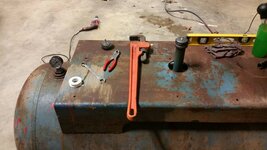
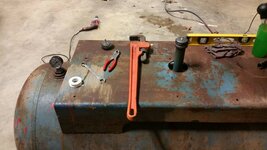
There's no check valve. That vertical stand pipe with the cap on it has a little plate welded to the bottom of it, but tacked only, and it's open enough to allow water to equalize. i verified that water comes out the gage stand pipe. That picture is a little old, i added a standpipe, valve, tee and the heights match on the gage side. When i added water to the standpipe, then opened the valve, water height equalized. Then i swapped the air fitting onto the ball valve and pressurized the tank to 125, and noted my gage worked fine. I verified grease was being pumped into the standpipe, but it gets too hard to pump and the gage never goes up. So i don't know what's going on. I'm looking to purchase a pressure washer now and just go that route. I did try an open standpipe one time with the grease gun as well, and got the same result but now i have grease floaters in the tank and it's not what i wanted, so i'm not going to do that again. The small plate welded to the bottom was to prevent grease migration as much as possible and contain the mess to the pipe.

Sent from my SM-N910T using Tapatalk
 
To avoid these ads, REGISTER NOW!
Top Bottom