To avoid these ads, REGISTER NOW!

Generator to back feed house from garage

theoldwizard1

Well-known member
Joined
Feb 22, 2011
Messages
43,202
Location
SE MI
Can I have a 2nd 60 amp breaker in my main panel connected to the same 4-wire feed but locked off with a disconnect and add a power inlet port in the garage?
Not with the same 4 wire feed, which is why said :
... add 4 more (additional) appropriately sized wires to the conduit from the house to the garage and wire them into a generator interlock breaker kit in your main panel.

Simply put, I know of no way to do a mechanical switch/interlock that would be safe using the same set of wires to send power to a garage when the POCO is supplying power and in the opposite when the generator is running.. It is theoretically possible with relays/contactors, but I doubt it would ever be approved.
 
To avoid these ads, REGISTER NOW!

theoldwizard1

Well-known member
Joined
Feb 22, 2011
Messages
43,202
Location
SE MI
I have a GE Powermark Gold main panel. Top left breaker is the 60 amp that feeds out to the garage. If I have a breaker added to the top right I can use an interlock and feed it through the outside wall to a connection box. Then an extension cord to the generator at the garage.

100% correct !
 

yeldogt

Well-known member
Joined
Jan 2, 2012
Messages
18,184
More like $1000 correct though.

If you did secondary panel -- it would not be that much. Small load center and exterior connection could not be more than $250 -- plus the 10g extension cord ?? another $!00?

That's why people do the transfer switch between the meter and the main -- often outside. The whole panel is switched over and the line to the generator is connected there. There is no lockout.

I believe with a manual transfer switch code allows you to do what you want as far as generator size. They figure you are smart enough to also manage the load when switching over. With an auto transfer doing the whole house you have to size the generator to the full load of the house or use load shedding.
 

Alchymist

Well-known member
Joined
Mar 1, 2009
Messages
4,423
Location
Central PA
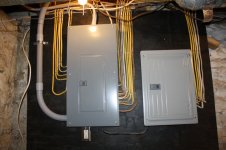
Pic of my install - done when I put the new service panel in. Only additional cost was that of the Reliance panel, and the #10-3 w/g to the inlet box (not installed in this picture).

http://www.reliancecontrols.com/ProductDetail.aspx?TRC1006D

Reliance panel takes the same breakers as the Square D main panel, and is fed from a 60 amp breaker in the main panel. Breakers in the Reliance panel power only the necessary circuits needed during gen power.
 

Attachments

  • ElectPanel.jpg
    ElectPanel.jpg
    66.5 KB · Views: 65

Hpozzuoli

Well-known member
Joined
Dec 11, 2013
Messages
3,428
Location
Rhode Island
Aside from all the legalities I power my house from my shed which is about 50ft from my house. The generator is a portable 6500watt diesel. Just last week we were out 3 days due to the storm we had. I ran the generator for 3 days straight only shutting down when I left the house. She runs all night long from 11pm until 7-8am on a tank. Running it inside a structure protected from the elements is great.
 

mrobins297aaa

Well-known member
Joined
Sep 20, 2010
Messages
3,283
Location
south east michigan
here's my inter lock and panel, I have all the circuits that I use with the generator labeled with those orange dots
 

Attachments

  • DSCN1147.jpg
    DSCN1147.jpg
    136.4 KB · Views: 70
  • DSCN1144.jpg
    DSCN1144.jpg
    133.2 KB · Views: 74

grantw

Well-known member
Joined
Nov 10, 2016
Messages
249
Location
Bay Area, CA
NOT AUTOMATIC ! There are 6 switches that have to be moved.

Installation of those things is more complicated than the average person realizes.

my bad,,, I was mainly pointing out the price... It doesn't take $1000 to install something that meets code. But it will take a lot of effort. But that is usually the case at home depot. The cheaper something is, the more labor and hassle it takes to install correctly. :p
 

mrobins297aaa

Well-known member
Joined
Sep 20, 2010
Messages
3,283
Location
south east michigan
mechanical interlock on the main panel looks like a very cheap solution. Is that legal? I was thinking maybe not.

to honest I don't know whether it is or not, but it's safe. On my panel there is no way you can turn on both breakers at once.
it's a pretty easy install but you have to move the two existing breakers that are currently installed in that upper left of the panel to make room for the generator breaker.
 

theoldwizard1

Well-known member
Joined
Feb 22, 2011
Messages
43,202
Location
SE MI
mechanical interlock on the main panel looks like a very cheap solution. Is that legal?

to honest I don't know whether it is or not, but it's safe. On my panel there is no way you can turn on both breakers at once.

HOW MANY TIMES DO I HAVE TO SAY IT IS LEGAL AND SAFE !

There are third party version, but most of the major load center (breaker box) manufacturers make and sell them. Do you think Square D (owned by Schneider Electric) would actually sell something that is NOT safe or legal ? Big companies do not take risks like that !
 

wyliesdiesels

Well-known member
Joined
Aug 14, 2012
Messages
20,031
Location
Modesto, CA
Can I have a 2nd 60 amp breaker in my main panel connected to the same 4-wire feed but locked off with a disconnect and add a power inlet port in the garage?

No that wont work

mechanical interlock on the main panel looks like a very cheap solution. Is that legal? I was thinking maybe not.

yes of course its legal

Why would it not be legal?
 
Last edited:

CJ7VFR

Well-known member
Joined
Jan 13, 2015
Messages
2,939
Location
Central New Jersey
actually, there are some decently priced solutions for ..... transfer switches...

https://www.homedepot.com/p/Relianc...Circuit-Transfer-Switch-Kit-3006HDK/202213700

NOT AUTOMATIC ! There are 6 switches that have to be moved.

Installation of those things is more complicated than the average person realizes.

I have the 10 circuit version similar to this manual transfer switch unit, and I installed it myself in a few hours. It is really not all that complicated because all the wires are color coded for incoming and outgoing feed to the main panel, and also all the wires are labeled with letters "A", "B", "C" and so on in order to keep them in pairs. If people have added a light switch or receptacle anywhere in their house, and ran the wires and did all the connections for that, or ran a new circuit from their load center, then the installation of a manual transfer switch is the same, just on a larger scale.

Yes, it takes more time to install and involves working with more of the existing wires inside your load center versus an Interlock kit, but it is still a great solution for anyone looking for a safe and legal way to run the necessary circuits to keep you in your home during a power outage.

I went the manual transfer switch route because of the ease of use, and the fact that if I had the Interlock, my wife would never go into the load center to manage turning different breakers on and off to keep things working so she doesn't overload the generator.

She is deftly afraid of going anywhere near the main panel in our basement, and to use an Interlock would be out of the question for us. With the manual transfer switch, she is not afraid of it at all. She knows how to start up our generator. She knows how to connect it via the twist lock cord to the power inlet box on the outside of the house. And she knows that to get things running in the house all she has to do is flip the 10 switches on the transfer switch and she is done. No keeping track of which breakers are supposed to be on and off. No worries.

I asked her how come she has no fear of the generator, but fears the main panel and opening it up? She just says that is how she feels. So, I just say ok.

Jim
 
Last edited:

BlackJackJim

Member
Joined
Oct 31, 2017
Messages
17
It is legal and many do it including myself. If it was illegal then surely someone would have posted a code cite by now. I use it as a temporary emergency power source in case the standby generator is down. Rather than wire it to a dryer or welding receptacle, I have a RV generator receptacle box with weather cap on the side of the garage and that is wired to a 50A breaker. The only thing you need to insure is that you first shut off the main disconnect.
 

Alchymist

Well-known member
Joined
Mar 1, 2009
Messages
4,423
Location
Central PA
It is legal and many do it including myself. If it was illegal then surely someone would have posted a code cite by now. I use it as a temporary emergency power source in case the standby generator is down. Rather than wire it to a dryer or welding receptacle, I have a RV generator receptacle box with weather cap on the side of the garage and that is wired to a 50A breaker. The only thing you need to insure is that you first shut off the main disconnect.

Really? Have you checked the National Electrical Code?

"702.5 Transfer Equipment. A transfer switch is required for
all fixed or portable optional standby systems.

Ex: Temporary connection of a portable generator without transfer
equipment is permitted where written safety procedures are in
place and conditions of maintenance and supervision ensure that only
qualified persons will service the installation, and where the normal
supply is physically isolated by a lockable disconnecting means or by
the disconnection of the normal supply conductors".
 

Galaxie-Ed

Well-known member
Joined
Jul 28, 2012
Messages
98
Location
Roanoke IL
To make it work you'd need a full 50 amp outlet to feed into. Well, unless the generator only outputs 30 amps. As stated you are better off with a transfer switch though.

Sent from my SM-J320V using Tapatalk
 
To avoid these ads, REGISTER NOW!

R6 Racer

Well-known member
Joined
Feb 21, 2010
Messages
1,632
Location
Northern Ontario Canada
This is the question I've had. If you did power up the whole block, wouldn't everyone's appliances kicking on trip the breaker on the generator?

Yes it would!!!!!

IMHO
The chances of a 1 kilowatt generator feeding back threw the community & doing any damage to anyone or anything are so incredibly slim its hardly even worth talking about.

Linemen treat all wires as live = no problem

Your small generator WILL trip its breaker almost instantly if you did back feed. It can not possibly power up all the draw that's there & will kick off almost right away = no problem.

I don't know 100% for sure but I was told (by hydro one) that a typical home generator does not have enough power to power up a transformer. making the fabled mega voltage non existent =no problem

IF one is not a complete idiot or without any common sense then OK. Realistically tho, it's so incredibly simple to follow a basic set predetermined actions that will make it totally safe. In reality its 100 times easier than driving. And many people get threw a lifetime of driving without incident.

OP, the fear mongers are alive & well. You do what you feel is right.
Personally I will not be coerced threw unreasonable fear to hand over a couple years worth of electricity payments for no logical reason. The fear is there to scare you into giving the people who are trying to scare you a pile o cash. Be taken if you want.

Steve
 

Alchymist

Well-known member
Joined
Mar 1, 2009
Messages
4,423
Location
Central PA
Yes it would!!!!!

IMHO
The chances of a 1 kilowatt generator feeding back threw the community & doing any damage to anyone or anything are so incredibly slim its hardly even worth talking about. .......

Steve

Very few generators are 1 KW. Heck, the little portable we use for camping is 2 KW. Typical emergency or standby generators range from 5 KW up to 20 KW or more, and available up to 40+ KW. Once you get above 10 or 15 KW they usually are full house automatic changeover units.
 

terabitdan

Well-known member
Joined
Jul 16, 2016
Messages
152
This looks to me like a good solution

4e0af09fb0c0ea9e749dd12c2f78a067.jpg

Sure wish the idea of running an additional set of wires to the garage for generator hookup were part of the regular discussions of the best way to run wiring to a garage a year ago. That’s a great idea.


Sent from my iPhone using Tapatalk
 

Attachments

  • 4e0af09fb0c0ea9e749dd12c2f78a067.jpg
    4e0af09fb0c0ea9e749dd12c2f78a067.jpg
    211.6 KB · Views: 3

BlackJackJim

Member
Joined
Oct 31, 2017
Messages
17
Thanks for making my point. It states that it is permitted as long as the mains are disconnected. I don't understand how anyone can interpret that it is not permitted.
 

BlackJackJim

Member
Joined
Oct 31, 2017
Messages
17
Really? Have you checked the National Electrical Code?

"702.5 Transfer Equipment. A transfer switch is required for
all fixed or portable optional standby systems.

Ex: Temporary connection of a portable generator without transfer
equipment is permitted where written safety procedures are in
place and conditions of maintenance and supervision ensure that only
qualified persons will service the installation, and where the normal
supply is physically isolated by a lockable disconnecting means or by
the disconnection of the normal supply conductors".

Thanks for the code cite showing it is indeed permitted. Disconnection of the normal supply conductors is accomplished simply by opening the main disconnect. Whether a homeowner has written procedures or not is irrelevant to the homeowner, as long as he/she knows what to do.
 

McFarmer

Well-known member
Joined
Aug 29, 2009
Messages
2,139
Don't do like the church in Iowa last week. Their's was in the basement.

One dead, 20 something in the hospital. You would think with that many folks someone would think it wasn't a good idea.

Guess the good lord was busy
 

Alchymist

Well-known member
Joined
Mar 1, 2009
Messages
4,423
Location
Central PA
Thanks for the code cite showing it is indeed permitted. Disconnection of the normal supply conductors is accomplished simply by opening the main disconnect. Whether a homeowner has written procedures or not is irrelevant to the homeowner, as long as he/she knows what to do.

No, disconnection of the normal supply conductors means just that - the CONDUCTORS are to be disconnected. It says nothing about opening switch gear or breakers. Notice the part about PHYSICALLY isolated - not just switched off. Opening a breaker is not "disconnecting".
 

mm08822

Well-known member
Joined
Jan 13, 2012
Messages
5,978
Location
NJ
Thanks for the code cite showing it is indeed permitted. Disconnection of the normal supply conductors is accomplished simply by opening the main disconnect. Whether a homeowner has written procedures or not is irrelevant to the homeowner, as long as he/she knows what to do.

Read the first half of that exception. I doubt you have written procedures in place and no supervision to assure only qualified personnel perform this procedure. And who there is qualified?

Also notice it is written as "and" not "or".

Who knows how to properly disconnect the service conductors and isolate them? Opening the main cb doesnt cut it.
Then what do you do once power comes back on with these disconnected conductors? So doesn't that create a bigger safety hazard?

The AHJ would fail this because it is a residence and there is nothing permanently in place to enforce the requirements of the exception. What happens when the"qualified" homeowner sells and the next homeowner is clueless on what to do?

Running a generator with the grid coming back on line and main cb closed is great way to fry the generator and possibly melt the gas tank and start a big ole fire. Now that inexpensive mechanical interlock doesnt seem so stupid afterall.

Even with written procedures, people make mistakes. So why not build in a higher level of safety......and be code compliant?
 

theoldwizard1

Well-known member
Joined
Feb 22, 2011
Messages
43,202
Location
SE MI
Running a generator with the grid coming back on line and main cb closed is great way to fry the generator and possibly melt the gas tank and start a big ole fire. Now that inexpensive mechanical interlock doesnt seem so stupid afterall.

Even with written procedures, people make mistakes. So why not build in a higher level of safety......and be code compliant?

2 EXCELLENT points !
 

theoldwizard1

Well-known member
Joined
Feb 22, 2011
Messages
43,202
Location
SE MI
"702.5 Transfer Equipment. A transfer switch is required for
all fixed or portable optional standby systems.

Ex: Temporary connection of a portable generator without transfer
equipment is permitted where written safety procedures are in
place and conditions of maintenance and supervision ensure that only
qualified persons will service the installation, and where the normal
supply is physically isolated by a lockable disconnecting means or by
the disconnection of the normal supply conductors".

Thanks for the code cite showing it is indeed permitted. Disconnection of the normal supply conductors is accomplished simply by opening the main disconnect. Whether a homeowner has written procedures or not is irrelevant to the homeowner, as long as he/she knows what to do.
While a set of written instructions may not be important to a homeowner (especially if that person installed the equipment) but does the "qualified persons" include everyone in that domicile tall enough to reach the load center ?

What are the legal ramification/liability of selling that house if a subsequent homeowner get injured ?
 

BlackJackJim

Member
Joined
Oct 31, 2017
Messages
17
While a set of written instructions may not be important to a homeowner (especially if that person installed the equipment) but does the "qualified persons" include everyone in that domicile tall enough to reach the load center ?

What are the legal ramification/liability of selling that house if a subsequent homeowner get injured ?

Even NFPA 70 will stumble if asked what constitutes a "Qualified Person" -- simply and eventually declaring "someone who knows what they are doing" - similar to OSHA definition. Legal questions such as you pose are amorphous - especially in the context that we are discussing that essentially makes no wiring changes to the electrical architecture - only in its temporary use. However, even if someone did make a change, authorized or not, and somehow that change caused a subsequent injury, you still do not fulfill the prongs to show negligence, that is, the person did something wrong, the person knew they did something wrong, and that wrong was a contributory cause of the injury. The question posed asked if it was legal to back feed a home system with a temp generator. We later saw a code cite that permits it. Lets really gum up the works by bringing in the law and questions of liability.
 

BlackJackJim

Member
Joined
Oct 31, 2017
Messages
17
Read the first half of that exception. I doubt you have written procedures in place and no supervision to assure only qualified personnel perform this procedure. And who there is qualified?

Also notice it is written as "and" not "or".

Who knows how to properly disconnect the service conductors and isolate them? Opening the main cb doesnt cut it.
Then what do you do once power comes back on with these disconnected conductors? So doesn't that create a bigger safety hazard?

The AHJ would fail this because it is a residence and there is nothing permanently in place to enforce the requirements of the exception. What happens when the"qualified" homeowner sells and the next homeowner is clueless on what to do?


Running a generator with the grid coming back on line and main cb closed is great way to fry the generator and possibly melt the gas tank and start a big ole fire. Now that inexpensive mechanical interlock doesnt seem so stupid afterall.

Even with written procedures, people make mistakes. So why not build in a higher level of safety......and be code compliant?

We are all entitled to our own interpretations, and I am comfortable reading that simply opening the main disconnect satisfies the article. In which case there are no dangling conductors to reconnect. With the main cb open and utility restored, there is no path to "fry the generator" etc. As to selling the home -- the original electrical architecture has not changed and the emergency generator is not permanently attached, so I don't know how this has anything to do with impacting house sales. Similarly, this is not a change that the AHJ will see or has to rule on.
 

BlackJackJim

Member
Joined
Oct 31, 2017
Messages
17
No, disconnection of the normal supply conductors means just that - the CONDUCTORS are to be disconnected. It says nothing about opening switch gear or breakers. Notice the part about PHYSICALLY isolated - not just switched off. Opening a breaker is not "disconnecting".


You are not reading your own cite, in particular the part that provides isolation via lockable means. In this case, a simple disconnect with a padlock feature satisfies the requirement. Therefore, the code does say something about switch gear, et al. In that regard, someone opening the main CB and installing a LOTO device, a lockable means would be just peachy.
 

exranger06

Well-known member
Joined
Aug 9, 2015
Messages
1,686
Location
CT
702.5 Transfer Equipment. Transfer equipment shall be
suitable for the intended use and designed and installed
so as to prevent the inadvertent interconnection of normal
and alternate sources of supply in any operation of
the transfer equipment.
Transfer equipment and electric
power production systems installed to permit operation
in parallel with the normal source shall meet the requirements
of Article 705.
 

Alchymist

Well-known member
Joined
Mar 1, 2009
Messages
4,423
Location
Central PA
You are not reading your own cite, in particular the part that provides isolation via lockable means. In this case, a simple disconnect with a padlock feature satisfies the requirement. Therefore, the code does say something about switch gear, et al. In that regard, someone opening the main CB and installing a LOTO device, a lockable means would be just peachy.

Reading comprehension does not seem to be a strong suite with some people. Of course a lockout device would work. Read back through the posts - what is not "just peachy" is relying on opening the main breaker without an interlock installed, and/or using a double male ended cable to connect through a dryer or welder, whatever, receptacle.

With that said, there is enough information from real sparkies, (and enough misinformation from others) that everyone can draw their own conclusions and go their own way. The problems have been spelled out, the relevant code sections posted, and it to each his own. End result is that the end results are on the individual for their choices.
 
OP
T

thickhead

Well-known member
Joined
Apr 4, 2014
Messages
817
Location
Connecticut
...With that said, there is enough information from real sparkies, (and enough misinformation from others) that everyone can draw their own conclusions and go their own way. The problems have been spelled out, the relevant code sections posted, and it to each his own. End result is that the end results are on the individual for their choices.
There is the answer right there.
 

yeldogt

Well-known member
Joined
Jan 2, 2012
Messages
18,184
Yes it would!!!!!

IMHO
The chances of a 1 kilowatt generator feeding back threw the community & doing any damage to anyone or anything are so incredibly slim its hardly even worth talking about.

Linemen treat all wires as live = no problem

Your small generator WILL trip its breaker almost instantly if you did back feed. It can not possibly power up all the draw that's there & will kick off almost right away = no problem.

I don't know 100% for sure but I was told (by hydro one) that a typical home generator does not have enough power to power up a transformer. making the fabled mega voltage non existent =no problem

IF one is not a complete idiot or without any common sense then OK. Realistically tho, it's so incredibly simple to follow a basic set predetermined actions that will make it totally safe. In reality its 100 times easier than driving. And many people get threw a lifetime of driving without incident.

OP, the fear mongers are alive & well. You do what you feel is right.
Personally I will not be coerced threw unreasonable fear to hand over a couple years worth of electricity payments for no logical reason. The fear is there to scare you into giving the people who are trying to scare you a pile o cash. Be taken if you want.

Steve

There are many areas where two houses share a pole -- who knows what's running in a neighbors house and if both houses would trip the generator?

What the OP wants to do is not a good idea IMO -- it's not a question of "will it work" .. its question of "should he do it". Cutting into the SE is not something most want to do .. but the rest of the setup is straight forward. Get the parts to do it correctly -- do the easy stuff and have a pro connect the service.

I see some crazy stuff in my line of work -- we all think nothing can happen. Well **** happens every day. What if the OP gets it set up and running -- he trips on the cord and knocks himself out ... and his son tries to shut it off. It's always the unexpected that gets you.
 

colomboj

Active member
Joined
Sep 11, 2017
Messages
25
Location
Cornpatch USA
Backfeed breakers need to be bolted into the buss of the panel per 408.36(d) So unless you have a bolt on breaker panel... you can't "legally" do what you're talking about.
 

exranger06

Well-known member
Joined
Aug 9, 2015
Messages
1,686
Location
CT
Backfeed breakers need to be bolted into the buss of the panel per 408.36(d) So unless you have a bolt on breaker panel... you can't "legally" do what you're talking about.

408.36(d) says the breaker needs to be secured in place by an additional fastener that requires other than a pull to release the breaker from the panelboard. It doesn't necessarily have to be a bolt-on breaker. A lot of interlock kits include a strap to secure the push-on breaker. The strap is the "additional fastener" and is within code.
 

grantw

Well-known member
Joined
Nov 10, 2016
Messages
249
Location
Bay Area, CA
Yes it would!!!!!

IMHO
The chances of a 1 kilowatt generator feeding back threw the community & doing any damage to anyone or anything are so incredibly slim its hardly even worth talking about.

Linemen treat all wires as live = no problem

Your small generator WILL trip its breaker almost instantly if you did back feed. It can not possibly power up all the draw that's there & will kick off almost right away = no problem.

I don't know 100% for sure but I was told (by hydro one) that a typical home generator does not have enough power to power up a transformer. making the fabled mega voltage non existent =no problem

IF one is not a complete idiot or without any common sense then OK. Realistically tho, it's so incredibly simple to follow a basic set predetermined actions that will make it totally safe. In reality its 100 times easier than driving. And many people get threw a lifetime of driving without incident.

OP, the fear mongers are alive & well. You do what you feel is right.
Personally I will not be coerced threw unreasonable fear to hand over a couple years worth of electricity payments for no logical reason. The fear is there to scare you into giving the people who are trying to scare you a pile o cash. Be taken if you want.

Steve

This is why we have opinions and facts. I'm glad I'm not your neighbor. I'll leave this here:

There are numerous power company videos about back feeding dangers. You're apparent lack of care scares me, but might not be a problem for very much longer. :shocking:

edit: video starts at 19:30
 
Last edited:
To avoid these ads, REGISTER NOW!
Top Bottom