NOT AUTOMATIC ! There are 6 switches that have to be moved.
Installation of those things is more complicated than the average person realizes.
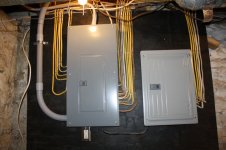
I have the 10 circuit version similar to this manual transfer switch unit, and I installed it myself in a few hours. It is really not all that complicated because all the wires are color coded for incoming and outgoing feed to the main panel, and also all the wires are labeled with letters "A", "B", "C" and so on in order to keep them in pairs. If people have added a light switch or receptacle anywhere in their house, and ran the wires and did all the connections for that, or ran a new circuit from their load center, then the installation of a manual transfer switch is the same, just on a larger scale.
Yes, it takes more time to install and involves working with more of the existing wires inside your load center versus an Interlock kit, but it is still a great solution for anyone looking for a safe and legal way to run the necessary circuits to keep you in your home during a power outage.
I went the manual transfer switch route because of the ease of use, and the fact that if I had the Interlock, my wife would never go into the load center to manage turning different breakers on and off to keep things working so she doesn't overload the generator.
She is deftly afraid of going anywhere near the main panel in our basement, and to use an Interlock would be out of the question for us. With the manual transfer switch, she is not afraid of it at all. She knows how to start up our generator. She knows how to connect it via the twist lock cord to the power inlet box on the outside of the house. And she knows that to get things running in the house all she has to do is flip the 10 switches on the transfer switch and she is done. No keeping track of which breakers are supposed to be on and off. No worries.
I asked her how come she has no fear of the generator, but fears the main panel and opening it up? She just says that is how she feels. So, I just say ok.
Jim