To avoid these ads, REGISTER NOW!

2 post car lift anchored from above :-)

RWorth

Well-known member
Joined
Aug 29, 2016
Messages
592
Location
Cape Cod , Mass.
Interesting. So it takes two people to release and hold the safety latches, one on each column, when lowering?

My lift has individual safety latches that only work while going up, normally to come down you pull a cable on each post that releases the the safeties. That's how it came from the factory. My old lift had a single lever I had to hold to lower the lift. I actually never thought of that until you mentioned it, there is no safety going down, never was.
If you think of it though, after you release the 2 safeties you're not under it anymore, and in my case now, I'm not even near the posts, I'm 4 feet behind the car and off to the side.
 
To avoid these ads, REGISTER NOW!

lakeroadster

Well-known member
Joined
Jan 19, 2015
Messages
5,166
Location
Central Colorado
My lift has individual safety latches that only work while going up, normally to come down you pull a cable on each post that releases the the safeties. That's how it came from the factory. My old lift had a single lever I had to hold to lower the lift. I actually never thought of that until you mentioned it, there is no safety going down, never was.
If you think of it though, after you release the 2 safeties you're not under it anymore, and in my case now, I'm not even near the posts, I'm 4 feet behind the car and off to the side.

Well, that's the issue with not having the cable from side to side. If you had it and a hose blew on one side, or there was a mechanical issue, then both sides of the lift would come down evenly.

But as long as you're aware of the circumstances, are ok with it, and know the risks.. you're good.

:headscrat Did you buy the lift new and was it originally an ALI certified lift? I never knew they made a lift where, from the factory, the latches could be defeated without the user holding them open.
 

Partsguy57

Banned
Joined
Jan 19, 2016
Messages
456
My lift has individual safety latches that only work while going up, normally to come down you pull a cable on each post that releases the the safeties. That's how it came from the factory. My old lift had a single lever I had to hold to lower the lift. I actually never thought of that until you mentioned it, there is no safety going down, never was.
If you think of it though, after you release the 2 safeties you're not under it anymore, and in my case now, I'm not even near the posts, I'm 4 feet behind the car and off to the side.
Wanting a stiffer floor is one thing, worried about lift safety is another. Have you noticed that those that are so concerned about lift safety are those that do not work under them for a living? Good grief those that work under for a living are not voicing their " concern" why is this? I'll say it again, if you can't follow instructions and put up something as basic and easy as lift, it makes mw wonder about one's qualifications to even be working on a car under a lift..... cheers ( reply to post 40)

Sent from my SM-G920R4 using Tapatalk
 

Bob Peach

Well-known member
Joined
Apr 23, 2007
Messages
134
Location
Cape Cod ,Ma
Wow, RWorth is my neighbor. I`ll keep an eye out for the collapse of his garage the next time he uses his lift. I`ll be sure to post pictures if there is a disaster.
 

Oregon rock crusher

Well-known member
Joined
Jun 28, 2016
Messages
1,916
Location
West of Salem
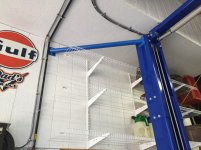
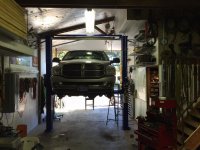
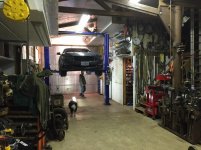
A friend of mine had the first two post lift I was ever exposed to around 35 years ago. The column on it was massive. probably nearly twice the width of current two post lift columns. Also the anchor plate was a very heavy Angle Iron shaped base that extended out about 3' either side of the column. Many anchor bolts were used to attach it to the floor. It was and still is very solid.

When I bought my lift I went with one of the current designed two post lifts rated and certified for 10000 lbs. It has significantly less structure than my friends old lift. It does easily pop up my full size four door PU and I have no concern it will "fall off". What I did not like was the bounce and movement when I really had to reef on something while under the truck. I don't like bounce. Jack stands do help and I use them but I decided to try anchoring the tops of the columns to my shop walls which are close enough and strong enough (I have diagonal bracing in the walls) to resist some external force.

I did this two or three years ago because I could and I believed it would strengthen the structure and not have any negative side effects. Anchoring to the walls took nearly all movement or "bounce" out of this lift and it now has a much more solid feel than it did. Deflection at the top of the columns can certainly occur as a result of the two post design but is not something necessary to their operation. Trying to improve our tools, vehicles, and homes is kind of what we do when we go out to our garages or shops. If you like your lifts and anything else bone stock and exactly per instructions that's fine by me. I'm just saying I'm very happy with this simple mod on my lift.....and nothing bad is going to happen. Ed.
 

Attachments

  • Lift Bracing.jpg
    Lift Bracing.jpg
    64.6 KB · Views: 89
  • PU on lift.jpg
    PU on lift.jpg
    141.7 KB · Views: 83
  • IMG_0864.jpg
    IMG_0864.jpg
    80.6 KB · Views: 84

Ironcrow

Well-known member
Joined
Sep 30, 2005
Messages
1,169
Location
Arizona
Exactly! Mine is anchored at the top too. However, my two car garage is made of, literally, 200 tons of concrete, block, rock, and rebar. It's a bomb shelter.

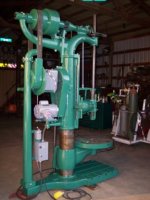
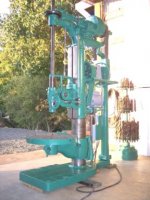
Do you have a bigger picture of that drill press in your avatar? Cool!
 

Oregon rock crusher

Well-known member
Joined
Jun 28, 2016
Messages
1,916
Location
West of Salem
Exactly! Mine is anchored at the top too. However, my two car garage is made of, literally, 200 tons of concrete, block, rock, and rebar. It's a bomb shelter.

Do you have a bigger picture of that drill press in your avatar? Cool!

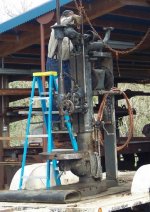
I think having a secure place to anchor the top is definitely the key to success with it. Sounds like you have just that. Wouldn't want to hang it by a wire from a purlin and expect any gain in rigidity. As for my 32" Mechanics Machine Co drill, not trying to change subjects but here are a couple pics. Ed.
 

Attachments

  • 002_picid=6270YfvhY6jlImfcnATulNiSP7iwMaDvhv4xQp5Fd3Ig=&size=m.jpg
    002_picid=6270YfvhY6jlImfcnATulNiSP7iwMaDvhv4xQp5Fd3Ig=&size=m.jpg
    26.4 KB · Views: 51
  • 001_picid=6270YfvhY6jlImfcnATulNiLqEVbe-Q55v4xQp5Fd3Ig=&size=m.jpg
    001_picid=6270YfvhY6jlImfcnATulNiLqEVbe-Q55v4xQp5Fd3Ig=&size=m.jpg
    32.3 KB · Views: 48
  • Sam rigging cropped.jpg
    Sam rigging cropped.jpg
    94.2 KB · Views: 47

wssix99

Well-known member
Joined
Mar 2, 2011
Messages
5,165
Location
Chicago, IL
Like almost never? I'm not disagreeing with anything you said, but what does it say about a designer of equipment to rely on the operator to execute a safety practice that you KNOW rarely happens? Is that ethical design? Or is the designer blameless?

I wouldn't think this direction is due to lack of confidence in the design, but more to protect against the user not balancing the load properly.

I would be surprised in the lift certification procedure relies on these auxiliary jacks. I haven't taken the time to read it, but if not, that would reinforce my expectation above.
 

wssix99

Well-known member
Joined
Mar 2, 2011
Messages
5,165
Location
Chicago, IL
I did this two or three years ago because I could and I believed it would strengthen the structure and not have any negative side effects.

Mechanically, there must be undesirable movement with any anchor at the top of the post. In your case, by putting diagonal restraints on only one side, it will cause the lift to "tip" as it takes load. The movement may be very small, but it would not be in a desirable direction.

As the lift takes load, the columns will bend inward. The diagonal brace doesn't constrain that and remains a fixed length, so as the tops move inward, the distance from the brace's bolts needs to stay constant. This will cause one or both of the following to happen:
- The lift will tip backwards towards the point where the braces are anchored to the wall, pushing the posts slightly out of plumb.
- The walls where the braces are anchored will bend inward towards the center of the room.
 

Ironcrow

Well-known member
Joined
Sep 30, 2005
Messages
1,169
Location
Arizona
I wouldn't think this direction is due to lack of confidence in the design, but more to protect against the user not balancing the load properly.
Yes, it is user error. But, is the process robust enough for the average user? I guess. Cars don't fall off lifts everyday. Although there is no shortage of pictures on the internet. My experience is more industrial fixturing and factory automation rather than professional garages. Clean-sheeting something like a car lift for a factory would no doubt have system(s) to ensure the load was balanced, stayed balanced, or the car would be latched to the lift arms. That is, the factory operator would not be expected to "guess" where the cg was, lift the load, and place a jack at their discretion if a heavy component was removed.
I would be surprised in the lift certification procedure relies on these auxiliary jacks.
Auxiliary jacks are not mentioned in the lift cert document.
As the lift takes load, the columns will bend inward.
The columns are constrained from deflecting together by the top cross bar support.
 

Oregon rock crusher

Well-known member
Joined
Jun 28, 2016
Messages
1,916
Location
West of Salem
Mechanically, there must be undesirable movement with any anchor at the top of the post. In your case, by putting diagonal restraints on only one side, it will cause the lift to "tip" as it takes load. The movement may be very small, but it would not be in a desirable direction.

As the lift takes load, the columns will bend inward. The diagonal brace doesn't constrain that and remains a fixed length, so as the tops move inward, the distance from the brace's bolts needs to stay constant. This will cause one or both of the following to happen:
- The lift will tip backwards towards the point where the braces are anchored to the wall, pushing the posts slightly out of plumb.
- The walls where the braces are anchored will bend inward towards the center of the room.


Not completely sure I understand your concern wissix but to be clear both columns on my lift are secured to capable mounting positions. I did consider bracing the other side as well but the steel tubing I used is more than capable of restraining these minimal loads both in compression and tension. Inward deflection of the columns is restricted by the top cross bar that also contains the cables and overlift stop as it always was (as Ironcrow pointed out above).

I think most things these days are being designed to meet minimal performance standards and they do. Minimal performance might get the lift certified but it does not mean it couldn't be better. I am never going to remove the bracing and have enjoyed the additional rigidity of the lift after this simple modification. Ed.
 

Attachments

  • IMG_0429.jpg
    IMG_0429.jpg
    87.9 KB · Views: 56

lakeroadster

Well-known member
Joined
Jan 19, 2015
Messages
5,166
Location
Central Colorado
I think most things these days are being designed to meet minimal performance standards and they do. Minimal performance might get the lift certified but it does not mean it couldn't be better. I am never going to remove the bracing and have enjoyed the additional rigidity of the lift after this simple modification. Ed.

Lifts with the simple rectangular formed steel columns do seem to flex quite a bit. Not that it's a problem but it is a bit unnerving.

As you your self pointed out.. all lifts aren't created equal. If you were to step up in lift quality you would probably be happier with the rigidity of the unit.
 

Oregon rock crusher

Well-known member
Joined
Jun 28, 2016
Messages
1,916
Location
West of Salem
For sure on that Lakeroadster. I seriously considered selling this lift and buying a much heavier built unit prior to bracing it. Should have done it in the first place. Unnerving is a good description of the concern that can occur like when your fighting a heavy ****** back in and giving it a bit of shoulder and the damn lift is getting bouncy. The hell with that. Ed.
 

RWorth

Well-known member
Joined
Aug 29, 2016
Messages
592
Location
Cape Cod , Mass.
What this whole thread boils down to is , the safety of YOUR lift is more related to YOU the operator than the mechanical devise you bought, or the alterations you have done to it. Of all the machine failures I have seen in my life 99.9% of them were operator error. No-one can teach you to be mechanically inclined, you are born with it or without it. I have a 1a and 2a hoisting lic. and a CDL A. I have worked with licensed operators that I wont get near while they are operating a machine because they are mechanical morons and only move things safely by accident because they have no clue. I worked for a very nice guy for 7 years that every time he showed up at my jobsite I would sit in my truck until he left. You can take as many mechanics, engineering and safety classes as you can find, and if you are not mechanical, you'll never be safe, and you'll always be afraid of deviating from your written instructions.

PS , ORegon, I love your drill press. This is my little power hack saw.
https://www.garagejournal.com/forum/attachment.php?attachmentid=722936&stc=1&d=1515325420
 

Attachments

  • IMG_20160105_094036885 (2017_08_26 16_27_05 UTC).jpg
    IMG_20160105_094036885 (2017_08_26 16_27_05 UTC).jpg
    147.8 KB · Views: 28
Last edited:

wssix99

Well-known member
Joined
Mar 2, 2011
Messages
5,165
Location
Chicago, IL
What this whole thread boils down to is , the safety of YOUR lift is more related to YOU the operator than the mechanical devise you bought, or the alterations you have done to it.

Great point.

No-one can teach you to be mechanically inclined, you are born with it or without it.

There are also the types who "think" they are mechanically inclined but are not. lol That's the worst.
 
To avoid these ads, REGISTER NOW!

wssix99

Well-known member
Joined
Mar 2, 2011
Messages
5,165
Location
Chicago, IL
The columns are constrained from deflecting together by the top cross bar support.

Some don't have top cross bars and all the top bars I've seen are non-structural and can bend up into an arc slightly, allowing the columns to move inward.
 

wssix99

Well-known member
Joined
Mar 2, 2011
Messages
5,165
Location
Chicago, IL
Not completely sure I understand your concern wissix but to be clear both columns on my lift are secured to capable mounting positions.

Prior to to the braces, the columns would have bent inward as they took load. After adding that brace, they will move in an arc around the point where the brace is attached to the wall. (Assuming the wall doesn't move.)

Here is a sketch of how everything would move together:

View media item 79269
I did consider bracing the other side as well but the steel tubing I used is more than capable of restraining these minimal loads both in compression and tension.

Right. Other things have to give, which is more the worry. When the load goes up, something has to move. The walls weren't designed to have a truck hanging off the side of them, so they would (could be a small amount) deflect inward. (Besides the question as if they can take the load, that inward movement can also stress the ceiling above.)

I would be cautious adding a second brace without working with a structural engineer. In your current state, your post column can move with the wall and the two can arbitrate the loads a little bit. If you add another brace and have them forward and aft, then the wall will share 100% of the loading with the post column. (But the column would move straight inward with two braces.)

One thing you might do is the next time you take a load on the lift, check the plumb of your columns before and with the load at height and see how far they are rotating backwards towards the braces. (Maybe even measure from the back of your garage to the top of the column before and after.) The movement may be very small, but if you noticeably fall out of plumb, that would be a greater concern.
 

Oregon rock crusher

Well-known member
Joined
Jun 28, 2016
Messages
1,916
Location
West of Salem
Prior to to the braces, the columns would have bent inward as they took load. After adding that brace, they will move in an arc around the point where the brace is attached to the wall. (Assuming the wall doesn't move.)

Here is a sketch of how everything would move together:

View media item 79269
A very nice sketch wissix and I do appreciate your concern for my safety. Your sketch did leave out the top cross bar however and that is significant. Noticeable movement at the top of the columns does not have to occur nor is it desirable. It can and does occur because many lift companies have cut materials cost and are meeting minimal design standards driven by price point. A simple support has helped mitigate this cost cutting and allows the lift to feel like a much more rigid structure.


Right. Other things have to give, which is more the worry. When the load goes up, something has to move. The walls weren't designed to have a truck hanging off the side of them, so they would (could be a small amount) deflect inward. (Besides the question as if they can take the load, that inward movement can also stress the ceiling above.)

I would be cautious adding a second brace without working with a structural engineer. In your current state, your post column can move with the wall and the two can arbitrate the loads a little bit. If you add another brace and have them forward and aft, then the wall will share 100% of the loading with the post column. (But the column would move straight inward with two braces.)

The load is fully supported on the columns. Not shared with the wall. The wall simply stabilizes the columns. The bolts in the floor do their job. All I'm doing is offering a bit of resistance to deflection fore and aft and dampening vibrations induced by load movements.


One thing you might do is the next time you take a load on the lift, check the plumb of your columns before and with the load at height and see how far they are rotating backwards towards the braces. (Maybe even measure from the back of your garage to the top of the column before and after.) The movement may be very small, but if you noticeably fall out of plumb, that would be a greater concern.

I have checked....no worries here. Ed.
 

Ironcrow

Well-known member
Joined
Sep 30, 2005
Messages
1,169
Location
Arizona
This cross bar between the columns is strong enough to not bow in compression and certainly not stretch in tension. Fore-aft movement of the lift columns loads the wall in racking and due to the angle of the added braces tends to pull the walls in and out. The in and out motion of the walls is constrained by the bottom cord of the truss located inches from where the loads are carried to the wall. As far as racking, if the building can hold up the roof and resist wind loads, the racking strength is likely sufficient for the few hundred pounds of added stress from the column braces.

I would not suggest that this scheme would always work. With truss and braces in different places we would have a different story. If the lift had no cross brace or a flimsy cross brace a different plan would be needed. Also, if the building was sheetrocked on the inside or stucco on the outside, perhaps we'd see some cracks with dynamic loads etc.

Overall this design seems good, whether derived empirically or through exhaustive calculation. In the end, the ultimate evidence is that it has been observed to accomplish the owner's goals and it has been in place for several years without ill effect.
 

wssix99

Well-known member
Joined
Mar 2, 2011
Messages
5,165
Location
Chicago, IL
The load is fully supported on the columns. Not shared with the wall. The wall simply stabilizes the columns. The bolts in the floor do their job. All I'm doing is offering a bit of resistance to deflection fore and aft and dampening vibrations induced by load movements.

I think this is the key point to the whole thread and what a lot of people assume is happening when they consider attaching a support at the top. Looking at it a little more, one can see that the mechanics don't function exactly like this.


The load is fully supported on the columns. Not shared with the wall. The wall simply stabilizes the columns. The bolts in the floor do their job.

This is true only if there is no movement of the columns. At the point, the columns bend or move, forces go through the braces and the wall or ceiling takes on load.

All I'm doing is offering a bit of resistance to deflection fore and aft and dampening vibrations induced by load movements.

Since movement is being constrained, the wall is helping and the columns and base plates aren't taking 100% of the forces.

A single diagonal brace exerts parallel and perpendicular forces on the wall. For a brace at a 45 degree angle, the force parallel to the wall will be equal to the force pushing/pulling the wall out/in.
 

Ironcrow

Well-known member
Joined
Sep 30, 2005
Messages
1,169
Location
Arizona
I think this is the key point to the whole thread and what a lot of people assume is happening when they consider attaching a support at the top....
Some of us are engineers here. And others, as I mentioned, may have empirical solutions.
... For a brace at a 45 degree angle, the force parallel to the wall will be equal to the force pushing/pulling the wall out/in.
Only if the brace is pinned at both ends. Which this one isn't.;)
 

wssix99

Well-known member
Joined
Mar 2, 2011
Messages
5,165
Location
Chicago, IL
Some of us are engineers here. And others, as I mentioned, may have empirical solutions.

That's why I suggested measuring the plumb and actual deflection. Real-world stuff.


Only if the brace is pinned at both ends. Which this one isn't.;)

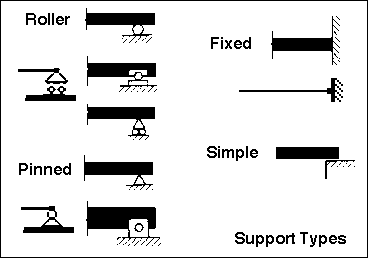
There's only two bolts on either end of the brace, lined up with the brace. It doesn't constrain moment and is a classic pin joint.

The joint doesn't have to be a hinge to be a pin joint:

1_lecture13_pic1.gif
 

Oregon rock crusher

Well-known member
Joined
Jun 28, 2016
Messages
1,916
Location
West of Salem
wssix I'm not sure if you are saying my buildings strength and anchor points are inadequate to restrict movement in my lift or if you are stuck on the argument that all lifts must be free to move around and no attempt to restrict unwanted movement is ever justified.

To address your first concern the wall to the left in my picture is an inside wall and an intersection with another full height inside wall occurs at my anchor point. these are 2x6 walls screwed together and fully sheated on both sides with cdx or exterior siding also screwed on every 8". The truss chord is directly above and between the anchor points. Also look up at that horizontal shelf that extends an equal amount on the other side of the wall that is also contributing strength to that wall and mounting point. That mounting point is not going to move nor do I want it to. It is effectively restraining unwanted movement of the column.

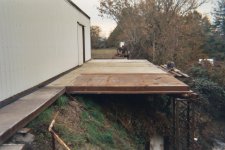
The left side also has a bump in the deck portion of my shop and has multiple steel components supporting the anchor point and is not going anywhere either. I draw heavily on my observations and experience in building things. I can only tell you that my lift is now significantly more stable and does not move around like it did. If you believe no external bracing should ever be used on a two post lift I got nothing for you... we just have to agree to disagree. A couple pics of part of my building. There is no shortage of steel in my shop and the damn thing isn't going to fall down. Ed.
 

Attachments

  • 017_14.jpg
    017_14.jpg
    153 KB · Views: 21
  • 010_7.jpg
    010_7.jpg
    143.9 KB · Views: 24
  • 016_13.jpg
    016_13.jpg
    151.5 KB · Views: 23
  • IMG_0863.jpg
    IMG_0863.jpg
    145.5 KB · Views: 23
  • IMG_0865.jpg
    IMG_0865.jpg
    114.2 KB · Views: 25

Ironcrow

Well-known member
Joined
Sep 30, 2005
Messages
1,169
Location
Arizona
There's only two bolts on either end of the brace, lined up with the brace. It doesn't constrain moment and is a classic pin joint.
Oops, sorry. I'll give you that one. I thought I remembered 4 bolts on each flange which does, of course, support moment.
 

audioworks04

Well-known member
Joined
Oct 6, 2015
Messages
141
Location
Olathe KS
I find it baffling why anyone would want to second guess the integrity of a solid steel structure soundly anchored to a concrete slab, and instead fasten it to a wooden structure that was never envisioned or designed to take those loads.

I keep wondering if people who insist on 2 cubic yard lift footers have any qualms with getting in elevators or flying in airplanes.


This! The chance of damage to the structure is higher than the chance that the lift was incorrectly engineered. The lift will flex some as it is loaded, it is designed to.


Sent from my iPhone using Tapatalk
 

RWorth

Well-known member
Joined
Aug 29, 2016
Messages
592
Location
Cape Cod , Mass.
Originally Posted by Daedalus View Post
I find it baffling why anyone would want to second guess the integrity of a solid steel structure soundly anchored to a concrete slab, and instead fasten it to a wooden structure that was never envisioned or designed to take those loads.

Because concrete and anchors ,CAN NEVER FAIL?:dunno:

I just had a thought, IF in fact the anchors in the concrete will hold all the load ever placed on the lift, than how is it possible for that post to pull the building down?
 
Last edited:

Ironcrow

Well-known member
Joined
Sep 30, 2005
Messages
1,169
Location
Arizona
The architect who designed the pad never intended it to support the moment loads of a column planted in the center of it either. It was a lift designer who worked that out decided it was adequate. Right before the design was shipped to China to be made of 22 gauge radioactive re-melt tacked together with coat hanger welding rod.
 

Oregon rock crusher

Well-known member
Joined
Jun 28, 2016
Messages
1,916
Location
West of Salem
This! The chance of damage to the structure is higher than the chance that the lift was incorrectly engineered. The lift will flex some as it is loaded, it is designed to.


Sent from my iPhone using Tapatalk

I think this is the argument I have the most difficulty with. The lift is designed to flex??? Really??? A fly rod's designed to flex. A lift column is designed to be as rigid as they can make it within the restrains of the design parameters. The first big challenge in the design is they can only fix the column to a slab at the base. Also you cannot fully box the column. you have to have the face open for the carriage to travel. You end up with an open C and bend the steel surrounding the opening to make it as strong/rigid as possible. Also more column width would help but is not particularly desirable either as it limits access to the vehicle and also requires more steel which equals higher cost. That's what it comes down to in the competitive low end lift market. How rigid can I make the structure and still hit the price point while passing certification.

While lifts are not designed to flex, as there is no benefit in it, they are designed to withstand/survive the additional stresses that load movement imparts on them. Yes two post lifts flex as they are not strong enough to fully resist the forces they are subjected to. You can never get rid of all of it with the two post design. The arms themselves will flex some (some more than others). What bothers me is that load movement can transfer up the unrestrained columns and then echo back down into the arms and back to the vehicle. Makes the load bouncy. Securing the top will minimize the movement of the column and you will notice it in better load stability. If you don't have good anchor points or know how to build them don't try it. I did because I was too tight to spend 2 to 3 times as much cash for a better and more stable lift but wanted my lift to perform like one. Ed.
 

wssix99

Well-known member
Joined
Mar 2, 2011
Messages
5,165
Location
Chicago, IL
wssix I'm not sure if you are saying my buildings strength and anchor points are inadequate to restrict movement in my lift or if you are stuck on the argument that all lifts must be free to move around and no attempt to restrict unwanted movement is ever justified.

Oh, no. If I were to make a recommendation, it would be that a professional engineer should be consulted (for the lift and the building) before doing any bracing that isn't previously detailed by the manufacturer.

I don't think making "points" on the internet are generally useful. Who knows, my account could be anyone behind a keyboard or even a North Korean hackbot. ;)

^ I would make the engineer recommendation to avert any negative consequences through trial and error. (Depending on the situation, they could be deadly.) In your case, you have a body of experience (you've already been through the trial period) in your situation and are able to manage and monitor movement.

My other comments are intended to helpfully point out the mechanics of your particular situation so you can be aware of the forces at play as you manage and monitor.

Personally, I know of a few situations where it was definitely advisable to modify a lift, however the slab/base conditions differed from the manufacturer's spec, and engineers needed to be called in.


I think this is the argument I have the most difficulty with. The lift is designed to flex??? Really???

Any structure is going to bend under load. This video has gotten a lot of airplay here. Obviously, this should NOT happen to any of our lifts (hopefully our arms won't buckle like wet noodles...) but it shows an exaggerated example of what all of our lifts do to a smaller extent under load. (As pointed out above, models with top cross bars, likely will bend even less.)
 
Last edited:

James-W

Well-known member
Joined
Feb 3, 2013
Messages
12,432
Location
Southeastern Wisconsin
I think this is the argument I have the most difficulty with. The lift is designed to flex??? Really??? A fly rod's designed to flex. A lift column is designed to be as rigid as they can make it within the restrains of the design parameters. The first big challenge in the design is they can only fix the column to a slab at the base. Also you cannot fully box the column. you have to have the face open for the carriage to travel. You end up with an open C and bend the steel surrounding the opening to make it as strong/rigid as possible. Also more column width would help but is not particularly desirable either as it limits access to the vehicle and also requires more steel which equals higher cost. That's what it comes down to in the competitive low end lift market. How rigid can I make the structure and still hit the price point while passing certification.

While lifts are not designed to flex, as there is no benefit in it, they are designed to withstand/survive the additional stresses that load movement imparts on them. Yes two post lifts flex as they are not strong enough to fully resist the forces they are subjected to. You can never get rid of all of it with the two post design. The arms themselves will flex some (some more than others). What bothers me is that load movement can transfer up the unrestrained columns and then echo back down into the arms and back to the vehicle. Makes the load bouncy. Securing the top will minimize the movement of the column and you will notice it in better load stability. If you don't have good anchor points or know how to build them don't try it. I did because I was too tight to spend 2 to 3 times as much cash for a better and more stable lift but wanted my lift to perform like one. Ed.
I am not an engineer and I don't work for a lift manufacturer so I can't say this for certain, but I do think there is a certain amount of "give" to a lift. You can say that a bridge or a building is not meant to move either, but that would be wrong too. Some bridges are supposed to move a bit as are some buildings. That's how they can survive strong winds and/or earthquakes. I suspect an automotive lift would be in a similar category, if it can flex a little the odds it will break will be less.
 
To avoid these ads, REGISTER NOW!
Top Bottom