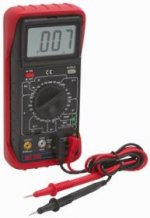
Personally, for just about anything I get by just fine with my $3 HF meters. They're so cheap I have one in every place I need (desk, box, bag, drawer, etc). The only thing I wish they had is a beeper for continuity (really handy), and zero resistance reading when you touch the leads together.
I have a small Radio Shack meter from 30 years ago. Very flat, size a bit longer than a business card. Probe wire stored in the folded lid and not detachable. Batteries lasted for ever. Only changed it 2 times. Now it needs a change. The two coin type battery will cost me about $10. If I look really hard, maybe $6. The probe wire is open so I need to open the case and re-solder the disconnect. It is still a very nice meter with basic functions. I would not be using it at my job (electrical engineer, hardware design) but it serve me well in my personal life with cars, motorcycle, general household stuff.
HF meter is $3. Detachable probes, bigger, same basic functions, battery is cheap and easily available instead of the coin batteries and it is a throw away if lost. So I bought one. No brainer decision. Ultimate convenience since I am lazy. Only ONE minor drawback .... it is a size of a pack of cigarette.
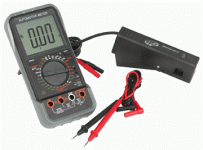
I have an expensive meter, at home, but it rarely come out of the case for typical home owner need, car need, or bike need. BASIC functions is all you need if you are starting out. You'll be amaze how accurate the cheap meters are. I doubt you'll need to read voltages down to mV. Go buy the expensive one when it is time, you'll know it .....
BTW: The $10 cheap Sears one and the $3 cheap HF one may just use the same integrated circuit chip. So the functions are all the same with minor differences. Please don't start with the quality issues. We all know that already so no need to beat a head horse into a pulp. AND ..... Don't worry, they won't explode in your face and your willie won't fall off either.


 .
.