To avoid these ads, REGISTER NOW!

Max lighting wattage on 15 amp circuit

bdog

Well-known member
Joined
Oct 17, 2007
Messages
227
I have a 15 amp circuit with 14ga wire. I know 15 amps at 120volts is 1800 watts and if I recall you aren’t supposed to put over 80% continuously on it so 1440 watts max? Would it be wise to put 14 100 watt LED’s on a single circuit or would I be pushing my luck?

The wires are already there and adding more or larger ones would not be easy. I am not considering that as an option. I just want to add as many lights as I can to the wiring I have without overdoing it.
 
To avoid these ads, REGISTER NOW!

BillK

Well-known member
Joined
Aug 24, 2006
Messages
9,365
Location
Beautiful Southern Maryland
b,
Is it actually a 100 watt LED (probably not) or an LED that is equivalent to a 100 watt incandescent bulb ? The 100 watt equivalent leds typically only draw 15 watts or so.
 
OP
B

bdog

Well-known member
Joined
Oct 17, 2007
Messages
227
They are 100 watt actual led high bay fixtures - around 13,000 lumens.
 
OP
B

bdog

Well-known member
Joined
Oct 17, 2007
Messages
227
I would split them into 2 switched banks.

Bill

The actually are split and switched. There are two separate 15 amp circuits for lights in the shop. I need to know how many 100 watt led fixtures I can put on each one.

The wires are already ran in an existing building that had much smaller wattage lights originally. Without running more wire I can't separate them further nor do I want to.

All I need to know is how much LED wattage I can put on a 15 amp circuit. I am not looking to redesign or rewire the shop I just am putting new fixtures and need to know how many it can handle. If it is 14 I will put 14, if it is 12 I will put 12 or 10 or whatever.
 
Last edited:

pattenp

Well-known member
Joined
Jun 4, 2008
Messages
10,175
Location
Virginia - USA
To figure this..., 15A X 80% = 12A max continuous load. 12A X 120V = 1400 watts. 1400 watts / 100 watts = 14.
 

AP514

Well-known member
Joined
Jan 23, 2014
Messages
768
Location
Pearland, Tx
:confused:
12X120=1440

Yup that is correct..a 15 Amp C/B...
(to be safe on the 15AMP circuit.) %80 of a 15amp circuit is 12 amps..
So 12 x 120 volts =1440 watts

1440 watts -- Each Light fixture is 100 watts..1440/100 = 14 Fixtures...


Oh, **** I just now got it...

:withstupi..Doh....
 

Matt Matt

Well-known member
Joined
May 11, 2017
Messages
523
Location
Ontario
You are pushing your luck a little bit. As stated earlier 12 would be the max but…

The other problem is the switch needs to be rated for this much amperage in rush. Most light switches are only rated for 6 to 700 W. you will need to get a motor rated Horse power light switch.

Motor rated light switches have a bigger clunk when switched. They don’t have wire stabs only screws.
 

bigb56

Well-known member
Joined
Jan 27, 2018
Messages
169
Location
Tucson, Arizona
You are pushing your luck a little bit. As stated earlier 12 would be the max but…

The other problem is the switch needs to be rated for this much amperage in rush. Most light switches are only rated for 6 to 700 W. you will need to get a motor rated Horse power light switch.

Motor rated light switches have a bigger clunk when switched. They don’t have wire stabs only screws.

How is he pushing his luck? NEC says for a circuit supplying a continuous load (3 hours or more) the circuit must be sized at 120%, which is where he is at with 14 fixtures. Unless CEC is different? OP doesn't have a location shown.
 

Matt Matt

Well-known member
Joined
May 11, 2017
Messages
523
Location
Ontario
How is he pushing his luck? NEC says for a circuit supplying a continuous load (3 hours or more) the circuit must be sized at 120%, which is where he is at with 14 fixtures. Unless CEC is different? OP doesn't have a location shown.
I said a little bit.

Depends on how you want to do the math. I thought the NEC stated 80% of circuit. 1800 W x 80% equals 1440. But 1440×120%=1728. I’m just suggesting he’s pushing the redline. As well I suggested A standard light switch is not efficient under the circumstances.

The line will handle it, the switchgear should be rated adequately too. CS115W or better.

Correct me if I’m wrong.
 
Last edited:
To avoid these ads, REGISTER NOW!

6PTsocket

Well-known member
Joined
Mar 12, 2014
Messages
4,593
I have a 15 amp circuit with 14ga wire. I know 15 amps at 120volts is 1800 watts and if I recall you aren’t supposed to put over 80% continuously on it so 1440 watts max? Would it be wise to put 14 100 watt LED’s on a single circuit or would I be pushing my luck?

The wires are already there and adding more or larger ones would not be easy. I am not considering that as an option. I just want to add as many lights as I can to the wiring I have without overdoing it.
Are you talking about real 100 watt leds or 100 watt equivalent leds. They only pull about 15 watts each. A 100 watt led is a monster and not generally found in a home or small shop setting. I have 2 clusters of 4 in in my garage. They are 100 watt equivalent and the total draw is only 120 watts.

Sent from my SM-G900V using Tapatalk
 

wyliesdiesels

Well-known member
Joined
Aug 14, 2012
Messages
20,073
Location
Modesto, CA
You are pushing your luck a little bit. As stated earlier 12 would be the max but…

The other problem is the switch needs to be rated for this much amperage in rush. Most light switches are only rated for 6 to 700 W. you will need to get a motor rated Horse power light switch.

Motor rated light switches have a bigger clunk when switched. They don’t have wire stabs only screws.

What the heck are you talking about? :headscrat

you have a code for that?

Why would one need a HP rated switch for a lighting load?

Where are you getting 600-700w?

The push-wire terminals have nothing to do with this. One can use the screws on the cheapo push wire type of switches as well.

And what is "a bigger clunk?"

How is he pushing his luck? NEC says for a circuit supplying a continuous load (3 hours or more) the circuit must be sized at 120%, which is where he is at with 14 fixtures. Unless CEC is different? OP doesn't have a location shown.

No thats incorrect. it says the OCPD cannot be sized less than 125% of the continuos load. 80% is the inverse of 125%.

When using 125% you divide, 20a/1.25 = 16a and when using 80%, you multiply- 20a * .8 = 16a.

120% is the wrong figure.

See 210.20 (A)

I said a little bit.

Depends on how you want to do the math. I thought the NEC stated 80% of circuit. 1800 W x 80% equals 1440. But 1440×120%=1728.

No the code says 125%. Read above comment.

So your math is wrong on the last equation.

I’m just suggesting he’s pushing the redline. As well I suggested a standard light switch is not efficient under the circumstances.

What redline?

And switches dont have efficiency ratings. Not even sure what youre trying to say here. Its just a bunch of mumbo jumbo... :dunno:

The line will handle it, the switchgear should be rated adequately too. CS115W or better.

Correct me if I’m wrong.

Switchgear? :wtf:

Are you talking about real 100 watt leds or 100 watt equivalent leds. They only pull about 15 watts each. A 100 watt led is a monster and not generally found in a home or small shop setting. I have 2 clusters of 4 in in my garage. They are 100 watt equivalent and the total draw is only 120 watts.

Sent from my SM-G900V using Tapatalk

He answered that in #3... ;)
 
Last edited:

mm08822

Well-known member
Joined
Jan 13, 2012
Messages
6,053
Location
NJ
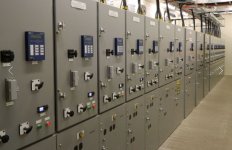
Yeah, switchgear.......one cubicle per light. Safety first.

Realize what youre talking about.JPG
 

GRB

Well-known member
Joined
May 6, 2014
Messages
828
Location
SoCal
Those fixtures say 0.6a per unit so drawing less than 100w each.

If I'm borderline when needing a bunch more lights on a circuit, I just change to 240v or 277v. Most commercial lighting runs 120-277v.
 

Matt Matt

Well-known member
Joined
May 11, 2017
Messages
523
Location
Ontario
CS115W isn't a rating, it's a part number
C=Commercial Grade
S=Switch
1=Single pole
15=Amp rating
W= White
Somebody know’s what I’m talking about... A heavier switch. In this situation, all I’m suggesting a better switch (or switchgear, not a whole cube LOL). I replaced many arced out switches and this is my new go to. I’ve replaced a general (Levton) switch about 3 times in the past six years that I had rated for 1200 W. last time I spent $8 (instead of$1) on the switch. I’ve not had any problems since(2y). Now I keep both on the truck. My personal explanation of the feel (and the clunk) might not register to some. The Switch is a little wider. I’ll post some pics (because I can demonstrate the difference between two Hubbell). Yes, one is commercial. It does not have stabs!

Maybe Willy can explain why commercials don’t have stabs (or Hubbell doesn’t have them on the commercial) ? And the bigger clunk switching is applied in the spring mechanism. And why he feels Hubbell and The bigger spring mechanism should be required for the clunk?

I’m OK with you just explaining why(or why not) the commercial switch is/or might be better or not in this situation.

What is the difference between these two switches and why you would use them in different situations?

Last question is is why do I use Hubbell over any other manufacture, because I trust it! What is your go to?

Edit; You can highlight every question in red and answer.
 

Attachments

  • C29037D7-A123-4EFF-8113-A8CD3557189D.jpg
    C29037D7-A123-4EFF-8113-A8CD3557189D.jpg
    77.2 KB · Views: 32
  • CBB42A9E-1BED-4539-90D5-22D5B719FF41.jpg
    CBB42A9E-1BED-4539-90D5-22D5B719FF41.jpg
    89 KB · Views: 32
Last edited:

sberry

Banned
Joined
Jun 18, 2005
Messages
35,747
Location
Brethren, Michigan
Commercials are rarely used on 14 solid wire, hence no stabs. Matt doesn't advocate dangerous practice, might make him confusing but ok.
I also rarely load light circuits that far and in homes they never are anymore. I just did a house, while we used 3 circuits to eliminate some confusion the whole place could have easily ran on 1 and still been half loaded.
Lots of times there is a lot on a circuit but on multiple switches. I realize that this is a bit off track of the original question, in many cases there is an extra wire to split switching.
 
Last edited:

Matt Matt

Well-known member
Joined
May 11, 2017
Messages
523
Location
Ontario
yes i know about dimmers.

but were not talking about dimmers. His 600w rating just adds confusion to the thread like so much else he posts...

I agree we’re not talking about dimmers. LEDs have micro transformers and florescence auto transformers... these take a toll on the switch. As I have stated earlier, I’m not worried about the wire, just a switch under the situation. I’m only expressing my experience with failing points. And you got what you paid for with my information and field testing.

-My home shop has 36 t8 32w on 120v. 450 ft.² commercial switch
-My business has four rows (of five metal halide) 90W per bulb on the same switch. But, one switch for each row. 20,000 ft.² that I have 2 32w task lighting above each granite surface table x4 in the grinding room...
-My basement wood shop has 8 23w florescence spiral , same switch with 370 ft.².
-Two more of my hobby shops have a 60 minute timer, with 12 T8 are use the same switch.
- the funny thing is the industrial college/university I work at, uses the same switch..
I guess you are supporting sub par or I am supporting above par switching?

I literally enjoy the fact that you are confused by any of my posts. If I was a regular Joe ,I’d be confused most to your posts and mine too...
 
Last edited:

sberry

Banned
Joined
Jun 18, 2005
Messages
35,747
Location
Brethren, Michigan
I can't even remember the last time i replaced a cheap switch. I don't recall if I ever have.
Just FWIW, I have the 1hp paint fan plugged in to a 15 recept and with a 49 cent switch, has hundreds of cycles on it. I wonder how long it's going to last?
 
Last edited:

mm08822

Well-known member
Joined
Jan 13, 2012
Messages
6,053
Location
NJ
Op, forget the LED wattage statement.
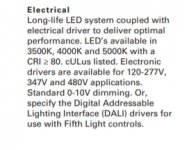
The spec sheet for the fixture states it is a universal voltage fixture – capable of 120 – 277 vac input. The spec sheet also states 0.6A @ 277v = 166va.

At 240 vac, load current would be ~ 0.7A and @120vac would be ~ 1.4A/fixture.
100w/120vac = 0.83a which is not equal to 1.4A. 0.83 underestimates the actual load on the ckt by ~33%.
At 120vac with a single 15A ckt, only 8 fixtures max are permitted. Any greater qty overloads the ckt and switch. Now it is easy to understand why a switch can get replaced so quickly - the ckt design is wrong and hence installed components are mis-applied.

It may be better to run them @240vac which would allow up to 17 fixtures on each ckt. Depends upon total number of fixtures planned and #/bank, safety aspects if losing all fixtures at once.

An el cheapo residential Leviton 15A 120v toggle switch (#1451) is only rated for 12A and 0.5 hp. 2 yr warranty.
A commercial spec grade 15A Leviton switch (#CS115-2) is rated for 120-277vac. Its Hp rating is 0.5 hp @120vac and 2hp @240vac. 10 yr warranty.
Industrial spec/extra heavy-duty grades (20A) also get into minimum # of switch cycles and # of cycles at ~5x o/l value. Residential grade makes no mention.

The “clunk” heard in spec grade switches is due to the larger spring incorporated for faster opening of the contacts to break the arc of inductive loads to preserve the contact surfaces. It also requires a more definite action to move the toggle.
 

cybrdyke

Well-known member
Joined
Sep 9, 2014
Messages
3,449
Location
USA
The spec sheet for the fixture states it is a universal voltage fixture – capable of 120 – 277 vac input. The spec sheet also states 0.6A @ 277v = 166va.

Got a link to the spec sheet that says this?
The Eaton literature says it's 100w.
CD
 

wyliesdiesels

Well-known member
Joined
Aug 14, 2012
Messages
20,073
Location
Modesto, CA
Got a link to the spec sheet that says this?
The Eaton literature says it's 100w.
CD

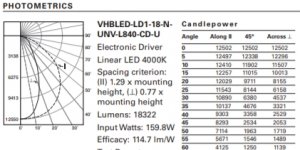
Thats the bulb wattage not the total input. Theres usage and losses associated with the driver.

The pic above shows almost 160w total input.

When calculating fluorescent, HID, or LED fixture load, you have to factor in the total input current not just the bulb wattage.
 

Matt Matt

Well-known member
Joined
May 11, 2017
Messages
523
Location
Ontario
Thats the bulb wattage not the total input. Theres usage and losses associated with the driver.

The pic above shows almost 160w total input.

When calculating fluorescent, HID, or LED fixture load, you have to factor in the total input current not just the bulb wattage.

What the heck am I talking about scratch your head?
Can you clarify what you mean by that? Is this a code under the NEC?

I call it surge, you call it input. Can you clarify what the differences are? Let’s clarify confusion.

Most people understand what I’m saying when I refer to the “clunk” of a switch. (sorry to confuse you)There is a very distinct and similar operation between a 30 amp Square D disconnect and the L cheapo $.49 Levington HD...

The “clunk” I was referring to is the action and reaction time of the switch to break current. This is achieved by Multi thermal spring mechanism’s with a double action thermal break.

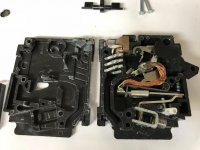
This is in our test tonight. Just a arc-out 100 amp breaker.
 

Attachments

  • 7B8AEE08-1FE0-4DA8-8F38-52823DD9D758.jpg
    7B8AEE08-1FE0-4DA8-8F38-52823DD9D758.jpg
    143.4 KB · Views: 23
Last edited:

wyliesdiesels

Well-known member
Joined
Aug 14, 2012
Messages
20,073
Location
Modesto, CA
What the heck am I talking about scratch your head?
Can you clarify what you mean by that? Is this a code under the NEC?

I call it surge, you call it input. Can you clarify what the differences are? Let’s clarify confusion.

Most people understand what I’m saying when I refer to the “clunk” of a switch. (sorry to confuse you)There is a very distinct and similar operation between a 30 amp Square D disconnect and the L cheapo $.49 Levington HD...

I see you cut and pasted my #22 comment out of context and made it look like i was replying to something else. And yet you never answered me about your comment which i quoted in #22....

Moving on. Theres a difference between a surge and an input.

A surge lasts a short duration. An input would be while it is on.

Similar to motor FLA input and motor in-rush current.

A motor doesnt run at in-rush current the whole time it is running. SO thus the FLA is the input...

You are twisting things around. Or maybe you dont understand the difference between a surge and an input.

youve spouted a lot of BS in this thread and then people call you out on it and you just keep going like nothing happened...never responding to getting called out on the BS...

light switches are not switchgear and you called them that....

you claimed cs115w is a rating and yet its a part number....

you claimed "most" light switches are only rated for 5-5.83a(6-700w); more BS....

then you claimed standard light switches are not efficient under these circumstances... no such rating on light switches....

then you claimed one would need a motor rated HP light switch... say what? for lights? give me a break.

I think youve had one too many beers some times....

The “clunk” I was referring to is the action and reaction time of the switch to break current. This is achieved by Multi thermal spring mechanism’s with a double action thermal break.

This is in our test tonight. Just a arc-out 100 amp breaker.

The clunk is better termed snap. Just the reason why light switches are often called snap switches....

Clunk is better used to describe something else...maybe a 480v motor starter contacts clunking when the coil is energized...

And i dont know why youre comparing switches to breakers. Switches do not have thermal mechanisms like breakers...

Light_switch_inside_explained.jpg
 
Last edited:

Matt Matt

Well-known member
Joined
May 11, 2017
Messages
523
Location
Ontario
Are they not just all switch’s. What is your best suggestion switch for the job at hand? For a +1400w 15a Circuit using LED Lighting? Lcheapo or a bit better??? I believe, I gave my preferable switch. What is yours????
 
Last edited:
To avoid these ads, REGISTER NOW!
Top Bottom