What the heck am I talking about scratch your head?
Can you clarify what you mean by that? Is this a code under the NEC?
I call it surge, you call it input. Can you clarify what the differences are? Let’s clarify confusion.
Most people understand what I’m saying when I refer to the “clunk” of a switch. (sorry to confuse you)There is a very distinct and similar operation between a 30 amp Square D disconnect and the L cheapo $.49 Levington HD...
I see you cut and pasted my #22 comment out of context and made it look like i was replying to something else. And yet you never answered me about your comment which i quoted in #22....
Moving on. Theres a difference between a surge and an input.
A surge lasts a short duration. An input would be while it is on.
Similar to motor FLA input and motor in-rush current.
A motor doesnt run at in-rush current the whole time it is running. SO thus the FLA is the input...
You are twisting things around. Or maybe you dont understand the difference between a surge and an input.
youve spouted a lot of BS in this thread and then people call you out on it and you just keep going like nothing happened...never responding to getting called out on the BS...
light switches are not switchgear and you called them that....
you claimed cs115w is a
rating and yet its a part number....
you claimed "most" light switches are only rated for
5-5.83a(6-700w); more BS....
then you claimed standard light switches are not
efficient under these circumstances... no such rating on light switches....
then you claimed one would need a
motor rated HP light switch... say what? for lights? give me a break.
I think youve had one too many beers some times....
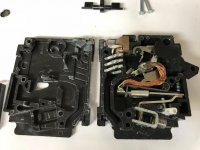
The “clunk” I was referring to is the action and reaction time of the switch to break current. This is achieved by Multi thermal spring mechanism’s with a double action thermal break.
This is in our test tonight. Just a arc-out 100 amp breaker.
The clunk is better termed snap. Just the reason why light switches are often called snap switches....
Clunk is better used to describe something else...maybe a 480v motor starter contacts clunking when the coil is energized...
And i dont know why youre comparing switches to breakers. Switches do not have thermal mechanisms like breakers...


 ..Doh....
 or
or