To avoid these ads, REGISTER NOW!

Air Hose Repair

Provincial

Well-known member
Joined
Sep 21, 2011
Messages
6,869
Location
Near Salem, OR
I hate using worm screw hose clamps to shorten/repair air hoses. They stick out and catch on things or scratch up paint or nice surfaces.

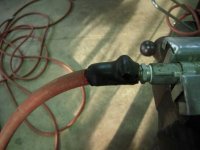
When I have to use these clamps, I use heat shrink tubing to cover them. This makes the repair less likely to do the bad things that uncovered hose clamps do.

I often use a layer of heat shrink tubing over the hose before installing the clamp. This protects the hose from the clamp and I believe helps spread the clamping force over a larger area. This layer of heat shrink also acts to spread out the bending force on the hose when it is forced into a bend.

I use 3M heat shrink tubing that I get from an electrical supply house. It is approved for insulating underground splices in electrical cables. It is more expensive than HF or the auto parts store, but it is much thicker and more flexible. It also has a very large shrink ratio.

I like the large shrink ratio for two reasons. First, it gives me more latitude in choosing a tube for a given diameter job. Second, if I choose tubing near the bottom of its size range for a given job, the resulting insulation layer is the maximum thickness and density. This is especially nice when the hose or electrical joint is exposed to mechanical damage.

Here are photos of a hose end repair using both layers of shrink tubing.
 

Attachments

  • Air Hose Repair 1.comp.jpg
    Air Hose Repair 1.comp.jpg
    28.2 KB · Views: 94
  • Air Hose Repair 2.comp.jpg
    Air Hose Repair 2.comp.jpg
    22.1 KB · Views: 94
To avoid these ads, REGISTER NOW!

MileHighRover

Well-known member
Joined
Mar 13, 2018
Messages
1,120
That's the problem with hose clamps. And they get caught on things if the hose is dragged around. I used to wrap mine in electrical tape, though the shrink wrap is a more sophisticated method.

This is a great solution. I made a version of the last one shown.

ClampTite

Easy to make a homemade one for cheap.


Hose clamp tool from tent peg


Colin
 

Dingleburry

Well-known member
Joined
Mar 2, 2016
Messages
593
Location
Great white north in an igloo
I like to use parker push lok fittings. No clamp needed. Must use good quality hose with those. Goodyear i believe is what we have. Or for normal barbed fittings 2 ear clamps. Oetiker 2 ear clamps.
 
Last edited:

OccupantRJ

Well-known member
Joined
May 15, 2009
Messages
11,074
Location
Eastern North Carolina
I like to use parker push lok fittings. No clamp needed. Must use good quality hose with those. Goodyear i believe is what we have. Or for normal barbed fittings 2 ear clamps. Oetiker 2 ear clamps.

This. The 2 ear clamps. They easily install with end nips and are neat after installation.
 
To avoid these ads, REGISTER NOW!

Katodog

Well-known member
Joined
Mar 23, 2014
Messages
737
Location
Carol Stream Illinois
Flexzilla has reusable fittings, I have them on my air hose at home and like them way better than barbed fittings and hose clamps. I don't know if they'd work for other brands of hoses but they work perfectly for Flexzilla hose. Easy to install or remove, and no parts to get snagged on stuff.
 

Daves69

Well-known member
Joined
Feb 18, 2009
Messages
818
Location
Kernersville, N.C.
Gates power grip hose clamp. They are a heat shrink clamp.

Also search "reusable air hose repair ends" these fittings screw on the end of the hose like a hydraulic fitting.

MIL-S617__33757.1371225158.480.400.jpg
 
Last edited:

6PTsocket

Well-known member
Joined
Mar 12, 2014
Messages
4,593
I hate using worm screw hose clamps to shorten/repair air hoses. They stick out and catch on things or scratch up paint or nice surfaces.

When I have to use these clamps, I use heat shrink tubing to cover them. This makes the repair less likely to do the bad things that uncovered hose clamps do.

I often use a layer of heat shrink tubing over the hose before installing the clamp. This protects the hose from the clamp and I believe helps spread the clamping force over a larger area. This layer of heat shrink also acts to spread out the bending force on the hose when it is forced into a bend.

I use 3M heat shrink tubing that I get from an electrical supply house. It is approved for insulating underground splices in electrical cables. It is more expensive than HF or the auto parts store, but it is much thicker and more flexible. It also has a very large shrink ratio.

I like the large shrink ratio for two reasons. First, it gives me more latitude in choosing a tube for a given diameter job. Second, if I choose tubing near the bottom of its size range for a given job, the resulting insulation layer is the maximum thickness and density. This is especially nice when the hose or electrical joint is exposed to mechanical damage.

Here are photos of a hose end repair using both layers of shrink tubing.
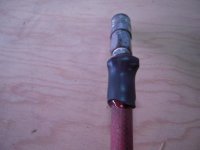
There are many sources, shrink ratios, materials and sonetimes adhesives for shrink tubing. 2:1 is most common but 3:1 is not hard to find. If you use the largest size that will shrink tight to your item, you will get the thickest wall. There are more abrasion resistant types but they are less flexible. There is all kinds of stuff for chemical, heat, high dielectric, abraison, etc.

Sent from my SM-G900V using Tapatalk
 
OP
P

Provincial

Well-known member
Joined
Sep 21, 2011
Messages
6,869
Location
Near Salem, OR
I have used the "reusable" hydraulic-like ends in the past. They don't last as long as I'd like.

I have had good luck with the "clampless" hose barbs with Gates Power Grip heat-shrink hose clamps. The clamps are not rated for this much pressure, but the barbs aren't supposed to need any clamps. They hold up just as long as the brass-ferrule ends. These are available from NAPA as well, but the sizes for hoses are often special-order from any local source.

The problem with the brass ferrules is that hoses aren't all the same dimensions. It seems like you end up needing a different ferrule and die for every hose.

The 1/2" hose shown was being used in a project with a hired worker involved. The hose blew out at the working end and I needed to get back to work as fast as possible, but with a repair that wouldn't have to be redone soon.

Reinforcing the hose UNDER the clamp with heat shrink seems to lengthen the life of the hose by a significant factor. I believe that this is due to the reduction of kinking where the hose meets the barb of the fitting.
 

Mr_fixit

Well-known member
Joined
May 24, 2008
Messages
1,221
Location
Rustylvania
I do my own ferrule crimps. If an end goes bad, I cut the old ferrule off , shorten the hose a few inches, reuse the barb and crimp on another. Or make small whips, etc.

I also bought a die for larger diameter hoses, like water hoses, so I can also do those. The tool comes with maybe 5 dies?
 

Attachments

  • 101_5413.jpg
    101_5413.jpg
    115.8 KB · Views: 33
  • 101_5412.jpg
    101_5412.jpg
    155.2 KB · Views: 38
  • 101_5411.jpg
    101_5411.jpg
    155.1 KB · Views: 32
Last edited:
To avoid these ads, REGISTER NOW!
Top Bottom