I think I maybe have been bitten by the big old vise bug after seeing this Reed 4C for sale locally. I recently bought a 5” Wilton bullet vise and it’s probably as large a vise as I’ll ever need, but that 4C behemoth is calling. I have no trouble admitting to myself that I want it not only for the project that cleaning it up represents, but also for the pride of ownership as much as anything else. Its the pride of ownership thing brings me to my problem.
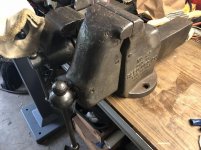
On one hand, the only picture I have shows a vise that while rusty, seems to be relatively free of gross mistreatment. The handle looks straight, the beam(?) doesn’t seem to have been used as an anvil, and there’s no paint to cover any repairs or cracks. Repairs or cracks that the seller has already assured me aren’t present. On the other hand, the swivel base isn’t there and I kinda feel like its omission might end up being a buzzkill of sorts. Not so much from a users perspective, but in the eyes of a person who’d like to have a nicely preserved AND complete example of its kind. What’s funny is that it didn’t bother me that it didn’t have a swivel base until I noticed that pretty much all the 4c vises I’ve seen pictures of here and across the web are equipped with one.
So my questions for those that know more about thes Reed vises are these... Was the 4C even offered without the swivel? If so, was the base the same with the intention being to just bolt the vise down through the same holes that the swivel locks wold have gone through? Seems like three holes minimum would be prudent for something expecting to see such heavy work. And if no to the first, do people ever part these old vises out so that there’d be any chance at all of finding a replacement base?
If this was one of those “I got it for 50 bucks!” type deals, I wouldn’t have hesitated for a second. Hell, I’d probably not have asked these questions if it were a 200 dollar deal, but the guy wants 300 for it. Now I know that in my part of the country really good deals on old iron don’t come up as often as they seem to in areas where a lot of old manufacturing took place, but 300 for an incomplete vise really has me on the fence. What say the vise guys here?
On one hand, the only picture I have shows a vise that while rusty, seems to be relatively free of gross mistreatment. The handle looks straight, the beam(?) doesn’t seem to have been used as an anvil, and there’s no paint to cover any repairs or cracks. Repairs or cracks that the seller has already assured me aren’t present. On the other hand, the swivel base isn’t there and I kinda feel like its omission might end up being a buzzkill of sorts. Not so much from a users perspective, but in the eyes of a person who’d like to have a nicely preserved AND complete example of its kind. What’s funny is that it didn’t bother me that it didn’t have a swivel base until I noticed that pretty much all the 4c vises I’ve seen pictures of here and across the web are equipped with one.
So my questions for those that know more about thes Reed vises are these... Was the 4C even offered without the swivel? If so, was the base the same with the intention being to just bolt the vise down through the same holes that the swivel locks wold have gone through? Seems like three holes minimum would be prudent for something expecting to see such heavy work. And if no to the first, do people ever part these old vises out so that there’d be any chance at all of finding a replacement base?
If this was one of those “I got it for 50 bucks!” type deals, I wouldn’t have hesitated for a second. Hell, I’d probably not have asked these questions if it were a 200 dollar deal, but the guy wants 300 for it. Now I know that in my part of the country really good deals on old iron don’t come up as often as they seem to in areas where a lot of old manufacturing took place, but 300 for an incomplete vise really has me on the fence. What say the vise guys here?