To avoid these ads, REGISTER NOW!

Anyone knowledgeable on battery cable lug crimping?

mikegt4

Well-known member
Joined
Sep 12, 2005
Messages
3,277
Location
sw ohio
Excellent choice FigureItOut, that was my first choice until I found the FTZ at kljack for a price much cheaper then anyone else had at the time. Follow the instructions at pbase and you will be making great crimps in no time. After the first squeeze rotate the tool around the crimp 90* and squeeze again to get a nice round crimp (suggested by pbase). I cut apart one of my first crimps and found the fitting and wire were indeed smashed together as one solid piece. Don't forget to slide on the heat shrink tube (with adhesive) BEFORE crimping on the fitting or you will be cutting off the fitting too!

Warning: making crimps can become addictive and before long you will be asking your friends if they need new battery cables.
 
To avoid these ads, REGISTER NOW!
OP
F

FigureItOut

Well-known member
Joined
Sep 14, 2015
Messages
3,267
Location
Bentonville AR
Excellent choice FigureItOut, that was my first choice until I found the FTZ at kljack for a price much cheaper then anyone else had at the time. Follow the instructions at pbase and you will be making great crimps in no time. After the first squeeze rotate the tool around the crimp 90* and squeeze again to get a nice round crimp (suggested by pbase). I cut apart one of my first crimps and found the fitting and wire were indeed smashed together as one solid piece. Don't forget to slide on the heat shrink tube (with adhesive) BEFORE crimping on the fitting or you will be cutting off the fitting too!

Warning: making crimps can become addictive and before long you will be asking your friends if they need new battery cables.
No rotation needed, as the Quick Cable crimper is a hex rather than square die profile. I did appreciate that he contacted the manufacturer about the procedure before using/ recommending it. I've found most of those companies are easy to communicate with and happy to share tech info if you're the nerd type like I am. I spent an hour on the phone today with Molex, at least half that time was just chatting with the tech guy.
 

Lelandwelds

Well-known member
Joined
Sep 6, 2017
Messages
2,443
Location
Central Texas
You're only fooling yourself and perhaps a few others who don't know better. Fortunately the OP recognized this.

The hammer crimper is a cheap DIY workaround that produces vastly inferior crimps which cannot be relied upon. Perhaps OK to get you home in an emergency.

Your intermittent duty cycle battery current is very light duty compared to an industrial welding machine operating in a mine for example. A welder rebuilding a crusher will be rated 650 amps @ 100% duty cycle and actual amps will be higher. Such a machine will probably have an arc on time of a minimum of 3 hours per shift for manual and about 6 hours for mechanized. Those cables are crimped with a hammer.

You are kidding yourself if you think your battery application is tougher or the expensive crimper does better. The lug and cable are at a minimum size before the hammer type bottoms out.

The mechanical crimper die puts pressure against the die halves not necessarily the lug. Selecting the right die and lug for the wire is critical for a good crimp. If it was a male /female die, it would work better. If all six sides of the die were operable, it would work better.

The hammer swung against a crimper sitting on top of a 20 ton concrete slab is a dynamic, kinetic motion comparable to forging steel. The mechanical is a slow motion comparable to a pry bar or a pair of pliers.
 
Last edited:

ez-duzit

Well-known member
Joined
Jun 24, 2013
Messages
5,104
Location
Marina del Rey
...The hammer swung against a crimper sitting on top of a 20 ton concrete slab is a dynamic, kinetic motion comparable to forging steel...

If you actually understood the dynamics of crimping battery cables you would not be reduced to quoting the weight of your concrete slab.
 

Lelandwelds

Well-known member
Joined
Sep 6, 2017
Messages
2,443
Location
Central Texas
If you actually understood the dynamics of crimping battery cables you would not be reduced to quoting the weight of your concrete slab.

Brought your best, did ya?

Are we defining better by pull out force? Low electrical resistance? Ease of use? Coolest new tool?
 

bmwpowere36m3

Well-known member
Joined
Nov 8, 2012
Messages
1,125
A hammer crimper can work...but it can also be inconsistent and require a little practice. I'd would classify as crude, but "works". A typical crimper, even more so ratcheting, is more controlled and repeatable.

I've made crimps with a hammer crimper and haven't had issues.... however I'd prefer a traditional crimper. Those import hydraulic ones seem a better proposition for minimal investment.
 

rlitman

Well-known member
Joined
Oct 18, 2010
Messages
24,663
Location
Long Island
Brought your best, did ya?

Are we defining better by pull out force? Low electrical resistance? Ease of use? Coolest new tool?

Better is defined by the most repeatable to get an acceptable crimp. Hammer doesn't cut it in that department.

An acceptable crimp cold flows the copper strands into a solid shape with no voids that air can fit into. But it also does so, with a minimum amount of reduction in cross sectional area.

This takes a LOT of force, which can be achieved though mechanical advantage, hydraulic advantage, or impact. All of these methods are capable of compressing the copper sufficiently to make an acceptable crimp. But hammering is not so easily controlled. It is too easy to crimp insufficiently, or overcrimp with this method. Still, with sufficiently oversized conductors and terminals, a little overcrimping is generally not too much of a risk, unless it is bad enough to work harden to the point of causing cracking.

But of course, your personal experience trumps science and engineering every time. :bowdown:
 

gte718p

Well-known member
Joined
Mar 12, 2009
Messages
3,977
I have built and tested 100s if not thousands of battery cables building electric vehicles. I have tested battery cables in research labs at Georgia Tech. I will say definatively you can make as good of a crimp with a hammer and anvil setup as with a proper crimper. As long as you compress everything together, the cable doesn't know how it was compressed. Assuming you have the correct dies for the lugs, a proper crimper will be easier and more consistent. It is possible to make a bad connection with both methods.
 

ez-duzit

Well-known member
Joined
Jun 24, 2013
Messages
5,104
Location
Marina del Rey
I have built and tested 100s if not thousands of battery cables building electric vehicles. I have tested battery cables in research labs at Georgia Tech...

How many of those had been crimped with a hammer crimper?

I have built and tested 100's of battery cables on yachts.
 

Zewnten

Well-known member
Joined
Jun 11, 2017
Messages
1,841
Ez-duzit it looks like you are looking for an argument on this. How did you test your crimp connections: voltage and/or amp loss, salt water corrosion, metal fatigue, the wayvarious wire and lug manufacturers interchange in the crimpers? Have you used a hammer crimper or just decided they were garbage based on your experience with Joe blow wailing away at it and never used one yourself?

But this whole thing doesn't matter. The OP wanted the equivalent to a torque wrench for wire crump connections. If he wants to make every connection to NASA standards then that is between him and his customers. Personally no one I know is willing to pay for that level of precision and they'they'd be happy using a smashed bit of copper pipe with a hole drilled for a lug. So to the OP I would say you made the best choice for your needs. Let use know if you how like it after a year, I always curious how people's opinions change or not.
 

ez-duzit

Well-known member
Joined
Jun 24, 2013
Messages
5,104
Location
Marina del Rey
Z--actually it appears you are the one looking for an argument.

Really doubt if g had been testing hammer crimped connections, but I'll let him answer for himself. At least one of my projects has circumnavigated, perhaps the ultimate test. Not done with my hammer crimper.

My argument is against misinformation. It is understandable that everyone has a budget. Don't blow it on an inferior tool.
 

gte718p

Well-known member
Joined
Mar 12, 2009
Messages
3,977
How many of those had been crimped with a hammer crimper?

I have built and tested 100's of battery cables on yachts.

Many.

I actually did a project, of hammer crimped, press in the hammer anvil, expensive crimper hand crimper, and hydraulic crimper (can't remember the brands) and ultrasonic welded. The first two were for the SolarCar team and
extra data for an analysis class. The last three were for an OEM. They decided the ultrasonic welder didn't justify the extra cost.

The quality of the crimp as measured by resistance and mechanical strength follows that same order. However, for a good cable compared to a good cable, the differences were trivial. The main difference was the number of bad crimps. On a cable to cable basis they were about the same. As a batch the bad cables dragged down averages.

It is very possible to make a bad crimp with a hammer. We had plenty that were complete failures. We also had cables that were electrically indistinguishable from the ones made with the $50k ultra sonic welder. Actually the worst cables we made where with the first batch with high dollar industrial hydraulic crimper. We started with the wrong die.

I worked in two major research labs (Georgia Tech Research institute(GTRI) and National Electric Energy Testing, Research & Applications Center (NEETAC) as an undergrad research assistant. I did research for major OEMs including GM, AM General, Tesla, and a few others I can't mention. All of my equipment was calibrated and traceable back to standards.

How do you "test" you boat cables?

Overall I agree with bmwpowere36m3. If you are making hundreds of cables a proper crimper is the way to go. I will tell you I have not lost a second of sleep over the crimps that are on my 2/0 F350 rewire or my electric motor cycle. All made with a hammer and anvil.

rlitman is correct on what a good crimp looks like. I like open barrel lugs so you can see the wire. When a crimps is properly executed the wire looks solid. You no longer see the strands.
 

gte718p

Well-known member
Joined
Mar 12, 2009
Messages
3,977
Z--actually it appears you
. At least one of my projects has circumnavigated, perhaps the ultimate test. Not done with my hammer crimper.

For the record that really doesn't prove anything.

In my younger days, I used a 1 in piece of plumbing copper from HD pounded flat with two holes drilled in it as a fuse to "fix" a car at a race. It completed the event with 10 or so 2000+ amp passes. That car set an EV speed record that held for 5 or 6 years.

To stick with the nautical theme, I "repaired" an oil line with a plastic bag and a roll of duct tape. It completed a 9 month deployment traveling almost 50k mile in five seas.

Both were effective and stress tested. Neither was the only or the right way to do things.
 
OP
F

FigureItOut

Well-known member
Joined
Sep 14, 2015
Messages
3,267
Location
Bentonville AR
I actually did a project, of hammer crimped, press in the hammer anvil, expensive crimper hand crimper, and hydraulic crimper (can't remember the brands) and ultrasonic welded. The first two were for the SolarCar team and
extra data for an analysis class. The last three were for an OEM. They decided the ultrasonic welder didn't justify the extra cost.

The quality of the crimp as measured by resistance and mechanical strength follows that same order. However, for a good cable compared to a good cable, the differences were trivial. The main difference was the number of bad crimps. On a cable to cable basis they were about the same. As a batch the bad cables dragged down averages.

It is very possible to make a bad crimp with a hammer. We had plenty that were complete failures. We also had cables that were electrically indistinguishable from the ones made with the $50k ultra sonic welder. Actually the worst cables we made where with the first batch with high dollar industrial hydraulic crimper. We started with the wrong die.

I worked in two major research labs (Georgia Tech Research institute(GTRI) and National Electric Energy Testing, Research & Applications Center (NEETAC) as an undergrad research assistant. I did research for major OEMs including GM, AM General, Tesla, and a few others I can't mention. All of my equipment was calibrated and traceable back to standards.

So it appears that perhaps you're the most knowledgeable participant in this thread. From the perspective you've described, I can see why you're comfortable with a hammer crimp on your personal vehicles, or even fine with hammer crimps in production where a certain failure rate is acceptable. In my case, no failures are acceptable to me. The consequences of a failure are certainly not dire, nor is the application critical, but I'm glad to spend an extra couple hundred to protect my reputation, to increase my own confidence (and pride) in the product I charge for, and decrease the likelihood of a comeback, which in some cases could strand a driver.

Given that, could you really argue for the use of a hammer crimper in my circumstances? I realize you've simply stated your experience, and not belittled my choice to spend a moderate amount of money on the tooling, I've chosen to ignore the posters that have. You seem objective and experienced in the subject matter, if you were looking at this subjectively, from my position, what might you say?
 

ez-duzit

Well-known member
Joined
Jun 24, 2013
Messages
5,104
Location
Marina del Rey
...I have not lost a second of sleep over the crimps that are on my 2/0 F350 rewire or my electric motor cycle. All made with a hammer and anvil...

g--thank you for your reply. It is understandable that you would not be concerned about a failure on your pickup or motor cycle. A failure from a 2nd rate crimp would be a minor inconvenience. You might be late for work or miss an appointment. You might be stuck on the side of the road until AAA arrived. Or have to change to your other vehicle. Unlikely a life threatening event.

On yachts people's lives often do depend on their electrical systems. Ship-to-ship and ship-to-shore emergency communications, navigation electronics, watermakers, power to prevent being driven onto a lee shore or to maneuver out of a ship's path, or running lights to prevent being run over ...

I suppose your car might strand you during a blizzard, causing you to freeze to death? Maybe it's OK to make inferior crimps--maybe it's unwise. Why take a chance?
 
OP
F

FigureItOut

Well-known member
Joined
Sep 14, 2015
Messages
3,267
Location
Bentonville AR
Maybe it's OK to make inferior crimps--maybe it's unwise. Why take a chance?
My feelings exactly. Though I'm not in a production environment or doing anything critical to life and safety, the cost difference between a UL listed, controlled cycle crimper, and the imprecise tool, is pretty damn minimal. By gte's account, the hammer crimper was capable of making excellent crimps, but also had a much higher rate of failure. I personally don't choose a lesser method for my customers to save a one-time investment of a couple hundred bucks. For the occasional repair for my vehicles, I can see it. The argument against the better tool, just isn't there.

Edit: I do all of the electrical work for a small police department. If one of their cruisers had a battery cable that needed repair, I'd most certainly be tasked with rebuilding it. The potential consequence of that repair failing at the wrong time is surely more serious than a welder going down for a few minutes.
 
Last edited:

gte718p

Well-known member
Joined
Mar 12, 2009
Messages
3,977
So it appears that perhaps you're the most knowledgeable participant in this thread. From the perspective you've described, I can see why you're comfortable with a hammer crimp on your personal vehicles, or even fine with hammer crimps in production where a certain failure rate is acceptable. In my case, no failures are acceptable to me. The consequences of a failure are certainly not dire, nor is the application critical, but I'm glad to spend an extra couple hundred to protect my reputation, to increase my own confidence (and pride) in the product I charge for, and decrease the likelihood of a comeback, which in some cases could strand a driver.

Given that, could you really argue for the use of a hammer crimper in my circumstances? I realize you've simply stated your experience, and not belittled my choice to spend a moderate amount of money on the tooling, I've chosen to ignore the posters that have. You seem objective and experienced in the subject matter, if you were looking at this subjectively, from my position, what might you say?

Sorry threads are a conversation and sometimes the veer away from the OPs purpose. I jumped into the argument about hammer crimps not being a valid or correct method to make a crimp. That is complete BS.

For a professional or someone making a lot of cables a crimper makes sense. I wouldn't want to deal with bad crimps either. The attention it takes to make good crimps with a hammer and anvil takes time. With a little practice you will know as soon as you hit it if it was good or not. If you don't hit is square, slip a little, don't have everything lines up perfectly or don't get a good swing it is going to be a bad crimp. Then you have to take time to reprep and rework it. Time is money.

What is right for you depends on your situation.

Honestly the HF on make really good crimps. The only problem is the dies require modification. They are completely off out of the box. 15 minutes with the die grinder and it makes very good repeatable crimps. Can't beat it for $80.

The greenlee hydraulic versions are awesome. However they come with an $900-$1800 price tag. Oh the dies are specific for each size and sold separately.

The battery powered version is even better but they run $2500-$4500 depending on tonage. It is also super fast, super consistent. Again dies sold separately. You better be making a ton of crimps for that price.

I personally like stuff from a German company named Klauke. They make some of Grennlee's products. They make stuff under their own name but it runs ~800 with a single die.

Your choice is good. I've used the quick cable tooling before. It is good stuff. unrelated, but their fine stranded battery wire and parrot clamps are top notch. I don't mean to start the Snap On argument. You bought the Snappy version. Nothing wrong with that. + points for supporting a US manufacturer. However it is really not any better then the Taiwanese versions at 1/5 the price. I have no idea what quick cables customer service is like, but it may be worth the extra cost. No idea.
 

Zewnten

Well-known member
Joined
Jun 11, 2017
Messages
1,841
No Ez I was commenting on your completely none fact based opinions about crimping connections. gte718p has a fact based opinion as in he actually objectively tested these connections. As far your opinion is concerned it has equal weight to Lelandswelds', as in you both have a limited pool of examples to go by and none of it has been instrumentally tested in any way just anecdotally. So lets not just go off calling each others opinions junk just because ours differ. But again I ask have you ever used a hammer crimper?
 
To avoid these ads, REGISTER NOW!

Zewnten

Well-known member
Joined
Jun 11, 2017
Messages
1,841
Ex so your saying that if you had used your hammer crimper the connection would have failed? If thatvs the case why do you own one?
 

rlitman

Well-known member
Joined
Oct 18, 2010
Messages
24,663
Location
Long Island
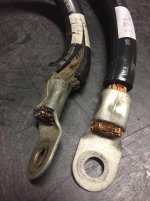
Here’s a real world example. Two ends of the same cable. Factory hydraulic crimps (made by Eaton).

One side started to run hot, due to a bad crimp. It happens. Even in the best of situations.

IMG_7464.jpg
 

rlitman

Well-known member
Joined
Oct 18, 2010
Messages
24,663
Location
Long Island
r--those were very poorly crimped. And non-tinned cable. Cheap stuff.

They weren't starter battery cables, so no weather exposure, so tinning should not have been necessary, though I used tinned wire for the replacement as tinned copper holds up better against oxidation at elevated temperatures. But these shouldn't have been running all that hot anyway.

And they had nylon insulators, so the crimp was done over the plastic. I think that was a large part of the problem. When I've made replacements, I crimp the bare metal, and then cover with double layer heat shrink.

To test my own crimps, I'll section them, polish and look with a microscope. I feel like I'd like to cut these open, but don't really have the time.
 

rlitman

Well-known member
Joined
Oct 18, 2010
Messages
24,663
Location
Long Island
Would you give some detail on how you do that?

Do a google image search for "crimp cross section", and you'll get an idea.

cross-sectionsAcceptableUnacceptable.gif


On small enough stuff, I'll shear through it with my Klein cable cutters, and then sand off the end. It's easy enough to see the details and defects in a 20x loupe, but not nearly as easy to get good pictures of them.

In a good crimp, the cross section of the wires (where maximally compressed) will no longer be round, but rather, they'll form a honeycomb without voids.

gte718p;7127351...rlitman is correct on what a good crimp looks like. I like open barrel lugs so you can see the wire. When a crimps is properly executed the wire looks solid. You no longer see the strands.[/QUOTE said:
Is there really anything to see in an open barrel crimp? I think that the only important parts to see are hidden in the inside. I'm sure than an X-ray would work well, but that's above my pay grade.

Personally, for battery cables, I chose closed terminals like this:
copper-cable-lugs-single-hole.jpg


They're seamless, so that's a plus, and the closed end better protects from corrosion (with paired with heat shrink) in the possibility that the crimp is less than perfect.
 
Last edited:

texasprd

Well-known member
Joined
Sep 6, 2010
Messages
376
Location
San Antonio, TX
Here’s a real world example. Two ends of the same cable. Factory hydraulic crimps (made by Eaton).

One side started to run hot, due to a bad crimp. It happens. Even in the best of situations.

I notice the corrosion under the insulation. I'd bet there was some significant voltage drop. Maybe a which-came-first question - the high temp or the corrosion?
 

theoldwizard1

Well-known member
Joined
Feb 22, 2011
Messages
43,250
Location
SE MI
r--those were very poorly crimped. And non-tinned cable. Cheap stuff.

While I agree that tinned wire is better is damp environments, it is not found on most heavy gauge cable. I have only seen it on marine cable and the price is $$$$ !! :eyecrazy:
 

theoldwizard1

Well-known member
Joined
Feb 22, 2011
Messages
43,250
Location
SE MI
Do a google image search for "crimp cross section", and you'll get an idea.

cross-sectionsAcceptableUnacceptable.gif
I have done my fair share of crimps and I prefer TE Connectivity Solistrand uninsulated **** and ring terminals for wire up to about 10 AWG. Most (all?) of these terminals have a seam on the barrel. The anvil of your crimper is placed directly on top of this seam and will give you the "normal" looking crimp. Slight over crimping will result in an "open seam".

I ALWAYS use marine/"dual wall" heat shrink so I am not overly concerned if the seam cracks a little.
 

ca90ss

Well-known member
Joined
Mar 4, 2015
Messages
340
Location
California
I jumped into the argument about hammer crimps not being a valid or correct method to make a crimp. That is complete BS.

It's not that it's not possible to make a good crimp with a hammer crimper but IMO if a tool isn't consistent then it isn't a good tool for the job. Lugs aren't cheap and it doesn't really take that many for the cost of wasted lugs to exceed the cost of buying a better tool to begin with.
 

rlitman

Well-known member
Joined
Oct 18, 2010
Messages
24,663
Location
Long Island
I notice the corrosion under the insulation. I'd bet there was some significant voltage drop. Maybe a which-came-first question - the high temp or the corrosion?

That I am prepared to answer. The crimp I posted was inspected semi-annually. Last July, it was found to be warmer than the neighboring phases via thermal scan. Suspecting a problem with the bolt, the connection was disassembled, cleaned, and re-torqued during the PM. At that time, the temperature was not high enough to damage the insulation, so it was put back into service. It was then found in the pictured condition this January, when it was replaced. Voltage drop wouldn't have been noticed. This was on a 480V 3-phase connection.

While I agree that tinned wire is better is damp environments, it is not found on most heavy gauge cable. I have only seen it on marine cable and the price is $$$$ !! :eyecrazy:

Yep. Stick the word marine on something and the price jumps through the roof. But copper corrosion is not just caused by dampness. Elevated temperatures are even worse. That's why wires found in your oven for example will use tinned conductors (and high temperature insulation). And is also why TEW wire may be called for instead of MTW in some cases, when they would otherwise be indistinguishable from each other.

I have done my fair share of crimps and I prefer TE Connectivity Solistrand uninsulated **** and ring terminals for wire up to about 10 AWG. Most (all?) of these terminals have a seam on the barrel. The anvil of your crimper is placed directly on top of this seam and will give you the "normal" looking crimp. Slight over crimping will result in an "open seam".

I ALWAYS use marine/"dual wall" heat shrink so I am not overly concerned if the seam cracks a little.

I really don't care for crimps with an open-able seam, though they do have their place in low power uses. The failed crimp I posted gets around this by brazing the seam shut (which is what I see when I google TE Connectivity Solistrand). Another method makes terminals out of two pieces, with a tubular section pressed over the inner section formed with a seam (my T&B StaKon flag disconnects use this method). The closed end terminals hide the seam between two layers around the ring hole. All of these closed seam methods keep more fixed compression on the strands than any open seam terminal.

Imagine cutting a slit across the copper press ring on a PEX fitting before crimping it. Could you picture that holding pressure? I guess that heavy gauge heat shrink does actually compress it a bit. Gates even sells it as a hose clamp. But it's nowhere near as much compression as you can get from a closed metal ring.
 

dogdog

Well-known member
Joined
Nov 15, 2011
Messages
12,711
Here’s a real world example. Two ends of the same cable. Factory hydraulic crimps (made by Eaton).

One side started to run hot, due to a bad crimp. It happens. Even in the best of situations.

IMG_7464.jpg

I know you have another post after this... this one is easier to reply with.

The cable on the left heats up is not because of the bad crimp at least not directly cause of the heating... the section you sliced open clearly shows the green stuff/oxidation on the wires.. for each strand of wire that get coated with oxidation... it reduces the cable capacity.. I have the exact same thing happened to the battery cable on my VW, some genius decided to put the fuse box on top of a the battery... .. until it just don't charge the battery any more. I cut open the cable and observed similiar what you have except a lot more sever with white-ish powder/green-ish coating on a lot more strands...
 

rlitman

Well-known member
Joined
Oct 18, 2010
Messages
24,663
Location
Long Island
I know you have another post after this... this one is easier to reply with.

The cable on the left heats up is not because of the bad crimp at least not directly cause of the heating... the section you sliced open clearly shows the green stuff/oxidation on the wires.. for each strand of wire that get coated with oxidation... it reduces the cable capacity.. I have the exact same thing happened to the battery cable on my VW, some genius decided to put the fuse box on top of a the battery... .. until it just don't charge the battery any more. I cut open the cable and observed similiar what you have except a lot more sever with white-ish powder/green-ish coating on a lot more strands...


My example was a chicken/egg problem.

I suppose I didn’t say this, but those wires came from an indoor piece of equipment permanently mounted in an air-conditioned (and humidity controlled) space. There was absolutely no possibility of corrosion due to condensation, salt or fume exposure. It was not a battery cable, but rather was a single phase in a piece of 3-phase (480VAC) equipment (wire 171 is the A phase on a power factor correction capacitor bank; why do I know the this off the top of my head...), and the other two adjacent phases showed absolutely zero signs of corrosion. The only plausible explanation in my special case was due to the crimp.

However the warm crimp led to accelerated corrosion, which accelerated the failure.
 

gearhead1

Well-known member
Joined
Oct 14, 2013
Messages
1,935
Location
NC
I used one of these for decades for thousands of welders. Three crimps per machine. DLO has a nicer jacket if you are getting crazy. Welding cable is available in two different strandings. One is slightly more flexible.


I once had a customer fish his welder out of the lake using my crimped cable.


Do you really feel electricity will flow better out of one shape of crimp compared to another?

This is what I have. I’ve made many crimps on welding cable and battery cables for my demolition derby cars. I understand you need to reduce variation when making in volume, but this works well for me. I always use heat shrink and never have had a problem.

I always have to remount the battery on the derby cars, so I do a lot of battery cables. Buying -remade was getting expensive and wasn’t exactly the right length. So when I was looking into it, I found the crimpers to be expensive and not sure what quality level each would give, then you add in the variation in the lugs. Then I read somewhere the HF hydraulic ones (more reasonably priced) were off on the size. When I saw the hammer crimper for like $20, I thought that’ll be perfect for me.

Think about how tough the derby car application is. The radiators get taken out at some point, the engine is very hot and tight, and you want the least resistance possible to get the engine to restart.

I think the OP also has an appearance standard to meet, this is for I assume to be a restored or in the process of it car. It has to look good as well as function.
 

dogdog

Well-known member
Joined
Nov 15, 2011
Messages
12,711
My example was a chicken/egg problem.

I suppose I didn’t say this, but those wires came from an indoor piece of equipment permanently mounted in an air-conditioned (and humidity controlled) space. There was absolutely no possibility of corrosion due to condensation, salt or fume exposure. It was not a battery cable, but rather was a single phase in a piece of 3-phase (480VAC) equipment (wire 171 is the A phase on a power factor correction capacitor bank; why do I know the this off the top of my head...), and the other two adjacent phases showed absolutely zero signs of corrosion. The only plausible explanation in my special case was due to the crimp.

However the warm crimp led to accelerated corrosion, which accelerated the failure.

I just realized this was an old thread... but anyways...

I am not sure if warm crimp can accelerate corrosion, without moisture I am not sure if dissimilar / galvanic corrosion is possible... as well on AC. , copper melting point is pretty high, warm probably won't corrode it... if the crimp is bad, at least it would show sign of arcing... which it doesn't seems like it... That copper wiring on the crimp looks fine, just everything after the crimp is bad, as if some one spill something on it or dip it in water or Pee on it....might be prior to having this cable installed... I supposed given this happened many moons ago, sniff test is not possible....
 

Mr_B

Well-known member
Joined
Nov 21, 2016
Messages
5,378
Location
Reading
I use hex crimp die blocks from a dumped no brand hydraulic crimper and made a jig use them in my press, could be used in a good vise too .
works pretty good besides portability, might be able rig it up in my astro bj press !
 

rlitman

Well-known member
Joined
Oct 18, 2010
Messages
24,663
Location
Long Island
I just realized this was an old thread... but anyways...

I am not sure if warm crimp can accelerate corrosion, without moisture I am not sure if dissimilar / galvanic corrosion is possible... as well on AC. , copper melting point is pretty high, warm probably won't corrode it... if the crimp is bad, at least it would show sign of arcing... which it doesn't seems like it... That copper wiring on the crimp looks fine, just everything after the crimp is bad, as if some one spill something on it or dip it in water or Pee on it....might be prior to having this cable installed... I supposed given this happened many moons ago, sniff test is not possible....


Absolutely yes. My situation was NOT galvanic corrosion. Copper’s melting point of 1085C is immaterial. By 200C, you can watch CuO form with your eyes. My wires were under 100C, but keep in mind that any increase in temperature will have a corresponding increase in oxidation rate. Clean a penny with some vinegar and observe how you can easily darken it in seconds with a heat gun. And then remember that I’m monitoring a process that unfolds in terms of months or even years.

That’s why I stated above that the wiring you can find in your range is all tinned. Bare copper will not survive long behind an oven.

Battery cables will never see so much time spent heated electrically. My poor cables run 24x7x365 near their design limits.
 
To avoid these ads, REGISTER NOW!
Top Bottom