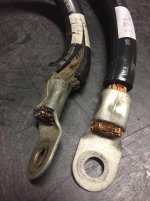
How many of those had been crimped with a hammer crimper?
I have built and tested 100's of battery cables on yachts.
Many.
I actually did a project, of hammer crimped, press in the hammer anvil, expensive crimper hand crimper, and hydraulic crimper (can't remember the brands) and ultrasonic welded. The first two were for the SolarCar team and
extra data for an analysis class. The last three were for an OEM. They decided the ultrasonic welder didn't justify the extra cost.
The quality of the crimp as measured by resistance and mechanical strength follows that same order. However, for a good cable compared to a good cable, the differences were trivial. The main difference was the number of bad crimps. On a cable to cable basis they were about the same. As a batch the bad cables dragged down averages.
It is very possible to make a bad crimp with a hammer. We had plenty that were complete failures. We also had cables that were electrically indistinguishable from the ones made with the $50k ultra sonic welder. Actually the worst cables we made where with the first batch with high dollar industrial hydraulic crimper. We started with the wrong die.
I worked in two major research labs (Georgia Tech Research institute(GTRI) and National Electric Energy Testing, Research & Applications Center (NEETAC) as an undergrad research assistant. I did research for major OEMs including GM, AM General, Tesla, and a few others I can't mention. All of my equipment was calibrated and traceable back to standards.
How do you "test" you boat cables?
Overall I agree with bmwpowere36m3. If you are making hundreds of cables a proper crimper is the way to go. I will tell you I have not lost a second of sleep over the crimps that are on my 2/0 F350 rewire or my electric motor cycle. All made with a hammer and anvil.
rlitman is correct on what a good crimp looks like. I like open barrel lugs so you can see the wire. When a crimps is properly executed the wire looks solid. You no longer see the strands.