To avoid these ads, REGISTER NOW!

How to clean feeler gauges without destroying ething

LawnBoy-5247

Well-known member
Joined
Aug 20, 2016
Messages
303
Location
Kansas City
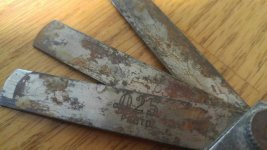
As the title says I picked up a old set of Proto feeler gauges and want to clean them and remove the rust from them without destroying the etchings on them what is the best way to go about it?20180608_110306.jpeg1528474322439.jpeg

Sent from my LGLS991 using Tapatalk
 
To avoid these ads, REGISTER NOW!

WWheeler

Well-known member
Joined
Jun 23, 2015
Messages
4,105
Location
Middleofnowhere USA
If I really wanted to use them I'd do so as is or maybe wipe them off with a scotch brite pad with a bit of WD40 on it and hope I didn't wipe off the etching in the process. More than likely I'd just get a brand new set for the $10-$15 those Protos likely cost.
 

KnurledNut

Well-known member
Joined
Jan 28, 2011
Messages
8,166
Location
n/a
That .03 is Plomb marked. :beer:

Those really arent too bad, other than the damaged ones.
If you plan to use them, id hit them with some WD-40 and a rag to wipe some surface rust off, and add a layer of protection.
IMO avoid any acid baths.
 

APEowner

Well-known member
Joined
Oct 2, 2009
Messages
4,166
Location
Sunny, New Mexico
Feeler gauges are consumables and that set is trashed. I wouldn't even think about trying to clean them unless you want to display them for some reason.
 

rlitman

Well-known member
Joined
Oct 18, 2010
Messages
24,633
Location
Long Island
I'd be afraid you then would compromise the true reading and thickness of the blade.

Neither will affect the thickness. We're talking about feeler gauges here and not AA Jo blocks.

However, Evaporust will likely remove the etchings.

My suggestion would be to use a solvent such as acetone to completely degrease the steel. Then rub the rust off the dry steel with 0000 steel wool. Finally, re-oil.
 

larry_g

Well-known member
Joined
Apr 28, 2007
Messages
16,889
Location
oregon
Feeler gauges are consumables and that set is trashed. I wouldn't even think about trying to clean them unless you want to display them for some reason.

X2 on this. These are a precision measurement devise. If you don't care about precision then abrade away at them. The corrosion has already rendered them worthless.

lg
no neat sig line
 

rlitman

Well-known member
Joined
Oct 18, 2010
Messages
24,633
Location
Long Island
X2 on this. These are a precision measurement devise. If you don't care about precision then abrade away at them. The corrosion has already rendered them worthless.

lg
no neat sig line

You and I have vastly different perspectives on "precision".

Feeler gauges generally come in steps of 0.001 (though a set will often have a 0.0015 blade to cut that in half). That's an enormous step. You can steel wool the blades till you're blue in the face and still not remove a hundredth of that thickness. And even if you managed to remove a tenth (which I posit as damn near impossible), it wouldn't affect the use of the feeler.

Next, we should consider the requirements of a precision ground surface. Low spots are not a problem, so no amount of corrosion pitting will affect the overall thickness. High spots ARE a problem, so once you brush off the rust spots, you're back in business.
 
To avoid these ads, REGISTER NOW!
OP
L

LawnBoy-5247

Well-known member
Joined
Aug 20, 2016
Messages
303
Location
Kansas City
I understand they are consumables and I have others I can use. I just want to clean these up because they are cool being dual marked Proto and Plomb.

Sent from my LGLS991 using Tapatalk
 
OP
L

LawnBoy-5247

Well-known member
Joined
Aug 20, 2016
Messages
303
Location
Kansas City
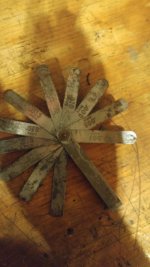
Scotchbrite worked great. Now for all the Proto/Plomb experts out there is there any chance the Plomb gauge is factory or did someone add it in at some point? 20180608_150643.jpg20180608_150732.jpg

Sent from my LGLS991 using Tapatalk
 

DadsTools

Well-known member
Joined
Jul 27, 2017
Messages
1,852
Scotchbrite worked great. Now for all the Proto/Plomb experts out there is there any chance the Plomb gauge is factory or did someone add it in at some point? 20180608_150643.jpg20180608_150732.jpg

Sent from my LGLS991 using Tapatalk
Post that question in the Vintage Tool Section for the best responses.
 

larry_g

Well-known member
Joined
Apr 28, 2007
Messages
16,889
Location
oregon
You and I have vastly different perspectives on "precision".

Feeler gauges generally come in steps of 0.001 (though a set will often have a 0.0015 blade to cut that in half). That's an enormous step. You can steel wool the blades till you're blue in the face and still not remove a hundredth of that thickness. And even if you managed to remove a tenth (which I posit as damn near impossible), it wouldn't affect the use of the feeler.

Next, we should consider the requirements of a precision ground surface. Low spots are not a problem, so no amount of corrosion pitting will affect the overall thickness. High spots ARE a problem, so once you brush off the rust spots, you're back in business.

I spent many years in machine maintenance and a lot of setups were done with feeler gauges. Part of the test is FEEL and if you have a rough surface then the feel goes to hell or the parts being gauged are scratched or abraded if the feeler stock is not smooth. If checking pinpoints then they drop into the divot. There are appropriate places for feeler gauges and their fine finish.
I'm in hope that some of the youngsters that read this learn that rusty old measuring tools are not something that can be brought to new. Some will not see the difference between this and polishing up a rusty set of jo blocks.

lg
no neat sig line
 

6PTsocket

Well-known member
Joined
Mar 12, 2014
Messages
4,593
I'd be afraid you then would compromise the true reading and thickness of the blade.
The Evaporust absolutely would not. It only removes rust and not sound steel, unlike acid based derust baths. What metal has already turned to rust is gone and whatever innacuracy this causes you are stuck with. The brass brush will not remove good steel either. It is softer than steel but dealing with those thin leaves, possibly depositing brass on the rough surface or creasing a leaf, I would use the Evaporust. To be honest, corroded measuring standards are not something I would bother with.

Sent from my SM-G900V using Tapatalk
 

rlitman

Well-known member
Joined
Oct 18, 2010
Messages
24,633
Location
Long Island
I spent many years in machine maintenance and a lot of setups were done with feeler gauges. Part of the test is FEEL and if you have a rough surface then the feel goes to hell or the parts being gauged are scratched or abraded if the feeler stock is not smooth. If checking pinpoints then they drop into the divot. There are appropriate places for feeler gauges and their fine finish.
I'm in hope that some of the youngsters that read this learn that rusty old measuring tools are not something that can be brought to new. Some will not see the difference between this and polishing up a rusty set of jo blocks.

lg
no neat sig line

If you're checking between pinpoints, once the gauge is in, there is nothing to feel. It either passes or doesn't. Once it's in the gap, all you've learned is that it already fit. Anyway, that's what wire gauges were made for. With a wire, the roundness does give you something to feel.

As for abrading parts, this too is BS. Either the steel isn't going to hurt the parts, or you need to be using brass gauges. FYI, the manufacturer's etching is no different than a controlled rust, and leaves a texture identical to what cleaned up rust is like. Yes, this can be abrasive, but again, not to a degree that would matter, when we're talking about the tolerances of the gigantic steps between blades.

The Evaporust absolutely would not. It only removes rust and not sound steel, unlike acid based derust baths. What metal has already turned to rust is gone and whatever innacuracy this causes you are stuck with. The brass brush will not remove good steel either. It is softer than steel but dealing with those thin leaves, possibly depositing brass on the rough surface or creasing a leaf, I would use the Evaporust. To be honest, corroded measuring standards are not something I would bother with.

But the Evaporust will remove the etching, which is also iron oxide. :(

I was referring to using a wire wheel on the blades having an affect on their thickness.

Most steel wheels are probably way too harsh a treatment (though a CAREFUL use of a fine steel wheel should be ok). Personally, I find that scotchbrite is also too abrasive. But a brass wheel will not do any harm.
 
Last edited:

Provincial

Well-known member
Joined
Sep 21, 2011
Messages
6,872
Location
Near Salem, OR
During the name changeover, the company used up Plomb-marked parts. On larger parts they added the Proto name, resulting in "Dual-Marked" tools as named by collectors. Pendleton was frugal about discarding perfectly good tools because of markings.
 
To avoid these ads, REGISTER NOW!
Top Bottom