To avoid these ads, REGISTER NOW!

Plumbing Mathematics

Wamsutta

Well-known member
Joined
Jan 8, 2014
Messages
10,879
Location
Amarillo, Texas
3/4" Schedule 80 PVC pipe 0.742" I.D.

3/4" Schedule 40 PVC pipe 0.825 I.D.

Difference of 0.083 or 83/1000

Percentage Calculator says:

.0742 is 89.93% of 0.825 :headscrat

That doesn't seem like a whole lot of difference. And being that my steel pipes are probably already restricted from corrosion build up as it is, it might not be much difference in flow. I might actually gain some flow.

Why don't I join a plumbing forum you say? Because you have to have a contractor's license to join Contractor Talk. :dunno:
 
Last edited:
To avoid these ads, REGISTER NOW!

wkndwarrior29

Well-known member
Joined
Jan 19, 2015
Messages
719
Location
NorthEast
You need to use area instead of diameter, it's actually closer to 80%

A=pi*r^2

What problem are you trying to solve?
 
OP
W

Wamsutta

Well-known member
Joined
Jan 8, 2014
Messages
10,879
Location
Amarillo, Texas
The problem I'm trying to solve is my fear of Schedule 80 3/4" I.D. pipes. I need to change out some pipes, but I don't trust those super flexible Schedule 40 pipes at the home centers. I could go with one inch Schedule 80, but it has to reduce down to 3/4" before going through the exterior wall anyway. I'm thinking one inch reduced down to 3/4" would be the same as having 3/4" pipes in the ground to start with. :dunno:
 

Gmonkee

Well-known member
Joined
May 9, 2010
Messages
2,827
There are other plumbing forums with a DIY and a pro side. The answer on the DIY side is usually "hire a licenced and insured pro".

I found that quite helpful myself.
 

Leaflessshadetree

Well-known member
Joined
Aug 1, 2013
Messages
7,165
Location
Don't ask.
Don't forget to add in losses due to length and fittings. Then whatever other restriction there is at the fixtures at the other end.
What is your concern or what problem are you trying to solve?
 
OP
W

Wamsutta

Well-known member
Joined
Jan 8, 2014
Messages
10,879
Location
Amarillo, Texas
Don't forget to add in losses due to length and fittings. Then whatever other restriction there is at the fixtures at the other end.
What is your concern or what problem are you trying to solve?

Well to come to think of it, I guess what I'm trying to do is come up with a pipe that has the durability of steel without the corrosion problems of steel. It's got to go underground. I thought Schedule 80 would be the hot ticket, but it has a very slight smaller inside diameter do to the thicker wall thickness.
 

Yarpo

Well-known member
Joined
Feb 11, 2017
Messages
1,356
Location
Minnesota
Well to come to think of it, I guess what I'm trying to do is come up with a pipe that has the durability of steel without the corrosion problems of steel. It's got to go underground. I thought Schedule 80 would be the hot ticket, but it has a very slight smaller inside diameter do to the thicker wall thickness.

We run schedule 40 underground all day long but we're not using anything smaller than 1.5 inches.

What are you doing with the pipe?
 
OP
W

Wamsutta

Well-known member
Joined
Jan 8, 2014
Messages
10,879
Location
Amarillo, Texas
We run schedule 40 underground all day long but we're not using anything smaller than 1.5 inches.

Are you draining? Venting?

There's a 1.5 inch main water supply line coming from the street water meter and then it reduces down to three separate 3/4" lines before going into the house. The pipes are for delivering city drinking water.
 

RustyJunk

Well-known member
Joined
Jun 11, 2018
Messages
274
Location
Pasco Fl.
Find a local industrial or utility supply, or even an irrigation supply house, they have better quality materials then the home centers.
 

Yarpo

Well-known member
Joined
Feb 11, 2017
Messages
1,356
Location
Minnesota
There's a 1.5 inch main water supply line coming from the street water meter and then it reduces down to three separate 3/4" lines before going into the house. The pipes are for delivering city drinking water.

So you want to replace the 3/4 branches before they run into the house, or you want to replace the 3/4 branches inside the house running to fixtures etc?

How about PEX?

That was my thought, but only if hes replacing stuff inside the house. I imagine its outside the house based on him wanting to use PVC and him mentioning the exterior wall above
 

59 wagon man

Well-known member
Joined
Oct 25, 2010
Messages
1,589
Location
hollywood fla
pex will reduce the volume and flow of water due to the restriction of the fittings going inside the pipe rather than over the pipe
 
To avoid these ads, REGISTER NOW!

Yarpo

Well-known member
Joined
Feb 11, 2017
Messages
1,356
Location
Minnesota
That stuff might be too thin for underground; I don't know for sure.

We run pex underground all the time also, but only inside the house. Cant comment on outside the walls, we don't touch anything there but I imagine it'll freeze quickly if you're in a cooler climate. I'm just the FNG tho, maybe someone else will have more info :D

4e6496372bd39a6d8224bea857a6256b.png
 
OP
W

Wamsutta

Well-known member
Joined
Jan 8, 2014
Messages
10,879
Location
Amarillo, Texas
I posted some pictures in the Test section. They're quite gross, so make sure you don't look at them while you're having your dinner.
 

Gmonkee

Well-known member
Joined
May 9, 2010
Messages
2,827
Check local code especially if ground frost is a factor. I can get away with just about anything here for the climate but prefer to use sch 80 in the biggest reasonable size for the job. Nobody ever ******* about too much flow.

A friendly local plumber type friend would be better to give advice that will not hurt the sale of the home in the future.

Going DIY once you have a solid plan is ok.
 
OP
W

Wamsutta

Well-known member
Joined
Jan 8, 2014
Messages
10,879
Location
Amarillo, Texas
I thought about going with 1 inch schedule 80, but what would be the point if I have to reduce it down to 3/4 anyway? All the pipes in the walls are 3/4 inch.
 

WittHay

Well-known member
Joined
Jan 6, 2016
Messages
2,157
Location
Surrey, BC Canada
We have always used 3/4" to 1" polyethylene pipe for underground waterlines. Comes in different ratings 75,100 and 200 psi. It has more give than PVC pipe for frost and driving vehicles over. Doesn't corrode in acidic soil like steel does.

The pipe I am referring to is made locally up here by a company called IPEX, should be something similar available in your area
 
Last edited:

johnnyradiant

Well-known member
Joined
Mar 27, 2017
Messages
833
Location
Vancouver, BC
There are houses in my city that still run off of one 1/2" line coming in from the city, most run off of 3/4. A lot of the newer stuff has 1" or more. I haven't knowingly walked into a house with three 3/4" lines. What pressure does the city water come at and what sorta fixture unit demand do you have that the wall thinkness is so critical?

If you use pex and use the expansion type fittings (Uponor) you will find the fittings don't restrict like the crimp style fitting do.
 
OP
W

Wamsutta

Well-known member
Joined
Jan 8, 2014
Messages
10,879
Location
Amarillo, Texas
There are houses in my city that still run off of one 1/2" line coming in from the city, most run off of 3/4. A lot of the newer stuff has 1" or more. I haven't knowingly walked into a house with three 3/4" lines. What pressure does the city water come at and what sorta fixture unit demand do you have that the wall thinkness is so critical?

If you use pex and use the expansion type fittings (Uponor) you will find the fittings don't restrict like the crimp style fitting do.

I don't know what the PSI is coming from the street, but I don't think it's very much. I was just thinking I need a pipe durable enough to handle the riggers of an underground environment, but I'm not convinced schedule 40 PVC is it. You pick up a 10 foot piece at Lowe's and it wiggles back and forth in your hand.

Crimp style fittings are restrictive?
 

MattT

Well-known member
Joined
Feb 20, 2010
Messages
3,201
I thought about going with 1 inch schedule 80, but what would be the point if I have to reduce it down to 3/4 anyway? All the pipes in the walls are 3/4 inch.

Pressure drop is a function of pipe size and length for a given flow rate. So it depends on what flow you need and the length of the outside run.

High flow and a long run you could be looking at a 20 psi drop with 3/4" vs. around 5 psi with 1" just on the outside piping which will be noticeable. Shorter run and/or lower flow and you'll gain no discernible improvement.

Estimate your flow requirements and measure the length of your pipe runs. With those numbers then you can use a pressure drop table to figure the difference between pipe sizes for your application and make the call on whether using the larger pipe is worth it.
 

Christopher1

New member
Joined
Jul 24, 2018
Messages
3
Location
BELIGUM
I Think Math unfortunately is part of being a plumber or any other skilled trade for that matter. Although we don't tend to use many of these formulas in our daily plumbing chores, you better know them if your planning to write your plumbing exam. Volume of various Objects - Cylinder, sphere, rectangular, frustum.
 

sberry

Banned
Joined
Jun 18, 2005
Messages
35,747
Location
Brethren, Michigan
Using inch and then to 3/4 reduces line friction along the way. 100 ft of inch works better than 100 3/4 even with reduction at the end, if its short enough the 3/4 will hardly matter. A bit of this depends on incoming conditions, area with low pressure benefits more from larger pipe. All this depends on demand, common house fixtures doesn't mean much, filling tanks with wide open valves it does.
Secondly,,, some restriction can be good. It speeds up water a little making it flush faster and reduces consumption. Is the object here to get adequate service or use as much as you can?

3rd, underground is not brutal, its very good, very stable and well anchored and the benefit from 40 is a bit better flow, doesn't matter if the pipe is bendy. 3/4 matches the rest of the fittings without adapters, one size to work with. Use the 40 for working pressures under 100.
 

59 wagon man

Well-known member
Joined
Oct 25, 2010
Messages
1,589
Location
hollywood fla
We run pex underground all the time also, but only inside the house. Cant comment on outside the walls, we don't touch anything there but I imagine it'll freeze quickly if you're in a cooler climate. I'm just the FNG tho, maybe someone else will have more info :D

4e6496372bd39a6d8224bea857a6256b.png

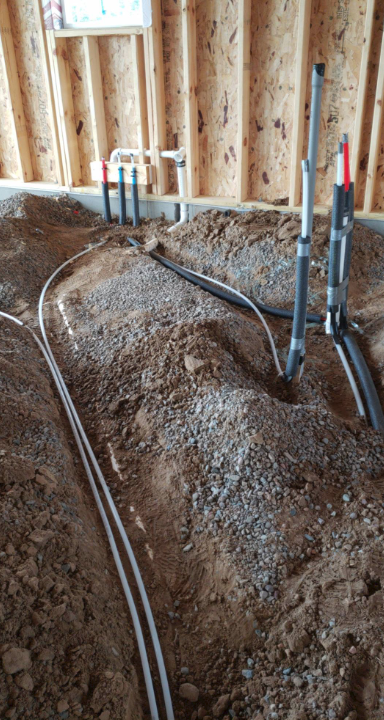
not sure what the code is in your area but down here we would sleeve the pex inside of black poly pipe for a few reasons.
1- if you have an underground leak without a sleeve you will never know it is leaking.
2- it seems as though you provide a sleeve where the pex protrudes through the slab. which is good to prevent the concrete from eating away at the pex but as your picture shows the surrounding dirt is full of rocks which can rub on the pex as it can vibrate with the water running thru it
3- sometimes you can slide out the leaking pipe from the sleeve and slide a new pipe right in the existing sleeve
4- pex is more forgiving if frozen where as something like copper will freeze and burst from expansion
 

Gmonkee

Well-known member
Joined
May 9, 2010
Messages
2,827
I run black poly with PVC hose ****** fittings as faked PEX. Sun and algae resistant on rooftop applications from the water tanks. Seals easily with just automotive hose clamps.

Not to any k.own US code but it eliminates the long term flaws of PVC/CPVC. I have to shade the white plastic from full sun or valve handles crumble and the rest gets very brittle.
 

Yarpo

Well-known member
Joined
Feb 11, 2017
Messages
1,356
Location
Minnesota
not sure what the code is in your area but down here we would sleeve the pex inside of black poly pipe for a few reasons.
1- if you have an underground leak without a sleeve you will never know it is leaking.
2- it seems as though you provide a sleeve where the pex protrudes through the slab. which is good to prevent the concrete from eating away at the pex but as your picture shows the surrounding dirt is full of rocks which can rub on the pex as it can vibrate with the water running thru it
3- sometimes you can slide out the leaking pipe from the sleeve and slide a new pipe right in the existing sleeve
4- pex is more forgiving if frozen where as something like copper will freeze and burst from expansion

Here they don't require it, but were using 2013 UPC.

Yah the rock is code here, gotta have 4 inches of rock ontop of the dirt and then its polyd over, suppose to be for radon gas I guess...

It's also backfilled -> Dirt -> Rock, so while the issue of rubbing is probably there, it should be buried mostly in dirt. We do sleeve the hots for energy savings they say tho haha.
 

matt_i

Well-known member
Joined
Mar 14, 2008
Messages
10,728
Location
SE Michigan
The problem I'm trying to solve is my fear of Schedule 80 3/4" I.D. pipes. I need to change out some pipes, but I don't trust those super flexible Schedule 40 pipes at the home centers. I could go with one inch Schedule 80, but it has to reduce down to 3/4" before going through the exterior wall anyway. I'm thinking one inch reduced down to 3/4" would be the same as having 3/4" pipes in the ground to start with. :dunno:

A single throttle from 1" down to 3/4" and back up is not nearly the same as having a 3/4" all the way.

I would run the 1" Sch 80 even if you have to installl the throttle.

However, along the lines of simplicity and fewer joints, why not also figure out how to core the (concrete?) wall to a larger diameter so you can go straight thru in 1"? Im guessing there is an SDS shanked solution you can obtain.
 

bpjr

Well-known member
Joined
Sep 2, 2013
Messages
554
Location
Florida east coast
Sch 40 is very tough stuff and used for exterior city water and septic drains here in Florida. I have a 500' pvc city water line to my house and no problems in 45 yrs. Sch 40 is used for CW supply and sch 80 used for hot water at a commercial building I own. It's buried deep enough to prevent damage from the occasional frost we have. If your're in doubt to strength, take a piece of 1" (or whatever) and driver your car over it. I did this with several diameters a couple of yrs ago to see what I could bury under my rock/dirt driveway. A RAV 4 didn't do anything to sch 40 from 3/4" to 4".

As far as size, go to a pvc supply house and have them size your run...or you can probably find a chart online. Every turn reduces pressure as does length. We have 70 psi cw here and like already mentioned, reducing down just to penetrate a wall isn't the same as reducing down for long distances. 3/4" sch 40 is likely all you need unless the delivery pressure from your city is way low.

I'd say relax and don't overthink it. Another comment...a very experienced plumber friend says he is seeing lots of leaks from older compression fitting behind walls.
 
OP
W

Wamsutta

Well-known member
Joined
Jan 8, 2014
Messages
10,879
Location
Amarillo, Texas
A single throttle from 1" down to 3/4" and back up is not nearly the same as having a 3/4" all the way.

I would run the 1" Sch 80 even if you have to installl the throttle.

However, along the lines of simplicity and fewer joints, why not also figure out how to core the (concrete?) wall to a larger diameter so you can go straight thru in 1"? Im guessing there is an SDS shanked solution you can obtain.

Sch 40 is very tough stuff and used for exterior city water and septic drains here in Florida. I have a 500' pvc city water line to my house and no problems in 45 yrs. Sch 40 is used for CW supply and sch 80 used for hot water at a commercial building I own. It's buried deep enough to prevent damage from the occasional frost we have. If your're in doubt to strength, take a piece of 1" (or whatever) and driver your car over it. I did this with several diameters a couple of yrs ago to see what I could bury under my rock/dirt driveway. A RAV 4 didn't do anything to sch 40 from 3/4" to 4".

As far as size, go to a pvc supply house and have them size your run...or you can probably find a chart online. Every turn reduces pressure as does length. We have 70 psi cw here and like already mentioned, reducing down just to penetrate a wall isn't the same as reducing down for long distances. 3/4" sch 40 is likely all you need unless the delivery pressure from your city is way low.

I'd say relax and don't overthink it. Another comment...a very experienced plumber friend says he is seeing lots of leaks from older compression fitting behind walls.


Guys, that is the key information I was hoping to find.

Thank you both very much! :beer:
 

bpjr

Well-known member
Joined
Sep 2, 2013
Messages
554
Location
Florida east coast
Guys, that is the key information I was hoping to find.

Thank you both very much! :beer:

Beer sounds good! Water pressures can vary between cities/counties. I would suggest calling your water dept and ask them what their normal pressure is. Also be aware that dead ends in the pipe can promote bacteria growth. Rule of thumb is a stub out is NO longer than the diameter of the pipe. Circulation is needed to keep bacteria away.
 

Rusty Bolt

Well-known member
Joined
Nov 12, 2017
Messages
87
Location
Carson City, NV
That stuff might be too thin for underground; I don't know for sure.


I wan't to replace the underground 3/4" branches before they go into the house.

I'd use PEX. The pipe is freeze proof - the fittings not so much.

I replaced an underground, leaking 1 1/2 PVC pipe with dual, 1 inch PEX about 10 years ago. It's a longer than 120 foot run. Has been working with no problems.

I used dual 1 inch lines to give me about the same cross section as the old PVC pipe. (1.57 versus 1.77 based on the nominal size) I could get 1 inch Shark Bite fittings for 1 inch PEX but not larger. The tools to expand and secure larger PEX would have run more $2K, so 1 inch PEX with Shark Bites was a lot cheaper. Though these days, I use copper crimp rings.

I have upwards of 400 feet of buried 1 inch PEX around my house. The only problem was that one brass fitting dissolved and started leaking!!

The flow restriction with a few fittings isn't much and I've never noticed it. Since you normally run single lengths of PEX, the only fittings are on the ends.

PEX is pretty tough. Just try wrestling with it when the temperature is in the mid 30's
 
To avoid these ads, REGISTER NOW!
Top Bottom