To avoid these ads, REGISTER NOW!

vintage saw restoration

OP
L

LesserSon

Well-known member
Joined
Feb 7, 2016
Messages
5,039
Location
PA USA
Sometimes things don’t go your way.
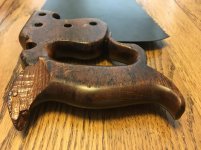
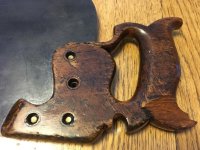
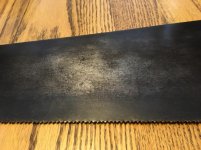
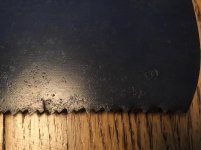
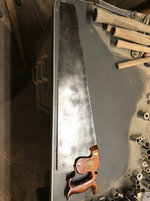
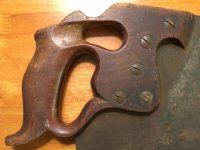
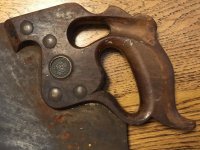
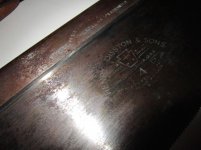
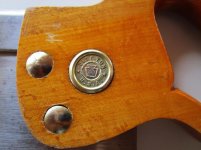
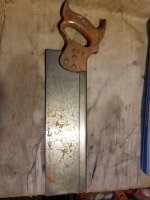
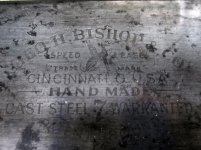
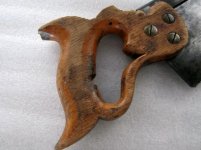
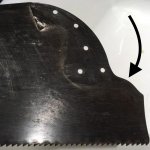
Today, I was trying to finish up some dismantled saws, and this one seemed easy. Along the way, I ran into the issues that stopped me the first time. It’s a Disston No7, nothing uncommon. But the cross-grain figure of the beech handle encouraged me to proceed. I started with the handle, gluing and shellacking. There’s a chunk out of the upper horn, but I can wait until a nice piece if beech comes my way. The cap screws and the medalion are missing. Not replaceable with standard saw unts because these are domed screws, and the smaller type, for panel saws, to boot. Arrg! Well, what about the blade? There’s a cup at the toe of the blade, which I think indicates it was shortened or at least bent long ago. Lovely patina, of course I went and rubbed it away prospecting for the etch, which didn’t show up. Now I wish I hadn’t. I suspect it was very shallow to begin with, and just got swallowed up in the oxidation. And finally, a tear in the cutting edge near the heal. Probably induces weird vibration when cutting.
So what to do? For now, I’ll just keep it together in hopes of finding a correct medalion and four caps nuts. Then I’ll patch in some beech to the handle. And maybe get creative with a progressive tooth geometry at the heel, to eliminate the tear.
 

Attachments

  • 7798BAC2-6376-44B1-A828-766EF36ABC59.jpg
    7798BAC2-6376-44B1-A828-766EF36ABC59.jpg
    75.4 KB · Views: 48
  • 16FC29F2-1778-4E5C-9AA9-6ADBCCB06E24.jpg
    16FC29F2-1778-4E5C-9AA9-6ADBCCB06E24.jpg
    153.9 KB · Views: 48
  • 64A827B0-B66F-413E-893A-4B0EE2075B8C.jpg
    64A827B0-B66F-413E-893A-4B0EE2075B8C.jpg
    149.6 KB · Views: 45
  • F5DBC2ED-51EE-4136-BEE9-39A8C30FBC3C.jpg
    F5DBC2ED-51EE-4136-BEE9-39A8C30FBC3C.jpg
    151.8 KB · Views: 46
  • F87B3C10-22D2-42A9-9C36-39352D67B065.jpg
    F87B3C10-22D2-42A9-9C36-39352D67B065.jpg
    97.3 KB · Views: 48
  • 875BBB7B-AF28-45D7-B897-02F2634850D5.jpg
    875BBB7B-AF28-45D7-B897-02F2634850D5.jpg
    150.3 KB · Views: 46
  • F24C46D7-9A18-4C4F-B6A9-C0944CC52E6C.jpg
    F24C46D7-9A18-4C4F-B6A9-C0944CC52E6C.jpg
    148 KB · Views: 50
To avoid these ads, REGISTER NOW!

jimreed2160

Well-known member
Joined
Aug 7, 2016
Messages
3,589
Location
Tallahassee FL
Sometimes they are too far gone and need to be repurposed. I like saws like this one to practice on. The weird split from the handle looks like a real challenge to repair but also a good learning experience. With substitute nuts maybe this 8 pointer becomes a good user.
 
OP
L

LesserSon

Well-known member
Joined
Feb 7, 2016
Messages
5,039
Location
PA USA
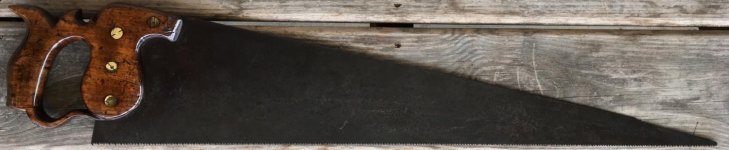
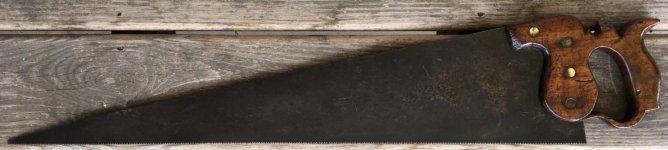
Today I tackled another saw that’s been sitting around for long enough that I don’t remember where it came from. It looks like a No7, but I’m not so sure. I extracted enough of the etch to see that it is a Disston, but it seems to say “Henry Disston & Son”. Exciting if true for a saw in this condition, but really, it’s too faint to be sure. And I cannot make out the model number. And the saw nuts and medalion are no help in dating it, because there are none! The beech handle is riveted with copper onto the blade.
When I started scraping it - big surprise: this is the hardest blade I’ve worked on. Hematite clinging with shocking tenacity. I went through five scrapers, lost all semblance of technique, and barely left a gouge or scratch on it. This is not characteristic of No7s. I began to think it might be more of a No340, 341, or 342, but the 7 teeth per inch are crosscut, and do have a set. And they’re dull. For how hard the steel is, how did THAT happen?
A mystery saw to me.
 

Attachments

  • 1FB97C42-CFD2-49F4-B189-3190AA4DC803.jpg
    1FB97C42-CFD2-49F4-B189-3190AA4DC803.jpg
    146.7 KB · Views: 55
  • D28BF4B6-68AA-41EF-892B-A72A2586B9AF.jpg
    D28BF4B6-68AA-41EF-892B-A72A2586B9AF.jpg
    150.9 KB · Views: 51
  • E445E93D-B342-4DF7-819B-DF8A9CE1519F.jpg
    E445E93D-B342-4DF7-819B-DF8A9CE1519F.jpg
    146.5 KB · Views: 53
  • FEB8BBCC-19D1-45EB-8F03-7E220F6D1C98.jpg
    FEB8BBCC-19D1-45EB-8F03-7E220F6D1C98.jpg
    153.7 KB · Views: 56
  • E3F100E5-9DB5-46D2-A1B7-567F2937929A.jpg
    E3F100E5-9DB5-46D2-A1B7-567F2937929A.jpg
    154.1 KB · Views: 66
Last edited:

jimreed2160

Well-known member
Joined
Aug 7, 2016
Messages
3,589
Location
Tallahassee FL
Those ghost etches can be frustrating because they ALMOST give up their secrets. Whatever it is, looks like you have a nice saw that was not abused. I'll bet a good sharpening would turn it into a great user.
 

rickhigginshtbr

Well-known member
Joined
Aug 7, 2012
Messages
1,551
Location
Lower Bucks, PA
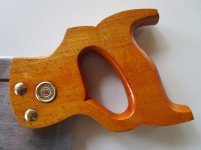
Knocked out another D7 I had this week. Still doing trial and error restoring these.

Successes:

heat up the blade before bluing. Definitely made Gun Blue darker.

I went 120 grit lightly, then used the blue. Then 320 after to clean it all up. Then blue again. Then more sanding. Think the lack of sanding before bluing helped preserve the etch more.

Fails:

I used BLSO on the handle after sanding with 120, then tried to sand again after 2 days. Yea, BLSO doesn’t sand well, at all. Used a lot of paper making it smooth lol.

I also took my first crack at sharpening with this one. Not horrible, made me realize half my files are junk or overly large lol. But with 6 passes I went half way through a 2x4 on the long side. Seems pretty sharp to me. Anyway, pics!

fd6b1881d8e7bf423e4f26e409906046.jpg0e02e0e8aec625a3912d79994f4a750e.jpg3c1e4ecdf20e01c0ad996506e57d8f79.jpg271f570bbdc053961f7b0ae5b681367d.jpg


Sent from my iPhone using Tapatalk
 

Attachments

  • fd6b1881d8e7bf423e4f26e409906046.jpg
    fd6b1881d8e7bf423e4f26e409906046.jpg
    732.7 KB · Views: 4
  • 0e02e0e8aec625a3912d79994f4a750e.jpg
    0e02e0e8aec625a3912d79994f4a750e.jpg
    853.1 KB · Views: 2
  • 271f570bbdc053961f7b0ae5b681367d.jpg
    271f570bbdc053961f7b0ae5b681367d.jpg
    763.5 KB · Views: 2
  • 3c1e4ecdf20e01c0ad996506e57d8f79.jpg
    3c1e4ecdf20e01c0ad996506e57d8f79.jpg
    846.4 KB · Views: 6
OP
L

LesserSon

Well-known member
Joined
Feb 7, 2016
Messages
5,039
Location
PA USA
That’s actually a pre1928 “No.7” (by the medallion, 1896-1917), not a post1928 “D7”. Looks good.
 
Last edited:

txlonghorn1989

Well-known member
Joined
Feb 27, 2017
Messages
2,786
I was getting a bit sloppy with the saw plates, so I took a break from them to work on the handles today.
This one had no noticeable finish. I want to give it one, so...
First, I sanded the edges. Wrapping sandpaper around a dowel can help with inside curves, but I was using very fine stuff just to remove the surface dirt, so not too worried about ruining the contour. I noticed that the two sides had worn a bit differently, so I evened them up with a rasp. Then I sanded the flats, using a sanding block this time.
On closer inspection it did have a very fine crack on one side, so superglue, which darkened the wood. This handle feels more like apple than beech, so I was thinking of keeping it light with clear shellac, but this decided for me. I rubbed it down with Boiled Linseed Oil (BLO), which darkens most wood, but really darkens some aged woods. This got to be the color I would expect American chestnut to get; I was a little surprised. I don't think BLO was commonly used when finishing handles, but the wood used in the factory was aged around six years, not a century. The BLO will help restore a little elasticity.
Very dry airmass today, with a breeze and strong sun to get the curing started. Rain in the forecast tomorrow, so it goes indoors tonight. After a few days, I should be able to put shellac over it.

That handle turned out very well LS! Enjoying the thread too! Thanks for sharing!
 
OP
L

LesserSon

Well-known member
Joined
Feb 7, 2016
Messages
5,039
Location
PA USA
Here’s the Wilson Hawksworth & Moss saw from post #40, glued and shellacked and waxed. I may restore the lower horn someday, but it’s fine as is for a 170-185-year-old saw.
 

Attachments

  • 6FDB5D07-7E74-4D00-A323-798EE0DF5E6A.jpg
    6FDB5D07-7E74-4D00-A323-798EE0DF5E6A.jpg
    65.7 KB · Views: 52
  • AE02DDB4-6066-49D5-9E32-082E6E42ED2A.jpg
    AE02DDB4-6066-49D5-9E32-082E6E42ED2A.jpg
    76.3 KB · Views: 52
  • 97DD2C85-B551-4B4F-BE41-346ABCC2C9F4.jpg
    97DD2C85-B551-4B4F-BE41-346ABCC2C9F4.jpg
    94.6 KB · Views: 45
Last edited:
OP
L

LesserSon

Well-known member
Joined
Feb 7, 2016
Messages
5,039
Location
PA USA
Picked up a second D8 thumbhole rip saw today. This one is 28”, 5-1/2tpi. The blade is straight, teeth are good, all the parts are there, except for a missing upper horn. Someone scratched up the blade on the etch side trying to remove some rust, but I don’t think it’s too deep. Still, I probably would not have bought it if the medalion had not caught my eye. I’ve never seen one exactly like it, but it looked to be in the 1878-1888 range. So home it came. Now I’ve got the scews out, and yes, the medalion is cast, not spun, and the screws have no shoulders. I liked that the slots on the capnuts were basically all turned the same direction, so I took the trouble to number them with a ultra fine sharpie, and match them up so they will go in the same holes.
The hand-made quality of this blade is more evident than on later examples I’ve seen. Note how the heel is precisely contoured to fit with even depth into the lower loop of the handle. In later examples, this is a straight cut, fitting with variable depth into the curve.
And, the medalion cleaned up with a fine brass brush.
 

Attachments

  • EA441FAC-BC7B-496E-9697-8805B335D93B.jpg
    EA441FAC-BC7B-496E-9697-8805B335D93B.jpg
    139 KB · Views: 31
  • 531C23B9-353A-4DE4-9936-6F72C130E54C.jpg
    531C23B9-353A-4DE4-9936-6F72C130E54C.jpg
    149.5 KB · Views: 30
  • 8678E1AC-5B16-44C5-9058-2E0DE621F353.jpg
    8678E1AC-5B16-44C5-9058-2E0DE621F353.jpg
    139.3 KB · Views: 30
  • 1F5A5BC6-99F2-47BC-AE40-F5C75CFB7B99.jpg
    1F5A5BC6-99F2-47BC-AE40-F5C75CFB7B99.jpg
    152.1 KB · Views: 34
  • 69D15615-FD20-4AB4-BAF2-C15F913CC4A5.jpg
    69D15615-FD20-4AB4-BAF2-C15F913CC4A5.jpg
    128.9 KB · Views: 28
  • C31D1722-56E4-4630-B7A8-714BF9D2D935.jpg
    C31D1722-56E4-4630-B7A8-714BF9D2D935.jpg
    108.4 KB · Views: 30
  • 42D2DE56-C3D7-4F37-A2E3-9259689EA318.jpg
    42D2DE56-C3D7-4F37-A2E3-9259689EA318.jpg
    134 KB · Views: 31
Last edited:
OP
L

LesserSon

Well-known member
Joined
Feb 7, 2016
Messages
5,039
Location
PA USA
Yes, I’m scheming to get an old chunk of apple from an uncle. I’ve got poplar and cherry, which I think would look fine, but in my heart, I want to match the species. I patched a rosewood Stanley plane handle a few years ago with a piece of walnut, and it’s been bothering me ever since.
 

LNKMK8

Well-known member
Joined
Feb 6, 2013
Messages
1,183
Location
Overland Park, KS
Maybe someone can help me as I'm very ignorant when it comes to hand saws... I always see a lot of these at estate sales, some obviously recent ones, and some that are much holder, have nice medallions, etc. Which ones are valuable and sought after, and which ones are common and not worth buying unless you have a use/love for them? They all look the same to my untrained/ignorant eye, yet some sell on eBay for $400+ and others are probably only worth the $4 they are asking for them.
 

Stuart in MN

Well-known member
Joined
Sep 8, 2005
Messages
22,974
Location
Minneapolis
Condition is obviously a big thing when looking at hand saws, and you want to look for collectible brands as well - Disston, Simonds, Simmons Keen Kutter, etc. Usually it's easy to tell if a saw is good quality - for one thing, look at the handle and how it's made. The style of the handle will be more elaborate and the finish will be finer than on your average hardware store or big box brand (if the handle is plastic, the saw is probably not worth the effort. ;) )


I usually can find decent saws at garage sales or swap meets for $5 or less, sometimes $10. It would take a lot for me to pay much more than that.
 

rickhigginshtbr

Well-known member
Joined
Aug 7, 2012
Messages
1,551
Location
Lower Bucks, PA
5f60767f484e93186bbd7c5955c0c21b.jpgef857de02a984e5dcc13862347c32ac8.jpg

Latest $3 habitat find. But something like that is what you’re after. Out of the 2 or 3 dozen saws they had, this one was the highest quality. And it’ll stick out like a sore thumb once you start getting the hang of it.


Sent from my iPhone using Tapatalk
 

Attachments

  • ef857de02a984e5dcc13862347c32ac8.jpg
    ef857de02a984e5dcc13862347c32ac8.jpg
    841.4 KB · Views: 4
  • 5f60767f484e93186bbd7c5955c0c21b.jpg
    5f60767f484e93186bbd7c5955c0c21b.jpg
    819.5 KB · Views: 3

pfaustus

Well-known member
Joined
Feb 6, 2016
Messages
361
Another thing to check before buying most old saws is straightness. Hold it up at arms length and sight down the back of the blade. If it is curved or wavy, and you don't want to learn how to hammer saws, put it down. If you sight down the teeth, make sure the waviness isn't uneven set. (If it is stamped Henry Disston instead of etched, or the handle is carved like a panther's head, ignore this general rule and pay the $5 before the seller changes his mind.)
 

Stuart in MN

Well-known member
Joined
Sep 8, 2005
Messages
22,974
Location
Minneapolis
I picked up another couple Disston saws on the way home from work today at another yard sale. The jab saw isn't much but the backsaw is a #4 from I think about 1940, and it's pretty nice - the hallmark is still quite clear. They were $1.00 each. :)

attachment.php


attachment.php
 

Attachments

  • hallmark.jpg
    hallmark.jpg
    85.4 KB · Views: 188
  • saws.jpg
    saws.jpg
    58.1 KB · Views: 188
To avoid these ads, REGISTER NOW!

Stuart in MN

Well-known member
Joined
Sep 8, 2005
Messages
22,974
Location
Minneapolis
Believe that backsaw is quite older, but Lesser has more knowledge about the dates than I do.

I've only done about 30 seconds of research :) so the age is just a guess based on a few picture I found online. I'll look into it some more, but no matter what it was worth the price.
 
OP
L

LesserSon

Well-known member
Joined
Feb 7, 2016
Messages
5,039
Location
PA USA
LNKMK8,
I think good advice would depend a lot on what you want to do with saws. Flip, collect, use?
I have been collecting them for my own appreciation - I’m not prepping them for resale, and most of the time, I use a power saw for projects.
I got interested in conserving handsaws after my dad gave me a few that had belonged to members of my family - going back to my great-grandfather. I wanted them to be useable, but also attractive enough that future generations wouldn’t discard them out of hand. Three quarters of the saws were Disston, so that brand has been my focus since. The Disstonian Institute site has been a very helpful resource for identifying the various models and the chronological progression of their development. As a long-term collecting goal, I’d like two things: a group of saws representing as many models as possibe of a single age (1896-1917), and a group of saws representing the design progression of a limited number of models (No7, No8, D8) from 1840 to 1940. (I do have some saws from after 1940, but they’re not my focus.) Those two goals guide my purchases, but sometimes a saw outside those parameters just calls to me. A few years ago I would buy just about any saw, but now I assess the condition it’s in by how much effort it will require to make it look good.
If it’s from before 1896, I’m not that particular.
Otherwise, the wood handle should be relatively intact (both horns present, no difficult-to-glue splits, surface not carved-up with initials or abrasions). If the finish is patchy, I would just remove what’s left with denatured alcohol and paper towels and give it a few coats of shellac. That’s me - someone else might prefer to keep it as-found, and another might use a more modern finish.
If the blade is shiny, is it the factory surface, or has the seller done some work on it? Do you like it? Is the etch visible, or lost? Most of the time, the blade is going to have rust. Is it deep, uneven, pitted? Forget it - unsalvageable. Is it recent, crusty but superficial? Probably not a problem. Is it heavy but smooth and even? A lot of work, but worthwhile if you want a dark blade and use mechanical rust removal.
The bolts: I have a few saws with steel bolts, but I won’t buy any more. As users, this is probably the ideal - you don’t have to baby them, or feel too bad if they get damaged. Instead, I collect saws with brass bolts. The medalion, a bolt with a wider head, often identifies the saw maker, and by tracing changes over time allows dating the saw. Many USA saws were produced without the manufacturer putting their name on it. These will usually say, “Waranted Superior.” Theses saws often closely resemble an established branded model, but with some odd difference, which I think is interesting, but they are usuallly not considered as collectible as branded saws.
 
OP
L

LesserSon

Well-known member
Joined
Feb 7, 2016
Messages
5,039
Location
PA USA
Stuart
A dollar is a fantastic price for a No4 backsaw! The medalions are the most reliable indicator of age. I can’t make out details of yours, but you might want to compare them here.
 

Stuart in MN

Well-known member
Joined
Sep 8, 2005
Messages
22,974
Location
Minneapolis
Stuart
A dollar is a fantastic price for a No4 backsaw! The medalions are the most reliable indicator of age. I can’t make out details of yours, but you might want to compare them here.

That was interesting. It appears the back saw is from the 1947-1955 time frame (there are two different examples shown for the medallions but I can't tell the difference, I'll have to look at them more.)

On the other hand, the jab saw medallion is from the 1896-1917 timeframe - I wouldn't have guessed that. At first I wasn't thinking about doing anything with it, but now I guess I better see about cleaning it up as well. :)

edited to add: I just realized the tip of the jab saw is broken off...I should have figured that out right away, as it is squared on the tip instead of going to a point. Oh, well. It's still a worthwhile saw.
 
Last edited:
OP
L

LesserSon

Well-known member
Joined
Feb 7, 2016
Messages
5,039
Location
PA USA
The only difference in the side-by-side examples is the size of the medalion - it’s either 1” or 13/16” in diameter. I think backsaws (and smaller-sized miter saws) are going to be 13/16”. And after 1953, ALL Disston medalions are 13/16”. The 1947-1953 example for 13/16” and the 1953/1955 example both use the same photo - no changes.
 
Last edited:

Stuart in MN

Well-known member
Joined
Sep 8, 2005
Messages
22,974
Location
Minneapolis
That explains that. You're right - according to the description, given all back saws used s 13/16" medallion, so I guess that means the exact date can't be narrowed down any further than 1947 to 1955.
 

Stuart in MN

Well-known member
Joined
Sep 8, 2005
Messages
22,974
Location
Minneapolis
So here it is, as cleaned up as I'm going to get it for now. I soaked the blade in Evaporust for a while but there's still a fair amount of staining; I was afraid of leaving it in the soup any longer, in case it would damage the hallmark. Maybe I should do it again for a longer time period.

After the soaking, I scrubbed off the residue with fine steel wool; followed by a soft, worn wire brush on my bench grinder; followed by 400 grit wet and dry sandpaper; followed by a buffing wheel on my bench grinder; followed by some Flitz metal polish on a rag; and finally a good coat of paste wax.

The handle finish was nice enough that all I did there was a polish and wax (since I had the Flitz in my hand I polished it with that, even though it's meant for metal it worked pretty well on the handle. :) ) I polished up the screws and medallion with Flitz as well, but looking at the photos I see there's one screw that's not yet fully seated so I have to fix that next time I go down to the basement workshop.

attachment.php


attachment.php


attachment.php


attachment.php


attachment.php


attachment.php


attachment.php
 

Attachments

  • back saw 1.jpg
    back saw 1.jpg
    134.6 KB · Views: 266
  • back saw 2.jpg
    back saw 2.jpg
    130.2 KB · Views: 262
  • back saw 4.jpg
    back saw 4.jpg
    57.9 KB · Views: 260
  • back saw 5.jpg
    back saw 5.jpg
    87.5 KB · Views: 266
  • back saw 6.jpg
    back saw 6.jpg
    78 KB · Views: 261
  • back saw 3.jpg
    back saw 3.jpg
    71.7 KB · Views: 262
  • back saw 7.jpg
    back saw 7.jpg
    99.6 KB · Views: 260

Stuart in MN

Well-known member
Joined
Sep 8, 2005
Messages
22,974
Location
Minneapolis
Thanks! It was a fun little project. I dug around in the basement today, I have maybe a dozen other old saws I've picked up over the years but haven't done anything with them, including another back saw just like this one except 2" longer that I forgot I even had. Looks like I may have some projects for this winter. :)
 

tym

Well-known member
Joined
Mar 5, 2016
Messages
2,427
Location
MA
Got this Keystone by Disston K1 backsaw for $3 today. Looks to be a brass "spine." Too bad about the carved initials. How old is this one? 40s-50s?
 

Attachments

  • 20180916_131346.jpg
    20180916_131346.jpg
    118.1 KB · Views: 50
  • 20180916_131331.jpg
    20180916_131331.jpg
    119.5 KB · Views: 55

Stuart in MN

Well-known member
Joined
Sep 8, 2005
Messages
22,974
Location
Minneapolis
Got this Keystone by Disston K1 backsaw for $3 today. Looks to be a brass "spine." Too bad about the carved initials. How old is this one? 40s-50s?

It looks to be in pretty good condition. I think it's a little longer than the one I posted. If you can read the hallmark on the blade, does it have a number? Mine is a #4 back saw.

Check this link that LesserSon posted earlier: http://www.disstonianinstitute.com/medv2.html You can get a general time period based on the little Disston medallion on the handle. This page on the same website would indicate the brass back makes it a #5. http://www.disstonianinstitute.com/backsawpage.html
 

tym

Well-known member
Joined
Mar 5, 2016
Messages
2,427
Location
MA
Thanks! The only number is "K1" inside the keystone on the blade. The medallion says "warranted superior" with a keystone in the center. From the link, I'm guessing mid 30s to mid 50s.

EDIT: A magnet sticks to the back, so maybe it isn't brass.
 
Last edited:
OP
L

LesserSon

Well-known member
Joined
Feb 7, 2016
Messages
5,039
Location
PA USA
I think you’re probably right about the age. The K1s I see in pdf catalogs from the 1950s have a oval hand hole, while yours has that v-terminus near the blade. I don’t have enough catalogs to pin down when the change would have been. Looks like K1s were offered in 12” and 14” lengths. It would make sense that they might have a brass-plated back. It would look like a brass back, but have the strength and economy of steel.
 
Last edited:

tym

Well-known member
Joined
Mar 5, 2016
Messages
2,427
Location
MA
Thanks, LS. It looks like it's from when they started to economize but before they got really cheap. ;-) Incidentally my dad has the same saw but probably from the 50s/60s and it has the oval hand hole.
 
Last edited:

LNKMK8

Well-known member
Joined
Feb 6, 2013
Messages
1,183
Location
Overland Park, KS
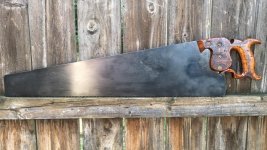
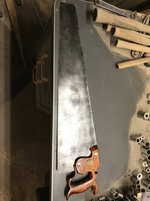
Here is my first vintage saw purchase... a No. 7 Bishop. Seems to be in reasonable original condition, handle showing some wear.
 

Attachments

  • HandSaw8.jpg
    HandSaw8.jpg
    100.6 KB · Views: 46
  • HandSaw1.jpg
    HandSaw1.jpg
    82 KB · Views: 36
  • HandSaw3.jpg
    HandSaw3.jpg
    82.1 KB · Views: 35
  • HandSaw5.jpg
    HandSaw5.jpg
    90.6 KB · Views: 43
OP
L

LesserSon

Well-known member
Joined
Feb 7, 2016
Messages
5,039
Location
PA USA
Nice choice. I had an opportunity to buy three Bishop rip saws a few years ago. Cheap, but beat up. I didn’t get them and I regret it. Have not seen anything like them in the wild since. Really cool “angelic greyhound” icon.
 
To avoid these ads, REGISTER NOW!
Top Bottom