You are using an out of date browser. It may not display this or other websites correctly.
You should upgrade or use an alternative browser.
You should upgrade or use an alternative browser.
needed some understanding of Ballast...
- Thread starter dogdog
- Start date
theoldwizard1
Well-known member
Someone correct me if I am wrong, but if I recall correctly ...
Fluorescent bulbs have a "weird" characteristic. Once the bulb actually starts (which is a whole different discussion) the resistance of the "bulb" (forget what is going on inside of it) actually decreases. This would result in an INCREASE in current which would ultimately "burn out" the bulb. The ballast limits the amount of current going to the bulb. Electronic ballasts do this electronically (duh !) and actually use less power than a typical ballast.
From Wikipedia
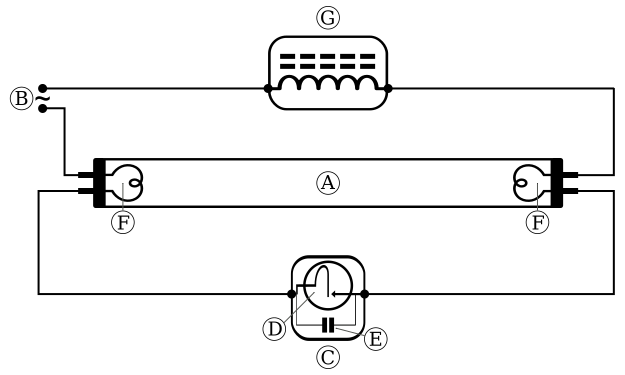
A: Fluorescent tube, B: Power, C: Starter, D: Switch (bi-metallic thermostat), E: Capacitor, F: Filaments, G: Ballast
An LED "bulb" needs a constant DC voltage at a constant current.
Fluorescent bulbs have a "weird" characteristic. Once the bulb actually starts (which is a whole different discussion) the resistance of the "bulb" (forget what is going on inside of it) actually decreases. This would result in an INCREASE in current which would ultimately "burn out" the bulb. The ballast limits the amount of current going to the bulb. Electronic ballasts do this electronically (duh !) and actually use less power than a typical ballast.
From Wikipedia
A: Fluorescent tube, B: Power, C: Starter, D: Switch (bi-metallic thermostat), E: Capacitor, F: Filaments, G: Ballast
An LED "bulb" needs a constant DC voltage at a constant current.
Best guide you'll find to fluorescent lighting systems....
https://www.scribd.com/document/74961932/Pocket-guide-to-Flourescent-Lamp-Ballasts
If you have any specific questions, just ask me either here or by PM.
Good luck,
CD
https://www.scribd.com/document/74961932/Pocket-guide-to-Flourescent-Lamp-Ballasts
If you have any specific questions, just ask me either here or by PM.
Good luck,
CD
Best guide you'll find to fluorescent lighting systems....
https://www.scribd.com/document/74961932/Pocket-guide-to-Flourescent-Lamp-Ballasts
If you have any specific questions, just ask me either here or by PM.
Good luck,
CD
ok thx folks... let me read up... trying to power a uv ozone generating lamp... apparently they are fluorescent lamps with different glass and coatings. but there are different connectors etc that makes it, hard to understand.
so thanks in advance.
Last edited:
ok thx folks... let me read up... trying to power a uv ozone generating lamp... apparently they are fluorescent lamps with different glass and coatings. but there are different connectors etc that makes it, hard to understand.
so thanks in advance.
It's not likely that you'll find a standard fluorescent ballast to fire a UV lamp. Like any other fluorescent lamp, it will require a specific ballast to operate it. If you have sourced a UV lamp, the manufacturer of that lamp should be able to direct you to a suitable ballast. Be prepared to spend alot of money.
Good luck,
CD
The ballast is needed to limit current, a fluorescent lamp basically has an arc inside it. In it's simplest form a fluorescent lamp could use a resistor for a ballast, but it would have other complications. This is one of the things you need to look for, what current does your lamp require? This is usually given in milliamps (mA).
The other thing to look for is lamp voltage. Different length and types of lamps have different arc voltages, typically shorter lamps have lower arc voltage. This is not critical for the ballast to work properly as long as the open circuit voltage is high enough to strike the arc. But is a lamp with to low of an arc voltage is used on a ballast not rated for it the ballast can overheat.
There are other considerations but these are most important.
The other thing to look for is lamp voltage. Different length and types of lamps have different arc voltages, typically shorter lamps have lower arc voltage. This is not critical for the ballast to work properly as long as the open circuit voltage is high enough to strike the arc. But is a lamp with to low of an arc voltage is used on a ballast not rated for it the ballast can overheat.
There are other considerations but these are most important.
Is this question about the same thing your asking about here?
If so I looked up those lamps and they list a current of 435 mA and 105V.
That is almost exactly the same specs as an F40T12. The only problem might be than the common rapid start ballasts may not get it to start, they are very picky. A preheat ballast would be sure to work.
An F48T12 ballast would definitely work also. Same specs as an F40T12 except it's instant start, it uses extremely high voltage to start the lamp rather than heating the cathodes. It would start reliably but instant start ballasts aren't a good choice if you will be turning it on and off a lot, it will shorten the lamp life. They are best if you leave them on for hours at a time.
Another ballast that should work is a F54T5 ballast. These are about 450 mA if I remember right. A T5 has a higher lamp voltage but most electronic ballast should be OK with it.
Of all the options I'd say the one most likely to work is a preheat F40T12 ballast or the F48T12 ballast. The preheat ballasts are not common any more. Non of these are really rated for your lamp but the specs are close, about all you can do is try the options and see what works reliably.
Needed to rig up a box with fan blowing on these UVC lamp to sterilize the air in a room... the small one "(germGuardian)I have is not strong enough to do the job.
Yes I know they will burn skins on prolong exposure etc... it will be in a box.
What I am asking is these 2G11 bulbs , what voltage or and how to power them?
straight 120V or ballast or sort ?
This thing just an example.
https://www.ebay.com/itm/Philips-TU...icidal-lamp-/191718677672?hash=item2ca352dca8
Abbreviation Name TUV PL-L 36W/4P
Base 2G11
Bulb Type Fluorescent Bulbs
Diameter (in) 1.496
Maximum Overall Length (in) 16.338
Rated Life (Hours) 9000
Shape Single Tube 4-PIN
Voltage (V) 105V
Wattage (W) 36W
If so I looked up those lamps and they list a current of 435 mA and 105V.
That is almost exactly the same specs as an F40T12. The only problem might be than the common rapid start ballasts may not get it to start, they are very picky. A preheat ballast would be sure to work.
An F48T12 ballast would definitely work also. Same specs as an F40T12 except it's instant start, it uses extremely high voltage to start the lamp rather than heating the cathodes. It would start reliably but instant start ballasts aren't a good choice if you will be turning it on and off a lot, it will shorten the lamp life. They are best if you leave them on for hours at a time.
Another ballast that should work is a F54T5 ballast. These are about 450 mA if I remember right. A T5 has a higher lamp voltage but most electronic ballast should be OK with it.
Of all the options I'd say the one most likely to work is a preheat F40T12 ballast or the F48T12 ballast. The preheat ballasts are not common any more. Non of these are really rated for your lamp but the specs are close, about all you can do is try the options and see what works reliably.
Last edited:
Is this question about the same thing your asking about here?
If so I looked up those lamps and they list a current of 435 mA and 105V.
That is almost exactly the same specs as an F40T12. The only problem might be than the common rapid start ballasts may not get it to start, they are very picky. A preheat ballast would be sure to work.
An F48T12 ballast would definitely work also. Same specs as an F40T12 except it's instant start, it uses extremely high voltage to start the lamp rather than heating the cathodes. It would start reliably but instant start ballasts aren't a good choice if you will be turning it on and off a lot, it will shorten the lamp life. They are best if you leave them on for hours at a time.
Another ballast that should work is a F54T5 ballast. These are about 450 mA if I remember right. A T5 has a higher lamp voltage but most electronic ballast should be OK with it.
Of all the options I'd say the one most likely to work is a preheat F40T12 ballast or the F48T12 ballast. The preheat ballasts are not common any more. Non of these are really rated for your lamp but the specs are close, about all you can do is try the options and see what works reliably.
It is the similar question on the other thread... , I have found a different bulb that is not 2G11 4pin,but advertise as Ozone generating bulb. (apparently couldn't find an ozone generating bulb for that type 2G11)...
I found these two.. the pin looks the same but watt is different by 1Watt... not sure.. 40Watt Vs 39Watt... it gets a bit confusing.
https://www.ebay.com/itm/Germicidal...PH793T5L-4-GPH793T5L-4pin-GPH793/291153728828
https://www.ebay.com/itm/Germicidal...PH739T5L-4-GPH739T5L-4pin-GPH739/351078453799
voltage is mentioned..
wattage is mentioned... not too sure how critical these two parameters are to match...etc
so one thing I learn about these UVC... they are dangerous, yes... can burn your eye and skins...
for UVC most are 245nm light output for sterilization and germicidal... only the 185nm are ozone generating... why... supposedly ozone also kills germs / spores that the lights don't hit... just don't breath the ozone while it is on.... anyways... the plan is still the same...
Now why I started a new thread...
Instead of kept asking questions every time I find a new potential lamp... I figured it might be a good idea to just learn about these ballast... pretty sure there are few common things in selecting these things....
thx will read up.
walta
Well-known member
If what you want to do is run a 36 watt bulb.
Get a Work horse ballast model WH3-120-c
It will run any florescent lamp from 25 watt up to 60 watt from a 120 volt power source.
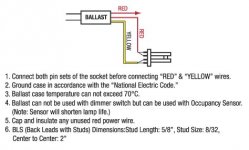
One red wire connects to the 2 pins on the left of the lamp
The other red wire is not used unless you are operating 2 lamps
The yellow wire connects to the 2 pins on the right of the lamp
The black and white wires go to the power source.
https://www.ebay.com/itm/WH3-120-BLS-/222287145773?_trksid=p2349526.m4383.l4275.c10#viTabs_0
https://www.ebay.com/itm/Generic-2G...=Base 2G11&_from=R40&rt=nc&_trksid=m570.l1313
Walta
Get a Work horse ballast model WH3-120-c
It will run any florescent lamp from 25 watt up to 60 watt from a 120 volt power source.
One red wire connects to the 2 pins on the left of the lamp
The other red wire is not used unless you are operating 2 lamps
The yellow wire connects to the 2 pins on the right of the lamp
The black and white wires go to the power source.
https://www.ebay.com/itm/WH3-120-BLS-/222287145773?_trksid=p2349526.m4383.l4275.c10#viTabs_0
https://www.ebay.com/itm/Generic-2G...=Base 2G11&_from=R40&rt=nc&_trksid=m570.l1313
Walta
If what you want to do is run a 36 watt bulb.
Get a Work horse ballast model WH3-120-c
It will run any florescent lamp from 25 watt up to 60 watt from a 120 volt power source.
One red wire connects to the 2 pins on the left of the lamp
The other red wire is not used unless you are operating 2 lamps
The yellow wire connects to the 2 pins on the right of the lamp
The black and white wires go to the power source.
https://www.ebay.com/itm/WH3-120-BLS-/222287145773?_trksid=p2349526.m4383.l4275.c10#viTabs_0
https://www.ebay.com/itm/Generic-2G...=Base 2G11&_from=R40&rt=nc&_trksid=m570.l1313
Walta
thx for this info.
It is the similar question on the other thread... , I have found a different bulb that is not 2G11 4pin,but advertise as Ozone generating bulb. (apparently couldn't find an ozone generating bulb for that type 2G11)...
I found these two.. the pin looks the same but watt is different by 1Watt... not sure.. 40Watt Vs 39Watt... it gets a bit confusing.
https://www.ebay.com/itm/Germicidal...PH793T5L-4-GPH793T5L-4pin-GPH793/291153728828
https://www.ebay.com/itm/Germicidal...PH739T5L-4-GPH739T5L-4pin-GPH739/351078453799
voltage is mentioned..
wattage is mentioned... not too sure how critical these two parameters are to match...etc
so one thing I learn about these UVC... they are dangerous, yes... can burn your eye and skins...
for UVC most are 245nm light output for sterilization and germicidal... only the 185nm are ozone generating... why... supposedly ozone also kills germs / spores that the lights don't hit... just don't breath the ozone while it is on.... anyways... the plan is still the same...
Now why I started a new thread...
Instead of kept asking questions every time I find a new potential lamp... I figured it might be a good idea to just learn about these ballast... pretty sure there are few common things in selecting these things....
Ok I get it.
Like I said above there are a couple main things to looks for, and it's not always easy to find the info.
You need to know lamp current. The current is determined by the ballast. You want a ballast that delivers within 20% or so of rated current. To much or to little lamp current will shorten the life as well as affect the brightness. The original lamp you asked about was rated at 435 mA for example.
The second is lamp voltage. The voltage is determined by the lamp, lamp length as well as the gas fill are what affects it. This is less important with some ballasts especially if they are rated for a wide range of lamps. Too low of lamp voltage on a ballast not rated for it can overheat the ballast.
Other things to consider is if it is a preheat, rapid start or instant start lamp. Preheat and instant start will not usually work on a rapid start ballast. A rapid start lamp will work on a preheat or instant start ballast. And a preheat lamp will also work on an instant start ballast.
If you noticed an instant start ballast can run pretty much any lamp. The downside is that instant start is not good for lamps that are turned on and off frequently. They are good if the lamp is left on for hours at a time.
Ballasts like the Fullham listed above are rated to run a wide range of lamps. They are not always the best choice since they are a compromise for many of the lamps listed. It will work but the lamp may be under driven or over driven, not enough to cause problems but it won't be optimal performance for many lamps. The one listed is instant start.
Last edited:
walta
Well-known member
It has been my experience that the Fullham electronic ballast is the same compromise as electronic ignition on a car. They start faster burn hotter and run longer. Magnetic ballast is as outdated as points in a distributor.
Walt
Walt
It has been my experience that the Fullham electronic ballast is the same compromise as electronic ignition on a car. They start faster burn hotter and run longer. Magnetic ballast is as outdated as points in a distributor.
Walt
We're not talking magnetic vs electronic, any new ballast will be electronic. I'm suggesting that a ballast designed to run a few specific types of lamps will be a better match than a ballast that lists a zillion lamps that may or may not run optimally, like the fullham. Some of the lamps listed for that fullham are supposed to have vastly different power supplies, I have my doubts that one ballast will be a good match for all of them.
OK I am back with this question.... 

got a 2 different ballast, can some one review it and see if it is compatible with the tube I am trying to buy and power.......well these were on sale, wattage wise it seems to be ok..
1 spec says it can power 2x T5 rapid start 54Watt Lamp. Not sure if I used it on a 40watt lamp it would pop the bulbs...
Lutron H3DT554CU210
http://www.lutron.com/TechnicalDocumentLibrary/Hi-lume3D rev b.pdf
It has E1 E2 Class 2 ecosystem bus?.. what is that for, do I needed it ?
The other says 40W... it says power 40Watt, but not sure if there is a differences in T5 T8 or what ever these UVC bulbs are differences...
Centium ICN-2TTP40-SC
http://www.lightingcomponents.us/Product-Manuals/advance icn2ttp40sc.pdf
not too sure.. sorry very noob on these matching game.
The goal is to power one of two of these UVC Ozone generating lamps. 40Watt or 39Watt ones..
https://www.ebay.com/itm/Germicidal...PH793T5L-4-GPH793T5L-4pin-GPH793/291153728828
https://www.ebay.com/itm/Germicidal...PH739T5L-4-GPH739T5L-4pin-GPH739/351078453799
got a 2 different ballast, can some one review it and see if it is compatible with the tube I am trying to buy and power.......well these were on sale, wattage wise it seems to be ok..
1 spec says it can power 2x T5 rapid start 54Watt Lamp. Not sure if I used it on a 40watt lamp it would pop the bulbs...
Lutron H3DT554CU210
http://www.lutron.com/TechnicalDocumentLibrary/Hi-lume3D rev b.pdf
It has E1 E2 Class 2 ecosystem bus?.. what is that for, do I needed it ?
The other says 40W... it says power 40Watt, but not sure if there is a differences in T5 T8 or what ever these UVC bulbs are differences...
Centium ICN-2TTP40-SC
http://www.lightingcomponents.us/Product-Manuals/advance icn2ttp40sc.pdf
not too sure.. sorry very noob on these matching game.
The goal is to power one of two of these UVC Ozone generating lamps. 40Watt or 39Watt ones..
https://www.ebay.com/itm/Germicidal...PH793T5L-4-GPH793T5L-4pin-GPH793/291153728828
https://www.ebay.com/itm/Germicidal...PH739T5L-4-GPH739T5L-4pin-GPH739/351078453799
Dogdog, you are thinking too much about watts. As mentioned before, a ballast is designed to deliver a specific amount of CURRENT to a lamp. All 40w lamps do not require the same amount of current. So you should not consider watts when selecting a ballast.
The Lutron is a dimming ballast and the E1 and E2 are dimming control circuits. You dont need those. The Philips ICN is not the right product for you.
All you need to do is google this: ballast for GPH793T5L/4 and a whole bunch of choices will appear.
CD
The Lutron is a dimming ballast and the E1 and E2 are dimming control circuits. You dont need those. The Philips ICN is not the right product for you.
All you need to do is google this: ballast for GPH793T5L/4 and a whole bunch of choices will appear.
CD
I think a T5HO ballast will be the best, you don't need dimming though. Try Philips icn-2s54. Your bulb won't blow or even get 54 watts, it will be close to 40. The ballast doesn't determine wattage, only current. Re read some of the above posts if it isn't clear.
I did that, and I'll be honest, not much comes up. Some sketchy stuff straight from china or one or two options for $150 that still look off brand. I'd be willing to try a something that should work just as well and is 1/5 of the cost
Nothing wrong with a little experimentation.
All you need to do is google this: ballast for GPH793T5L/4 and a whole bunch of choices will appear.
CD
I did that, and I'll be honest, not much comes up. Some sketchy stuff straight from china or one or two options for $150 that still look off brand. I'd be willing to try a something that should work just as well and is 1/5 of the cost
Nothing wrong with a little experimentation.
Last edited:
I think a T5HO ballast will be the best, you don't need dimming though. Try Philips icn-2s54. Your bulb won't blow or even get 54 watts, it will be close to 40. The ballast doesn't determine wattage, only current. Re read some of the above posts if it isn't clear.
I did that, and I'll be honest, not much comes up. Some sketchy stuff straight from china or one or two options for $150 that still look off brand. I'd be willing to try a something that should work just as well and is 1/5 of the cost
Nothing wrong with a little experimentation.
Yea .... I got both 4x of the icn and 1x of that lutron... I'll used the lutron and order 1 bulb for now... it is supposedly able to power 2x 54Watt lamps...I think both says it supports T5HO... some where... specs are very confusing to read.. Yes I tried to read your post, but the problem is the spec sheet doesn't always specify that way.
I did that, and I'll be honest, not much comes up. Some sketchy stuff straight from china or one or two options for $150 that still look off brand. I'd be willing to try a something that should work just as well and is 1/5 of the cost
You must have different google than I do, then. I get dozens of hits from amazon, alibaba, internet lighting sites...all with ballasts made specifically for this lamp.
CD
You must have different google than I do, then. I get dozens of hits from amazon, alibaba, internet lighting sites...all with ballasts made specifically for this lamp.
CD
But would you even consider ordering something like this from alibaba or some sketchy internet site?
I would want something I could trust if I was going to spent the amount of money they want for those ballasts. And they all look like they could be crappy off brand ballasts. To me it seems like ordering one of those ballasts would be just as big a risk as experimenting with one not meant for the lamp. And one option is quite a bit cheaper than the other.
Last edited:
But would you even consider ordering something like this from alibaba or some sketchy internet site?
I would want something I could trust if I was going to spent the amount of money they want for those ballasts. And they all look like they could be crappy off brand ballasts. To me it seems like ordering one of those ballasts would be just as big a risk as experimenting with one not meant for the lamp. And one option is quite a bit cheaper than the other.
I guess that decision is up to the OP. To me, it sounds like he wants to get this done and over with. I'd just buy the ballast that's made for the lamp he's using instead of experimenting with things that MIGHT work. If it turns out that the experiment doesn't work, then you have to order another ballast that MIGHT work and so on and so on....
CD
I guess that decision is up to the OP. To me, it sounds like he wants to get this done and over with. I'd just buy the ballast that's made for the lamp he's using instead of experimenting with things that MIGHT work. If it turns out that the experiment doesn't work, then you have to order another ballast that MIGHT work and so on and so on....
CD
yes going to try with the two I have now..... or some off the old T8 fixtures...
What I really wanted to hoping to understand something of this but guess this will be learning by fire,.... after I toast a few fuse or lights or ballast... will keep you updated , probably in a months or few... nothing rush atm, already got 2x 15watt norman lamps... which is UVC in E27 or E26 screw type sockets....
nsula_country
Well-known member
Subscribed!
CT
CT
yes going to try with the two I have now..... or some off the old T8 fixtures...
What I really wanted to hoping to understand something of this but guess this will be learning by fire,.... after I toast a few fuse or lights or ballast... will keep you updated , probably in a months or few... nothing rush atm, already got 2x 15watt norman lamps... which is UVC in E27 or E26 screw type sockets....
T8 ballast will probably light the lamp if they are instant start but they will severely under drive the lamp. I think most T8's are around 260 mA and your lamps want 430 mA.
The effects on the lamp might not be immediately noticeable but in addition to being really dim the cathodes will sputter making the ends turn dark and it won't last very long
T8 ballast will probably light the lamp if they are instant start but they will severely under drive the lamp. I think most T8's are around 260 mA and your lamps want 430 mA.
The effects on the lamp might not be immediately noticeable but in addition to being really dim the cathodes will sputter making the ends turn dark and it won't last very long
Not sure if I am looking at the right category... one of the specs says .95Amp
and the other one says .57Amp... for the philips...
Not sure if I am looking at the right category... one of the specs says .95Amp
and the other one says .57Amp... for the philips...
Guessing what you are looking at is LINE current, which for these purposes doesn't matter. What needs to match is LAMP current. That spec is not often published but you can usually find what current certain types of lamps are designed for.
you are correct, that the listed spec is for line current... that makes it harder or more confusing to understand these ballast things...
the pic with all 5...
still haven't order the lamp yet, spend my lunch money on some 14" Diablo steel demon blades...... maybe in a bit.. No worries will update and thx
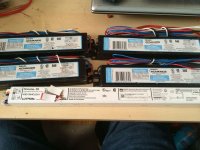
the pic with all 5...
still haven't order the lamp yet, spend my lunch money on some 14" Diablo steel demon blades...... maybe in a bit.. No worries will update and thx
Attachments
Electrican for 30+ years now. When I’m called to change out a ballest no matter what type of fixture. These are the steps I use.
1. Write down the lamp information “type and wattage of bulb.
2. Take a supply voltage reading make note of it.
3. How many lamps are to be supplied from 1 ballest. (1,2,3,4?).
4. Kill power to ballest first. Then cut the wires close to the old ballest as possible. This gives you plenty of wire to connect when you replace the ballest. Leave the other ends connected to the “tombstones”.
If the lamps are “T” type #’s 12, 8, 5. Then they are usually sold by the big box stores.
If your running into “PL or speciality type lamps the lamp wattage is the most important value to use in selecting a replacement ballest. The ballest MUST BE rated at least the wattage of the lamp, many, many times with old “pl” type fixtures there just wasn’t a ballest with the exact wattage as the lamp I was working on. So you then size up the ballest wattage. Try to stay as close as you can. But it not that critical the lamp operation determines the total load the ballest will see. With electronic ballest you can sway 25% on average on the higher side of wattage and not have problems.
“FULHAM” ballest company I think is spelled that right. Website has a downloadable 3 page sheet that can walk you through the selection process. And they are sold by amazon.
Good luck with it
Sent from my iPhone using Tapatalk
1. Write down the lamp information “type and wattage of bulb.
2. Take a supply voltage reading make note of it.
3. How many lamps are to be supplied from 1 ballest. (1,2,3,4?).
4. Kill power to ballest first. Then cut the wires close to the old ballest as possible. This gives you plenty of wire to connect when you replace the ballest. Leave the other ends connected to the “tombstones”.
If the lamps are “T” type #’s 12, 8, 5. Then they are usually sold by the big box stores.
If your running into “PL or speciality type lamps the lamp wattage is the most important value to use in selecting a replacement ballest. The ballest MUST BE rated at least the wattage of the lamp, many, many times with old “pl” type fixtures there just wasn’t a ballest with the exact wattage as the lamp I was working on. So you then size up the ballest wattage. Try to stay as close as you can. But it not that critical the lamp operation determines the total load the ballest will see. With electronic ballest you can sway 25% on average on the higher side of wattage and not have problems.
“FULHAM” ballest company I think is spelled that right. Website has a downloadable 3 page sheet that can walk you through the selection process. And they are sold by amazon.
Good luck with it
Sent from my iPhone using Tapatalk
Electrican for 30+ years now. When I’m called to change out a ballest no matter what type of fixture. These are the steps I use.
1. Write down the lamp information “type and wattage of bulb.
2. Take a supply voltage reading make note of it.
3. How many lamps are to be supplied from 1 ballest. (1,2,3,4?).
4. Kill power to ballest first. Then cut the wires close to the old ballast as possible. This gives you plenty of wire to connect when you replace the ballest. Leave the other ends connected to the “tombstones”.
If the lamps are “T” type #’s 12, 8, 5. Then they are usually sold by the big box stores.
If your running into “PL or speciality type lamps the lamp wattage is the most important value to use in selecting a replacement ballest. The ballest MUST BE rated at least the wattage of the lamp, many, many times with old “pl” type fixtures there just wasn’t a ballest with the exact wattage as the lamp I was working on. So you then size up the ballest wattage. Try to stay as close as you can. But it not that critical the lamp operation determines the total load the ballest will see. With electronic ballest you can sway 25% on average on the higher side of wattage and not have problems.
“FULHAM” ballest company I think is spelled that right. Website has a downloadable 3 page sheet that can walk you through the selection process. And they are sold by amazon.
Good luck with it
Sent from my iPhone using Tapatalk
Thanks, I will look for that FulHam Doc... Yea I am kinda not in that same situation... No fixture, no old lamp, just a ebay listing of an UVC Ozone lamp I wanted to power.... and all I could find is it's a Florescent bulb, might be a T5 and 40Watt.... But these things should be easy right..

walta
Well-known member
“FULHAM” ballest company I think is spelled that right. Website has a downloadable 3 page sheet that can walk you through the selection process. And they are sold by amazon.
Good luck with it
Sent from my iPhone using Tapatalk
Rjcnaples I could not agree more Fulham is the best.
In my post #11 has the link to a Fulham ballast that should work with his lamp.
Walta
Dingleburry
Well-known member
The ballast heats up 2 heating elements on each end of the lamp, to excite the gas, or make the mercury evaporate. Something like that, then switches the heating elements to your hot and neutal terminals to conduct across the "gas" inside the tube. Also to limit current, as it heats up or conducts across the gas its resistance will continur to go down. So the ballast keeps the current in check.
walta
Well-known member
The ballast heats up 2 heating elements on each end of the lamp, to excite the gas, or make the mercury evaporate. Something like that, then switches the heating elements to your hot and neutal terminals to conduct across the "gas" inside the tube. Also to limit current, as it heats up or conducts across the gas its resistance will continur to go down. So the ballast keeps the current in check.
Hello 1950! Most ballast today only requires 1 wire to each end of a tube.
The ballast hits the tube with up to 600 volts for a few tenth of a second to get the arc started and then adjusts is needed to pass its designed current.
Walta