trijeff
Well-known member
they're actually pretty handy and ultra mobile, you won't use it a ton but you'll be glad to have it when you need it
Sent from my SM-G900T using Tapatalk
Sent from my SM-G900T using Tapatalk


Yeah, I see them at the fair every year. Luckly i dodged that bullet 20 years ago and never looked back.they're actually pretty handy and ultra mobile, you won't use it a ton but you'll be glad to have it when you need it
Sent from my SM-G900T using Tapatalk


All:
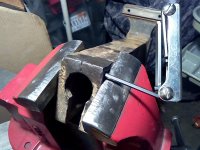
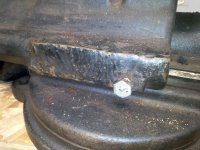
Here's a Prentiss vise restoration thread that shows details on my slide repair and other challenges. To me, drilling a relief hole at the end of the crack and installing a countersunk bolt at the side of the slide is the functional repair.
www.garagejournal.com/forum/showthread.php?t=358095


Mark
Thank you for reposting this. This is exactly the slide repair that I was thinking of and sorry that I could not recall that it was your great handy work.
You did a phenomenal job and thank you again for taking the time to document and provide detailed and step by step instructions
I have now booked marked on my iPhone for future reference
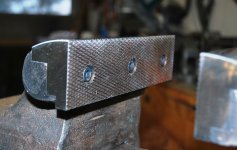
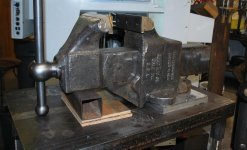


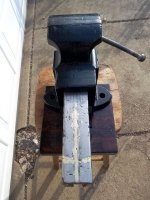
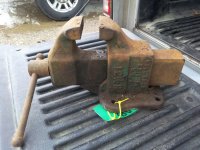
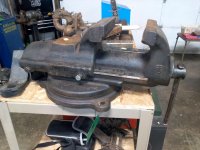
anyone know what this is? Couple of design elements look like Prentiss, but that collar?
Owner says no marks of any kind.

It kind of looks like an old Parker I have, but it would say it on the body of the vise.Anyone?
...How are you on post vises?
I have done a couple tail split repairs, just like Mark and. I used the same idea as he did. Burying a screw in my opinion is the best way, just will never let go. I measured the square opening and made sure the split was squeezed tighter by using a gauge block setup. Maybe you new guys never seen the Reed 109 repair I did for Demoman a couple years ago. The vise was a mess. Here is a post I wrote about the tail split. Getting ready to work on my Prentiss 58 and it has a tail split too.
https://www.garagejournal.com/forum/showpost.php?p=6809987&postcount=5041
Nobody is good with identifying post vises....especially the older ones.
The older post vises were made for blacksmiths by blacksmiths; the post vise I have is entirely hand forged except the box nut and collar washer, which are both cast iron/steel. Many different manufacturers of these vises bought nuts & collars from the same sources or made them in house. Mine has a number cast into the box nut but I was unable to find any reference to it. Some will have the weight stamped on the front of the dynamic jaw - most are not marked at all.
The later vises were made commercially by these companies:
Columbian
Fisher
Fuller
Indian Chief
Iron City
Peter Wright
Millstone Forge
Keenkutter
You will find some kind of stamping on one of the legs, the screw box, or the mounting brackets (if there is one). Otherwise, you're probably SOL in figuring out what it is.


Here is another one Dr. Scott did:
https://www.garagejournal.com/forum/showpost.php?p=6408716&postcount=4171


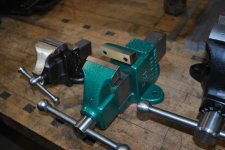

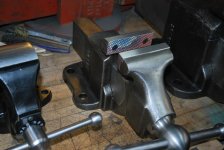
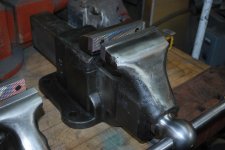
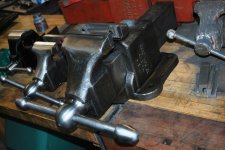

Yeah, it’s out of my price range. I do find the vise curious in the fact that it looks like a trade show demo or a hardware store sample. I’ve looked at my Prentiss vises from that era and they don’t have the stamping that this vise has.Yep Smitty, that's a real nice Prentiss but man they just ask too much for those swivel jaw jewels.---JMO
Yeah, it’s out of my price range. I do find the vise curious in the fact that it looks like a trade show demo or a hardware store sample. I’ve looked at my Prentiss vises from that era and they don’t have the stamping that this vise has.
Just curious but could you post a picture of what you are referring to.
Sent from my iPhone using Tapatalk


Wow two Hollands 12-1/2 vises at the shown same time. Mark, nice grab. I know you like the FPU vises, I am not a fan of them and have been offered many from customers. What would be the Holy grail for you?
Thanks, I think I know what you mean. Is it the 7”?Smitty, if you don't have one yet, try to find a Columbian-labeled Prentiss swivel jaw. I know where one is, but it's trashed.
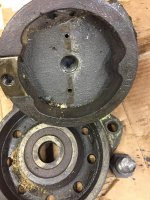
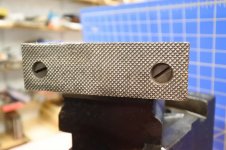
Wrapped up several vises today. Reed 106, Reed 104, Parker 973, Hollands 12-1/2 with 2-1/2" jaws and a little Athol 87 with 2" jaws. All vises except the Parker had cast in jaws and I replaced them with custom made sets of smooth and serrated. I tightened up the backlash by adding Bronze washers to the three of the vises except the Reeds. Reeds do not need washers. Machined the inside of the Hollands Dynamic so the collar rests more perpendicular. The Athol used a flat head screw as a collar, seems it was built that way so I added a bronze collar like a reversed Parker setup. The Reed 106 takes 6 x 1-1/4 jaws and built a teardrop type knobs for the 1" handle, I like the feel of the teardrops but they were time consuming to build. The Reed 104 I fitted the Starrett 624 and 924 4" jaws but made the new jaws at 30 degree serrations in stead of the straight serrations. These vises are ready to go back to work.
Wrapped up several vises today. Reed 106, Reed 104, Parker 973, Hollands 12-1/2 with 2-1/2" jaws and a little Athol 87 with 2" jaws. All vises except the Parker had cast in jaws and I replaced them with custom made sets of smooth and serrated. I tightened up the backlash by adding Bronze washers to the three of the vises except the Reeds. Reeds do not need washers. Machined the inside of the Hollands Dynamic so the collar rests more perpendicular. The Athol used a flat head screw as a collar, seems it was built that way so I added a bronze collar like a reversed Parker setup. The Reed 106 takes 6 x 1-1/4 jaws and built a teardrop type knobs for the 1" handle, I like the feel of the teardrops but they were time consuming to build. The Reed 104 I fitted the Starrett 624 and 924 4" jaws but made the new jaws at 30 degree serrations in stead of the straight serrations. These vises are ready to go back to work.
Thanks, I think I know what you mean. Is it the 7”?
All:
At an auction in S/W Indiana was a large FPU vise. It's hard to find one that doesn't have a part of the moving body, on the left side damaged. Also, the stationary jaw face was missing. This 150mm FPU was no exception. However, I was impressed with the repair. Most repairs to the moving body of these vises that I've seen are hack jobs. This one would have been great if it had been finished. One day I'll find my "Holy Grail" FPU vise.
Here are a couple of pictures.
I did manage to win a cute little Hollands machinist vise to be restored.
Wrapped up several vises today. Reed 106, Reed 104, Parker 973, Hollands 12-1/2 with 2-1/2" jaws and a little Athol 87 with 2" jaws. All vises except the Parker had cast in jaws and I replaced them with custom made sets of smooth and serrated. I tightened up the backlash by adding Bronze washers to the three of the vises except the Reeds. Reeds do not need washers. Machined the inside of the Hollands Dynamic so the collar rests more perpendicular. The Athol used a flat head screw as a collar, seems it was built that way so I added a bronze collar like a reversed Parker setup. The Reed 106 takes 6 x 1-1/4 jaws and built a teardrop type knobs for the 1" handle, I like the feel of the teardrops but they were time consuming to build. The Reed 104 I fitted the Starrett 624 and 924 4" jaws but made the new jaws at 30 degree serrations in stead of the straight serrations. These vises are ready to go back to work.
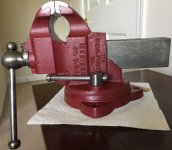
Well lets get the facts straight:
The Parker Vise Co. didn't START until 1832, so that Patent date has to be 1910, not 1810. This would tie in with the Model no. as well...
It also appears to be missing one mounting ear?
Overall condition is rough. I don't think that is a deal at all...

Not a reference to a 7" vise sorry. I have posted pix to this thread a few years ago but a Columbian 404 that was made by Prentiss. I never saw a cat page to know what sizes. That one was 4". It is marked on one side of the static jaw...kind of unusual. And had a big 404 behind the swivel jaw like the older Prentiss models.


Vise **** at its finest! Absolutely jaw dropping restorations Kevin as usual. I've been wrapping up a Reed 103 1/2 but I'll have to wait a couple weeks to post some pics now. You know, until the stunning physiques of your 104 and 106 fade into the distance a bit.
Oh yeah, what is that gorgeous bright green paint you used on the Hollands 12 1/2? I've seen you use it before on a few other vises and I've been meaning to ask because it really does pop!
Sent from my SM-G930P using Tapatalk
KMScott will for sure be able to advise you on the hardness and removal of those cast-in Reed jaws. In fact just in the last day he posted a Reed 104 & 106 in this thread that he did just that as part of his restoration. Just scroll up a bit!Wanted to add 1 photo of a Starrett 926 and a Reed 4C. Just got the Reed last week, when looking it over carefully, I determined that the vise jaws are integral/cast into the body and jaws. At first I thought someone welded them but there's no seam and they are soft (can touch with a file). I was wondering if there's a "breakpoint" in the manufacturing where jaw inserts are used, or if it was an option? The plant where I work has a Reed 4C which has the inserted vise jaws, as a point of reference.
The Starrett is considerably heavier, interestingly, but has a shorter slide.
I am considering, as a future project, putting both parts of the 4C into the machining center and mill a ledge for some soft or hard jaws as the as-cast jaws are fairly worn and uneven. Since the existing appear to be un-hardened it should not be a bad project.