To avoid these ads, REGISTER NOW!

Is my panel big enough?

DIYGuy

Well-known member
Joined
Dec 23, 2018
Messages
57
Location
Michigan
I have a 60amp sub panel in my 30x40 detached shop. It is fed from my 200amp main panel in the basement of my house. It's probably a 100ft run between the two. The sub panel is fed with 3 #6 wires and I think the ground is #8. It is ran in 1" metal conduit. The panel currently only has 6 or 8 spaces.

I currently have a 30 amp breaker feeding a 3 prong outlet that I plug my mig welder and plasma cutter into as needed. Obviously not at the same time.

I am out of space in the panel and still need a place to wire up my 5hp 220v compressor. I also would like to have room for a tig welder in the future as well as the Mr cool 36k mini split.

I bought a bigger panel that has more spaces that I was going to put a 60amp breaker in as the main. This way I could have the individual circuits for each of the big loads. It's just me in my shop. None of the welders or plasma cutter would ever be running at the same time. But the compressor, mini split, and a welder could. Is 60amps going to be enough? If not, how big of wire will I be able to fit in the 1" metal conduit? And how hard will it be fishing them about 100' through the conduit?

Sent from my SM-G935V using Tapatalk
 
To avoid these ads, REGISTER NOW!

sberry

Banned
Joined
Jun 18, 2005
Messages
35,747
Location
Brethren, Michigan
Number 4 copper isn't real popular but pulling the wire out and replacing the ungrounded conductors could work if needed. You don't have to weld while the comp is running, a plasma may need to some of this depends on the size of the machines and I might be tempted to see how this worked. No real way around more spaces without changing the panel or adding one.
 
OP
D

DIYGuy

Well-known member
Joined
Dec 23, 2018
Messages
57
Location
Michigan
Number 4 copper isn't real popular but pulling the wire out and replacing the ungrounded conductors could work if needed. You don't have to weld while the comp is running, a plasma may need to some of this depends on the size of the machines and I might be tempted to see how this worked. No real way around more spaces without changing the panel or adding one.

I have a new bigger panel that has more available spaces that I could install a 60amp main in, but I'm a little reluctant about installing it because I'm not sure if 60amps will be enough.

Will I be able to pull 3 #4 wires through 1" metal conduit? And will the existing ground size be adequate? (I think it is #8 but not positive. I will check and try to grab some pictures in a bit) How many amps will the panel be capable of with #4?

Thank you

Sent from my SM-G935V using Tapatalk
 

sberry

Banned
Joined
Jun 18, 2005
Messages
35,747
Location
Brethren, Michigan
You can use 100
a panel, the breaker feeding it in this case protects he wire from overload. If it has 8 ground and 6 neutral could replace the ungrounded (hot) conductors. A breaker to 70 even would improve the headroom a little, I leave that for someone else to comment on for 4, I am not near a book and don't use it enough to recall.
I got a Bud with same set up except 2 alum wire, 60A, worked 2 men for 25 years, never a trip. I have wired a bunch of garages with this never had one call back about a trip. Obviously not all of them really working but a couple for sure.
A couple guys here have 70A and a lot of stuff on, tons of it, never a trip either. Especially for modern welders and cutters, they run on 30A service. The actual demand may be way less than the breaker its connected to, same with the air comp. My Bud had a heavy 5 and it worked fine.
 
Last edited:

Terry D

Well-known member
Joined
Mar 25, 2015
Messages
2,202
Location
St. Louis, MO.
Good morning hope every ones holidays were great. I'm a licensed electrician here in St. Louis. With that 1 inch conduit, you can pull in (3) new #4 copper for your hots and neutral and (1) #8 copper for your equipment ground. You then can change your 60 amp breaker in the main panel to 100 amps. Then you can install a larger panel in the garage. Main thing is to make sure that the grounds and neutrals in the sub panel are not on the same bars. They need to be kept separate on different bars and the bonding screw not installed. If the garage is a separate building from the house, Then a main breaker needs to be installed in the garage panel and a ground rod added. You could also keep what you have, install a new main lug 100 amp panel in the garage and back feed it with a 60 amp breaker. The make a hold down device that will keep it from accidently from popping out. You then might have to keep a eye on what you turn on at the same time so you don't overload the 60 amp circuit. You might not be able to turn on the compressor and welder at the same time. I know there are a lot of installations done wrong out there. This is just the right way. This is right out of the NEC book. I understand the local authority having jurisdiction has the final say so.
 

sberry

Banned
Joined
Jun 18, 2005
Messages
35,747
Location
Brethren, Michigan
The comp can stay on, simply don't start welding if its running. I don't think 4 is good for 100. Takes 3. But I really doubt he will be tripping 60, he would almost have to try. I ran a welding shop one winter from 60, the air was on another line though. But we had a full size plasma and a 250 wire feeder. Never tripped it up. Even had a 175 feeder running tack up, simply didn't cut and weld at the same time.
 

Terry D

Well-known member
Joined
Mar 25, 2015
Messages
2,202
Location
St. Louis, MO.
#4 is good for 100 amps in residential. #3 is when it is for commercial or industrial.
Anything for single phase dwelling services and feeders use table 310.15(B)(6)
Anything commercial or industrial use Table 310.16
You could go larger for the wire, but it wont fit in the 1 inch conduit. The NEC is not a how to book, it is the bare minimum requirements for electrical installations. They might require different in your area, this is right out of the code book. Local jurisdiction has the final say
 

Terry D

Well-known member
Joined
Mar 25, 2015
Messages
2,202
Location
St. Louis, MO.
I only have 60 amps in my garage. Never had a problem. Just have to know what each load draws and go from there. I have 40 amps just for heat, I just shut it off for awhile if I need to turn on another large load
 

Bretny

Well-known member
Joined
Jul 31, 2017
Messages
3,918
Location
Dutchess county NY
Really depnds on your plasma cutter and compressor if 60a is enough. We dont know the size of either and we dont know if your ever going to have someone helping you work. You cutting and someone welding could trip 60a.

Personaly i wouldnt do less than 100a because the price difference is prety small.
 
OP
D

DIYGuy

Well-known member
Joined
Dec 23, 2018
Messages
57
Location
Michigan
The bigger panel that I was considering putting in is a 100amp main breaker panel. 24 spaces I think. I was just going to take the 100amp breaker out and install a 60amp as the main.

I am planning on installing the Mr cool 36k mini split too. So I can see where there might be a time when the mini split, compressor, and maybe welder or plasma cutter are all on at the same time. I'm not sure what the amp draw on the mini split is, but my compressor motor is a 220v 5hp. The tag says its FLA (not sure, but I think that stands for full load amperage) is 29. The welder and plasma cutter are both under 30amps.

The main panel in the house does have a 60amp breaker that feeds the sub panel in the detached shop. Then the sub panel also has a 60amp main breaker. The neutrals and grounds are on different bars and they dont seem to be connected that I can see. Also I dont see a grounding bar. But I do see a terminal that has the ground wire attached to it and its connected to the metal conduit. Is it possible that they used the metal conduit as the grounding rod?

2d33c9616f87df97e85b577cef263d52.jpg
70a1b3257c1322952deea4392e986729.jpg
568c9c5512ef5731467420aea7ac4a35.jpg


Sent from my SM-G935V using Tapatalk
 

TractorJeff

Well-known member
Joined
Dec 8, 2013
Messages
3,309
Location
Elkhorn, WI
My understanding is the 60 amp breaker in the house can go to the 100 amp breaker in the Panel.
There is no need to change the 100 amp to a 60 amp. The 100 amp is only there to serve as a Disconnect.
 

mm08822

Well-known member
Joined
Jan 13, 2012
Messages
5,965
Location
NJ
my understanding is the 60 amp breaker in the house can go to the 100 amp breaker in the panel.
There is no need to change the 100 amp to a 60 amp. The 100 amp is only there to serve as a disconnect.

^^^this^^^I would just change out the panel (with 100 main) and see where the existing 60A feeder takes me first.
 
Last edited:

mm08822

Well-known member
Joined
Jan 13, 2012
Messages
5,965
Location
NJ
#4 is good for 100 amps in residential. #3 is when it is for commercial or industrial.
Anything for single phase dwelling services and feeders use table 310.15(B)(6)
Anything commercial or industrial use Table 310.16

You could go larger for the wire, but it wont fit in the 1 inch conduit. The NEC is not a how to book, it is the bare minimum requirements for electrical installations. They might require different in your area, this is right out of the code book. Local jurisdiction has the final say

OP is in Michigan and they are on the 2014 NEC version.

You have referenced tables from the 2008 NEC. You can not apply the service entrance conductor sizing (310.15(B)(6)) to a feeder that is not a dwelling. Garages are not dwellings.

#3 Cu is the correct size for 100A feeder. However, as a good design, I would limit the cb to 90a based upon the 100' distance for VD considerations.
 

pattenp

Well-known member
Joined
Jun 4, 2008
Messages
10,175
Location
Virginia - USA
#4 is good for 100 amps in residential. #3 is when it is for commercial or industrial.
Anything for single phase dwelling services and feeders use table 310.15(B)(6)
Anything commercial or industrial use Table 310.16
You could go larger for the wire, but it wont fit in the 1 inch conduit. The NEC is not a how to book, it is the bare minimum requirements for electrical installations. They might require different in your area, this is right out of the code book. Local jurisdiction has the final say

I don't know where you're getting this residential vs. commercial from in the NEC. Wiring for branch circuits/feeders is sized using table 310.15(B)(16). Services and feeders where supplying the entire load associated with a dwelling is 310.15(B)(7) and does not apply in this case. #4 Cu is 85A at 75 deg. C., not 100A.

Edit: I didn't mean to pile on. I was typing when mm08822 posted his reply.
 
Last edited:
OP
D

DIYGuy

Well-known member
Joined
Dec 23, 2018
Messages
57
Location
Michigan
I think I may install the bigger 100amp main sub panel and keep it on the 60amp service that it's currently on and see what happens. Since I'm just changing the sub panel and not the amperage or wires, do I need a permit?

Also, does anyone know if grounding to the metal conduit is sufficient instead of a grounding rod? That's what it looks like as seen in the pics, but I'm not sure.

If I do need to go bigger in the future, will the #3 wires fit in the 1" conduit and I will be able to fish them through it? If the biggest i can go is #4 in that conduit, what amperage is that good for at that distance?

Sent from my SM-G935V using Tapatalk
 

swaterbenny

Well-known member
Joined
Nov 22, 2009
Messages
215
Location
New Richmond, WI
I have a 60 amp main, I have a oven, air compressor, 2 post lift, 240 welder, and like 200 t8 lamps ( half led), stereo, bench grinder, bandsaw. Never tripped the main yet, you don't do everything at once so the continuous load is not that great.

I also have a 24 space panel, my inspector made me change out the main in the panel to a 60 amp bolted in main, which is easy and about $20.

Permitting is based on your local area.

Best of luck, Ben
 
OP
D

DIYGuy

Well-known member
Joined
Dec 23, 2018
Messages
57
Location
Michigan
What is a bolted in main? Is that what I have in the picture? I'm assuming you guys are seeing the three photos I posted.

Sent from my SM-G935V using Tapatalk
 

mm08822

Well-known member
Joined
Jan 13, 2012
Messages
5,965
Location
NJ
I think I may install the bigger 100amp main sub panel and keep it on the 60amp service that it's currently on and see what happens. Since I'm just changing the sub panel and not the amperage or wires, do I need a permit?

Also, does anyone know if grounding to the metal conduit is sufficient instead of a grounding rod? That's what it looks like as seen in the pics, but I'm not sure.

If I do need to go bigger in the future, will the #3 wires fit in the 1" conduit and I will be able to fish them through it? If the biggest i can go is #4 in that conduit, what amperage is that good for at that distance?

Sent from my SM-G935V using Tapatalk
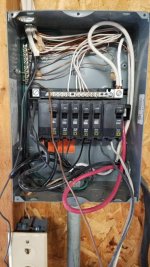
Was the original permitted? If so how long ago? My experience is that inspectors want to see even a panel change b/c they want the grounding and bonding up to date. That's really your call based on local enforcement stringency.

Since you have a dettached bldg, you will need a grounding electrode system. Easiest is to drive 2 rods 6+' apart.

The conduit provides an equipment ground only. You need the grounding electrodes.

How old is the conduit? It could be in good shape or swiss cheese. If in good shape, you be able to pull out old and pull 3-#3,s + #8 grd wire.

If you went with 4's + #8, it could be protected with a 90a cb, but I would put in 80a cb for voltage drop considerations.
 

mm08822

Well-known member
Joined
Jan 13, 2012
Messages
5,965
Location
NJ
I have a 60 amp main, I have a oven, air compressor, 2 post lift, 240 welder, and like 200 t8 lamps ( half led), stereo, bench grinder, bandsaw. Never tripped the main yet, you don't do everything at once so the continuous load is not that great.

I also have a 24 space panel, my inspector made me change out the main in the panel to a 60 amp bolted in main, which is easy and about $20.

Permitting is based on your local area.

Best of luck, Ben

The inspector wasted $20 of your money.
 
To avoid these ads, REGISTER NOW!

pattenp

Well-known member
Joined
Jun 4, 2008
Messages
10,175
Location
Virginia - USA
What is a bolted in main? Is that what I have in the picture? I'm assuming you guys are seeing the three photos I posted.

Sent from my SM-G935V using Tapatalk

The main breaker needs to be fastened to the panel via a bolt to prevent it from being pulled out since effectively it is live. I'm not seeing a retaining screw/kit on you main breaker in the subpanel.
 
Last edited:
OP
D

DIYGuy

Well-known member
Joined
Dec 23, 2018
Messages
57
Location
Michigan
Was the original permitted? If so how long ago? My experience is that inspectors want to see even a panel change b/c they want the grounding and bonding up to date. That's really your call based on local enforcement stringency.

Since you have a dettached bldg, you will need a grounding electrode system. Easiest is to drive 2 rods 6+' apart.

The conduit provides an equipment ground only. You need the grounding electrodes.

How old is the conduit? It could be in good shape or swiss cheese. If in good shape, you be able to pull out old and pull 3-#3,s + #8 grd wire.

If you went with 4's + #8, it could be protected with a 90a cb, but I would put in 80a cb for voltage drop considerations.
It was permitted and has an inspection sticker on the current panel. I've only lived in this house for a few years now, but I think it was built in either 1992 or 1998. I can't recall at the moment.

I don't see any grounding rods, unless I'm somehow missing them. All I see is the conduit coming out of the ground on the outside of the building and then going in the building and up into the panel.

Sent from my SM-G935V using The Garage Journal mobile app
 
OP
D

DIYGuy

Well-known member
Joined
Dec 23, 2018
Messages
57
Location
Michigan
The main breaker needs to be fastened to the panel via a bolt to prevent it from being pulled out since effectively it is live. I'm not seeing a retaining screw/kit on you main breaker in the subpanel.

Yea I think you're right. I can just remove the beaker like any other one. View attachment 1

Also if you can see in the photo, the previous owner has an RV plug wired right to the lugs. Doesn't even go to a breaker. Not sure if that's ok, but seems odd to me.

Sent from my SM-G935V using The Garage Journal mobile app
 

Attachments

  • 20190102_125804.jpg
    20190102_125804.jpg
    98.3 KB · Views: 71

swaterbenny

Well-known member
Joined
Nov 22, 2009
Messages
215
Location
New Richmond, WI
From what I can tell your panel doesn't appear to have a main. I may be missing it though?

Edit never mind I see it now, I thought the RV was the main feed. You have a whole lot of wrong going on here.

Ben
 

Bert_

Well-known member
Joined
Dec 24, 2016
Messages
9,746
Location
NW Iowa
The only thing wrong with the RV outlet is that it's protected by a 60a breaker instead of a 50a.
 

swaterbenny

Well-known member
Joined
Nov 22, 2009
Messages
215
Location
New Richmond, WI
The only thing wrong with the RV outlet is that it's protected by a 60a breaker instead of a 50a.

Might even be totally legit, that wire could be big enough for a 60 amp breaker, or could be only good for a 40 amp.

I see wires hanging out the front, of the panel....
 

mm08822

Well-known member
Joined
Jan 13, 2012
Messages
5,965
Location
NJ
Are you sure about that? I have a license, and checked the code...

408.36(D) in the 2014 code...

Based on the NEC article referenced, you’re talking about needing a hold-down kit for a back-fed cb used as the main in a main lug panel.

That’s an entirely different situation. This thread is discussing adding a 100a main breaker’d panel where the 60a feeder is protected in the house with a 60a cb.

When you write “my inspector made me change out the main in the panel to a 60 amp bolted in main” it seems to me that you are referring to a 24 space panel originally with a (100A?) main breaker that you had to change out to 60A. “Bolted in main” leads me to visualize a main cb bolted onto the end of the buss in typical main breaker position/fashion.

Why is it you needed a 60a main cb? Is this the garage service size or is this fed from a main panel?
 
OP
D

DIYGuy

Well-known member
Joined
Dec 23, 2018
Messages
57
Location
Michigan
Might even be totally legit, that wire could be big enough for a 60 amp breaker, or could be only good for a 40 amp.

I see wires hanging out the front, of the panel....
The wires for the RV plug are also #6 so if what I've learned (still have lots to learn) so far is correct then it would require a 60amp breaker.

And please disregard the wires hanging out of the front. I had to temporarily wire an outlet to plug my compressor in to so I could air up some tires. I didn't want to run a permanent circuit yet until I decide what I'm going to do with the panel. As soon as I posted that pic I knew for sure someone would comment on that.

Sent from my SM-G935V using The Garage Journal mobile app
 

swaterbenny

Well-known member
Joined
Nov 22, 2009
Messages
215
Location
New Richmond, WI
I have a 60amp in my main panel, but it also requires a main in the garage panel.

I was pointing out that if he moves up to a larger panel he can use a smaller main for $20, and then if he feels the need to move up to a 100amp feed, he can just reinstall the 100 amp main. The whole thread is the questioning of is 60 amps enough?

I'm not trying to create a dispute, just giving the guy possible solutions.
 

swaterbenny

Well-known member
Joined
Nov 22, 2009
Messages
215
Location
New Richmond, WI
And please disregard the wires hanging out of the front. I had to temporarily wire an outlet to plug my compressor in to so I could air up some tires. I didn't want to run a permanent circuit yet until I decide what I'm going to do with the panel. As soon as I posted that pic I knew for sure someone would comment on that.

I was just giving you a hard time.:thumbup:
 

Moto

Well-known member
Joined
Dec 9, 2007
Messages
153
The main breaker needs to be fastened to the panel via a bolt to prevent it from being pulled out since effectively it is live. I'm not seeing a retaining screw/kit on you main breaker in the subpanel.

No main breaker in that panel.

Or rather, there are six of them, but none are back-fed.
 
OP
D

DIYGuy

Well-known member
Joined
Dec 23, 2018
Messages
57
Location
Michigan
I was just giving you a hard time.[emoji106]
I appreciate everybody's help so far. [emoji481]

I've never fished wire through conduit before. So if I do decide to go that route, does anybody have a good how-to or some tips for me? This would probably be a good time to run some cat5 too if it fits.

Do I pull out the old wires and use a fish tape to run the new ones? Or would I tie off the new ones to the old ones and pull the new ones through?


Sent from my SM-G935V using The Garage Journal mobile app
 
OP
D

DIYGuy

Well-known member
Joined
Dec 23, 2018
Messages
57
Location
Michigan
No main breaker in that panel.

Or rather, there are six of them, but none are back-fed.
The double pole breaker on the far left is the main. The conductors from the main panel in the house come out of the conduit on the bottom and go into that breaker (the two hot wires.) The common from the house goes to the common bar and the ground goes to a connector on the conduit and then to the ground bar.

The wires I think that you are thinking are the mains are just going to an RV outlet. The previous owner just wired them right to the lugs rather than using a breaker. They are protected by the 60amp main (far left in pic) and the 60amp breaker in the main panel that's feeding this sub panel. (Whichever trips first)

Sent from my SM-G935V using The Garage Journal mobile app
 

mm08822

Well-known member
Joined
Jan 13, 2012
Messages
5,965
Location
NJ
OP, you can even re-coup the existing cb's. Just buy another SQ D QO panel.
 

mm08822

Well-known member
Joined
Jan 13, 2012
Messages
5,965
Location
NJ
I have a 60amp in my main panel, but it also requires a main in the garage panel.

I was pointing out that if he moves up to a larger panel he can use a smaller main for $20, and then if he feels the need to move up to a 100amp feed, he can just reinstall the 100 amp main. The whole thread is the questioning of is 60 amps enough?

I'm not trying to create a dispute, just giving the guy possible solutions.

Nor I. I’m just trying to tell you that if you already had a main cb in the panel greater than 60A, it did not need to be changed to a 60a. Any value cb would be acceptable meeting the disconnect requirement.

Fully agree with you needing a hold down for any back-fed cb.

As I said in post 12, change the panel out to a 100a main breaker panel. Then see (wait some time) if the feeder needs to be upgraded. If he can squeak by with the existing feeder, he can save $250 and some time.

The 100a cb can remain in the sub even if he never upgrades the feeder. NEC 408.36 permits this. The 60a feeder is also protected by the 60a cb in the main panel. Why buy and change out a cb that doesn’t need to be?
 

teamextreme

Well-known member
Joined
Aug 10, 2013
Messages
867
Location
Lakewood, CO
I've never fished wire through conduit before. So if I do decide to go that route, does anybody have a good how-to or some tips for me? This would probably be a good time to run some cat5 too if it fits.

Do I pull out the old wires and use a fish tape to run the new ones? Or would I tie off the new ones to the old ones and pull the new ones through?


Sent from my SM-G935V using The Garage Journal mobile app

It sounds as if you're planning on running CAT5 cable in the same conduit with your power feeder conductors. You can't and shouldn't do that. CAT5 cable likely doesn't have the correct voltage rating and it would not fare well with being pulled in with heavy power conductors. It would also be a bad idea due to electrical interference with the CAT5 signal. Most guys run a separate conduit for low-volt stuff. I ran a 1" and pulled a CAT5 and coax through it.

As far as pulling new wires, you can do it either way. A lot will depend on how "stuck" your existing wires are in the conduit. I would probably try pulling out all the conductors but one (which is sometimes hard to do if they are twisted together) and use the last one as a pull wire for the new wires.
 
OP
D

DIYGuy

Well-known member
Joined
Dec 23, 2018
Messages
57
Location
Michigan
It sounds as if you're planning on running CAT5 cable in the same conduit with your power feeder conductors. You can't and shouldn't do that. CAT5 cable likely doesn't have the correct voltage rating and it would not fare well with being pulled in with heavy power conductors. It would also be a bad idea due to electrical interference with the CAT5 signal. Most guys run a separate conduit for low-volt stuff. I ran a 1" and pulled a CAT5 and coax through it.

As far as pulling new wires, you can do it either way. A lot will depend on how "stuck" your existing wires are in the conduit. I would probably try pulling out all the conductors but one (which is sometimes hard to do if they are twisted together) and use the last one as a pull wire for the new wires.
Thanks for the info. I guess I'll skip the cat5 then.

Sent from my SM-G935V using The Garage Journal mobile app
 
To avoid these ads, REGISTER NOW!
Top Bottom