To avoid these ads, REGISTER NOW!

3 phase B & D grinder wiring and switch questions...

Ststephen7

Well-known member
Joined
Sep 24, 2016
Messages
165
Location
Elkins Park, PA
Hey guys,

I've done some searching and I haven't found the answers... maybe because I'm not asking the right questions ; )
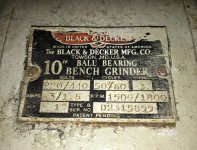
IMG_5217 2.jpg

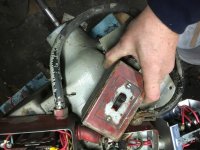
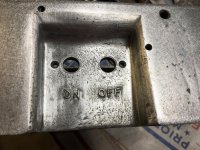
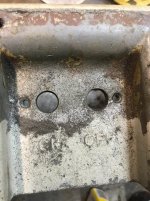
First, I'd like to "restore" this old grinder, and replace the original push button switch on the front. Are they still available, and it this a good idea? I couldn't post more pictures (although I have them) and the push button switch has 3 sets of screws, although only 1 pair had wires on them (and the wires had been cut).
IMG_5373.jpg
IMG_5374.jpg

Next... I am no electrician, and have never worked with 3 phase before, so the answers may be obvious for anyone familiar with 3 phase.

The wiring seems way more complicated than it needs to be (in my inexperienced mind at least). I have a total of 4 boxes, and 2 switches!?

I know I'll need a VFD (or RPC) when I have the $, and I'd like to clean up this mess if I can.

IMG_5361.jpg
IMG_5364.jpg

3 phase comes in the top, the next box down provides power out (left and right) for the lighting, and the bottom box has a switch (wired off the the left) and powers the motor through the back on the box and into the bottom of the motor.

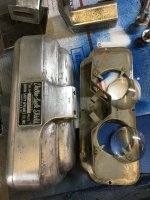
Oh... and it there any reason why one light/glass shield housing would be marked 110 and the other 220? They both had the same bulbs (2 bulbs in each housing, just regular appliance bulbs). I have pictures of the wiring for each if needed (before I took them apart ; )

IMG_5383.jpg

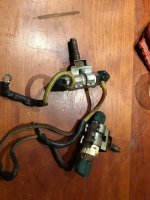
Wait, one last thing... are these mercury switches fine to put back in place? I'd like to keep it original if I can. They are in the light/glass shield housings, and probably turn the light on when tilted down, right?
IMG_5384.jpg

Thank you!
Steve
 
Last edited:
To avoid these ads, REGISTER NOW!
OP
S

Ststephen7

Well-known member
Joined
Sep 24, 2016
Messages
165
Location
Elkins Park, PA
****... one more question...

There is an Anderson 4-8 hp static phase converter (pretty local) for $50... Are my needs simple enough with this grinder to just hook up a static converter and go? Or am I not understanding, and need to use the static converter to move a larger 3 PH motor to create 3 phase power?

I need to do this as inexpensively as possible...

Thanks,
Steve
 
Last edited:

wyliesdiesels

Well-known member
Joined
Aug 14, 2012
Messages
20,032
Location
Modesto, CA
static converters are lame. It starts the motor on 3 phase then drops out a phase running the motor on single phase.

An older motor may not handle that well.

Do you know if the motor even works?

May be cheaper to buy a single phase motor.
 

Norcal

Well-known member
Joined
Mar 16, 2008
Messages
13,765
static converters are lame. It starts the motor on 3 phase then drops out a phase running the motor on single phase.

An older motor may not handle that well.

Do you know if the motor even works?

May be cheaper to buy a single phase motor.
,
The problem is without that motor, the OP does not have a machine, the only options is either supply 3Ø or use a VFD, it will be a expensive lesson to buy a VFD and find out it does not work, I use a VFD on a Rockwell 7" 200V 3Ø grinder & it works well. I do agree a static converter is not a good choice.
 

BreeStephany

ALLIANCE MEMBER
Joined
May 19, 2012
Messages
851
Location
Oregon
I would personally go with a VFD, do away with the old contactor and extra switches and just add a low voltage start & stop switch or station and wire them into the VFD. It will definitely simplify the wiring for you.

If you want to continue to have lighting, you can keep the light switch and use 4 wire SO cord (2 phase conductors, 1 neutral conductor & 1 ground conductor) and a 125/240V twistlock cord end & plug into a j-box below your VFD, then take your lighting circuit out of the j-box.

Just my two cents.
 
OP
S

Ststephen7

Well-known member
Joined
Sep 24, 2016
Messages
165
Location
Elkins Park, PA
I would personally go with a VFD, do away with the old contactor and extra switches and just add a low voltage start & stop switch or station and wire them into the VFD. It will definitely simplify the wiring for you.

If you want to continue to have lighting, you can keep the light switch and use 4 wire SO cord (2 phase conductors, 1 neutral conductor & 1 ground conductor) and a 125/240V twistlock cord end & plug into a j-box below your VFD, then take your lighting circuit out of the j-box.

Just my two cents.

Oooo... if I did that then I could replace the neat round button push button switch on the front... I'd like to keep that if I can. I think it adds a lot to the look and would make for a better 'restoration'.

IMG_5400.jpg

And the lights are a big part of what makes this grinder what it is... Each housing holds a huge 8" x 10" glass shield, plus 2 bulbs, each with a nice ground glass magnifying lens, plus a mercury switch that turns the lights on and off when you pull the shields down!

IMG_5399.jpg

I am hoping to be able to get a milling machine in the future, so I am keeping my eyes open for a cheap 5hp 3 phase motor to make a rotary converter to power the shop.
 

alfredeneuman

Well-known member
Joined
Mar 3, 2011
Messages
4,584
Location
Fullerton, CA
Oooo... if I did that then I could replace the neat round button push button switch on the front... I'd like to keep that if I can.

Any switch between the VFD and the motor will reduce the life of the VFD greatly.
There is damage to the output transistors when the VFD/motor connection is interrupted.
The only switch between the motor and the VFD should be emergency stops.
 
OP
S

Ststephen7

Well-known member
Joined
Sep 24, 2016
Messages
165
Location
Elkins Park, PA
Any switch between the VFD and the motor will reduce the life of the VFD greatly.
There is damage to the output transistors when the VFD/motor connection is interrupted.
The only switch between the motor and the VFD should be emergency stops.

Well then... I guess I'll just use that switch for the lights
 

larry_g

Well-known member
Joined
Apr 28, 2007
Messages
16,889
Location
oregon
Any switch between the VFD and the motor will reduce the life of the VFD greatly.
There is damage to the output transistors when the VFD/motor connection is interrupted.
The only switch between the motor and the VFD should be emergency stops.

Well then... I guess I'll just use that switch for the lights

Al is correct but you can use the origional switch to signal the input to the VFD for start/stop operation. It will look just like original. If your going to plant this machine in one spot then you could put a disconnect on the wall and wire it 4-wire like Bree suggests. The disconnect would apply power to the VFD and the lights. It's not a difficult thing to do.

lg
no neat sig line
 
To avoid these ads, REGISTER NOW!

metlmunchr

Well-known member
Joined
Sep 10, 2011
Messages
1,278
Its worth mentioning that you have to take extreme care to avoid overspeeding the wheel on any grinder when using a VFD. Failure to do so can result in the wheel exploding and maiming or killing you. This is even more critical on grinders where the user is in the direct path of the wheel, such as a bench grinder.

The max output frequency is normally a programmable parameter in a VFD, and should be programmed to allow a max of 60 Hz when applied to a bench grinder.
 

matt_i

Well-known member
Joined
Mar 14, 2008
Messages
10,730
Location
SE Michigan
Static converters are just fine if you can live with 2/3 of the nameplated HP. Its pretty simple, its just a start capacitor that's switched into the 3rd phase at the start and then back out. Some automate the switching with on-delay timers or a potential relay. There might be run capacitors to better balance the generated leg but if you balance it at idle it won't be balanced under load, so in my opinion why bother. The tool motor does not care. All it (and you) really care about is that the motor starts and goes to synchronous speed.
 

Low277

Member
Joined
Nov 21, 2018
Messages
17
Location
Minnesota
Its worth mentioning that you have to take extreme care to avoid overspeeding the wheel on any grinder when using a VFD. Failure to do so can result in the wheel exploding and maiming or killing you. This is even more critical on grinders where the user is in the direct path of the wheel, such as a bench grinder.

The max output frequency is normally a programmable parameter in a VFD, and should be programmed to allow a max of 60 Hz when applied to a bench grinder.

Very good point!!:thumbup:
 
OP
S

Ststephen7

Well-known member
Joined
Sep 24, 2016
Messages
165
Location
Elkins Park, PA
Its worth mentioning that you have to take extreme care to avoid overspeeding the wheel on any grinder when using a VFD. Failure to do so can result in the wheel exploding and maiming or killing you. This is even more critical on grinders where the user is in the direct path of the wheel, such as a bench grinder.

The max output frequency is normally a programmable parameter in a VFD, and should be programmed to allow a max of 60 Hz when applied to a bench grinder.

That IS a good reminder. I had thought about a vfd, and my lack of need to change the speed on the grinder. When I get a milling machine a vfd makes a lot of sense, and for the grinder I think a rotary converter might be cheaper and certainly a more simply set up.
 
OP
S

Ststephen7

Well-known member
Joined
Sep 24, 2016
Messages
165
Location
Elkins Park, PA
I was communicating with a local guy about a small mill he was selling, and he agreed to have me over to check that my motor was working.

He had set up a really simple 'pull start' converter for his own needs, and he was kind enough to take the time to run a line and check my motor.

I'm happy to say that it fired right up. And... the sound confirmed my need for new bearings. I cleaned and re-lubed the old ones just for the test, and even cleaned up and with brand new grease they sounded like they wanted to be replaced.

I'll order up some new ones.
 

Low277

Member
Joined
Nov 21, 2018
Messages
17
Location
Minnesota
Last rotary I installed was based on a 50hp motor. By the time the cost of the convertor, power wiring to it and from it to load is considered and installing a 3 phase voltage sensing relay to the control circuit of the end load. it is much more complicated to install and then you have all the capacitors to maintain as well.

VFD is very much nicer and many have a auto tune feature that will make the load motor just purr.
 

larry_g

Well-known member
Joined
Apr 28, 2007
Messages
16,889
Location
oregon
Last rotary I installed was based on a 50hp motor. By the time the cost of the convertor, power wiring to it and from it to load is considered and installing a 3 phase voltage sensing relay to the control circuit of the end load. it is much more complicated to install and then you have all the capacitors to maintain as well.

VFD is very much nicer and many have a auto tune feature that will make the load motor just purr.

A 50 horse rotary is not even close to what the OP needs. Apples to Oranges. In my shop I have a home built 5 HP rotary that runs 2 lathes, 2 mills, and a drill press. All the tools are in the 2-4hp range and they all run just fine. So in my opinion the OP, if more 3 Ph tools are in the future, then a RPC might be the better solution. You would have to figure the cost of a RPC against the number of VFD's you would have to purchase to cover the number of machines you have.

lg
no neat sig line
 

manwithtools

ALLIANCE MEMBER
Joined
Aug 24, 2015
Messages
13,983
Location
Lebanon, TN
What happened to make you prefer vfd's to rotary converters? I have no experience with either, and both are widely used...

What happened: VFD's cost has dropped significantly and even the cheapest ones are very capable. For the home shop, there is really no incentive to use a static or rotary phase converter.

Even with multiple machines, the VFD's win. You can vary the speed, run beyond 60hz, ramp up, ramp down, stop nearly instantly. Just no reason anymore. For the cost, VFD's are simply the way to go.
 

mm08822

Well-known member
Joined
Jan 13, 2012
Messages
6,004
Location
NJ
What happened: VFD's cost has dropped significantly and even the cheapest ones are very capable. For the home shop, there is really no incentive to use a static or rotary phase converter.

Even with multiple machines, the VFD's win. You can vary the speed, run beyond 60hz, ramp up, ramp down, stop nearly instantly. Just no reason anymore. For the cost, VFD's are simply the way to go.

I would use a vfd purely for the ramp up/ramp down feature. No more shocking the drive train on startup and can get a faster decel to zero than simply coasting to stop. A vfd keeps the equipment portable when it matters.

I like Lenze VFD's for my own installs and is my go to recommendation to others.
At work, it's all AB - $$$ but network connectivity is most important there.
 
To avoid these ads, REGISTER NOW!
Top Bottom