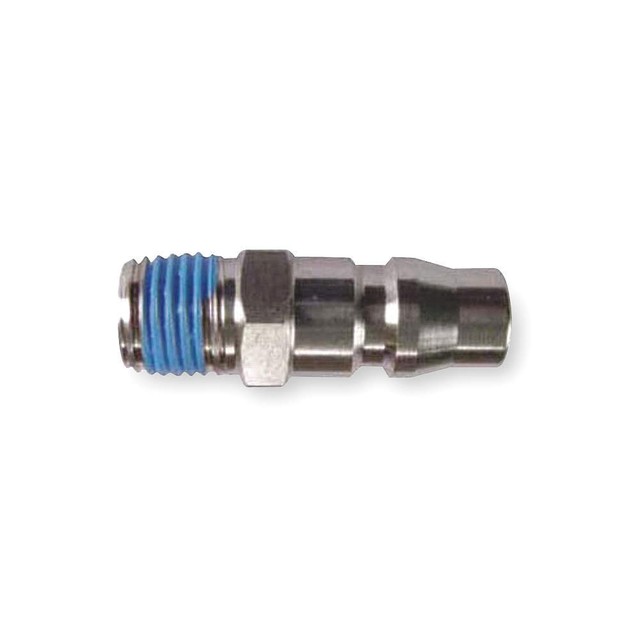
Thanks! Any timeline on the hi-flo orbital couplers?

WHY STEDLIN COUPLERS DO NOT SUPPORT THE COMMON EUROPEAN HIGH FLOW PLUG STANDARD CEJN-320)
A lot has been made about the significant improvement in air tool performance using the European 1/4" high flow standard which allows for bores as large as 7.6 millimeters. (.30 inch)
This plug standard originated with the Swedish company CEJN as part of their high flow safety coupler line. It was not intended to be used in non safety couplers.
It is unfortunate that it is now mass marketed with non safety couplers.
Lately I've noticed that many companies that sell couplers are offering package deals of these so called “Hi-Flo” non safety couplers with aluminum plugs.
Ironically, the typical buyer who wants increased air flow is probably using it with a tool such as an impact wrench or air hammer.
The aluminum plugs are not suitable for these applications because the steel balls in the couplers quickly damage the soft aluminum plugs.
(The Stedlin couplers use balls that do not damage aluminum plugs.)
I am bothered by this trend.
Before these types of couplers came on the market, 1/4” NPT threaded air hose couplers seemed to have standardized on a bore size of approximately 5 millimeters.
It is assumed that the main reason these new high flow couplers have so much more flow then the earlier 5 millimeter couplers was caused entirely by the larger plug bore size.
This is most definitely not the case. The biggest improvement comes from the air flow design of the coupler itself.
The original air couplers introduced in the US by Milton Industries used basically the exact same plug that is standardized today as the so called “industrial” or “M style” or more precisely ISO-6150B.
I believe this plug started out with a 3/16 of an inch hole through it and has remained very close to that for over 70 years.
The couplers that tend to be shipped with new portable compressors use the same type of coupler that has been available for about that long with little change. This is the type of coupler that requires the user to pull back the outer sleeve in order to insert the plug. These couplers tend to be restrictive to the flow of compressed air
The new high flow couplers work differently internally and do not require the sleeve to be retracted in order to insert the plug. These couplers also have a much more efficient internal flow path then the original couplers.
As an example:
At a flow rate of 32 SCFM the older style coupler and 5MM plug can have a pressure drop of over 35 PSI.
The exact same plug inserted into a high flow coupler such as a Stedlin Quick Coupler can reduce the pressure drop by 300 percent.
The 5 millimeter bore of most of these plugs could actually be 5.5 millimeter without any adverse effects. The Stedlin QuietPlugs have a 5.5 MM bore for maximum flow.
The problem with these European high flow plugs is in fact the very large bore.
The reason is that increasing the bore beyond 5.5 millimeters does not increase the system flow rate substantially considering all the other losses in a 1/4” NPT / 3/8” hose based setup.
However, the large bore plug on the end of a hose increases the flow rate substantially of the air exhausting the hose upon plug disconnection. This can be extremely hazardous. (Stedlin QuietHose or QuietPlug-HF) solves this problem).
The worst case scenario is an air tool such as a framing nail gun.
In this case, disconnecting the plug from a non safety coupler can cause serious injury and hearing damage. Because of the large plug bore the air is released at an initial flow rate as high as 150 CFM.
The Stedlin QuietPlug-HF and Orbital QuietPlug-HF are designed to solve this serious issue..
In other words: Large bore high flow plugs increase the flow rate greatly but in the wrong direction.