To avoid these ads, REGISTER NOW!

My attempt to make a better hose coupler

S

Stedlin

Guest
Here is a short demonstration of the difference in flow rate between a standard high flow coupler using the Euro standard 1/4 high flow plug and the Stedlin coupler with Stedlin plug.

<iframe width="560" height="315" src="https://www.youtube-nocookie.com/embed/2mBkwXmHPrE" frameborder="0" allow="accelerometer; autoplay; encrypted-media; gyroscope; picture-in-picture" allowfullscreen></iframe>

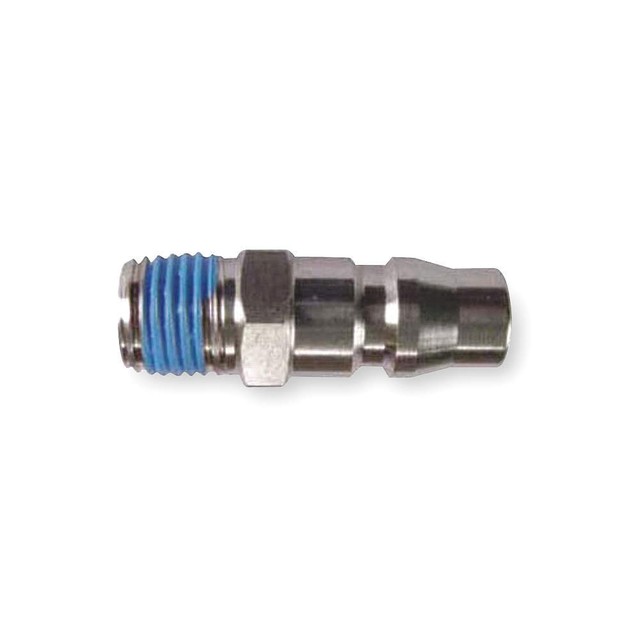
Here is a picture of what the Stedlin plug looks like.
stedlin-ff-plug-1024.png


As you can see, the performance is very close.
 
To avoid these ads, REGISTER NOW!
S

Stedlin

Guest
The few of you still viewing this thread might find this interesting.
flowtests.png

I did some flow rate testing today and I thought I would share the results.
The upper image is the most common 1/4" coupler and plug. (M style/industrial)
At 42 CFM (90 PSI on the gauge) the pressure drop is 41.5 PSI.
The 2nd image from the top shows a Sedlin Quick Couipler with the identical plug. The pressure drop is 20 PSI.
The 3rd image from the top shows a Stedlin Quick Coupler with a Stedlin designed plug that is very similiar in size to the standard M style.
The pressure drop is 9.5 PSI.
The 4th image is a Milton V style coupler and V style plug.
The pressure drop is 7.3 PSI
The 5th image is a very common high flow coupler body. Many companies are using the identical coupler with only minor changes in color and material. A common high flow large bore plug is inserted
The pressure drop is 10.3 PSI.


Repeating these tests results in very similar numbers.
 
S

Stedlin

Guest
Just in an attempt to be clear I will state for the record that the new Stedlin couplers are high flow without the need of the large bore European plugs.
The Stedlin Quick Coupler used with the Stedlin QuietPlug has virtually the same flow capacity as do the so called hi-flo couplers being mass marketed these days. It also takes less then half the effort to insert the plug under pressure.
The QuietPlug has a .219" bore and the European hi-flo has a .290" bore.
 

Clemson13

Well-known member
Joined
May 30, 2015
Messages
425
That you for keeping this thread open and making such an awesome product! I love mine. Your orbitals are amazing. I thinking of bringing some to Trinidad on my next work trip to let the guys at my client use since they won't find this thread.

I'm looking forward to buying some of these awesome couples in a few days!

Sent from my Moto G (5) Plus using Tapatalk
 
S

Stedlin

Guest
That you for keeping this thread open and making such an awesome product! I love mine. Your orbitals are amazing. I thinking of bringing some to Trinidad on my next work trip to let the guys at my client use since they won't find this thread.

I'm looking forward to buying some of these awesome couples in a few days!

Sent from my Moto G (5) Plus using Tapatalk

Thank you for your kind words.
 

The Cobbler

Super Moderator
Staff member
Joined
Oct 24, 2013
Messages
26,090
Location
Niagara Region, Ontario, Canada
as mentioned in a previous post, these couplers are not designed to compete with the regular run of the mill $5 ones, they are more expensive but a lot more user friendly and in heavy use they are awsome .
I am looking forward to getting some of the couplers soon.
 
S

Stedlin

Guest
as mentioned in a previous post, these couplers are not designed to compete with the regular run of the mill $5 ones, they are more expensive but a lot more user friendly and in heavy use they are awsome .
I am looking forward to getting some of the couplers soon.
Your support is appreciated. I am confident you will love our couplers.

parts.jpg

Everything we sell is designed by me and manufactured in our facility in Duluth Minnesota, across the street from Lake Superior.
I have been told that we are the only company manufacturing couplers in the United States.
 
Last edited:

L.Cheapo

Well-known member
Joined
Oct 23, 2014
Messages
6,061
Your support is appreciated. I am confident you will love our couplers.

Everything we sell is designed by me and manufactured in our facility in Duluth Minnesota, across the street from Lake Superior.
I have been told that we are the only company manufacturing couplers in the United States.

Man, those sure are pretty. Just so I am clear...are the current quick couplers and orbital coupler are as high flow as you intend to make? If so, the orbital coupler lists 12psi drop @ 32cfm. Would it be fair to say the drop at say, 10CFM would be negligible?

When do you plan to have those orbital quick couplers in stock? Everything I've bought from you works as great as it looks and I'd love to have a couple of those.
 
S

Stedlin

Guest
Man, those sure are pretty. Just so I am clear...are the current quick couplers and orbital coupler are as high flow as you intend to make?
NO
If so, the orbital coupler lists 12psi drop @ 32cfm. Would it be fair to say the drop at say, 10CFM would be negligible?
YES
When do you plan to have those orbital quick couplers in stock?
MONDAY
Everything I've bought from you works as great as it looks and I'd love to have a couple of those.
Good to hear.
 
S

Stedlin

Guest
Thanks! Any timeline on the hi-flo orbital couplers? :)


WHY STEDLIN COUPLERS DO NOT SUPPORT THE COMMON EUROPEAN HIGH FLOW PLUG STANDARD CEJN-320)

A lot has been made about the significant improvement in air tool performance using the European 1/4" high flow standard which allows for bores as large as 7.6 millimeters. (.30 inch)
This plug standard originated with the Swedish company CEJN as part of their high flow safety coupler line. It was not intended to be used in non safety couplers.
It is unfortunate that it is now mass marketed with non safety couplers.

Lately I've noticed that many companies that sell couplers are offering package deals of these so called “Hi-Flo” non safety couplers with aluminum plugs.
Ironically, the typical buyer who wants increased air flow is probably using it with a tool such as an impact wrench or air hammer.
The aluminum plugs are not suitable for these applications because the steel balls in the couplers quickly damage the soft aluminum plugs.
(The Stedlin couplers use balls that do not damage aluminum plugs.)

I am bothered by this trend.

Before these types of couplers came on the market, 1/4” NPT threaded air hose couplers seemed to have standardized on a bore size of approximately 5 millimeters.
It is assumed that the main reason these new high flow couplers have so much more flow then the earlier 5 millimeter couplers was caused entirely by the larger plug bore size.
This is most definitely not the case. The biggest improvement comes from the air flow design of the coupler itself.
The original air couplers introduced in the US by Milton Industries used basically the exact same plug that is standardized today as the so called “industrial” or “M style” or more precisely ISO-6150B.
I believe this plug started out with a 3/16 of an inch hole through it and has remained very close to that for over 70 years.
The couplers that tend to be shipped with new portable compressors use the same type of coupler that has been available for about that long with little change. This is the type of coupler that requires the user to pull back the outer sleeve in order to insert the plug. These couplers tend to be restrictive to the flow of compressed air
The new high flow couplers work differently internally and do not require the sleeve to be retracted in order to insert the plug. These couplers also have a much more efficient internal flow path then the original couplers.
As an example:
At a flow rate of 32 SCFM the older style coupler and 5MM plug can have a pressure drop of over 35 PSI.
The exact same plug inserted into a high flow coupler such as a Stedlin Quick Coupler can reduce the pressure drop by 300 percent.

The 5 millimeter bore of most of these plugs could actually be 5.5 millimeter without any adverse effects. The Stedlin QuietPlugs have a 5.5 MM bore for maximum flow.

The problem with these European high flow plugs is in fact the very large bore.
The reason is that increasing the bore beyond 5.5 millimeters does not increase the system flow rate substantially considering all the other losses in a 1/4” NPT / 3/8” hose based setup.
However, the large bore plug on the end of a hose increases the flow rate substantially of the air exhausting the hose upon plug disconnection. This can be extremely hazardous. (Stedlin QuietHose or QuietPlug-HF) solves this problem).
The worst case scenario is an air tool such as a framing nail gun.
In this case, disconnecting the plug from a non safety coupler can cause serious injury and hearing damage. Because of the large plug bore the air is released at an initial flow rate as high as 150 CFM.
The Stedlin QuietPlug-HF and Orbital QuietPlug-HF are designed to solve this serious issue..

In other words: Large bore high flow plugs increase the flow rate greatly but in the wrong direction.
 
S

Stedlin

Guest
I said that we will have couplers in stock on Monday and Monday it is and we have stock.:)
 

L.Cheapo

Well-known member
Joined
Oct 23, 2014
Messages
6,061
Does the new orbital coupler accept your orbital quietplug high flow? If not, is there one coming that will?
 

aczr2k

Well-known member
Joined
Oct 24, 2007
Messages
523
Location
NW Minnesota
Had some projects this weekend in the shop so it was the first time to use the new orbital coupler. The low insertion force is sure nice, my dad appreciates it.

Used the air ratchet to tighten some plow bracket bolts on the Polaris ranger and its sure nice not to have to fight the hose since the orbital coupling rotates and moves out of the way. Anyone that uses an air ratchet knows what I mean when I say "fight the hose".
 
S

Stedlin

Guest
Had some projects this weekend in the shop so it was the first time to use the new orbital coupler. The low insertion force is sure nice, my dad appreciates it.

Used the air ratchet to tighten some plow bracket bolts on the Polaris ranger and its sure nice not to have to fight the hose since the orbital coupling rotates and moves out of the way. Anyone that uses an air ratchet knows what I mean when I say "fight the hose".
Appreciate the feedback.
When I was designing these couplers I gave ease of connection a high priority.
 
S

Stedlin

Guest
So tell me this all of the Prevost stuff I have is it inferior to your connects?
I would not use the word "inferior", just different.
I have used many types of couplers in the last 50 years or so and I decided to try my hand at improving the state of the art.
What my company is trying to do is to make the safest, highest performing and most ergonomic products in this industry and do it all in the USA while making a living doing it.
I believe we have succeeded in all of these objectives except for the making a living part. (so far.)
 
To avoid these ads, REGISTER NOW!

ATC

Well-known member
Joined
May 12, 2012
Messages
8,433
Location
VA
Do you have any plans to make fittings for 1/2" hose?
 
S

Stedlin

Guest
Do you have any plans to make fittings for 1/2" hose?

I don’t mean to be flippant but I already use them with 1/2 inch hoses.
Perhaps you are looking for 3/8” NPT connectors?
 
S

Stedlin

Guest
Forgot to mention that all products are 25% off through Sunday the 17th.
 

ATC

Well-known member
Joined
May 12, 2012
Messages
8,433
Location
VA
I don’t mean to be flippant but I already use them with 1/2 inch hoses.
Perhaps you are looking for 3/8” NPT connectors?

Your 1/2" air hose has 1/4" NPT fittings?

I'm wanting to upgrade my air lines from 3/8 hose (1/4" NPT) to 1/2 hose (1/2" NPT) without reducing down to 1/4"NPT at the connections.
(Limited use for my 3/4" impact and sand blaster)
 
S

Stedlin

Guest
Your 1/2" air hose has 1/4" NPT fittings?

I'm wanting to upgrade my air lines from 3/8 hose (1/4" NPT) to 1/2 hose (1/2" NPT) without reducing down to 1/4"NPT at the connections.
(Limited use for my 3/4" impact and sand blaster)

I put 1/4 NPT to 1/2" barb fittings on my 1/2" air hoses.
1/4 NPT is not a flow restriction when used with 1/2" hoses. 1/2" hose fittings already have the same ID as the 1/4 NPT fittings do. (correction: some 1/4" NPT fittings have a 3/8" bore and some are as small as 5/16".
 
Last edited:

ATC

Well-known member
Joined
May 12, 2012
Messages
8,433
Location
VA
I put 1/4 NPT to 1/2" barb fittings on my 1/2" air hoses.
1/4 NPT is not a flow restriction when used with 1/2" hoses. 1/2" hose fittings already have the same ID as the 1/4 NPT fittings do. (correction: some 1/4" NPT fittings have a 3/8" bore and some are as small as 5/16".

Ah...gotcha now :thumbup:

I'm still gonna be a buyer...just gotta figure up how many I need for my other tools.
 

aczr2k

Well-known member
Joined
Oct 24, 2007
Messages
523
Location
NW Minnesota
Ha ha well my first order this year was during one of the sales. I was just being a smartass...thanks again for the hat.


Sent from my iPhone using Tapatalk
 
S

Stedlin

Guest
Ha ha well my first order this year was during one of the sales. I was just being a smartass...thanks again for the hat.


Sent from my iPhone using Tapatalk

You're very welcome and thanks for your support.

By the way.
I just did a short test to see if I could verify the claim of 2X the flow on some Hi-Flo couplers I just purchased.
At at static upsteam pressure of 120 PSI the output flow rate of a stock M style coupler and plug(the type with a pull back collar) was 37.5 CFM.
Under identical conditions the Hi-Flo coupler and plug had a flow rate of 46.6 CFM giving an increase of 24 percent.


25 percent off all Stedlin products through Sunday March 17th. Coupon code Garage Journal
 
Last edited:
S

Stedlin

Guest
plugs-ahf.png

I have decided to go ahead and produce these two plugs for exclusive use with our couplers. The plug bore size is identical to our current QuietPlug-HF and combined with our new couplers yields all the air flow of current high flow couplers using the European plugs.

Maybe I should call them the American high flow standard.:beer:
 

beelsr

Well-known member
Joined
May 6, 2007
Messages
1,324
Location
NE PA, USA
1. maybe I missed it but have you published flow restriction testing for the quiethose fittings as you've done for the quick couplers?

2. just to be sure, the neww quick couplers will not work with the milton V-style/high flow, right? so, if my shop was all "purple", i'm out of luck with your couplers. and does this include your own quietplug high flows?
 
S

Stedlin

Guest
1. maybe I missed it but have you published flow restriction testing for the quiethose fittings as you've done for the quick couplers?
I have not as yet. The Quietplug actually has less flow restriction than a standard industrial plug. The QuietPlug-HF has a 2 PSI pressure drop at 32 CFM. The QuietHose has a 2 PSI pressure drop at 32 CFM.
There you go. It's published!
2. just to be sure, the neww quick couplers will not work with the milton V-style/high flow, right? so, if my shop was all "purple", i'm out of luck with your couplers. and does this include your own quietplug high flows?
Did you read this?

Our Quietplug-HF, Orbital QuietPlug-HF are compatible. Of course you can always use a QuietHose fitting between a hose and female plug.


As you can see in this video, the Stedlin QuickCoupler with prototype Stedlin high flow plug out performs the nickel plated European versions of the V style coupler.
<iframe width="560" height="315" src="https://www.youtube-nocookie.com/embed/2mBkwXmHPrE" frameborder="0" allow="accelerometer; autoplay; encrypted-media; gyroscope; picture-in-picture" allowfullscreen></iframe>
 

beelsr

Well-known member
Joined
May 6, 2007
Messages
1,324
Location
NE PA, USA
There you go. It's published!

Touché. :beer: Question though, how can your plug, with the flowvalve thingie inside it, outperform a plug that has nothing inside? Is is the extra .5mm?


Did you read this?

i did read that. but sorry, it's kind of a ramble. bore size blah blah blah, safety non-safety, aluminum bad, coupler design good, euro boreszize makes couplers dangerous, quietplugs fix this but i won't do it for euro plugs because... well, you never actually answer the title of the post. :headscrat

as to the M or V style... you explicitly equate "industrial" and milton-M the same but then mention euro cejn320 and don't say "milton V" and off-handedly mention colorized aluminum plugs (without mentioning a specific color :)). is the euro cejn the same as milton v? unless that post for for a european audience, hardly anyone in america know what CEJN is, we know milton interchange letters.

so, your quick couplers will work with M-style plugs and both your regular quietplug and quietplug-HF plugs (which work with milton V couplers, right?) but not plain ole' regular milton V plugs themselves? please answer in simple one word yes or no answers.

and yes, I watched those videos and yeah cool, but I've gone all milton-v and i'm not replacing them all (again). so, I guess it's more quiethose adapters for me. Which is fine, I guess, since they work great. I just wanted to try your couplers since you've been bragging them all up. :)
 
Last edited:
S

Stedlin

Guest
The Milton V coupler and plugs are identical to the one I showed in the above video and yes, the CEJN-320 and Milton V style plug are in fact the same.
The purple Colorfit plugs are also the same standard.

My upcoming high flow plugs are my own standard and have numerous advantages, not the least of which is the significantly lower force required to insert them.
I could easily make my couplers accept the V style but I would prefer not to because they could be used in an unsafe manner.
Like I said in my "rambling" post, the extra large bore size increases the flow significantly in the wrong direction.

The Stedlin couplers use 8 locking balls that are not steel and will not damage aluminum plugs. This is quite revolutionary.
 
S

Stedlin

Guest
By the way, I am now virtually deaf thanks to an associate disconnecting a hose with V style plug at 150 PSI next to me.
 
To avoid these ads, REGISTER NOW!
Top Bottom