jdavis
Active member
I was recently looking for comparisons between Snap-on, Stahlwille, and Nepros ratchets, since they're (arguably), the best brands of ratchet from the US, Germany, and Japan. I couldn't find a comparison of them, so being a bit obsessed with ratchets, I bought one of each. I figured I'd make a comparison, since I previously couldn't find one.
I like locking flex-head ratchets, and chose 3/8" drive for its intermediate size (and intermediate price). However, Nepros doesn't make a locking flex head (at least not one that I saw). For that reason, I chose to purchase a 1/4" Nepros instead of a 3/8", since I thought a non-locking mechanism would be more useful in a small ratchet. I've attached a picture of all 3 beside one another.
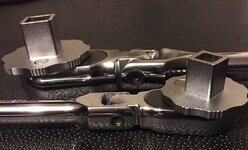
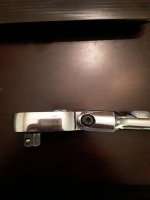
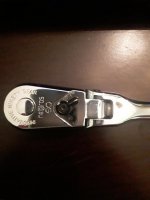
Because the Nepros is substantially different than the other 2, it won't quite be a 1-1 comparison with the others. I'll review it first, and get it out of the way. The Nepros has, without a doubt, the best fit and finish of the 3 of them. It feels like I'm working on my vehicle with a piece of jewelry, instead of a tool. There is no side-to-side play in the flex joint. The hinge friction mechanism is surprisingly stiff, but I'm skeptical of how well it would work on larger ratchets, or how it would react to oil and grease (it's really not the tool I'd use for a job that dirty though). It's a unique mechanism that doesn't get its resistance from the hinge or from yoke friction. It has a little (presumably) spring-loaded rubber brake that can be seen in the attached photos. It's not easily adjustable. I suppose if you really wanted to, you could take it apart and put a thin spacer underneath the spring (again, I've never actually had it apart, so I'm making some assumptions). The Nepros has the least driver play of the 3 of them, and has the most teeth at 90. The backdrag is so low, I sometimes can't tell when to start using my fingers. In my opinion, this tool is a must for accessing small, hard-to-reach fasteners. I paid about $120 for it, including shipping. It made it all the way from Japan in about a week. While I don't think I'd like the larger ones, part of me wants to purchase one in blind faith, due to my experience with this one.
As for the other 2, each one costs about $165 in the US. The Stahlwille can be had for about $100, but I didn't shop around very much. I bought mine from KC Tool. They were prompt, but expensive.
The Snap-on and Stahlwille both have 80 teeth. The Snap-on has the most backdrag (still low), and leaks oil around the driver, due to being oil-filled (still far less filthy than the places it will go, but I'm OCD and don't like that it leaks). Its driver also has more play than the Stahlwille, but neither are overly loose. The Snap-on is the quietest, and the Stahlwille is about as loud as the average ratchet. Both mechanisms are of high quality and function very well, but the Stahlwille is better IMO.
The selector is more positive on the Snap-on, and it's a little easier to switch. This is because the Stahlwille's selector is more beveled and rubs against the head a bit. Both switches are easy to use though. Also noteworthy, is that the Snap-on's selector switch locks into place better when the ratchet is under torque, helping to prevent a bump from dislodging it, but the extra beveling of the Stahlwille serves the same purpose. Also, to be clear, I've never had either of them come out of the selected setting. Both selectors work fine, but the Snap-on's is a little nicer.
As for the head, the Stahlwille has a smaller profile, but not by much. The Stahlwille is quick-release, and the Snap-on isn't. I prefer flex-heads larger than 1/4" to not have the quick-release mechanism, since I like to brace the back of the head with my hand much of the time (at least when I'm underneath the vehicle). I don't think Stahlwille sells this particular tool without it, but the Stahlwille's (and other German brands) that aren't quick-release have an exposed gear backing instead of a solid backing like the Snap-on (and other American brands). I can see pros and cons to each design, but I think I prefer the solid backing. With that said, I have never used the exposed-gear design.
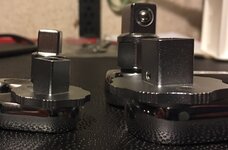
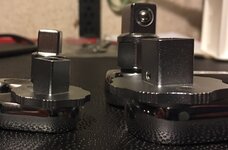
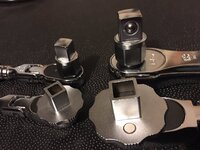
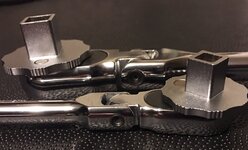
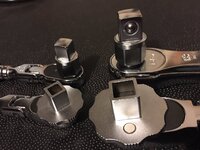
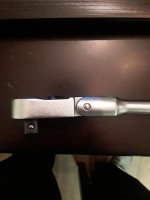
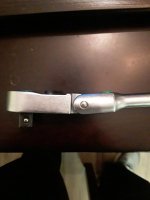
The hinge and locking mechanism is where the biggest difference is. The Snap-on's hinge and lock are orders of magnitude better than the Stahlwille's. This difference is significant enough to make a difference when using the tool. The Stahlwille's hinge has a small amount of side-to-side play, where the Snap-on has none. The Stahlwille's locking mechanism has a total of 4 positions (-30, 0, 30, and 60 degrees), and the Snap-on has 11 (spaced evenly between "about" +/- 75 degrees). The Stahlwille's locking mechanism has a lot of play in it, where the Snap-on's has much less. I've included a picture of the 2 extremes for each one in the 0 degree position. The Stahlwille's lock is button-operated, and cannot remain unlocked when using the ratchet. It's also easy to push the button on accident when spinning the ratchet by its head. The Snap-on's lock is slider-operated, and can remain unlocked when using the ratchet by pushing the slider back and toward the right (image attached). With that said, if your hand is up near the Snap-on's head while it's unlocked, it's easy to bump the slider and cause it to lock. The Stahlwille's hinge is pinned, has very low friction, and cannot be adjusted. The Snap-on's hinge is screwed, has substantial friction, and can be adjusted. It's worth noting that the hinge was uncomfortably tight when I received the tool. It wasn't an issue since I could loosen it, but that's the state it was in right out of the box, for those that care.
Personally, I go back and forth on which grip I like better. I will say I read that the Stahlwille's comfort grip tears up unusually fast, and my experience seems to confirm this. It has a few little marks, and a cut in the rubber. It's not bad, but given the amount of use the tool has seen, it's worn faster than any other grip I have. With that said, the Stahlwille's grip is comfortable, and is clearly designed to keep the grip centerline as far from the pivot point as possible, maximizing torque. However, moving your hand to the rear of the Snap-on's grip is not uncomfortable, and anything you couldn't break loose with it would probably best be done by a 1/2" ratchet.
The last 2 differences I can think of are obvious from the pictures, but the handle is thinner on the Stahlwille, and it's unpolished, unlike the Snap-on. I suppose this could be good or bad.
All things considered, I'd probably pick the Snap-on over the Stahlwille, unless I was looking at fixed head ratchets. For a fixed head ratchet, I'd probably pick a Stahlwille.
I like locking flex-head ratchets, and chose 3/8" drive for its intermediate size (and intermediate price). However, Nepros doesn't make a locking flex head (at least not one that I saw). For that reason, I chose to purchase a 1/4" Nepros instead of a 3/8", since I thought a non-locking mechanism would be more useful in a small ratchet. I've attached a picture of all 3 beside one another.
Because the Nepros is substantially different than the other 2, it won't quite be a 1-1 comparison with the others. I'll review it first, and get it out of the way. The Nepros has, without a doubt, the best fit and finish of the 3 of them. It feels like I'm working on my vehicle with a piece of jewelry, instead of a tool. There is no side-to-side play in the flex joint. The hinge friction mechanism is surprisingly stiff, but I'm skeptical of how well it would work on larger ratchets, or how it would react to oil and grease (it's really not the tool I'd use for a job that dirty though). It's a unique mechanism that doesn't get its resistance from the hinge or from yoke friction. It has a little (presumably) spring-loaded rubber brake that can be seen in the attached photos. It's not easily adjustable. I suppose if you really wanted to, you could take it apart and put a thin spacer underneath the spring (again, I've never actually had it apart, so I'm making some assumptions). The Nepros has the least driver play of the 3 of them, and has the most teeth at 90. The backdrag is so low, I sometimes can't tell when to start using my fingers. In my opinion, this tool is a must for accessing small, hard-to-reach fasteners. I paid about $120 for it, including shipping. It made it all the way from Japan in about a week. While I don't think I'd like the larger ones, part of me wants to purchase one in blind faith, due to my experience with this one.
As for the other 2, each one costs about $165 in the US. The Stahlwille can be had for about $100, but I didn't shop around very much. I bought mine from KC Tool. They were prompt, but expensive.
The Snap-on and Stahlwille both have 80 teeth. The Snap-on has the most backdrag (still low), and leaks oil around the driver, due to being oil-filled (still far less filthy than the places it will go, but I'm OCD and don't like that it leaks). Its driver also has more play than the Stahlwille, but neither are overly loose. The Snap-on is the quietest, and the Stahlwille is about as loud as the average ratchet. Both mechanisms are of high quality and function very well, but the Stahlwille is better IMO.
The selector is more positive on the Snap-on, and it's a little easier to switch. This is because the Stahlwille's selector is more beveled and rubs against the head a bit. Both switches are easy to use though. Also noteworthy, is that the Snap-on's selector switch locks into place better when the ratchet is under torque, helping to prevent a bump from dislodging it, but the extra beveling of the Stahlwille serves the same purpose. Also, to be clear, I've never had either of them come out of the selected setting. Both selectors work fine, but the Snap-on's is a little nicer.
As for the head, the Stahlwille has a smaller profile, but not by much. The Stahlwille is quick-release, and the Snap-on isn't. I prefer flex-heads larger than 1/4" to not have the quick-release mechanism, since I like to brace the back of the head with my hand much of the time (at least when I'm underneath the vehicle). I don't think Stahlwille sells this particular tool without it, but the Stahlwille's (and other German brands) that aren't quick-release have an exposed gear backing instead of a solid backing like the Snap-on (and other American brands). I can see pros and cons to each design, but I think I prefer the solid backing. With that said, I have never used the exposed-gear design.
The hinge and locking mechanism is where the biggest difference is. The Snap-on's hinge and lock are orders of magnitude better than the Stahlwille's. This difference is significant enough to make a difference when using the tool. The Stahlwille's hinge has a small amount of side-to-side play, where the Snap-on has none. The Stahlwille's locking mechanism has a total of 4 positions (-30, 0, 30, and 60 degrees), and the Snap-on has 11 (spaced evenly between "about" +/- 75 degrees). The Stahlwille's locking mechanism has a lot of play in it, where the Snap-on's has much less. I've included a picture of the 2 extremes for each one in the 0 degree position. The Stahlwille's lock is button-operated, and cannot remain unlocked when using the ratchet. It's also easy to push the button on accident when spinning the ratchet by its head. The Snap-on's lock is slider-operated, and can remain unlocked when using the ratchet by pushing the slider back and toward the right (image attached). With that said, if your hand is up near the Snap-on's head while it's unlocked, it's easy to bump the slider and cause it to lock. The Stahlwille's hinge is pinned, has very low friction, and cannot be adjusted. The Snap-on's hinge is screwed, has substantial friction, and can be adjusted. It's worth noting that the hinge was uncomfortably tight when I received the tool. It wasn't an issue since I could loosen it, but that's the state it was in right out of the box, for those that care.
Personally, I go back and forth on which grip I like better. I will say I read that the Stahlwille's comfort grip tears up unusually fast, and my experience seems to confirm this. It has a few little marks, and a cut in the rubber. It's not bad, but given the amount of use the tool has seen, it's worn faster than any other grip I have. With that said, the Stahlwille's grip is comfortable, and is clearly designed to keep the grip centerline as far from the pivot point as possible, maximizing torque. However, moving your hand to the rear of the Snap-on's grip is not uncomfortable, and anything you couldn't break loose with it would probably best be done by a 1/2" ratchet.
The last 2 differences I can think of are obvious from the pictures, but the handle is thinner on the Stahlwille, and it's unpolished, unlike the Snap-on. I suppose this could be good or bad.
All things considered, I'd probably pick the Snap-on over the Stahlwille, unless I was looking at fixed head ratchets. For a fixed head ratchet, I'd probably pick a Stahlwille.
Attachments
-
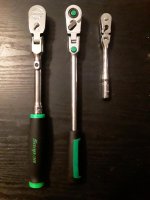 Snapon_Stahlwille_Nepros.jpg73.9 KB · Views: 439
 -
 Snapon_Unlocked_Setting.jpg63.5 KB · Views: 254
 -
 Snapon_Zero_Low.jpg57.9 KB · Views: 198
 -
 Snapon_Zero_High.jpg51.3 KB · Views: 198
 -
 Stahlwille_Zero_Low.jpg56.8 KB · Views: 220
 -
 Stahlwille_Zero_High.jpg58.4 KB · Views: 226
 -
 Nepros_Hinge_Brake.jpg58.6 KB · Views: 248