To avoid these ads, REGISTER NOW!

Connecting 2 chains together

seagull369

Well-known member
Joined
Jan 16, 2013
Messages
227
I need to pull out a tree stump, but I can't get my truck in far enough to use only 1 chain. I have 2 which would make it long enough but just want to make sure I connect them right before going ahead with it. Both sets have the usual clevis "grab hook" design on either end, where you can loop it onto itself and it stays hooked to the link it's put to.

To connect them up, I was thinking of looping the 1st chain on itself- maybe 5 links down from the end- then take the second chain, feed it though the eye of the 1st then loop it onto itself the same 5 links.

Would that be a decent way to do it or would I be putting excess strain on things?
 
To avoid these ads, REGISTER NOW!

Spencer Was Here

Well-known member
Joined
Jan 2, 2006
Messages
327
Location
Western Michigan
If they have the same diameter links, I would forego the loops and just hook them together straight. leaving those same five links or so on each chain between the hooks.
 

mike93lx

ALLIANCE MEMBER
Joined
Dec 9, 2013
Messages
37,776
Location
Richmond, VA
Whatever you do, make sure to put some heavy cloth/rug scrap on a couple points of the chain. It will lower the chances of getting killed by a flying shackle or link if it breaks.
 
Last edited:

NoMoreGreen

Well-known member
Joined
May 25, 2016
Messages
100
Along with the heavy cloth to dampen the shock of the chain breaking as mentioned above. (Chains tend to break and fly in a straight line) remember chain is for pulling and a ****** strap of for jerking.


Sent from my iPhone using The Garage Journal mobile app
 

Bretny

Well-known member
Joined
Jul 31, 2017
Messages
3,918
Location
Dutchess county NY
If you have to ask how to connect two chains both with grab hooks please take video when the chain/stump comes free and breaks out your back window.
 

seber

Well-known member
Joined
May 31, 2016
Messages
4,203
Location
Deep East Tx.
Never connect a grab hook to the side of a chain. That puts all of the stress on one side of the link, doubling the strain. Hook the chains in a straight line using both hooks. Chains when broken in tension do not fly like cables and straps. The weight of the chain will cause it to drop. At worst it might hit the suspension.
 

Dingleburry

Well-known member
Joined
Mar 2, 2016
Messages
593
Location
Great white north in an igloo
Crosby Lok-A-Loy Grade 100 Coupling Link

crosby-3-8-a-1337-lok-a-loy-reg-10-connecting-link-1015122-35.jpg
 

rlitman

Well-known member
Joined
Oct 18, 2010
Messages
24,638
Location
Long Island
Never connect a grab hook to the side of a chain. That puts all of the stress on one side of the link, doubling the strain...

What the heck are you talking about?

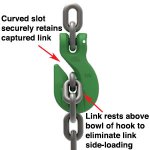
Grab hooks ALWAYS come in from the side of the chain. However, they are designed to stop the link on the outside from slipping through the slot, which is what makes all the pulling contact with the link the hook is slipped over.

I wish I could find a better diagram online, but this was the best I could find on short order:
CMP_CradleGrab_ExceptionalDesignVer2.jpg


edit:
Here's how I can best explain it. The top visible link just rests inside the hook. Assuming the load is hanging from the chain in front of the hook in this picture, the first invisible link that's hiding behind the hook is what actually carries all the load. That link's shoulders interfere with the hook, preventing it from passing through the slot, and that link is what's holding up the top visible link.

NEVER try to use a grab hook to stick INSIDE a chain link!
 
Last edited:

Captain Spaulding

Well-known member
Joined
Feb 13, 2017
Messages
754
Location
Southern Indiana
Never connect a grab hook to the side of a chain. That puts all of the stress on one side of the link, doubling the strain. Hook the chains in a straight line using both hooks. Chains when broken in tension do not fly like cables and straps. The weight of the chain will cause it to drop. At worst it might hit the suspension.

You aren’t suggesting hooking two grab hooks together?
 

RedF

Well-known member
Joined
Aug 31, 2013
Messages
203
Location
Central Alberta
Make no mistake, chain doesn't necessarily "just drop" if it breaks. A former co-worker put a chain thru the back window of his SUV when it broke. Be careful.
 

Nick Danger

Well-known member
Joined
May 7, 2013
Messages
4,252
Location
Albuquerque
I don't know anything about chains, but the Crosby Twin Clevis looks to me like what you need.
 

Attachments

  • crosby-s-249-twin-clevis-links-31.jpg
    crosby-s-249-twin-clevis-links-31.jpg
    4.2 KB · Views: 798

Sweetcorn

Well-known member
Joined
Feb 14, 2018
Messages
679
Location
North Central Ohio
Never connect a grab hook to the side of a chain. That puts all of the stress on one side of the link, doubling the strain. Hook the chains in a straight line using both hooks. Chains when broken in tension do not fly like cables and straps. The weight of the chain will cause it to drop. At worst it might hit the suspension.

None of this is true.
 

seber

Well-known member
Joined
May 31, 2016
Messages
4,203
Location
Deep East Tx.
What the heck are you talking about?

Grab hooks ALWAYS come in from the side of the chain. However, they are designed to stop the link on the outside from slipping through the slot, which is what makes all the pulling contact with the link the hook is slipped over.

I wish I could find a better diagram online, but this was the best I could find on short order:
CMP_CradleGrab_ExceptionalDesignVer2.jpg


edit:
Here's how I can best explain it. The top visible link just rests inside the hook. Assuming the load is hanging from the chain in front of the hook in this picture, the first invisible link that's hiding behind the hook is what actually carries all the load. That link's shoulders interfere with the hook, preventing it from passing through the slot, and that link is what's holding up the top visible link.

NEVER try to use a grab hook to stick INSIDE a chain link!

Notice that the example given has one end loose. This allows the hooked link to slide into a full tension position. That is a totally different situation than hooking a link in the middle of a loop. When you do that, the link that is hooked has the inside stressed in compression while the outside takes all of the tension instead of splitting the load between the two. If you don't believe it, do a vector diagram. It will get clear very quickly.
 
Last edited:

2oolhound

Well-known member
Joined
Dec 18, 2010
Messages
5,918
Location
BC Canada
Each link has equal strength and the hook is stronger. There is no need to go 5 links down, the last link before the hook will do unless you have too much chain and want to grab it further in. You don't need to hook both hooks up but you can if you want. Chains wear at the crotch of the links where they contact the next link so you should check for wear there. If a chain is overloaded the links **** in toward center (the links stretch and the sides of the link come closer together as if wearing a girdle). You can measure this with verniers. As long as you can't see evidence of that your chains are full strength.

Here are some things you can try with the stump. Chop as many roots off as you can reach and don't try a straight pull. Choke the tree so the chain pulls from one side and kind of turns the stump (after deciding where the weakest side of the root structure is and which would be the best way to twist it). You can reverse it and try twisting the other way if it doesn't come. Try to choke the stump as high up as you can even if you have to chop a notch in the back side to keep it from slipping over. You can wrap the chain twice around the stump if it's long enough. You can also hook it right at the back and bring the chain over the top to get maximum leverage.

You can prevent the chain from shock loading by aligning the truck for a straight pull in line with the stump and let's say, Dead North. Now, keeping the truck parallel with it's position move the truck 10' to one side so the chain is on an angle to the truck but the truck is still pointing Dead North. Give it some slack and take a bit of a run at it. When the chain becomes taught it won't be at it's maximum distance between the stump and the truck and it will swing the truck's *** end over to achieve a straight line. This utilizes all the truck's momentum and weight without shock loading the chain which causes breakage. It may only loosen the stump but next time it will loosen more. A straight pull is a last resort.

Like what has been said, cover the chain to prevent it from flying at you if it breaks.
 
OP
S

seagull369

Well-known member
Joined
Jan 16, 2013
Messages
227
Thanks for all the great responses, guys.

What about a d shackle would that work at all ?

The grab hooks wouldn't be able to fit on something like a d-shackle. The coupling link that Dingleburry mentioned would be better fit the bill in that regard

I don't know anything about chains, but the Crosby Twin Clevis looks to me like what you need.

Good idea but I think that would only work if the grab hooks were removable.

Chains normally don't fly well,,

Chains fly REALLY well, especially when jerking (shock loading) them. The last stump I yanked about a month ago took out the cap's back glass and a taillight when a link broke :(

Thanks for the tips on how to get a stump out, 2oolhound. I actually even pressure washed the dirt off the exposed roots so I could lop off the most I could.

I'm a little confused about whether it's okay or not to hook up the chains this way:
 

Attachments

  • CMP_CradleGrab_ExceptionalDesignVer2.jpg
    CMP_CradleGrab_ExceptionalDesignVer2.jpg
    15.9 KB · Views: 38
To avoid these ads, REGISTER NOW!

theoldwizard1

Well-known member
Joined
Feb 22, 2011
Messages
43,227
Location
SE MI
BTDTGTT !

A pair of "D" shackles or a pair of anchor shackles works. A double (twin) clevis is the cleanest/easiest.

I don't know anything about chains, but the Crosby Twin Clevis looks to me like what you need.

attachment.php

These maybe good, but they are ridiculously expensive.

Crosby Lok-A-Loy Grade 100 Coupling Link

crosby-3-8-a-1337-lok-a-loy-reg-10-connecting-link-1015122-35.jpg
 
Last edited:

nikerret

Well-known member
Joined
Jan 22, 2015
Messages
757
Location
Kansas
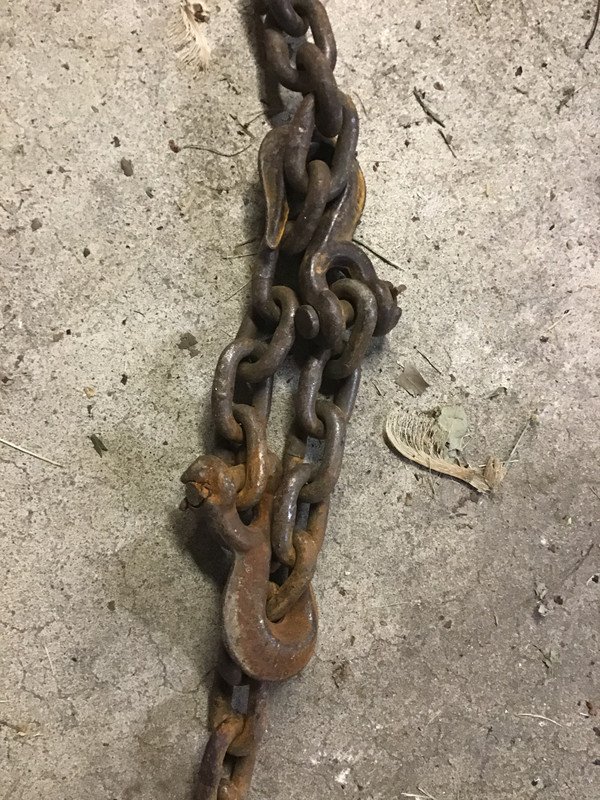
If I had to pull with two chains and they had grab hooks, I would do it like this, but I’m sure someone will be along to tell me why it’s a deathbed guarantee.


I would use a reciprocating saw on the roots and dig it with my backhoe, but those aren’t always available, for everyone.
 
Last edited:

Showkey

"MEMBER EMERITUS"
Joined
Aug 9, 2014
Messages
8,638
Location
Wausau WI
Don’t try to ****** or yank the stump........pull the stump.

Skip the chains...........Use ropes:

 
OP
S

seagull369

Well-known member
Joined
Jan 16, 2013
Messages
227
My backhoe's broke at the moment and I wouldn't be able to get in the area anyway with it.. Too many trees around.

I've actually seen that video before, Showkey. Frankly, it's just too involved and I don't have the block and tackle and multiple ****** blocks to get it done. The tree that that fell was probably 100 ft tall to give you an idea of the stump size. At some point, the rope in that configuration will also need to be pretty thick- more than I could probably find easily.
 
Last edited:

2oolhound

Well-known member
Joined
Dec 18, 2010
Messages
5,918
Location
BC Canada
That's how grab hooks work. They've been in use for decades. What you need to look at is how big is your truck and match the chain strength to it. A half ton truck would suit 3/8" chain although the actual breaking strength could be met with a 10,000 lb vehicle if it's low grade chain. We want the stump to break but if it's too much stump then do you want your truck to break or the chain? (actually the truck will likely just stall out or spin.) I'd give it a whirl with the chain you have on hand and then rethink it if it doesn't budge.

Out of curiosity what is the size of the chain, stump and truck and where on the truck are you hooking to?

And remember, keep clear and this means pets too. The truck driver should be the only one in the danger zone so you could duck down below the window at the last moment if you're really slammin it.


^^^ it took a while to type the above. If the tree was 100' you're in for a challenge.
 
Last edited:
OP
S

seagull369

Well-known member
Joined
Jan 16, 2013
Messages
227
Out of curiosity what is the size of the chain, stump and truck and where on the truck are you hooking to?

Well, the chain I was using was 3/8" with a grade of 0, or so it would seem :)
I recently upgraded, though, to a 1/2" grade 70, and will be using that on truck, which is a mid 90s Ford Ranger. I know the chain is probably overkill for the truck (and the stump overkill for the Ranger), but it was only a little bit more for the bigger size, plus I like that I have some breathing room in tensile strength. As far as attaching the chain, I loop it around the hitch frame.

I pull on the chain more like you would with a kinetic rope. Keep slack in chain, drive truck ~5mph, wait for bang. Probably not best for the truck's frame, the chain or anything in harm's way, but I've found it works worlds better than the burnout method. On bigger pulls, the thing to keep in mind is to never try to get it on the 1st shot. Sometimes it takes 5 or more, but usually you'll get some movement each time you do it (in the stump, hopefully =D)
 

Captain Spaulding

Well-known member
Joined
Feb 13, 2017
Messages
754
Location
Southern Indiana
Well, the chain I was using was 3/8" with a grade of 0, or so it would seem :)
I recently upgraded, though, to a 1/2" grade 70, and will be using that on truck, which is a mid 90s Ford Ranger. I know the chain is probably overkill for the truck (and the stump overkill for the Ranger), but it was only a little bit more for the bigger size, plus I like that I have some breathing room in tensile strength. As far as attaching the chain, I loop it around the hitch frame.

I pull on the chain more like you would with a kinetic rope. Keep slack in chain, drive truck ~5mph, wait for bang. Probably not best for the truck's frame, the chain or anything in harm's way, but I've found it works worlds better than the burnout method. On bigger pulls, the thing to keep in mind is to never try to get it on the 1st shot. Sometimes it takes 5 or more, but usually you'll get some movement each time you do it (in the stump, hopefully =D)

Unless it’s a small stump, my money is on the hitch being the weakest link.
 

2oolhound

Well-known member
Joined
Dec 18, 2010
Messages
5,918
Location
BC Canada
Well it's good it's a hitch because it mounts to both frame rails equally. When I lived up north in the snow belt I pulled lots of vehicles out of the ditches and I had a single pipe rear bumper that I'd wrap a chain around and hook the hook to the tongue that was welded to the pipe and bolted to the frame rail. Quick and easy. You could choose either side that way to get lots of direction to get the stuck vehicle out. That exerted most the pressure on the one side though so for something like a big ole stump the equally balanced hitch is the ticket.

Lots of weight in the truck would help.
 

BLUE72CAMARO

Well-known member
Joined
Jan 1, 2014
Messages
911
Location
IL
I'm a little confused about whether it's okay or not to hook up the chains this way:

Yes that is how they are intended to be hooked. If both chains have grab hooks then hook them a nikerret shows, one chain will take the load as they are slightly different lengths most likely but this is how it should be done.
 

rlitman

Well-known member
Joined
Oct 18, 2010
Messages
24,638
Location
Long Island
Yes that is how they are intended to be hooked. If both chains have grab hooks then hook them a nikerret shows, one chain will take the load as they are slightly different lengths most likely but this is how it should be done.

Basically, yes. Grab hooks are designed to connect chains in a straight line only. If you want to connect two chains, each with grab hooks, then there's no harm in connecting the second hook, like nikerret shows, but really, only one will be doing all the work.

Higher up, seber raised an important point. Grab hooks are ONLY for connecting two chains in a straight line. They are not made to connect one chain to a loop of chain. Used in that way (sideways), the chain's strength is compromised.
 

ClappedOutBport

Well-known member
Joined
Mar 30, 2016
Messages
998
If I had to pull with two chains and they had grab hooks, I would do it like this, but I’m sure someone will be along to tell me why it’s a deathbed guarantee.


I would use a reciprocating saw on the roots and dig it with my backhoe, but those aren’t always available, for everyone.

This^

No need to over-complicate it. I snatched a stump out a hole before with an 8k lbs backhoe and 1/4" chain (when I was younger and dumber). I got the job done but the chain was pretty stretched and ruined after that. When in doubt go up a chain size and get'r done.

Well, the chain I was using was 3/8" with a grade of 0, or so it would seem :)
I recently upgraded, though, to a 1/2" grade 70, and will be using that on truck, which is a mid 90s Ford Ranger. I know the chain is probably overkill for the truck (and the stump overkill for the Ranger), but it was only a little bit more for the bigger size, plus I like that I have some breathing room in tensile strength. As far as attaching the chain, I loop it around the hitch frame.

I pull on the chain more like you would with a kinetic rope. Keep slack in chain, drive truck ~5mph, wait for bang. Probably not best for the truck's frame, the chain or anything in harm's way, but I've found it works worlds better than the burnout method. On bigger pulls, the thing to keep in mind is to never try to get it on the 1st shot. Sometimes it takes 5 or more, but usually you'll get some movement each time you do it (in the stump, hopefully =D)

With 1/2" grade 70 chain you could ****** that tree at 250mph with a ford ranger and not have to worry about the chain breaking. Your truck on the other hand....
 
Last edited:
OP
S

seagull369

Well-known member
Joined
Jan 16, 2013
Messages
227
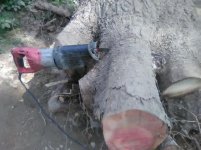
Just thought I'd throw up some pics of my ordeal regarding the stump. I threw some random props in there to help gauge the size of things. Took the Ranger about 20 yanks, but she finally came out (and I barely needed a neck brace afterwards). I was able to get into the area close enough so that I didn't need to lump the 2 chains together after all, but I did buy a nice grade 70 double clevis for future suicide missions. Anyway, if my truck starts creeping down the road sideways now, I think I'll have a hunch what may have caused it :thumbup:

While I'm here, just wondering if there's such a thing as a reciprocating blade that cuts decent in both wood AND rocks. I've been hacking things up with carbide tipped Freud 'Italian demon' pruning blades, and though they work pretty well, they aren't the most tolerant of embedded rocks that are all over this thing.

The last photo in the batch is for those that say chains can't fly. It's the rear liftgate (or whatever it's called) on the truck cap where the previous chain snapped taking out the window and leaving chain impressions in the aluminum. Might be a little hard to make out.
 

Attachments

  • 1a.jpg
    1a.jpg
    153.7 KB · Views: 77
  • 1b.jpg
    1b.jpg
    148.9 KB · Views: 73
  • 1c.jpg
    1c.jpg
    149.7 KB · Views: 76
  • 1d.jpg
    1d.jpg
    105.4 KB · Views: 72
  • 1e.jpg
    1e.jpg
    94.6 KB · Views: 71
  • 1f.jpg
    1f.jpg
    45.7 KB · Views: 81
Last edited:

ezover

Well-known member
Joined
Jan 15, 2008
Messages
2,412
Location
3rd rock from the sun
The weight of the chain will cause it to drop. At worst it might hit the suspension.

hahaha guess I have bad luck, was trying to pull a trailer with the front hook on a cab over semi, when the chain broke it hit the windshield 6 feet higher then the attachment point.
 

tarmy

Well-known member
Joined
May 28, 2014
Messages
4,705
Location
Nor Cal
On the cutting with recip question. I use a chainsaw...after I hose as much debris as possible of the stump. I have an old beater chainsaw...and buy cheapo chains at home despot...soon as they hit a rock or dull...new chain. I have figured out how to start the cuts in good wood and make all those cuts first...then go to the **** parts and eat the chains up!.

I also use synthetic rope in a 9k winch...so if it snaps...not a lot of stored energy to do damage or maim...

Oh...got tired of your method and got a tractor with a backhoe to help...
 
To avoid these ads, REGISTER NOW!
Top Bottom