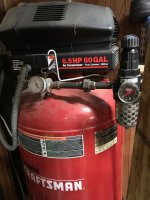
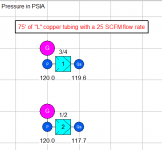
The compressor output is 15 cfm at 40 and 11.8 at 90 psi. I don’t see any problem with him getting the 14-16 cfm he needs at no more than 35 psi, approximately 100’ away, using 1/3 copper. Even as a person with no knowledge of fluid dynamics person, I see no issues here. I just see the typical “bigger is better” and when questioned why, the answer is “because it’s bigger.”
You are correct, he will get the flow he needs. I think that's a major consideration but not the only one:
Smaller isn't always better and neither is bigger, there's a range of good sizing with different considerations.
We don't know his water reduction strategy, but he says he's spraying furniture. Copper conducts heat very well, so it's a great way to cool hot air (after the compressor has been running a while). When the air cools more water drops out. IF the air moves too slow (through a very large pipe) there isn't a lot of turbulence and the surface area/volume is small so too big isn't ideal either. Too fast through the pipe and the air doesn't spend enough time and the water gets pushed to the end. This isn't a consideration if he's running an AC drier or has other water knockout equipment.
He's spraying, so his usage will be on/off (every time he waves the gun). Pressure regulation is important when spraying. It's much easier to get consistent pressure regulation when the pressure inlet to the gun remains constant. That is much easier with a higher volume of air in the line and a larger line with lower psi drop.
Particle contamination: Faster moving air carries particles past traps, slower moving air lets it drop out. Same as with water, if he's filtering less of a consideration.
The difference in cost of the material here is generally insignificant to the cost of installation (time is money to EVERYONE) and the long term function of the system.
My vote is 3/4". Note I didn't say 2" or something crazy, too big isn't better. 1" copper gets a lot pricier and from there forget it.
Regarding restrictions, a short restriction (lets say 3/8 diameter but a very small length) is much different than a long run of 3/8" pipe. Restrictive openings (but with short duration) are not nearly as impactful as most folks think especially with compressible (gas) flow. You generally can't change every part of the system, rebuild the compressor, etc to make it as free flowing as possible and there generally wouldn't be much of a return on that investment anyway.