To avoid these ads, REGISTER NOW!

3/8" Compressor Output - 3/4" Copper Overkill?

bugsysiegals

Member
Joined
Jul 31, 2019
Messages
14
Location
Wisconsin
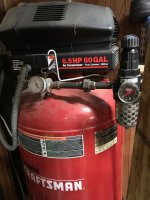
I've a 5hp 60 Gallon Air Compressor and bought 3/4" Copper "L" to run air in the garage and down to the basement (~75ft away) for spraying furniture in my wood shop. That said, the compressor output is 3/8" and now I'm wondering if I should save $100 and get 1/2" pipe instead since 3/4" will offer little to no improvement with 3/8" output limiting the air flow.

FWIW - The compressor motor connects to an inlet that has a nut on it which I suspect could be expanded. If so, perhaps I could add a larger "splitter/manifold", reconnect the motor, and move the output to the that port instead?

Thoughts?
 

Attachments

  • IMG_3688.jpg
    IMG_3688.jpg
    93.9 KB · Views: 102
To avoid these ads, REGISTER NOW!

Shiftless

Well-known member
Joined
Mar 9, 2014
Messages
14,896
Location
East Bay SFO
keep the bigger line you have more volume of air.

Air volume storage or air flow in CFM?
So for $100 more cost of pipe and fittings, is it really worth it to add such a tiny extra volume of air to the system. OP already has a 60 gallon tank.
What it the cubic inch difference between 75 feet of 3/4 inch pipe compared to 75 feet of 1/2 inch pipe?
I’d say save the money and go with half inch.
What’s the flow rate needed for the job?
 
Last edited:

dagofast

Well-known member
Joined
Oct 15, 2006
Messages
413
Location
The QC in AZ
I ran ¾" copper and have zero regrets. The added volume really seems to help when using something that flows a lot of air, like an impact or grinder. You won't miss the $100.
 
OP
B

bugsysiegals

Member
Joined
Jul 31, 2019
Messages
14
Location
Wisconsin
FWIW - I've battery powered tools for most of my needs and only use air for blowing things off and airing up tires but am now looking to spray.

That said, I'm using a Devilbiss Tekna Prolite and based on the air cap uses the following...

HV30 - 14.5 to 16.5 CFM @ 20-24 PSI Inlet
TE10 - 7.5 to 11.0 CFM @ 20-35 PSI Inlet
TE20 - 9 to 12 CFM @ 16-26 PSI Inlet

The compressor says 15.0 SCFM @ 40 PSI and 11.5 SCFM @ 90 PSI. It seems the compressor will handle the demands of the spray gun fine since it will use less than 40 PSI?
 

Shiftless

Well-known member
Joined
Mar 9, 2014
Messages
14,896
Location
East Bay SFO
That should work fine.
I can’t seem to get the pressure drop calculator to work from the Engineering Toolbox website.
That lets you calculate the pressure drop at a certain CFM flow rate for half inch vs. 3/4 inch copper pipe. Off the top of my head, I don’t think it would be much.
Even if it was 5, you could just dial up your regulator a tiny bit to compensate.
 

Kaizen

Well-known member
Joined
Jan 9, 2015
Messages
6,949
Location
New England
Save yourself 800 and go with a roll of rapid air. No connections to worry about and on that long run you can use one of their kits. You sure that bung in the tank doesn’t have a reducer in it? Strange it’s so small for a decent setup.
Using 3/4 for storage isn’t something I do. I use it for a radiator dryer but when supplying if you exhaust it you will have to wait longer for that volume to get up to needed psi. In this use case I don’t think you will have a problem. I beg to ask. Spraying in basement??hope you have an incredible exhaust setup


Sent from my iPhone using Tapatalk
 
OP
B

bugsysiegals

Member
Joined
Jul 31, 2019
Messages
14
Location
Wisconsin
10' 3/4" Copper L only cost me $17 each. Throw in the elbows/tees, etc. and I doubt I have more than $250 into the whole setup.

I'd considered the rapid air but since this is for spraying, I need to eliminate moisture and read the Copper would do this better than the Pex-Al-Pex for cooling hot air and would be straighter to prevent any moisture building up in any pipe which isn't exactly straight.

The bung used on the input does have a reducer which is why I was wondering if I could use another to allow 3/4" but am not sure if there's a check valve and if I can put the output inline with the input from the motor. FWIW - It's an oil-less compressor.

I'm going to be spraying waterborne rather than solvent based clear. While there's still some solvent in waterborne, I've heard it's very minimal. From what I've seen, it seems it can be done in the basement without issue which is great since I live in Wisconsin and would like to spray during the winter. I'm planning to build a cube spray booth from PVC, put a drop cloth on the floor, and Velcro plastic to the exterior to seal it up. I'd then use 1-3 box fans with furnace filters in front of them to capture any over spray and exhaust any "fumes" out of the booth. If waterborne doesn't have many "fumes" this will work perfect and if I'm wrong, then I'll use my torpedo heater to warm the garage, crack the door open, and spray in the garage. Do you have experience with waterborne?
 

pbon

Well-known member
Joined
May 14, 2017
Messages
3,498
I don’t see how the OP needs 3/4 for his use. However, it won’t hurt and most people like massive overkill. I’d change the compressor fitting to 1/2 and run 1/2.
 
OP
B

bugsysiegals

Member
Joined
Jul 31, 2019
Messages
14
Location
Wisconsin
I don’t see how the OP needs 3/4 for his use. However, it won’t hurt and most people like massive overkill. I’d change the compressor fitting to 1/2 and run 1/2.

The output can not be changed. I could put a 3/8” plug and leave it for air pressure gauge and the thing which activated the motor.

The input can be changed but I’d have to modify it to then also allow air out the same hole it’s pumping air into. Are you suggesting this?
 

Bretny

Well-known member
Joined
Jul 31, 2017
Messages
3,918
Location
Dutchess county NY
I would only use 3/4 if your useing black pipe. That stuff qill rust inside so bad that 1/2in can have a ID of 3/16 after 15 yrs.

Your 3/8 compressor outlet can be drilled and tapped out to 1/2 or 3/4. I would drill it out. I did this on my 60gal compressor years ago. I should note that i did this on the removable bung that was in the compressor. Not a welded on bung.
 

Kaizen

Well-known member
Joined
Jan 9, 2015
Messages
6,949
Location
New England
10' 3/4" Copper L only cost me $17 each. Throw in the elbows/tees, etc. and I doubt I have more than $250 into the whole setup.My mistake thought you said you had 1000 dollars into this. Price of rapid air is a little less then copper at my last pricing. It is slightly rigid so can be rolled straight. It is NOT pex

I'd considered the rapid air but since this is for spraying, I need to eliminate moisture and read the Copper would do this better than the Pex-Al-Pex for cooling hot air and would be straighter to prevent any moisture building up in any pipe which isn't exactly straight. A straight run of copper will not stop the moisture. You need to make a radiator with drain valves or use water filter/trap/cooler. If you run the copper to the basement and go low and then put a drain and some back and forth runs it will probably take out most of the water

The bung used on the input does have a reducer which is why I was wondering if I could use another to allow 3/4" but am not sure if there's a check valve and if I can put the output inline with the input from the motor. FWIW - It's an oil-less compressor.With that size compressor going up to 3/4 won't hurt. Mostly just future proofing your installation.
Say in the future you wanted a larger gun or 2 running then you'd be set.


I'm going to be spraying waterborne rather than solvent based clear. While there's still some solvent in waterborne, I've heard it's very minimal. From what I've seen, it seems it can be done in the basement without issue which is great since I live in Wisconsin and would like to spray during the winter. I'm planning to build a cube spray booth from PVC, put a drop cloth on the floor, and Velcro plastic to the exterior to seal it up. I'd then use 1-3 box fans with furnace filters in front of them to capture any over spray and exhaust any "fumes" out of the booth. If waterborne doesn't have many "fumes" this will work perfect and if I'm wrong, then I'll use my torpedo heater to warm the garage, crack the door open, and spray in the garage. Do you have experience with waterborne?
Waterborne.......depending on the kind......is definitely far less smelly but atomized particles in a closed space like a house can be noticed. I'd put those fans so they blow out a window while you are spraying and for a little while after. yea a little heat loss but it will warm up quickly
Never seen an oil less compressor that big before. Thing must wake the dead
 
Last edited:
OP
B

bugsysiegals

Member
Joined
Jul 31, 2019
Messages
14
Location
Wisconsin
I would only use 3/4 if your useing black pipe. That stuff qill rust inside so bad that 1/2in can have a ID of 3/16 after 15 yrs.

Your 3/8 compressor outlet can be drilled and tapped out to 1/2 or 3/4. I would drill it out. I did this on my 60gal compressor years ago. I should note that i did this on the removable bung that was in the compressor. Not a welded on bung.

Unfortunately this tank's output does not have a removable bung so if it gets messed up drilling, it's toast. Probably better to sell it and upgrade to a different setup.

My main water supply in the house is on 3/4" Copper so I'm not sure how that will rust...
 
OP
B

bugsysiegals

Member
Joined
Jul 31, 2019
Messages
14
Location
Wisconsin
I would only use 3/4 if your useing black pipe. That stuff qill rust inside so bad that 1/2in can have a ID of 3/16 after 15 yrs.

Your 3/8 compressor outlet can be drilled and tapped out to 1/2 or 3/4. I would drill it out. I did this on my 60gal compressor years ago. I should note that i did this on the removable bung that was in the compressor. Not a welded on bung.

My main water runs in the house are 3/4" Copper ... how can that rust?
 
OP
B

bugsysiegals

Member
Joined
Jul 31, 2019
Messages
14
Location
Wisconsin
Waterborne.......depending on the kind......is definitely far less smelly but atomized particles in a closed space like a house can be noticed. I'd put those fans so they blow out a window while you are spraying and for a little while after. yea a little heat loss but it will warm up quickly
Never seen an oil less compressor that big before. Thing must wake the dead

FWIW - I will connect a flexible hose between compressor and the Copper on the wall which will run up and down a few times (~30ft) with drains on each bottom loop followed by a desiccant filter. This will then flow downstairs with another drain and desiccant filter. I suspect this will remove the water.

The compressor is very loud when it's running. I had no idea this was because it was oil-less. I'll have to watch some YouTube videos to see how quiet an oiled one is but for painting I suspect I would not want an oiled compressor?
 
OP
B

bugsysiegals

Member
Joined
Jul 31, 2019
Messages
14
Location
Wisconsin
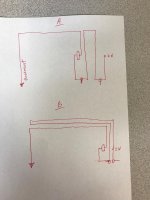
Extremely ill advised. Make the long runs nearly horizontal and pitched so it drains to one valve.

It seems even with your idea (B), I'd still need 2 drain valves in the garage as I'd want a drain where it connects and runs upwards??
 

Attachments

  • IMG_3721.jpg
    IMG_3721.jpg
    76.1 KB · Views: 44
OP
B

bugsysiegals

Member
Joined
Jul 31, 2019
Messages
14
Location
Wisconsin
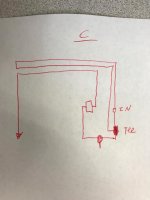
It seems I overlooked another option (C), which implements a Tee in order to capture condensation from both pipes and using 1 drain valve ... perhaps this is best?
 

Attachments

  • IMG_3722.jpg
    IMG_3722.jpg
    57 KB · Views: 34
To avoid these ads, REGISTER NOW!
OP
B

bugsysiegals

Member
Joined
Jul 31, 2019
Messages
14
Location
Wisconsin
He said he’d only run 3/4 if he was using black pipe as it will rust and therefore reduce the inner diameter

Seems a bit backwards ... perhaps better to say if I was using Black Pipe, then I'd only use 3/4" as it will rust and reduce the inner diameter, but if using Copper, any size.
 

ford33

Well-known member
Joined
Feb 26, 2011
Messages
2,118
Location
Chicago, IL. USA
I have a similar setup as the OP. I ran 3/4" copper and have had no regrets. I didn't need the larger size but for the small increase in material cost I thought it was useful if I ever needed greater airflow. Time to install was the same.

One very small benefit. The larger pipe looks better and more substantial on my wall and ceiling mounting. People can see my external mounted air pipe and electrical conduit in my shop so good appearance is something I do strive to attain. I did it myself and visitors sometimes remark about how professional the installation is for my little home shop.
 

sberry

Banned
Joined
Jun 18, 2005
Messages
35,747
Location
Brethren, Michigan
I tend to like 1/2 at this scale just to reduce the number of fitting reducers to get to final size which is 1/4 pipe. The 1/2 is twice as good as the tools you are using needs. The 3/8 bung is so short and these volumes so small it won't mean squat. I know masters who worked a whole career from a 3/8 and they use 1/2 impacts. I paint 60 ft of double bottom semi with one,, actually a couple.
 

sberry

Banned
Joined
Jun 18, 2005
Messages
35,747
Location
Brethren, Michigan
I tend to like 1/2 at this scale just to reduce the number of fitting reducers to get to final size which is 1/4 pipe. The 1/2 is twice as good as the tools you are using needs. The 3/8 bung is so short and these volumes so small it won't mean squat. I know masters who worked a whole career from a 3/8 and they use 1/2 impacts. I paint 60 ft of double bottom semi with one,, actually a couple and even run 2 guns on occasion.
 

pbon

Well-known member
Joined
May 14, 2017
Messages
3,498
Unfortunately this tank's output does not have a removable bung so if it gets messed up drilling, it's toast. Probably better to sell it and upgrade to a different setup.

My main water supply in the house is on 3/4" Copper so I'm not sure how that will rust...

My tank fitting was removeable so I changed to 1/2. You could drill and tap and if that fails to work, weld a 1/2 bung on if you can weld. If your tank fitting is cast iron female 3/8 npt, a 3/8 male not to 1/2 copper fitting would increase the ID over a 3/8 NPT cast iron fitting.
 

sberry

Banned
Joined
Jun 18, 2005
Messages
35,747
Location
Brethren, Michigan
It wont make any difference to this user. Only time it might be an issue is if he ran impacts 3/4 or larger and it might have only marginal effect to a 3/4 if any. It ends up thru a 3/8 hose in the end, thru a 1/4 fitting. A 3,8 pipe ****** which you can dress with a 7/16 drill bit is about 2x as good as a 3/8 hose.
 
Last edited:

ItsNemo

Well-known member
Joined
Mar 5, 2016
Messages
4,811
Location
Canada
Go with 3/4", think of it like an extension cord...the further the run, the heavier gauge you want. Same with pipe, you gain resistance over distance and so the thicker pipe won't reduce your flow as much over the distance.
 

pbon

Well-known member
Joined
May 14, 2017
Messages
3,498
Go with 3/4", think of it like an extension cord...the further the run, the heavier gauge you want. Same with pipe, you gain resistance over distance and so the thicker pipe won't reduce your flow as much over the distance.

What is the pressure drop of 100’ of 1/2 copper pipe that is 135 psi coming out of the compressor and 135 psi at the end of the 100’?
 

Innovate1

Well-known member
Joined
Jul 28, 2014
Messages
4,329
Location
Illinois near St. Louis, Missouri
Lots of opinions but very few numbers.... Run the numbers through a calculator.
Here is one:

https://www.engineeringtoolbox.com/pressure-drop-compressed-air-pipes-d_852.html

16 cfm for 100' (ID is 0.527 for 1/2" copper K, other types are slightly larger)
Pressure drop is 2.5 PSI
Fittings will add a bit more. Still seems insignificant.

And a short length of smaller will have very little effect as has been stated.

1 ft of 0.25 ID pipe at 16 CFM has a pressure drop of 1 PSI.

Now if you did the whole run of 100' at 0.25 it would drop 100 PSI and be totally unacceptable but for a short length not an issue.
 

Innovate1

Well-known member
Joined
Jul 28, 2014
Messages
4,329
Location
Illinois near St. Louis, Missouri
Those pressure drops are at 100 PSI. The pressure drop is at least roughly proportional to pressure. Thus at 50 PSI the pressure drops are twice as much and at higher pressure it will be less.
 

Kaizen

Well-known member
Joined
Jan 9, 2015
Messages
6,949
Location
New England
Lots of opinions but very few numbers.... Run the numbers through a calculator.
Here is one:

https://www.engineeringtoolbox.com/pressure-drop-compressed-air-pipes-d_852.html

16 cfm for 100' (ID is 0.527 for 1/2" copper K, other types are slightly larger)
Pressure drop is 2.5 PSI
Fittings will add a bit more. Still seems insignificant.

And a short length of smaller will have very little effect as has been stated.

1 ft of 0.25 ID pipe at 16 CFM has a pressure drop of 1 PSI.

Now if you did the whole run of 100' at 0.25 it would drop 100 PSI and be totally unacceptable but for a short length not an issue.

Thanks for trying to put numbers behind this. But it doesn't make sense. I've used 3/8 hose at 90psi for 50 feet with small drop in psi. you are saying if i use 100 feet of quarter inch pipe i will get zero psi at the end?
 
OP
B

bugsysiegals

Member
Joined
Jul 31, 2019
Messages
14
Location
Wisconsin
I'm not sure I understand "pressure drop". It seems the pressure would remain consistent across the entire run no matter the size of pipe but what would change would be the amount of volume throughput which drops off as the pipe shrinks?
 

bikesandcars

Well-known member
Joined
Nov 4, 2016
Messages
127
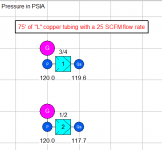
Pressure drop differences for 25 SCFM are negligible.

The velocity in the 1/2" pipe is double at 33 vs 16 fps.

If you care about dropping more water out I would still run the 3/4.
 

Attachments

  • pressure drop.PNG
    pressure drop.PNG
    11.2 KB · Views: 15

Innovate1

Well-known member
Joined
Jul 28, 2014
Messages
4,329
Location
Illinois near St. Louis, Missouri
I'm not sure I understand "pressure drop". It seems the pressure would remain consistent across the entire run no matter the size of pipe but what would change would be the amount of volume throughput which drops off as the pipe shrinks?

There is friction along the pipe. With no flow the pressure is equal at both ends. But with flow there is less pressure at the output than the input. The reason the flow drops with smaller sizes is the pressure drop is greater.
 

Innovate1

Well-known member
Joined
Jul 28, 2014
Messages
4,329
Location
Illinois near St. Louis, Missouri
Thanks for trying to put numbers behind this. But it doesn't make sense. I've used 3/8 hose at 90psi for 50 feet with small drop in psi. you are saying if i use 100 feet of quarter inch pipe i will get zero psi at the end?

You wouldn't get zero that would equal no flow. The flow rate likely wouldn't be 16 CFM but something lower.

Also note that I used 0.25" ID (as an extreme case of small pipe) and 1/4" sch 40 steel pipe ID is 0.364 which is quite a bit bigger.
 

pbon

Well-known member
Joined
May 14, 2017
Messages
3,498
The compressor output is 15 cfm at 40 and 11.8 at 90 psi. I don’t see any problem with him getting the 14-16 cfm he needs at no more than 35 psi, approximately 100’ away, using 1/3 copper. Even as a person with no knowledge of fluid dynamics person, I see no issues here. I just see the typical “bigger is better” and when questioned why, the answer is “because it’s bigger.”
 

bikesandcars

Well-known member
Joined
Nov 4, 2016
Messages
127
The compressor output is 15 cfm at 40 and 11.8 at 90 psi. I don’t see any problem with him getting the 14-16 cfm he needs at no more than 35 psi, approximately 100’ away, using 1/3 copper. Even as a person with no knowledge of fluid dynamics person, I see no issues here. I just see the typical “bigger is better” and when questioned why, the answer is “because it’s bigger.”

You are correct, he will get the flow he needs. I think that's a major consideration but not the only one:

Smaller isn't always better and neither is bigger, there's a range of good sizing with different considerations.

We don't know his water reduction strategy, but he says he's spraying furniture. Copper conducts heat very well, so it's a great way to cool hot air (after the compressor has been running a while). When the air cools more water drops out. IF the air moves too slow (through a very large pipe) there isn't a lot of turbulence and the surface area/volume is small so too big isn't ideal either. Too fast through the pipe and the air doesn't spend enough time and the water gets pushed to the end. This isn't a consideration if he's running an AC drier or has other water knockout equipment.

He's spraying, so his usage will be on/off (every time he waves the gun). Pressure regulation is important when spraying. It's much easier to get consistent pressure regulation when the pressure inlet to the gun remains constant. That is much easier with a higher volume of air in the line and a larger line with lower psi drop.

Particle contamination: Faster moving air carries particles past traps, slower moving air lets it drop out. Same as with water, if he's filtering less of a consideration.

The difference in cost of the material here is generally insignificant to the cost of installation (time is money to EVERYONE) and the long term function of the system.

My vote is 3/4". Note I didn't say 2" or something crazy, too big isn't better. 1" copper gets a lot pricier and from there forget it.

Regarding restrictions, a short restriction (lets say 3/8 diameter but a very small length) is much different than a long run of 3/8" pipe. Restrictive openings (but with short duration) are not nearly as impactful as most folks think especially with compressible (gas) flow. You generally can't change every part of the system, rebuild the compressor, etc to make it as free flowing as possible and there generally wouldn't be much of a return on that investment anyway.
 
Last edited:
To avoid these ads, REGISTER NOW!
Top Bottom