Find the tool(s) you will use, or some likely candidates.
Look up the CFM requirements on the tool.
Multiply that number by 4 to get the 'real' number of what the tool will use in the real world if you are using said tool for more than a 15 second burst (just the way the industry has decided/agreed to market/label air tools, basing the air usage on a 15 second 'burst' usage). Some of the tool makers (or sellers) will give the information for both the 'standard' air usage (15 second usage time in a minute and extrapolated out to air usage on CFM) and the 'actual' air demand of what the tool uses when you run the tool. I-R has (or had) that info on their website for at least some of their air tools.
Example time (hypothetical, but approximate numbers used): A die grinder. Label or box or specs claim 5 CFM air usage. If you only use that tool for 15 seconds and then don't use it for a minute, that will be close. But if I'm using a die grinder, I'm typically using it for minutes at a time. Real-world, that tool NEEDS 20+ CFM if used in at least a semi-continuous manner, otherwise you WILL have to stop and wait on the air compressor to refill.
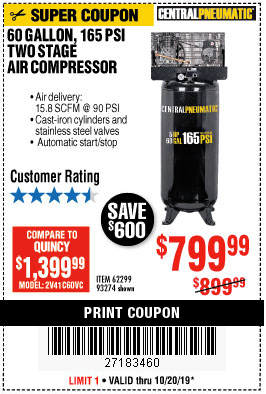
A bigger tank gives you a bit of a 'cushion' before the compressor turns back on to refill, but even the biggest typical practical air tank (60 or 80 gallons) will be not give you an unlimited run time before you use up the compressed air in the tank.
The compressor pump (and the motor driving the pump) determine the sustained air delivery capability of an air compressor system.
A bigger and slower-turning pump is generally quieter than a smaller pump spinning faster to give the same air delivery amount (CFM).
And watch out for some of the lower-end units which only fill to 125 psi. Typical air tools run at 90 psi at the tool, so you only have the amount of air in the tank that is compressed from 125 psi down to 90 psi before the pump has to turn on and try to put air back in to the tank (and then to the tool) before you have to wait for a 'refill' of the tank.
Waiting on an air compressor to refill before you can continue using an air tool gets old, real fast.
Your call on where you want the $$ versus CFM trade-off to be.
But more CFM lets you do 'more'.
10 CFM can be used up pretty fast, even in a 60 or 80 gallon tank. 15+ CFM can let you do 'more'. Close to 20 CFM can let you do most home-shop tasks including some media blasting or spray painting if you choose or 'want' to.
Just zipping off a set of lug nut with an air impact? Most compressors can handle that (short term intermittent usage).
Trying to remove some REALLY stuck suspension fasteners with the air impact and you might be having to stop and let the air tank refill a few times before you can get the darn things finally off (even with a 1000 ft-lb air impact, I've had to let the tool hammer away for a while before the fastener finally loosened, And the impact socket was hot-to-the-touch by that point. )
Spray painting? You can't really be waiting on the compressor to refill in the middle of a paint job. Make -sure- you have enough air capacity before painting!


 ave reference