To avoid these ads, REGISTER NOW!

N-G bond for B&S 8000 watt generator

Mike_Patrick59

New member
Joined
Oct 8, 2011
Messages
3
Can anyone here tell me where the N-G bond is located on a Briggs & Stratton Model 30471, 8000 watt portable generator?

Thank you,
Mike
 
To avoid these ads, REGISTER NOW!

Stuart in MN

Well-known member
Joined
Sep 8, 2005
Messages
23,186
Location
Minneapolis
I looked at the online manual and the schematic shows the neutral-ground bond right at the output terminals of the alternator, although that doesn't necessarily mean the actual location of the bond is right at that point.
 
OP
M

Mike_Patrick59

New member
Joined
Oct 8, 2011
Messages
3
I looked at the online manual and the schematic shows the neutral-ground bond right at the output terminals of the alternator, although that doesn't necessarily mean the actual location of the bond is right at that point.

That's how I saw it also. I hope that the terminals are not buried inside the alternator too far. Years ago I had an EXCEL 7550 and the bonding jumper was across the neutral - ground terminal of the duplex receptacle in the front panel. That was an easy fix. I was hoping to find someone here that had removed the bond on this model.

Thank you,
Mike
 

ishiboo

Well-known member
Joined
Oct 27, 2010
Messages
9,481
Location
Oshkosh, WI
What do you use the netural bond on a generator for?

Typically people who use a portable generator do not drive two 8' copper ground rods into the ground wherever they're using it, so the "next best thing" is bonding it to the neutral so it acts more or less the same :)
 

Ranman333

New member
Joined
Jan 21, 2014
Messages
1
Can anyone here tell me where the N-G bond is located on a Briggs & Stratton Model 30471, 8000 watt portable generator?

Thank you,
Mike

I know this is an old thread, but I found it searching online with the same question and I now have the answer.

On the Briggs & Stratton 8000W Elite Series generator 30471, the neutral ground bond N-G jumper wire, is located just behind the alternator vent cover.

At the opposite end of the genset from the recoil starter, there is a finned vent cover on the end of the alternator. There are two screws in the center of the cover holding it on. Remove the two screws and slide the cover off. Near the 11 o'clock position, you will see a bolt with two, green with yellow tracer ground wires bolted to the alternator case. One of the two green/yellow wires is a very short run to a terminal block that has a white wire (with a red ring terminal). This is the N-G bond jumper wire. I disconnected the green/yellow jumper from the grounding end on the alternator case and taped it off. this way you can still remember where it goes on the terminal block end should you want to reinstall. Also, be careful when reinstalling the cover to make sure you get the wiring harness strain relief positioned correctly. Hope this helps someone looking for the same thing.

This likely applies to the 7000W model 30470 as well.
 
To avoid these ads, REGISTER NOW!

sberry

Banned
Joined
Jun 18, 2005
Messages
35,747
Location
Brethren, Michigan
Thanks, seems I had an occasion a while back to wonder the same thing. But,,,,, this is not the same function as a ground rod.
 
Last edited:

brad b rad

Member
Joined
Nov 1, 2019
Messages
5
Location
manitoba
Hello, I followed this thread as I have a B&S 8000 watt Generator with a bonded ground.

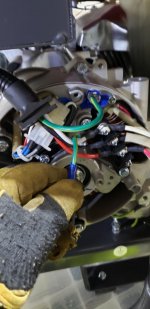
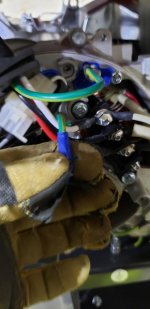
I opened the cover and disconnected the small green/yellow Jumper but the gfci still flips whenever I hook it to my panel. I am going through a 30 amp twist lock cord attached to the exterior of the house and into a breaker. a L14 r/p to the panel with an interlock.

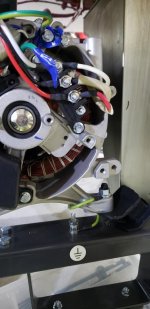
There also is a ground wire on the frame.. i undid that too and same result.

Not sure what to try next. There is another green/yellow wire there as well that hooks to the frame and comes from the outlet panel on the generator itself.

The blue tape on the end of the wire is so I can reconnect it if I want to. I also put a bit of blue tape on the screw that I took it off from. One picture has the ground to the frame at the bottom.

Any suggestions?


I know this is an old thread, but I found it searching online with the same question and I now have the answer.

On the Briggs & Stratton 8000W Elite Series generator 30471, the neutral ground bond N-G jumper wire, is located just behind the alternator vent cover.

At the opposite end of the genset from the recoil starter, there is a finned vent cover on the end of the alternator. There are two screws in the center of the cover holding it on. Remove the two screws and slide the cover off. Near the 11 o'clock position, you will see a bolt with two, green with yellow tracer ground wires bolted to the alternator case. One of the two green/yellow wires is a very short run to a terminal block that has a white wire (with a red ring terminal). This is the N-G bond jumper wire. I disconnected the green/yellow jumper from the grounding end on the alternator case and taped it off. this way you can still remember where it goes on the terminal block end should you want to reinstall. Also, be careful when reinstalling the cover to make sure you get the wiring harness strain relief positioned correctly. Hope this helps someone looking for the same thing.

This likely applies to the 7000W model 30470 as well.
 

Attachments

  • 20191101_134050.jpg
    20191101_134050.jpg
    59.7 KB · Views: 25
  • 20191101_134103.jpg
    20191101_134103.jpg
    64.6 KB · Views: 23
  • 20191101_134030.jpg
    20191101_134030.jpg
    50.2 KB · Views: 22

wyliesdiesels

Well-known member
Joined
Aug 14, 2012
Messages
20,089
Location
Modesto, CA
Typically people who use a portable generator do not drive two 8' copper ground rods into the ground wherever they're using it, so the "next best thing" is bonding it to the neutral so it acts more or less the same :)

Completey INCORRECT and dangerous misinformation!! :shocking: They are NOT the same thing!

NEVER confuse the neutral to ground bond or equipment grounding conductor, with grounding electrodes! They are 2 VERY different animals. A grounding electrode has NOTHING to do with equipment grounding and clearing fault current.

A neutral to ground bond is for establishing the fault current pathway so breakers can trip when current faults to a grounded object or surface.

A grounding electrode is for shunting lightening to earth, limiting voltage potential to earth, etc
 

wyliesdiesels

Well-known member
Joined
Aug 14, 2012
Messages
20,089
Location
Modesto, CA
Hello, I followed this thread as I have a B&S 8000 watt Generator with a bonded ground.

I opened the cover and disconnected the small green/yellow Jumper but the gfci still flips whenever I hook it to my panel. I am going through a 30 amp twist lock cord attached to the exterior of the house and into a breaker. a L14 r/p to the panel with an interlock.

There also is a ground wire on the frame.. i undid that too and same result.

Not sure what to try next. There is another green/yellow wire there as well that hooks to the frame and comes from the outlet panel on the generator itself.

The blue tape on the end of the wire is so I can reconnect it if I want to. I also put a bit of blue tape on the screw that I took it off from. One picture has the ground to the frame at the bottom.

Any suggestions?

The yellow/grn wire is the chassis ground. You DONT want to disconnect that. If you do, and something shorts the frame, the breaker wont trip and then you have fault current on anything that is metal.

The GFCI is tripping because you have a neutral to grnd bond somewhere along the line.

Can you post a pic of your panel with the covers removed.
 

brad b rad

Member
Joined
Nov 1, 2019
Messages
5
Location
manitoba
I thought this after I posted here... That the panel is also grounded to the frame. That would be the other green yellow striped wire that is there. The problem is that the whole panel is GFCI protected I am going to use the 30 amp twist 240v connection, but if i remember correctly, the ground (green yellow stripe) connects them all.

I will go take it out and snap a pic. be back shortly and post it.

Thanks.

b


The yellow/grn wire is the chassis ground. You DONT want to disconnect that. If you do, and something shorts the frame, the breaker wont trip and then you have fault current on anything that is metal.

The GFCI is tripping because you have a neutral to grnd bond somewhere along the line.

Can you post a pic of your panel with the covers removed.
 

brad b rad

Member
Joined
Nov 1, 2019
Messages
5
Location
manitoba
Looks like all the grounds are together, but not connecting to the white anywhere that I can see.


The other bit of the wiring is as follows...

from the gen a 30 amp twist lock moulded cord to a Reliance control box on the outside of the house.

From there to the panel, the usual connections. XY hot. W neutral, and the green ground to the ground.

Inside the box, a 40 amp breaker (didnt have a 30 amp) and the N to the white buss bar and the neutral to the neutral bus bar.


The yellow/grn wire is the chassis ground. You DONT want to disconnect that. If you do, and something shorts the frame, the breaker wont trip and then you have fault current on anything that is metal.

The GFCI is tripping because you have a neutral to grnd bond somewhere along the line.

Can you post a pic of your panel with the covers removed.
 

Attachments

  • 20191101_150114.jpg
    20191101_150114.jpg
    81.2 KB · Views: 37

brad b rad

Member
Joined
Nov 1, 2019
Messages
5
Location
manitoba
after re-reading this.... do you mean the electrical panel in the house?

Am I checking to see if the neutral conductor from the service is also disconnected from the two hots coming from the pole? (200 amp service)


b
The yellow/grn wire is the chassis ground. You DONT want to disconnect that. If you do, and something shorts the frame, the breaker wont trip and then you have fault current on anything that is metal.

The GFCI is tripping because you have a neutral to grnd bond somewhere along the line.

Can you post a pic of your panel with the covers removed.
 
To avoid these ads, REGISTER NOW!
Top Bottom