To avoid these ads, REGISTER NOW!

Anyone know anything about JO-Line torque wrenches?

Packard V8

Well-known member
Joined
Mar 16, 2009
Messages
7,380
Location
Spokane, WA
These were quite popular click style back in the day and they had several military contracts.

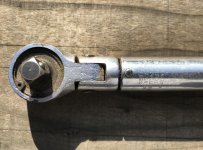
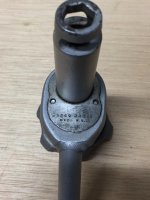
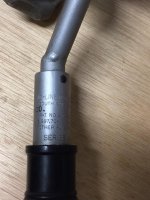
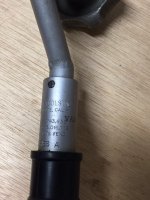
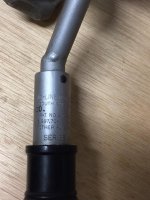
I have a 1/4" inch-pound torque wrench and a 3/8"dr flex-head branded AC Spark Plug, both made by JO Mfg of South Gate, CA.

The 3/8"dr is a very solid unit and checks out within specs as to calibration. (The ratchet head may have come from S-K; it's very much like their round heads.)

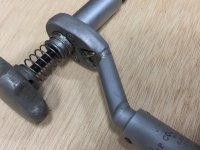
The 1/4"dr needs calibrating, but there's no obvious point of entry. The head joint is riveted, so removing that would require fabricating a new pivot pin. The handle has a solid plug in the bottom and appears removing that would destroy the plug.

Anyone ever been inside one of these little jewels?

jack vines
 
To avoid these ads, REGISTER NOW!

Private Lugnutz

Well-known member
Joined
Mar 30, 2012
Messages
30,477
Location
The Authentic Jersey Shore
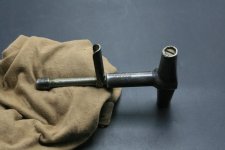
Can't help you, jack. I have a couple of the pre-set inch-pound 1/4-inch drive Tee-handle jobbies (that they called JOTE wrenches) from WWII, but that doesn't sound like what you're describing.
 
OP
P

Packard V8

Well-known member
Joined
Mar 16, 2009
Messages
7,380
Location
Spokane, WA
FWIW, with nothing to lose on an inaccurate example, I scratched around on the plug in the base of the handle and determined it was soft solder. With a propane torch, it melted out instantly.

There's a 3/8" nut which holds the handle on. Kids, don't try this at home, as it remains to be seen if I can get the ball bearing, the locking ring and the spring steel tensioner all back on.

The calibration seems to be a stack of washers. More as it happens.

jack vines
 
OP
P

Packard V8

Well-known member
Joined
Mar 16, 2009
Messages
7,380
Location
Spokane, WA
Had to make a washer to add to the stack to move the handle down for the marks to line up, but now it seems to repeat.

So I spent two hours figuring out how to calibrate a 1/4"dr torque wrench I never use. OTOH, I got it while in the US Army in 1969 because it was out of calibration then. It may be the tool I've had the longest, so there's sentimental value.

The smart move would have been to buy a new HF for $20.

jack vines
 

Grayspoked

Well-known member
Joined
Jul 5, 2019
Messages
52
Location
Pasadena
Jack:

I’m a little late to this thread. My apologies.

My grandfather started Jo-Line Tools, my Dad owned and ran it for many years, and I worked in the shop summers and weekends for ten years. I spent several years in the repair room, fixing torque wrenches that came in from the field. I disassembled, repaired, reassembled, and tested everything from the tiny jomites to the 4-foot long “1202”s.

You’re right. The seal at the bottom of a wrench is soft solder. Easy to melt out and replace, if you have the material. It was intended to keep people from messing with the innards of the tool and to enable us in the repair room to see when someone’s self-help had invalidated their warranty. Realigning the handhold as you describe below is no big deal. Taking out the screw to which the handhold attaches is.

Happy to respond to any other questions anyone has about Jo/Line. I have many happy memories of it.

Bill
 

BajaScout

Well-known member
Joined
May 1, 2011
Messages
4,608
Location
San Diego, CA
Jack:


I’m a little late to this thread. My apologies.


My grandfather started Jo-Line Tools, my Dad owned and ran it for many years, and I worked in the shop summers and weekends for ten years. I spent several years in the repair room, fixing torque wrenches that came in from the field. I disassembled, repaired, reassembled, and tested everything from the tiny jomites to the 4-foot long “1202”s.


You’re right. The seal at the bottom of a wrench is soft solder. Easy to melt out and replace, if you have the material. It was intended to keep people from messing with the innards of the tool and to enable us in the repair room to see when someone’s self-help had invalidated their warranty. Realigning the handhold as you describe below is no big deal. Taking out the screw to which the handhold attaches is.


Happy to respond to any other questions anyone has about Jo/Line. I have many happy memories of it.


Bill


That is too cool to get a response from the grandson of the founder!!


Sent from my iPhone using The Garage Journal mobile app
 

Private Lugnutz

Well-known member
Joined
Mar 30, 2012
Messages
30,477
Location
The Authentic Jersey Shore
That is too cool to get a response from the grandson of the founder!!
:+1:

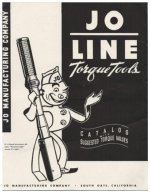
Thanks for chiming in, Bill. I've got a few of your granddad's tools, including a 9/32-inch drive wingnut socket! I enjoyed the research, too. I've posted this in other threads when the subject has come up before, but you may enjoy seeing it...

attachment.php
 

Attachments

  • Jo Mfg cover only.jpg
    Jo Mfg cover only.jpg
    102.8 KB · Views: 891

Grayspoked

Well-known member
Joined
Jul 5, 2019
Messages
52
Location
Pasadena
Thanks, Lugz. I have a few of the old ads (Grandfather ran them for a few years after World War II), but I haven’t seen a catalog like this one. Grandfather (he was NEVER “Grandpa” to me) was essentially a government contractor during the war, and needed to retool for the post-war economy. Hence, the ads and catalogs from about 1945 to 1951.

The company was named after one of Grandfather’s employees of which he was especially fond, and whose initials were J. O. I have thought that the ads with just JO on them were a tip o’ the hat to that history.

Bill
 

Private Lugnutz

Well-known member
Joined
Mar 30, 2012
Messages
30,477
Location
The Authentic Jersey Shore
The company was named after one of Grandfather’s employees of which he was especially fond, and whose initials were J. O. I have thought that the ads with just JO on them were a tip o’ the hat to that history.
That's very interesting. Looking through the few pages of this particular catalog that I was able to find and save from an eBay sale several years ago, it was unavoidable forming the impression that JO, whoever he, she, or it was, was central to all the naming conventions in the company. All of the names of the various tools start with the letters "Jo"! If you can't read it, there is a Joex, a Joel, a Jote (I have two of these, 0-25 inch-lb preset t-handle torkers), and a Joar on these two pages alone.

attachment.php


Here are the JO Line 9/32-inch drive wingnut sockets I have.

attachment.php


attachment.php


attachment.php


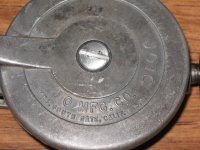
They are marked JO MFG CO and SOUTH GATE, CALIF with a part number. They were found with a bunch of other wartime 9/32-inch drive pieces from Plomb, Williams, and Armstrong, and most of it was in boxes marked with wartime US Army Air Forces markings.

And here are some kind of specialty pliers or tongs named Joda. Brake or wheel related perhaps. Not mine. Also found them in a search several years ago. Marked J.O. MFG. CO.

attachment.php
 

Attachments

  • Jo Mfg Catalog page.jpg
    Jo Mfg Catalog page.jpg
    122.9 KB · Views: 859
  • JO 9-32nds 1.jpg
    JO 9-32nds 1.jpg
    93.9 KB · Views: 816
  • JO 9-32nds 2.jpg
    JO 9-32nds 2.jpg
    84.3 KB · Views: 813
  • JO 9-32nds 3.jpg
    JO 9-32nds 3.jpg
    86.4 KB · Views: 812
  • JO JODA_7_1.jpg
    JO JODA_7_1.jpg
    103.6 KB · Views: 815

BarryWells

Well-known member
Joined
May 26, 2019
Messages
647
Location
In the mountains
Jack:

I’m a little late to this thread. My apologies.

My grandfather started Jo-Line Tools, my Dad owned and ran it for many years, and I worked in the shop summers and weekends for ten years. I spent several years in the repair room, fixing torque wrenches that came in from the field. I disassembled, repaired, reassembled, and tested everything from the tiny jomites to the 4-foot long “1202”s.

You’re right. The seal at the bottom of a wrench is soft solder. Easy to melt out and replace, if you have the material. It was intended to keep people from messing with the innards of the tool and to enable us in the repair room to see when someone’s self-help had invalidated their warranty. Realigning the handhold as you describe below is no big deal. Taking out the screw to which the handhold attaches is.

Happy to respond to any other questions anyone has about Jo/Line. I have many happy memories of it.

Bill
I have a question. Why did the company die ?
 

Grayspoked

Well-known member
Joined
Jul 5, 2019
Messages
52
Location
Pasadena
Lugz, I'll have a response for you when I have a bit more time over the next 24 hours. I am enjoying reliving a part of my life that I found formative through fielding your questions. However, responding to you requires telling some stories, and I want to do that right. Meanwhile, my wife is telling me that I have to get our Lab out for a run, or else he'll be in our faces during dinner. I'll get in trouble if he (the Lab) does that.

I have a more direct, if not necessarily more brief, response for Barry. My Grandfather got a bunch of patents that were integral to the micrometer torque wrench business in the 1950's and 1960's. My recall is that the heart of the patented system was the "pivot," a small, rectangular shaped piece of metal that sat in the spring tube between the hinge (that's what we called the piece at the top of the wrench that held the ratchet, if the tool in issue had a ratchet) and the spring. As I understood it, Jo-Line had the market largely to itself in high-quality micrometer torque wrenches from the 1950's on because of their patents on this system. Anyway, my Dad looked into the future in the mid-'70's and didn't like what he saw. The key patents were going to expire in the mid-1980's. Already, the Japanese were showing signs of manufacturing precision hand tools at costs that he couldn't touch in the USA. So, he sold the business in late 1979. I don't remember the name of the buyer, but Dad might. He turns 95 this fall, and will probably remember if anyone is curious. Anyway, the buyer closed the factory in California, and moved production back east, Unfortunately, the buyer didn't figure out that one of the crown jewels of the business was its work force, many of whom up through late 1979 loved to take me aside to tell me stories of when they were young men, and my Grandfather would terrorize them. Grandfather died in 1972, so that gives you an idea about how loyal the employees had been. They knew those tools and the machines and processes necessary to manufacture them like no one else, and their loyalty to the company still amazes me. The buyer found himself with a bunch of machinery, expiring patents, and confused customers. What he didn't have was the know-how to make the manufacturing business smooth enough to make a profit at it. As my Dad put it to me, the business just kind of went away in the first few years of the 1980's. That's all he ever said about that, but I will never forget the sad shake of his head as he did so.

I don't know if Jo-Line's private label customers put pricing pressure on my Dad, as they saw the patents expiring and such. However, my Dad's big insight that helped Jo-Line support the second and third generations of my family to be involved in the business was to emphasize the manufacture of private label micrometer torque wrenches for the likes of Snap-On, Owatonna Tool, Central Tool, Ridgid, AC Delco (Dunno if you've seen the special hinge on the spark plug wrench), even Montgomery Ward (true!). Jo-Line manufactured all the Snap-On QJ and QJR 3200s, 3200As, and 3200Bs. The first non-Jo-Line micrometer wrench was the 3200C. I got personally involved in the business in 1969, and the only Jo-Line branded wrenches I ever saw going out of the Shipping Room door were for military contracts and a dribble of some of the more unusual tools, like the JoMite and JoTite lines. Maybe some JoTes, although Ridgid got most of those, with private labelling and special paint jobs. My Dad saw Jo-Line branded product as competing with his private label product for customers whose distribution networks were far better than he could ever dream of having, and so he de-emphasized the Jo-Line brand starting in the early 1960's.

Anyway, my Dad was right from an economic sense. A couple of years ago, I went on Ebay and looked for micrometer torque wrenches. All the new ones were made in China, and they sold for prices that were less than Jo-Line's cost of manufacture in the 1970's, before taking inflation into account. Jo-Line would have been road-kill had he held onto it.

I'll be back to you, Lugz, probably tomorrow.

Bill
 

MR.X

Well-known member
Joined
Dec 13, 2010
Messages
1,792
I used to find these random 9/32 drive sockets in old Plomb kits. Cal-Air, De Co.(Deco?), That's a Jo in upper right hand corner next to a Plomb with the identical contract#. Have some of their torque stuff buried around here somewhere and a couple of Joar wrenches in a packed WW2 era aircraft tool roll.
 

Attachments

  • IMG_0149.jpg
    IMG_0149.jpg
    148.8 KB · Views: 94

Grayspoked

Well-known member
Joined
Jul 5, 2019
Messages
52
Location
Pasadena
Lugz:

OK, the dog is winded and the potatoes are in the oven. I have a few minutes, so here goes.

I noted in another post that my Grandfather was essentially a government contractor during World War II. American manufacturing in the first half of the 1940's was geared to the war effort, so a company like J O had one customer during that period. We have a picture of Grandfather around here somewhere showing him proudly receiving his "E For Excellence" award in 1943 from someone with a lot of scrambled eggs on the bill of his hat and a lot of action decorations on his chest. He was proud of that award long after the war was over.

Anyway, he found himself in the position of needing new customers beginning in the fall of 1945. The military had all the micrometer torque wrenches it was going to need for a while in peacetime. Further, most of his natural customers were converting from wartime production to civilian, peacetime production. Car companies, shipbuilding companies, and aircraft companies had made nothing but tanks, jeeps, Victory ships and landing craft, and warplanes for 5 years or so at that point. Car dealers and gas stations had been pinched by the unavailability of new cars and trucks to sell/work on, and parts with which to repair them. On the other hand, he faced a tremendous opportunity. He had sold a ton of micrometer torque wrenches to car, shipbuilding and aircraft companies during the war. Many more had been shipped overseas for use in repairing things that had gotten busted up in the war. A whole generation of engineers and mechanics had seen what they could do and were used to them. On yet a third hand, none of these potential customers had a lot of loose change banging around in their pockets. It wasn't that these potential customers were poor; in many cases, far from it. The problem was that the financial cost and physical effort to convert from wartime to peacetime production was nothing short of daunting. There was SO much to do, SO little time in which to do it, and SO much cost involved in getting it all done that getting managers at potential customers to focus on micrometer torque wrenches was a real task.

On top of that, my Grandfather was an inventor and a mechanic at heart, not a businessman. He got to California starting from Missouri in (I think) 1912, at the age of 16 by using all the money he had to buy a train ticket for as far west as he could get. That turned out to be Boulder, Colorado. He got employed by a wealthy man in Boulder who was an early adopter of one of those things called an automobile. Grandfather's job was to keep the darn thing on the road, and to drive his employer around in it. After a couple of years on the Western Front as a motorcycle messenger (see the thread of motor vehicles developing?) where he was gassed, he returned to Boulder, married my Grandmother (she wasn't "Grandma," either) and drove her, crying most of the way and pregnant with my father, to the outskirts of Los Angeles, then Huntington Park. He started what became J O in the 1930's.

In case it's of interest to you, J O's (and Jo-Line's) address in South Gate was 8442 Otis Street, South Gate, California. That's a skip and maybe a jump-and-a-half from Huntington Park, so the commute for Grandfather was good. That building was old, and was not an efficient place in which to manufacture torque wrenches. I remember narrow passageways through a dark and dank enclosed space that smelled deeply of decades of oil and grease. The offices where my dad worked were upstairs. The rubber pads on the wooden stairs were worn smooth and all the wood floors creaked. My Dad moved the business to 4225 East La Palma Avenue, Anaheim in 1968, and there it remained until its buyer moved it back east in the early 1980's. The building that appears at the Anaheim address on Google is the one my Dad built, but the owners since 1979 have changed the front so much as to be unrecognizable to me. The parking lot that appears on Google at 8442 Otis certainly doesn't resemble the building I remember....

But I digress. I think Grandfather tried to survive in the dislocations following World War II by giving in to his natural inclinations - inventing, designing, and manufacturing stuff that someone (he hoped) would buy. He continued to manufacture and sell micrometer torque wrenches. But he also built and tried to sell other things in the off-times, when he had sold all the micrometer torque wrenches the market would bear. Unfortunately, these other products just didn't sell. My Dad had to rescue the business a few times.

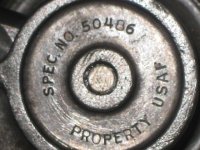
My Dad put together a wall display of my Grandfather's inventions. He hung it in the Anaheim front office just behind reception. It may have had your 9/32nds socket on it -- I can't recall. What I do recall (remember, I was a teenager at this time), was the most barbaric-appearing eyelash curler I could ever imagine, much less had ever seen. Each of the pair (there were two) were maybe two inches across, and looked like an instrument of torture.

I remember seeing a couple of old Joars, gathering dust in a storage room in the plant. Same with the Joels. I don't recall the Joex. The Jote was very popular, primarily for tightening the lugs on the fittings that joined together PVC piping for plumbers. In my era - 1969-79 - Ridgid bought a lot of these under private label. I do recall Jote's under the Jo-Line brand being shipped, but they were kind of unusual. As I noted to Barry, my Dad knew where his bread was buttered.

Your Jote is unusual to me, but that may be because the market had shifted since yours were manufactured. They were all preset, because they were all intended for a single purpose. I recall the Ridgid tools being preset at 46 ft/lbs for plumbing uses, but that's a recollection that goes back nearly fifty years. Further, unlike all the other torque wrenches Jo-Line (or J O ) produced, these were tested and calibrated on preset testing machines, so that the assembly team didn't even have to pay attention to the calibration. So long as the wrench "broke" when the testing needle was between two lines, you were good. I don't know what industry your Jote was intended to be used in. It predates me.

I don't recall your Joda. It REALLY looks like one of my Grandfather's pipe dreams to become a big-time manufacturer of all sorts of tools. It is unquestionably a J O product. JO was spelled with either "Manufacturing" or "Mfg.," as here. I would date your Joda to the 1950's, probably the first half. My Grandfather would make this kind of stuff all the time. My Dad got more involved at a senior level as the 1950's wore on, and he wouldn't stand for investing in the tools and jigs to manufacture stuff that just didn't sell.

I am not familiar with your 9/32 inch drive pieces. But the fact that you found them in a box marked USAAF with other tools from the war era sounds right. Clearly J O products, as well.

One last digression. I have an ad from the January 1946 edition of Air News with Air Tech. The ad is for the Jomi, of which there was an inch-pound and a foot-pound model. The character that appears on the front of your catalog also appears in the ad, but here he has a name. It is "GI (Good InTENSIONS) JO." The capitalized TENSIONS was lower case and italicized in the original. GI JO is dressed in a hat with a shirt having buttons that really resemble (OK, they're nuts, but they are arranged in a manner that would be familiar) an enlisted man's uniform in World War II. It isn't hard to see the market to which Grandfather was trying to sell - the young men returning from the war, hanging up but deeply remembering the khakis they had worn in the conflict - and, or so Grandfather hoped, their micrometer torque wrenches.

I wonder if we can sue Habro for a cut of their "G.I. Joe" profits. I mean, Grandfather came up with it first!

Just kidding......

Bill
 

Private Lugnutz

Well-known member
Joined
Mar 30, 2012
Messages
30,477
Location
The Authentic Jersey Shore
Fascinating!

The character that appears on the front of your catalog also appears in the ad, but here he has a name. It is "GI (Good InTENSIONS) JO."
He has the same name on the catalog. The tiny illegible writing on the lower left corner of the cover reads...G.I. (Good Intentions) JO says, "Precision tight means it's right." :)

I don't know how early your Grandfather started naming the tools with the Jo prefix, but my "Jote" tee-handle torker, which I am sure is wartime (cadmium plated), is not marked "Jote", but I have seen them so marked. I suspect the catalog is from the 50's and perhaps that convention didn't start until after the war.
 

Attachments

  • 20161120_091858.jpg
    20161120_091858.jpg
    63.6 KB · Views: 100
Last edited:

Grayspoked

Well-known member
Joined
Jul 5, 2019
Messages
52
Location
Pasadena
I think this one is directed most to Lugz, but maybe there is broader interest. I had a chance to talk to Dad this morning after church. He filled me in on a few details.

First, those wingnut 9/32 inch sockets are from a wrench that Lugz photographed yesterday. As Dad put it, these wrench/socket sets were designed to permit Rosie the Riveter to quickly and accurately tighten wingnuts in the aircraft factories. Women don't quite have the same arm-strength as men as a general rule, so the wrench operated as a lever allowing the women to get the wingnuts tight without expending undue effort. They predated the micrometer torque wrench. Definitely a World War II item.

It sounds like I got my description of the Jote wrong yesterday. Dad said that 25 inch pounds sounded about right on that one. He also said that the plumbers bought a bunch of Jotes, but they eventually found that they could estimate the necessary tightness on their fittings and stopped buying them.

The Joar in the catalog has some history behind it. The B-17 bomber was a revolutionary aircraft in the late 1930's. Revolutionary machines inevitably have things that are thought through right the first time, and other things that need tweaking in later models.

The electrical system in the B-17 was one of its revolutionary aspects. The Sperry machine guns on top and in the belly of the aircraft were electrical from the start, and electrical systems proliferated through the aircraft, as electrical power helped the crew make the aircraft a "Flying Fortress." This was important, because the B-17 flew without ****** in daylight over the heart of Germany until the P-47 and P-51 came along.

The electrical wire in the B-17 originally was routed through the aircraft in conduit. This caused manufacturing issues. The conduit had to be installed into the aircraft and the wiring run through it in the body of each aircraft. Essentially, electricians stuffing wire into conduit had to get involved in the manufacturing process at the same place in the airplane and at the same time as plumbers were installing the hydraulics, equipment installers were installing equipment, and structure people were building out the airframe. The conduit helped create a manufacturing bottleneck. It was discovered that eliminating the conduit would save over 100 pounds of weight, streamline manufacturing, and allow quality control checks to be much more efficient.

Oh, and one other thing. The B-17As and B-17-Bs didn't do a whole lot of unescorted flying over hostile territory. However, the USAAF lent some B-17Cs to the RAF in 1941. The RAF tried these B-17Cs in unescorted daytime raids, and experienced losses they deemed unacceptable. One of the things that led to these losses was that a lucky German shot that hit the electrical conduit tended to shatter the conduit it hit, causing complete loss of whatever electrical systems passed through the affected conduit.

The USAAF and Boeing responded by eliminating the conduit, introducing the revolutionary electrical harnesses, and running the electrical wiring through numerous spots in the B-17's inner hull, so that a lucky shot might sever one strand of wiring, but not a bunch of them. I don't know when this change was made, but the B-17D is a likely suspect. It was manufactured in large numbers, and the conduit problem came to white-hot light in the B-17C.

So, how does the Joar figure in this story? Well, the Joar was designed to be used in the installation of conduit in those early B-17s. Each piece of conduit was only so many feet long, and did not run in a single piece from nose to tail of the aircraft. The fasteners and joints where pieces of conduit were joined needed to be tightened to within specified tolerances. Boeing used Joars to do that.

Dad says that J O was selling Joars like hotcakes in the early years of World War II, but that sales fell off a cliff once Boeing eliminated conduit from the B-17. Your catalog indicates that Grandfather was still trying to sell Joars in the early 1950's. Why not? He had all the tools and jigs to make them. However, Dad says that selling Joars after their use on the B-17 was done was like beating a dead horse.

So you have a little (OK, tiny) piece of history in your hands when you hold one of J O's Joars in your hand.

I forgot to ask Dad about your Joda at church, but sent him a text about it later. I hope to have a little more for you later.

Bill
 

Private Lugnutz

Well-known member
Joined
Mar 30, 2012
Messages
30,477
Location
The Authentic Jersey Shore
Bill,

Thanks to you and your father for the wonderful and generous insight.

In all my years of collecting and tool forums I can't think of someone this close to a family-owned mfgr adding this kind of first-hand history. There is another mfgr's grandson here on GJ from time to time. Joshua Ferguson, the grandson of William H. Ferguson (1900-1963), who was the lead designer and engineer at Trimo-Ferguson up through 1945, and then Porter-Ferguson, which became a division of H.K. Porter. He had a dozen auto body repair related patents to his name. In his case he is mainly looking for information to learn more about his grandfather and his inventions.
 

MR.X

Well-known member
Joined
Dec 13, 2010
Messages
1,792
So here's some stuff i dug out. the Jote T fixed torque wrench has a 58 patent. This very much reminds me of some similar tools i have buried around here somewhere marked Skyway Precision Tool Co. also out of Los Angeles. ( I'm not going to research if their was a connection) The JOAR conduit wrench and the the JOCO side breaking torque were in an old mixed aircraft tool roll stuffed with WW2 era Pratt Whitney, Wright and a variety of other companies' tools.
 

Attachments

  • IMG_0170.jpg
    IMG_0170.jpg
    141.5 KB · Views: 88
  • IMG_0173.jpg
    IMG_0173.jpg
    124.7 KB · Views: 83
  • IMG_0174.jpg
    IMG_0174.jpg
    143.6 KB · Views: 80
  • IMG_0175.jpg
    IMG_0175.jpg
    143.8 KB · Views: 81

Grayspoked

Well-known member
Joined
Jul 5, 2019
Messages
52
Location
Pasadena
Mr. X:

Some quick thoughts.

Your Jote looks very familiar. Good to see another one of those guys. My Grandfather received that 1958 patent to which you refer.

I'll save you some research time. There was no relationship between Skyway Precision Tool and J O/Jo-Line. As Lugz has noted and I saw, my Grandfather was relentless and consistent in putting some variant of "JO" in his company names and in his J O/Jo-Line branded product. My Dad did not change that.

I addressed the Joar earlier today in this thread. I haven't seen a Joco. Does it have "J O Mfg. / South Gate, Calif." on it? That's really the "pick up point" for J O products. I'll ask Dad about that one.

Bill
 

MR.X

Well-known member
Joined
Dec 13, 2010
Messages
1,792
Mr. X:

Some quick thoughts.


I'll save you some research time. There was no relationship between Skyway Precision Tool and J O/Jo-Line. As Lugz has noted and I saw, my Grandfather was relentless and consistent in putting some variant of "JO" in his company names and in his J O/Jo-Line branded product. My Dad did not change that.

I haven't seen a Joco. Does it have "J O Mfg. / South Gate, Calif." on it? That's really the "pick up point" for J O products. I'll ask Dad about that one.

Bill
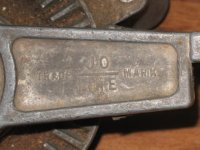
Not gonna save me much time as I said "I'm NOT going to research.." ....and then I misspelled "there". Anyway, earlier I posted a pic of a bunch of tools found in an old Plomb box. There was a Plomb 44B8812 a JO CO South Gate 44B8812 and Skyway had a 44B8812 too, though that's not in my pic. I'm assuming that's a military contract. Did Los Angeles really need multiple companies making virtually the same sockets? That earlier post and mentioning the skyway torque wrench ( which may have a completely different internal design for all I know) was in case ANYONE reading, especially in California, noticed the same thing and had some insight as to how those contracts were doled out or if there was some sub contracting going on or whatever. There doesn't need to be a "JO" on the tool for there to be a connection or relationship, a relationship or connection could be anything as simple as an important employee moving to something as significant as one company being the OEM for a portion of another's line. A relationship could be adversarial ie. was Skyway a significant competitor for example? OK, I'm already losing interest in whatever I was saying....
The JOCO marked tool does not have any other writing on it.
 
To avoid these ads, REGISTER NOW!

Private Lugnutz

Well-known member
Joined
Mar 30, 2012
Messages
30,477
Location
The Authentic Jersey Shore
So, how does the Joar figure in this story? Well, the Joar was designed to be used in the installation of conduit in those early B-17s. Each piece of conduit was only so many feet long, and did not run in a single piece from nose to tail of the aircraft. The fasteners and joints where pieces of conduit were joined needed to be tightened to within specified tolerances. Boeing used Joars to do that.

Dad says that J O was selling Joars like hotcakes in the early years of World War II, but that sales fell off a cliff once Boeing eliminated conduit from the B-17. Your catalog indicates that Grandfather was still trying to sell Joars in the early 1950's. Why not? He had all the tools and jigs to make them. However, Dad says that selling Joars after their use on the B-17 was done was like beating a dead horse.
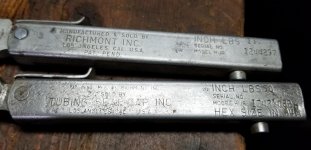
Found one today. A No. 7. Not in the same condition as MR. X's No. 11 upthread, but it'll do! :)
 

Attachments

  • 20190719_163838.jpg
    20190719_163838.jpg
    109 KB · Views: 66
  • 20190719_163738.jpg
    20190719_163738.jpg
    131.9 KB · Views: 58
  • 20190719_163709.jpg
    20190719_163709.jpg
    147.7 KB · Views: 57
  • 20190719_163550.jpg
    20190719_163550.jpg
    151.1 KB · Views: 67

RubiconJK

Well-known member
Joined
May 15, 2016
Messages
1,380
Location
"I'm bad, I'm Nationwide"
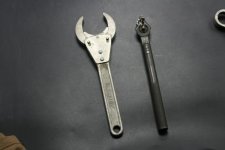
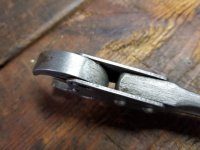
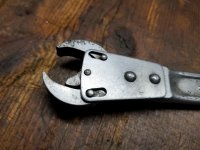
Post 1 of 2: Glad I found this thread and hoping that Grayspoked is still around to comment. I recently picked this Jo-Line "Jotru 10" up on an online auction. I was first attracted to it due to the fact that I'm always looking for Plomb or Proto ratchet variations. This tool makes use of an adapted Proto 3/8" drive 5249 ratchet head. I've taken several pics and will split up with two posts.
 

Attachments

  • r1.jpg
    r1.jpg
    146.9 KB · Views: 76
  • r2.jpg
    r2.jpg
    68.2 KB · Views: 70
  • r3.jpg
    r3.jpg
    73.8 KB · Views: 66
  • r4.jpg
    r4.jpg
    108.1 KB · Views: 62
  • r5.jpg
    r5.jpg
    91.2 KB · Views: 59
Last edited:

RubiconJK

Well-known member
Joined
May 15, 2016
Messages
1,380
Location
"I'm bad, I'm Nationwide"
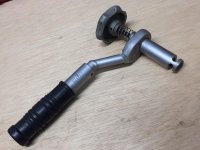
Post 2 of 2: The Jo-Line Jotru 10 has a spring loaded spinner knob which when depressed extends a flathead screwdriver tip into the ported "socket" on the ratchet. The 6 point drive end to the "socket" is about 1/2" in size. The tool is also dual stamped Van F Belknap Co 1008A. Three separate patents are listed and I will be researching those next.
 

Attachments

  • r9.jpg
    r9.jpg
    148.7 KB · Views: 47
  • r8.jpg
    r8.jpg
    101.1 KB · Views: 40
  • r7.jpg
    r7.jpg
    89.6 KB · Views: 41
  • r6.jpg
    r6.jpg
    89.5 KB · Views: 37
  • r5.jpg
    r5.jpg
    91.2 KB · Views: 52

Private Lugnutz

Well-known member
Joined
Mar 30, 2012
Messages
30,477
Location
The Authentic Jersey Shore
It reminds me of a valve adjuster. My guess is special valve adjuster. The socket would hold the lock nut and the flat head tip would turn the adjuster. J.O. Mfg had a close relationship, not just in geographic vicinity, with Plomb, due to them both supplying stuff to the US Army Air Forces. Both of the JO pre-set torque wrenches I have found had Plomb 9/32-inch drive sockets attached to them!

That is an intriguing and, dare I say it, probably unique find, Roob!
 

Grayspoked

Well-known member
Joined
Jul 5, 2019
Messages
52
Location
Pasadena
Post 2 of 2: The Jo-Line Jotru 10 has a spring loaded spinner knob which when depressed extends a flathead screwdriver tip into the ported "socket" on the ratchet. The 6 point drive end to the "socket" is about 1/2" in size. The tool is also dual stamped Van F Belknap Co 1008A. Three separate patents are listed and I will be researching those next.
Rubicon:

Yes, I'm still here. Of course, it helps when Garage Journal sends me a notice of your posting....

Your Jotru predates me, but it doesn't predate my Dad. I will ask him about it. Check back in a day or two, and I'll post what I find from him.

In the meantime, your reference to Van Belknap caught my eye. Van was Jo-Line's sales rep to the auto industry in the 1960's. Van was a burly fellow with salt and pepper hair cut in a fashion familiar to every US Marine over the past 70 years. He was based in Detroit. I may be off a bit in the details here, but I think my Dad hired him to rep Jo-Line in the early 1960's, and terminated the relationship sometime in the 1969-71 period. Dad has said that Van promised great things, but that his actual sales were noticeably lower than he had led my Dad to believe. Oh, well. However, pending my getting the lowdown from my Dad, I'd expect that your Jotru was manufactured for sale by Van to the automotive industry for a specific automotive application. The adjustment mechanism on the Jotrus was sufficiently complex to make this a secondary choice in the market if flexibility in the amount of torque to be applied to different jobs was a real consideration for a buyer. Certainly, Jo-Line was manufacturing regular adjustable micrometer torque wrenches in the 1960's.

It looks like Van started a company selling torque products that's still there. Search for "Van Belknap" on the web and you'll find it. The company says it has a history of 57 years, which would put it being founded in 1962. That's about when my Dad hired Van to rep Jo-Line.

I'll be back with an update.

Bill
 

RubiconJK

Well-known member
Joined
May 15, 2016
Messages
1,380
Location
"I'm bad, I'm Nationwide"
Intrigued to say the least! Thanks so much for the reply. I had indeed seen that Van Belknap was still a going concern.

Lugz I think you are right. I can completely see this as a valve adjuster.

Edit: BTW, I did research the three patent numbers on the handle. None of the patents referenced seem to pertain exactly to this tool which leads me to wonder if the handle itself was used on multiple tools? The way it is pinned to the ratchet may support this theory as it looks as if it could easily be used universally.
 
Last edited:

Grayspoked

Well-known member
Joined
Jul 5, 2019
Messages
52
Location
Pasadena
It reminds me of a valve adjuster. My guess is special valve adjuster. The socket would hold the lock nut and the flat head tip would turn the adjuster. J.O. Mfg had a close relationship, not just in geographic vicinity, with Plomb, due to them both supplying stuff to the US Army Air Forces. Both of the JO pre-set torque wrenches I have found had Plomb 9/32-inch drive sockets attached to them!

That is an intriguing and, dare I say it, probably unique find, Roob!
Rubicon and Lugz:

I was able to catch up with Dad. He had some strong impressions.

Rubicon and Lugz:

I caught up with Dad. He had some things to say.

First, the Jotru 10. Van Belknap regularly came up with "great ideas" for new applications of torque wrench technologies in the auto industry. And why not? He got 15% of the gross for each one he sold and bore none of the expenses of developing the tool. However, he needed demonstration models to show the automakers concretely what his great idea was. Les Trimble was the senior engineer for J O and Jo-Line for decades. Van would call Les to tell Les what he needed in a spec tool to show the automakers. Les would build it, and it would be sent to Van. Dad immediately identified Rubicon's Jotru 10 as one of Les Trimble's one-offs at Van's request. He thought it might be the only one that exists. I told Dad that I had seen a Jotru 10A in a post to this board about ten years ago. Dad replied, "Well, OK, maybe we built 10-15 of these, but that's it. No more." So, Rubicon, you have a rare one. I don't know if it is still properly calibrated or if there is any use for it these days, but it is rare.

Dad said your Jotru probably dated to the second half of the 1950's, given its Belknap labelling and its J O Mfg. source.

I asked Dad what a Jotru 10 might have been used for. He didn't know immediately. I passed on Lugz' suggestion that it might be a valve adjuster. Dad reacted to that immediately, saying that using this tool as a valve adjuster would be a "perfect application" for it.

Oh, and I misstated one detail in my earlier post. Dad told me that he formed his relationship with Van Belknap in the mid-1950's, shortly after he (Dad) came to work at J O Mfg. Thus, it appears that Van was selling J O and Jo-Line Tools wrenches before he founded his Belknap tool company that we can find on the web.

Lugz, I also followed up with Dad re Plomb Tool. I had never heard of Plomb Tool over 9 years working at Jo-Line, and decades looking at its history since, so I was intrigued. I had heard of Proto, the new name for Plomb after it got sued, but I couldn't recall any Jo-Line product ever being sold to Proto. Thus, when you wrote about a "close relationship" between these two Los Angeles-based companies, I wanted to hear more.

Turns out there was something there, but not something most of us would consider a "close relationship." Dad knew Morris Pendleton. He said Morris was a "nice old guy" with whom he enjoyed talking at Hand Tool Institute meetings. Morris lived in La Canada, California, which is right next door to Pasadena, from which I am typing this tonight. He gave a lot of money to the Crescenta-Canada YMCA, which accounts for why his picture hangs in the lobby of the YMCA building to this day. Dad said that Morris (or his Dad) started off making wrenches out of the axles of Model T cars. However, Morris moved on to manufacturing Richmont Torque Wrenches, a line of tools Dad believes was directly competitive with the product of J O Mfg. and Jo-Line Tools. Dad said that neither J O nor Jo-Line ever bought anything from Plomb Tool, nor sold anything to them. Instead, Plomb Tool was a vigorous competitor of J O Mfg. and Jo-Line. Dad said that there were only two major distributors of hand tools in the US during the relevant time period to which he was never able to sell private-label torque wrenches manufactured by J O or Jo-Line. One was Sears Roebuck, and the other was Plomb Tool. Dad called Plomb his "bitter enemies" and said that J O on the one hand and Plomb on the other "didn't like each other very much." I have never in my life - 64 years now and going strong - heard my Dad ever refer to anyone as his "enemy," bitter or otherwise. Until earlier today. Thus, I am taking him at his word on the relationship between him and Morris.

Based on my conversation with Dad, I think I can explain why you find J O wrenches with Plomb sockets. The USAAF needed wrenches with sockets. It had a contract with my grandfather for wrenches, and a contract with Morris for sockets. The grunts maintaining the aircraft for USAAF during WWII combined the two. Then, they left the tools combined when WWII ended. Each of Grandfather and Morris simply had a government contract. They didn't cooperate at all.

I hope this is interesting!

Bill
 

bonneyman

Well-known member
Joined
Apr 22, 2010
Messages
8,761
Location
Desert SW
Might be related or not, but I have this pair of egg beater drills, double knuckled for tight spaces. Was told they were for working inside an airplane wing, WW2-ish. Marked JO LINE and JO Manufacturing.
Same JO company we're talking about?
 

Attachments

  • IMG_3256.JPG
    IMG_3256.JPG
    118.1 KB · Views: 61
  • IMG_3253.JPG
    IMG_3253.JPG
    127.7 KB · Views: 61
  • IMG_2178.JPG
    IMG_2178.JPG
    132.2 KB · Views: 54
  • IMG_2174.jpg
    IMG_2174.jpg
    49 KB · Views: 53
  • IMG_2176.JPG
    IMG_2176.JPG
    120.3 KB · Views: 78

Grayspoked

Well-known member
Joined
Jul 5, 2019
Messages
52
Location
Pasadena
Might be related or not, but I have this pair of egg beater drills, double knuckled for tight spaces. Was told they were for working inside an airplane wing, WW2-ish. Marked JO LINE and JO Manufacturing.
Same JO company we're talking about?
Bonneyman:

Absolutely the same J O and Jo-Line. And it isn't WWII-"ish," it's WWII, period (at least the one marked "PROPERTY USAF" is). Looks like a product of one of the government contracts my grandfather had during World War II, like the Joars that are discussed earlier in this thread. Grandfather wasn't shy about taking the government's money during the war, so he made whatever he figured they might buy. I think Dad gave me a couple of drills like yours, although mine are probably post-war. The egg beater part is painted red, no doubt for the consumer market.

I can follow up with Dad tomorrow to find out what they were used for by the Air Force.

Bill
 

Private Lugnutz

Well-known member
Joined
Mar 30, 2012
Messages
30,477
Location
The Authentic Jersey Shore
Dad knew Morris Pendleton. He said Morris was a "nice old guy" with whom he enjoyed talking at Hand Tool Institute meetings. Morris lived in La Canada, California, which is right next door to Pasadena, from which I am typing this tonight. He gave a lot of money to the Crescenta-Canada YMCA, which accounts for why his picture hangs in the lobby of the YMCA building to this day.
So, which one of our LA-area members is going to run up there and snap a photo for the Plomb thread? :)

Grayspoked said:
...However, Morris moved on to manufacturing Richmont Torque Wrenches, a line of tools Dad believes was directly competitive with the product of J O Mfg. and Jo-Line Tools....Plomb Tool was a vigorous competitor of J O Mfg. and Jo-Line. Dad said that there were only two major distributors of hand tools in the US during the relevant time period to which he was never able to sell private-label torque wrenches manufactured by J O or Jo-Line. One was Sears Roebuck, and the other was Plomb Tool. Dad called Plomb his "bitter enemies" and said that J O on the one hand and Plomb on the other "didn't like each other very much."
Haha. Well, that was the other of the only two possibilities of them being so close! Thanks for adding something only your father could add to the deduction! Only show him the attached photos when his heart rate needs a bit of a kick! :lol:
 

Attachments

  • 20191108_062200.jpg
    20191108_062200.jpg
    148.8 KB · Views: 97
  • 20191108_062229.jpg
    20191108_062229.jpg
    138.9 KB · Views: 107
Last edited:

drivesitfar

Well-known member
Joined
Oct 23, 2013
Messages
35,999
Location
Pacific Northwest
LUG: thanks for cross posting cause I'm subscribed to so many threads that I don't always get time to look at new ones.

i'll read up more on this and maybe make a comment or two or i'll just **** up some more information and learn about these cool tools.
 

RubiconJK

Well-known member
Joined
May 15, 2016
Messages
1,380
Location
"I'm bad, I'm Nationwide"
Rubicon and Lugz:

I was able to catch up with Dad. He had some strong impressions.

Rubicon and Lugz:

I caught up with Dad. He had some things to say.

First, the Jotru 10. Van Belknap regularly came up with "great ideas" for new applications of torque wrench technologies in the auto industry. And why not? He got 15% of the gross for each one he sold and bore none of the expenses of developing the tool. However, he needed demonstration models to show the automakers concretely what his great idea was. Les Trimble was the senior engineer for J O and Jo-Line for decades. Van would call Les to tell Les what he needed in a spec tool to show the automakers. Les would build it, and it would be sent to Van. Dad immediately identified Rubicon's Jotru 10 as one of Les Trimble's one-offs at Van's request. He thought it might be the only one that exists. I told Dad that I had seen a Jotru 10A in a post to this board about ten years ago. Dad replied, "Well, OK, maybe we built 10-15 of these, but that's it. No more." So, Rubicon, you have a rare one. I don't know if it is still properly calibrated or if there is any use for it these days, but it is rare.

Dad said your Jotru probably dated to the second half of the 1950's, given its Belknap labelling and its J O Mfg. source.

I asked Dad what a Jotru 10 might have been used for. He didn't know immediately. I passed on Lugz' suggestion that it might be a valve adjuster. Dad reacted to that immediately, saying that using this tool as a valve adjuster would be a "perfect application" for it.

Oh, and I misstated one detail in my earlier post. Dad told me that he formed his relationship with Van Belknap in the mid-1950's, shortly after he (Dad) came to work at J O Mfg. Thus, it appears that Van was selling J O and Jo-Line Tools wrenches before he founded his Belknap tool company that we can find on the web.

Lugz, I also followed up with Dad re Plomb Tool. I had never heard of Plomb Tool over 9 years working at Jo-Line, and decades looking at its history since, so I was intrigued. I had heard of Proto, the new name for Plomb after it got sued, but I couldn't recall any Jo-Line product ever being sold to Proto. Thus, when you wrote about a "close relationship" between these two Los Angeles-based companies, I wanted to hear more.

Turns out there was something there, but not something most of us would consider a "close relationship." Dad knew Morris Pendleton. He said Morris was a "nice old guy" with whom he enjoyed talking at Hand Tool Institute meetings. Morris lived in La Canada, California, which is right next door to Pasadena, from which I am typing this tonight. He gave a lot of money to the Crescenta-Canada YMCA, which accounts for why his picture hangs in the lobby of the YMCA building to this day. Dad said that Morris (or his Dad) started off making wrenches out of the axles of Model T cars. However, Morris moved on to manufacturing Richmont Torque Wrenches, a line of tools Dad believes was directly competitive with the product of J O Mfg. and Jo-Line Tools. Dad said that neither J O nor Jo-Line ever bought anything from Plomb Tool, nor sold anything to them. Instead, Plomb Tool was a vigorous competitor of J O Mfg. and Jo-Line. Dad said that there were only two major distributors of hand tools in the US during the relevant time period to which he was never able to sell private-label torque wrenches manufactured by J O or Jo-Line. One was Sears Roebuck, and the other was Plomb Tool. Dad called Plomb his "bitter enemies" and said that J O on the one hand and Plomb on the other "didn't like each other very much." I have never in my life - 64 years now and going strong - heard my Dad ever refer to anyone as his "enemy," bitter or otherwise. Until earlier today. Thus, I am taking him at his word on the relationship between him and Morris.

Based on my conversation with Dad, I think I can explain why you find J O wrenches with Plomb sockets. The USAAF needed wrenches with sockets. It had a contract with my grandfather for wrenches, and a contract with Morris for sockets. The grunts maintaining the aircraft for USAAF during WWII combined the two. Then, they left the tools combined when WWII ended. Each of Grandfather and Morris simply had a government contract. They didn't cooperate at all.

I hope this is interesting!

Bill
Bill,
Thank you so much for the detailed responses you have provided on this thread and please thank your father as well! I am honored to have a piece of Jo-Line history and will surely keep my eye open for future additions. I am an avid (border line crazed!) collector of Plomb tools and also find the related comments and the feelings your father had of this competitor interesting especially given the fact that a Proto ratchet head was chosen for this prototype. I hate to impose, but would also be interested in the choice of the Proto ratchet given the availability of other options at the time? Thanks again!
Dewayne
 
Last edited:

Private Lugnutz

Well-known member
Joined
Mar 30, 2012
Messages
30,477
Location
The Authentic Jersey Shore
...and also find the related comments and the feelings your father had of this competitor interesting especially given the fact that a Proto ratchet head was chosen for this prototype. I hate to impose, but would also be interested in the choice of the Proto ratchet given the availability of other options at the time? Thanks again!
I was thinking about that in combination with the 'Chopped' thread, Roob. Either he enjoyed the Proto rat being mutilated by the welder, or it slipped through the "No Plomb tools under any circumstances" rule in the QC check in the acquisition department! :lol:
 

RubiconJK

Well-known member
Joined
May 15, 2016
Messages
1,380
Location
"I'm bad, I'm Nationwide"
I was thinking about that in combination with the 'Chopped' thread, Roob. Either he enjoyed the Proto rat being mutilated by the welder, or it slipped through the "No Plomb tools under any circumstances" rule in the QC check in the acquisition department! :lol:

Lol, that may be it Lugz! Maybe the Senior Engineer Les Trimble thought the mutiliation of the Proto would be humorous to Bill's father.
 

drivesitfar

Well-known member
Joined
Oct 23, 2013
Messages
35,999
Location
Pacific Northwest
Grayspoked (Bill): thank you so much for all the information you've mentioned and for asking your dad to fill in some of the holes only he knew.

i'm not sure I own any of your family's company tools, but if i see any I will most likely pick them up and start a collection.

Lug: i just was going thru an old cabinet and a drawer full of WING NUTS that might be too big for your sockets, but I never knew there was a tool other than smashing your thumbs and fingers for tightening wing nuts and I love them for certain applications. I used to save all the old rusty nuts and bolts, but i'm in a cleaning organizing mode so i'm tossing some. I did save the wing nuts though.

ALL: just reading and learning and the story about the B17's and conduit was pretty interesting especially since i think a lot of the B17's were built just prior to my dad going to work for Boeing here in Seattle. in fact Boeing's museum of flight has doubled or tripled in size since I was last there and it's all of 10 minutes from my home and I think a visit is over due.

I agree the YMCA picture of Morris might be nice for the Plvmb thread. my son lives about 30 minutes from there but he doesn't own a car any more now that he works 6 blocks from his home, but I know he knows how to take an UBER so if a member isn't available maybe i'll call in a favor.

we won't ask Bill to take a picture knowing that Morris was a bitter enemy of his dad, but maybe he has time and would like to see his dad's blood boil a bit to keep his engine running at 95?

cheers
 

Private Lugnutz

Well-known member
Joined
Mar 30, 2012
Messages
30,477
Location
The Authentic Jersey Shore
Lol, that may be it Lugz! Maybe the Senior Engineer Les Trimble thought the mutiliation of the Proto would be humorous to Bill's father.
'Zackly! HAHA. There is another possibility, and one that I would only mention with a safe distance between Bill's father and me. :lol: Sometimes, feelings get burnished with age. It could be that the magnitude and scope of the enmity has been a little exaggerated with time and they were doing some limited business together. The ratchets may bear that out. Or they were pulled out of a scrap bin! :)

Lug: i just was going thru an old cabinet and a drawer full of WING NUTS that might be too big for your sockets, but I never knew there was a tool other than smashing your thumbs and fingers for tightening wing nuts and I love them for certain applications.
Oh yeah. Not just for aviation fabrication either. Many civilian socket drive sets in the 1930's had them. Wingnut sockets, pre-Zerk and Zerk sockets, valve lapping sockets, and sockets with a beveled ridge of knurling around the inside of the service opening (EDIT: they were for radio cabinet thumbscrews) are the sockets that stump collectors who have not seen them before.

I agree the YMCA picture of Morris might be nice for the Plvmb thread. my son lives about 30 minutes from there but he doesn't own a car any more now that he works 6 blocks from his home, but I know he knows how to take an UBER so if a member isn't available maybe i'll call in a favor.
If it's not an inconvenience, that would be cool. It's not as if we don't have photographs of Morris Pendleton online. They're all over, including most recently from the foreword to that 1946 Plomb handbook Unaiu bought. But it would be neat to complete Bill's story seeing it actually hanging in the YMCA he donated money to.
 
Last edited:

bonneyman

Well-known member
Joined
Apr 22, 2010
Messages
8,761
Location
Desert SW
Bonneyman:

Absolutely the same J O and Jo-Line. And it isn't WWII-"ish," it's WWII, period (at least the one marked "PROPERTY USAF" is). Looks like a product of one of the government contracts my grandfather had during World War II, like the Joars that are discussed earlier in this thread. Grandfather wasn't shy about taking the government's money during the war, so he made whatever he figured they might buy. I think Dad gave me a couple of drills like yours, although mine are probably post-war. The egg beater part is painted red, no doubt for the consumer market.

I can follow up with Dad tomorrow to find out what they were used for by the Air Force.

Bill

:thumbup:
 

drivesitfar

Well-known member
Joined
Oct 23, 2013
Messages
35,999
Location
Pacific Northwest
LUG: hopefully we'll find a member closer that would actually like seeing that picture in person cause I just looked at his commute and it would be about an hour each way (and thru the middle of LA which might be the worst traffic in the USA).

if Bill or maybe his dad (ha ha) would be able to take a picture and also post one of them for this thread that would be even better, but hearing Bill's stories is already over the top great.

anyway we'll figure it out even if we need to call a kid at the YMCA to text us one?

cheers
 
To avoid these ads, REGISTER NOW!
Top Bottom