To avoid these ads, REGISTER NOW!

New to in-slab radiant heat, questions on operation & settings

Steve R

Active member
Joined
Nov 19, 2018
Messages
31
Location
South Dakota
I got my in-slab radiant heat system in my garage up and running about 3 weeks ago and have some questions on what would be considered normal operation and on some settings.
The garage is 40X64X16 pole barn. I have 2" Foamular 250 R10 under the slab and along the sides of the slab extending down 8" below the bottom of the insulation under the slab. The slab is 6" thick. I have 8 loops of 1/2" barrier pex tied to the bottom of the rebar with the rebar on 3" stands. The loops are 285 ft on the shortest and 290ft on the longest loop. The loops are on 12 " spacing with the exception of in the center part of the floor they are a little wider. All 8 loops are connected to one manifold for 1 zone through out the build (no offices or rooms). I contacted Hydro-Smart with my build specs and they recommended their HSPS120LT pump panel with a primary and secondary pumps and the the Hydro-Smart 115 micro boiler (LP gas). So that is what I got. The thermostat is an Aube TH114-AF-024T which has the floor sensor. I have tube ran in the floor for the sensor to go into and that is were the sensor is located. The walls are covered in 3"+ of closed cell foam. Ceiling has R50 blow-in. I have 3 overhead doors 2 are 10x10 and 1 is 12x14. All 3 are 2" insulated & bonded commercial doors.
Heating system - I have the thermostat set on floor only, no air temp. I have the temp set a 50'F. It will stay of 50' and sometimes even hit 51' I used my inferred heat gun and the floor temp shows about 54 in the warmest to 50 at the coolest spot which is where the thermostat sensor should be located. The boiler runs what I consider a lot. I have an hour meter connected to the pumps on the panel so I can see how much it did run. It will run for a short while and off for few minutes and back on again. Even with the Thermostat is set on 50 and the temp is 50, I have seen the boiler run when it showed 51 on the thermostat. Is this normal for a radiant system to do that??
Settings - The boiler can be set from 99'F to 122'F. At first I had it set on 120' but after reading different post on the web I backed it down to 100'. Both primary and secondary pumps have 3 settings low, med. hi. I have the primary set on hi, and played around with the secondary pump settings. With the secondary pump on low, I have about .4 gpm flow rate (according to indicators on manifold) and about 28' difference in drop in temperature from inlet to return. Inlet about 80' with return coming back at 52. With secondary on med. I get about a 22' difference between inlet and return temps. Flow is about .6 gpm. Inlet was showing about 76' and return about 54'. With the secondary pump on hi get flow rate of about .8 gpm but don't remember what the temp drop from inlet to return was, but the inlet was a several degrees cooler. Seems like a waste of heating the water up, and mixing cool water with it to go through the loops. Any suggestions on what temp the boiler should be on and pump settings?? Why would it be running with the thermostat set on 50 and temp showing 50' to 51'??
 

Attachments
  • heat panel.jpg
    heat panel.jpg
    149.9 KB · Views: 458
Last edited:
To avoid these ads, REGISTER NOW!

Lonnies Performance

Well-known member
Joined
Aug 20, 2017
Messages
267
Location
Pittsburgh, PA
Hard to diagnose, but my first question is...

To verify, do you mean 0.8 gpm each loop x 8 = 6.4 total GPM?
That is pretty close to ideal for a 300ft 1/2" line.

Are your loop balance valves wide open?
You should run the pump at lowest speed that it can maintain the required flow, while still being able to balance each loop.

You have gauges on the primary, but where are you getting secondary temp readings?
You need to look at secondary temps to know what the floor is receiving.

What is your desired room temp? How is it in relation to the floor?
Once you are happy with the room conditions, you can then determine where the floor temp should be.

My water temp into the floor is about 80 & it's happy at 20-30 OA temps. The higher the space temp setpoint, the longer the heat runs & the return temp will increase as the slab gets hotter to satisfy the demand. Slab temp seems to run about 6-8 deg above the space setpoint.

You can vary primary flow (pump speed) if necessary to alter your floor loop temp. As you said, more secondary flow makes the loop cooler, due to re-circulation. This is not particularly bad if you require less floor water temp than the boiler puts out. Heating it higher than necessary just wastes energy.
 

Montyx5

Well-known member
Joined
Mar 5, 2017
Messages
45
Location
Kankakee IL. area
I could be wrong, but I believe the Aube TH114-AF-024T t-stat is for electric heat control. I can only find an over simplified user manual for it indicating that it varies its output for heating demands. From what I see, there is no floor only input for floor only. From what I read, the floor sensor can be used to maintain min/max floor temps along with the thermostat normal operation. From the quick searching I was unable to find a thorough description of the thermostats operating process.
 

Verado1250

Well-known member
Joined
Feb 9, 2016
Messages
97
I have almost the same exact set-up, with the exception of the 120 boiler (LP), and just the air temp thermostat. My shop is 40x68 so I have 1 more loop than what you have. I purchased all the parts at Menards and made my own board exactly like Hydrosmart's. Like you, I keep my air thermostat at 50. It only comes on when the temp gets below 49, so I would assume it may have something to do with the sensor in the floor. I also have the Foamular 250, 2", and I went down on my foundation 2 ft with it. Is there anyway to temporarily disconnect the floor temp probe and just run it with the air temp? FYI, I have both of my pumps on the medium speed and everything seems to be working great.
 
OP
S

Steve R

Active member
Joined
Nov 19, 2018
Messages
31
Location
South Dakota
Hard to diagnose, but my first question is...

To verify, do you mean 0.8 gpm each loop x 8 = 6.4 total GPM?
That is pretty close to ideal for a 300ft 1/2" line.
Yes that is correct for each loop. That is with both pumps on high. Primary on high and secondary on medium is about 0.6 gpm for each loop.


Are your loop balance valves wide open?
You should run the pump at lowest speed that it can maintain the required flow, while still being able to balance each loop.
Yes, each valve at the return side of the loops are fully open. The flow valves on the pressure manifold are full open for each loop


You have gauges on the primary, but where are you getting secondary temp readings?
You need to look at secondary temps to know what the floor is receiving.
I have digital thermometers on connected to the pipe going into the pressure side about 2" from going into manifold, and one on the return side about 2" coming out of the return manifold.

What is your desired room temp? How is it in relation to the floor?
Once you are happy with the room conditions, you can then determine where the floor temp should be.
Not really going for room temp, more just the floor temp to have a warm floor. I would like to keep it around 50'F, if it would be economically enough later, maybe up toward 60'F

My water temp into the floor is about 80 & it's happy at 20-30 OA temps. The higher the space temp setpoint, the longer the heat runs & the return temp will increase as the slab gets hotter to satisfy the demand. Slab temp seems to run about 6-8 deg above the space setpoint.

You can vary primary flow (pump speed) if necessary to alter your floor loop temp. As you said, more secondary flow makes the loop cooler, due to re-circulation. This is not particularly bad if you require less floor water temp than the boiler puts out. Heating it higher than necessary just wastes energy.
Yes, both primary and secondary pumps have Lo, Med, Hi settings. The pumps are Grundfos Type UPS15-58FC P/N 98933633P1
 
OP
S

Steve R

Active member
Joined
Nov 19, 2018
Messages
31
Location
South Dakota
I have almost the same exact set-up, with the exception of the 120 boiler (LP), and just the air temp thermostat. My shop is 40x68 so I have 1 more loop than what you have. I purchased all the parts at Menards and made my own board exactly like Hydrosmart's. Like you, I keep my air thermostat at 50. It only comes on when the temp gets below 49, so I would assume it may have something to do with the sensor in the floor. I also have the Foamular 250, 2", and I went down on my foundation 2 ft with it. Is there anyway to temporarily disconnect the floor temp probe and just run it with the air temp? FYI, I have both of my pumps on the medium speed and everything seems to be working great.
You have no idea how much better I feel now. I got everything through Menards. I can go off the air temp by switching thermostat to AF and disconnection floor.
The thermostat box says for Electric & Hydronic heating
 
Last edited:

Verado1250

Well-known member
Joined
Feb 9, 2016
Messages
97
You have no idea how much better I feel now. I got everything through Menards. I can go off the air temp by switching thermostat to AF and disconnection floor.
I do believe Montyx5 is correct that the thermostat is for electric but didn't think that made much difference.

I got my thermostat at Menard's, too. I don't have the information in front of me, but it looks nothing like yours. Mine is the basic, about 3.5" square. Though, I believe its the same brand as yours. Only 2 wires (wh-rd) and it is battery powered (2 aa batteries). The manual says the batteries should last an entire season. When the heat system is shut down next spring, I will trash the batteries and put new ones in this time next year, to prevent battery leakage. Also, I hooked up a manometer to the port on the heater to double check the propane pressure and ensure it was within the factory spec's. One more thought, when I wired my controller (Taco), there were no instruction/schematics for the one zone-2 pumps. I contacted Taco, who were very friendly and helpful. They emailed me a simple schematic on how to wire it up. Very easy process.
 
OP
S

Steve R

Active member
Joined
Nov 19, 2018
Messages
31
Location
South Dakota
I did have that thermostat first, but was told to get one with a floor sensor and run off that. The one I got was the only one with a floor sensor. If there is a better one, I would have no issue replacing this one.
 

Verado1250

Well-known member
Joined
Feb 9, 2016
Messages
97
I just turned on my system for the first time about 2 weeks ago, as I had just completed my shop. The one thing I've learned from the radiant floor heat business, is, every company thinks the other ones all ****, and theirs is the only one to go with. My local company that does this gave me a bid, and it was more than double of what I have in mine. I looked at some of his installs, and I was not impressed. I think these forums are the best place for info, but, one's answer(s) may work for some, but not for everyone due to different environments, construction quality, backfill, weather, insulation, winds, etc. I have read every thread that I possibly could on these systems, took notes, and applied them to my own situation to see what works for my own system. For what I saved doing it myself, I figure its well worth it to endure a little trial and error. Hydrosmart recommends 50-50% glycol, but it seems a lot of folks here don't recommend using it, for what seems good reasons and rationale. Being as this is my first time at this, I opted to go with 30%. Before I put it in my system, I put a diluted (30%) gallon of it in my freezer for 48 hours. It ended up being "slush". I've never lost power at my place for more that 5-6 hours, so I hope I would be safe in the event of a power failure.
 

Montyx5

Well-known member
Joined
Mar 5, 2017
Messages
45
Location
Kankakee IL. area
I suspect that the stat that you have is trying to modulate power to control desired temp. For example it is applying 10% power and your system is seeing it as on. Perhaps the hydronic reference was for an electric water heater/boiler to control.

I purchased all the parts at Menards and made my own board exactly like Hydrosmart's.

For my own setup, I am curios as to what pumps they use on that board. If you could pass that on I would appreciate it.
 
Last edited:
OP
S

Steve R

Active member
Joined
Nov 19, 2018
Messages
31
Location
South Dakota
I am curios as to what pumps they use on that board. If you could pass that on I would appreciate it.[/QUOTE]

both primary and secondary pumps have Lo, Med, Hi settings. The pumps are Grundfos Type UPS15-58FC P/N 98933633P1
 

Verado1250

Well-known member
Joined
Feb 9, 2016
Messages
97
I suspect that the stat that you have is trying to modulate power to control desired temp. For example it is applying 10% power and your system is seeing it as on. Perhaps the hydronic reference was for an electric water heater/boiler to control.


For my own setup, I am curios as to what pumps they use on that board. If you could pass that on I would appreciate it.

My pumps are the same ones as Steve R has.
 

Lonnies Performance

Well-known member
Joined
Aug 20, 2017
Messages
267
Location
Pittsburgh, PA
Primary pump should not effect the secondary flow only the temperature.

I'm guessing the desired flow is approx .8 gpm/loop... if so you must run the secondary on high all the time.

Personally I would try to run the room off of a space temp. The floor holds a lot of heat & will have temperature variances depending on where the tubes are located. You state a close to 20deg difference supply to return. This means once the flow stops the floor starts to equalize... likely midway between the supply & return temps. The longer it runs the closer the 2 temps will get as the floor gets hotter & the room also gets up to temp & slows the rate of heat transfer from the floor.

My system runs for about 3 hrs then is off for an entire day & the space temp stays consistent.

You are on the right track with gathering data... if you can get supply/return temps from the primary simultaneously with the secondary I can help you determine flow rates in both systems. If you do this after the boiler runs for about 15-20 minutes with a cold floor, it will likely be at full output & we can use the boiler BTU to calculate the missing flows at various pump settings. Leave secondary at full speed & vary primary to get the readings.
 
Last edited:
OP
S

Steve R

Active member
Joined
Nov 19, 2018
Messages
31
Location
South Dakota
Thanks for everyone's comments and help so far. Much appreciated.

I got to thinking about this comment
I suspect that the stat that you have is trying to modulate power to control desired temp. For example it is applying 10% power and your system is seeing it as on.
The thermostat has on the display up to 5 lines showing how much heat is required to bring up to temp. Example 5 lines is 100%, 4 lines 80%. ect.

When I first turned it on, after a couple of hours I used my thermal imaging scope and you could see the layout of the lines. White for the warmer and darker for the cooler parts. After several hours you could see the white areas started to get wider and longer and cooler areas getting lighter in color. After two days the floor was pretty much white. It was neat to watch the transition of the heat moving through the floor.
 

Montyx5

Well-known member
Joined
Mar 5, 2017
Messages
45
Location
Kankakee IL. area
In reference to the stat, I see that it is shown to work with HydroSmart controllers/relays. It is probably a matter of having certain settings. A call to HydroSmart should clarify how it is meant to work with their equiptment.

I also have a thermal viewer that works with my phone and it quit handy. It is indeed interesting to see in that wavelength. I have found it to be quite useful as a diagnostic and maintenance tool.
 

75gmck25

Well-known member
Joined
Jul 21, 2014
Messages
1,328
Location
Alexandria, VA
I have a simple Honeywell setback thermostat and I thought it was wired wrong because the gas burner on so often. I called the repair guy out who had installed the upgraded controls on my boiler and found out that it was the boiler controls that were kicking the system on too often.

My system has radiators, not in-floor heat, so the temp is runs at 140 max and 100 degrees minimum. The 100 degree minimum was the problem because the boiler was trying to always keep the water at 100 degrees or more. Even if it was 75 degrees in the house (no heat needed), the boiler wanted to keep the water at 100 degress so that it would react quicker if there was a call for heat. That meant the boiler was running and trying to keep water at 100 degrees, even in the summer.

I initially solved the problem by just shutting off power to the boiler, but the repair guy, who understood the controls, did it differently. He just pulled up a configuration screen on the controls and reset an option that said something like "maintain minimum water temp" so that instead of 100 degrees it just said "option off." I left it that way for the summer, and set it back to 100 now for the winter.

My point is that maybe your controls have some minimum setting that is trying to keep water a minumum set point even when you don't need additional heat in the floor.

Bruce
 

Burl

Well-known member
Joined
Sep 21, 2007
Messages
791
Location
Where Mountaineers are free
I have the same system as you, 32X30X12 stick frame, well insulated. I'm located about 60 miles west of Pittsburgh, and have not had any frigid weather yet. I keep the garage at 60 deg., and the system barely runs. I have a simple air thermostat , located about 5' high in the middle of the garage, which cycles at 1/2 deg. intervals. My system is new this season, fired up about the middle of Oct., the pumps are on the meduim settings for my 4 250' loops. Each loop pulls about 1.3 GPM as indicated by the manifold gauges, just like yours. My advice to you would be to let Hydrosmart help with your system, and definitely not overthink the situation.
 
OP
S

Steve R

Active member
Joined
Nov 19, 2018
Messages
31
Location
South Dakota
I tried to call Hydro-Smart on Friday but they must have been closed so I couldn't find out anything on Thermostat

Lonnies Performance
You are on the right track with gathering data... if you can get supply/return temps from the primary simultaneously with the secondary I can help you determine flow rates in both systems. If you do this after the boiler runs for about 15-20 minutes with a cold floor, it will likely be at full output & we can use the boiler BTU to calculate the missing flows at various pump settings. Leave secondary at full speed & vary primary to get the readings.

I left the system off during the day. I set both primary and secondary pumps on HI. The thermostat was set on 51'F for a set point. The flow rate for each loop showed about 0.8 gpm. Boiler set to out-going water temp of 99'F. Water going into supply manifold showed 70.2 and return was 49.7 after it ran a while (I didn't time it but it didn't run too long) I had 70.8' going into supply and 53.4' at the return when it shut off. When I first turned the system back on the thermostat showed 50'F, so it had to come up 1 degree
 
To avoid these ads, REGISTER NOW!
OP
S

Steve R

Active member
Joined
Nov 19, 2018
Messages
31
Location
South Dakota
I agree with the big drop in temp. If I keep primary pump on high and turn secondary pump on low, I will have warmer water going into manifold. I had seen it up around the 81 - 82'F. But I only have about 0.4 gpm flow rate going through each loop. I have a hard time with the idea of heating the water up and mixing cooler water to cool it down as it goes through the loops which seems to be happening with the secondary pump. The faster the secondary pump runs the cooler the water going into the manifold. Secondary pump on low gives 0.4 gpm, medium about 0.6 gpm and on high about 0.8 gpm per loop. Primary pump didn't seem to make much difference with the flow rate going through loops.
 
Last edited:

Verado1250

Well-known member
Joined
Feb 9, 2016
Messages
97
Is there a reputable source for a desired difference with recommended temps on each manifold? I could not find any. My boiler is Hydro-smart as with my board that I made myself with their parts. However, my manifolds and pex came from Blue Ridge. The person I talked to at Hydro-smart was very rude when I told him where I got the other components, and basically said I was on my own, on that conversation. When I talked to Blue Ridge, they said most people over-think it all. They suggested I not even buy the flow indicators, even though they sell them and could have made some more money. They told me they all leak eventually. When I asked how to set the flow, they said to just open up all the valves on the manifolds and set both pump speeds to medium. I just bought a hour meter and installed it on my system yesterday after reading this thread. The temps last night got down to 17 degrees and the high today was 31. From 5pm yesterday until 5pm tonight, the system ran 3/10's of an hour to keep my 40'x68'x14' at 50 degrees. For the system to run only 18 minutes in a 24 hour span, I can live with that. I'm sure when it gets colder, it will run more. I am very surprised the system runs that little to keep my shop at that temp. Is it possible to make it even more efficient? Maybe. But, I don't want to over think the temps in-out. When I go out to my machine shed that is not heated and go back into my shop, that's all the thinking I need to do.
 

Lonnies Performance

Well-known member
Joined
Aug 20, 2017
Messages
267
Location
Pittsburgh, PA
You have a few issues to consider...

First low flow will not get you even heat in the floor even though the water enters hotter, it comes back very cold, making a large differential from supply to return & a resulting uneven slab temp.

With a higher flow/lower water temp, the longer you run the system, the water will eventually return hotter as the slab heats up, which will also cause the entering water temp to rise. In turn, the system will shut off at a lower floor temp if the room setpoint is satisfied, or will keep running until it is.

At half the flow, you should see twice the temperature drop, supply to return, which means the water still gives up the same amount of energy to the floor.

You also see the boiler will not reach it's setpoint because the return water is too cold.
Your boiler is only so big, so it can only add so much temperature for a given flow. This is normal.

If you get the the 4 simultaneous temperature readings that I mentioned earlier, I can help you calculate your primary flow at different pump speeds to better explain what it is doing.
 

seanc_mt

Well-known member
Joined
Jul 20, 2015
Messages
285
Steve R, Im with you. people WAY WAY over think these radiant heat systems as far as concrete. Heat flows from warm to cold. The slab is obviously always going to be colder than the 120* water you are pushing through it so the heat will go into the slab. Heat also rises so it will then go up and out of the slab heating all the stuff in the shop.

One last thing I will never ever understand is why a "boiler" is better than say a decent on demand hot water heater. My well water at 55 feet below the ground level is ALWAYS about 45 degrees. My on demand hot water heater heats it up to 140F INSTANTLY. If i use the same heater for my radiant heat it will leave the heater at 140F and come back at probably 100F making the heater work less... So why spend $5k on a boiler when i can spend $500 on an on demand hot water heater? even if it lasts 4 years. It would take the boiler 40 years to pay for itself...
 
OP
S

Steve R

Active member
Joined
Nov 19, 2018
Messages
31
Location
South Dakota
One last thing I will never ever understand is why a "boiler" is better than say a decent on demand hot water heater

The unit I have is called a micro boiler which is an on demand water heater. Once the thermostat kicks the pumps on and the water starts flowing, the flow kicks the boiler (heater) on.
 

RayBob58

Well-known member
Joined
Jan 1, 2015
Messages
282
Location
St. Louis, MO
I did have that thermostat first, but was told to get one with a floor sensor and run off that. The one I got was the only one with a floor sensor. If there is a better one, I would have no issue replacing this one.
Steve R,
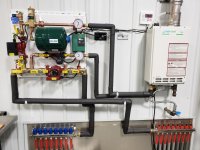
In your photo, that black wire running by the right side manifold up to the boiler. Is that your floor sensor? How does it enter into the floor? I didn't plan for that when I poured. Thanks.

Sent from my SAMSUNG-SM-G890A using Tapatalk
 

Firebrick43

Well-known member
Joined
May 12, 2015
Messages
14,207
Location
West central Indiana
Steve R, Im with you. people WAY WAY over think these radiant heat systems as far as concrete. Heat flows from warm to cold. The slab is obviously always going to be colder than the 120* water you are pushing through it so the heat will go into the slab. Heat also rises so it will then go up and out of the slab heating all the stuff in the shop.

One last thing I will never ever understand is why a "boiler" is better than say a decent on demand hot water heater. My well water at 55 feet below the ground level is ALWAYS about 45 degrees. My on demand hot water heater heats it up to 140F INSTANTLY. If i use the same heater for my radiant heat it will leave the heater at 140F and come back at probably 100F making the heater work less... So why spend $5k on a boiler when i can spend $500 on an on demand hot water heater? even if it lasts 4 years. It would take the boiler 40 years to pay for itself...

First the boiler is designed for higher flow and lower delta t where the on demand water heaters are high delta t and lower flow. Might not make as big of difference on small spaces(such as a 20x 20 garage) but makes a huge difference in a whole house system.

Second an on demand water heater is ment for realitively low hours of use compared to a boiler. I think you have already surmised this point.

Third is your pricing is quite skewed. Modcon and even a condensing cast iron boiler such as a gv90+ 3 are around $2500~ and decent on demand units are $600-700. So it's really only a two and half to one ratio. $5000 dollar boilers are huge.

Lastly, it may befit you to do exactly as you say and install an on demand water heater every 4-5-6 years or so. But if some one else is paying labor for someone to install it's false economy as installation twice will more than cover the extra cost of a boiler. Also what is the consequence of equipment failure of a non approved on demand heater? There is more to it than just purchase cost.
 
Last edited:
OP
S

Steve R

Active member
Joined
Nov 19, 2018
Messages
31
Location
South Dakota
RAYBOB58
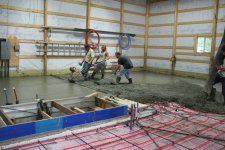
No that black line you see there is a hose coming off my condensing/back flow preventer on my boiler exhaust vent. I have the hose going into a bottle on the floor. I attached an image if you can open it up. Behind the guys working along the wall you can see my supply and return lines. Before the stair way you can see 3 pieces of conduit sticking up. One of the small pieces of conduit runs over and up behind my supply and return lines. The other small one goes under the rebar at a diagonal direction. That is a piece of 1/2 conduit that goes out about 8-9 ft with a cap on the end and stops midway between loops. That is where my sensor is. I took some clear plastic 1/4" water line and pushed it into the conduit till it hit the end and cut it off so about 3" was still sticking out of the conduit. I took a vacuum cleaner to pull a piece of string through the water line and tied the string onto the sensor lead and pulled through the water line. I used water line to push the sensor to the end, and the plastic line stayed in the conduit with the sensor. Worked out good.
 

Attachments

  • IMG_1550.jpg
    IMG_1550.jpg
    158.6 KB · Views: 184

Latitude42

Member
Joined
Jan 16, 2019
Messages
22
Location
S. Wis
Just a thought, as I am no expert... In your Pic, the "Purge T" looks to be in the open position... shouldn't that be closed so you have separation between the primary/ secondary loops??
 

road_king

Well-known member
Joined
Dec 17, 2018
Messages
77
Location
Eastern USA
maybe you mentioned somewhere in this thread, but have you set the thermostat to keep set temp based on the ambient air temp verses the floor temp?
I have a Viega thermostat with optional in floor sensor and all the floor sensor does is provide temp readings to the thermostat to monitor upper and lower slab temperatures.
These numbers are programmable but I have left them at factory settings of 41F and 83F

I looked up your Aube TH114-AF-024T thermostat and it is basically designed to do the same thing
 
OP
S

Steve R

Active member
Joined
Nov 19, 2018
Messages
31
Location
South Dakota
Latitude42 - Just a thought, as I am no expert... In your Pic, the "Purge T" looks to be in the open position... shouldn't that be closed so you have separation between the primary/ secondary loops??
According to the instructions and the label on the handle, it is to be open for operating conditions and closed only when filling system.

road_king - maybe you mentioned somewhere in this thread, but have you set the thermostat to keep set temp based on the ambient air temp verses the floor temp?
I have it set to go the floor sensor. The ambient air sensor is turned off

One thing I noticed with this is that it does a lot of run cycles of 1.5 to 3 minutes (timed it several times). Example the thermostat kicks the system on and it runs between that 1.5 to 3 minutes and then turns off. Then after a while it turns back on for the 1.5 to 3 minutes. The length in time it is off varies greatly from about 5 minutes in between cycle times to several hours. I called hydro smart and they said that was not normal and the run cycles should be longer and probably have a bad thermostat. The thermostat is set on 55' and does move off of that. This thermostat is a PWM thermostat with little icons that show up on the display (1 thru 5 lines) to show how much heat is needed. Usually it is just one line unless I turn it up a degree then the lines usually go to show 3 or 4 lines. I call Aube to talk to tech support on this and they told me that thermostat was not compatible with my system. Was not impressed with their tech support. They recommended their version that just runs off ambient air temp that runs off 2AA batteries and not use the floor sensor at all.
 
OP
S

Steve R

Active member
Joined
Nov 19, 2018
Messages
31
Location
South Dakota
Spring is coming sooner or later, getting some warmer temps to where the snow is finally melting.

What does one do, for down time (summer) on this type of heating system. I have been told the pumps need to be run every week or two for best life span. Do you just unplug the boiler so it doesn't run and turn up the thermostat to kick the pumps in for a couple minutes run time or is there a better solution?? Or don't need to do anything during the summer??
 

mlyonsdc

Well-known member
Joined
Nov 23, 2018
Messages
238
Location
USA
Hello,
I installed my garage floor last winter and I am getting ready to purchase the parts to finish the heated floor. I was looking to get the Hydrosmart 115 Boiler and the 120LT control panel for 1 zone. This looks a lot like what you did SteveR?

How has it been holding up for you are you happy with the Hydrosmart choice? They have some pretty bad reviews online and I am concerned about dropping $3k on all the stuff to find out it is junk and they will not support it.

I am told the "boiler" they are using is actually a Takagi on demand water heater. I can save a few bucks if I just buy the Takagi direct. Any suggestions or is the Hydrosmart different in some way?
Thanks
 
OP
S

Steve R

Active member
Joined
Nov 19, 2018
Messages
31
Location
South Dakota
mlyonsdc
I haven't had too much for issues, had one gauge that leaked around the threads. Had to depressurize the system and reseal it. Then I had one gauge start leaking inside the gauge. The lens got wet. Called Hydrosmart and told them about and they sent another gauge out right away.

johnnyradiant
No on the short cycling. It still does it. I called the thermostat company (Aube, the number in the paperwork that came with it) and they said that thermostat (Aube TH114-AF-024T thermostat) was not compatible with my system. I ask what thermostat that they made was, they said none. Still using it as I have not found anything that had an in slab sensor.
 

fitter30

Well-known member
Joined
Jun 23, 2019
Messages
2,992
Location
Peace Valley,mo
30% propylene glycol has a freeze point of 8°F but the burst point is -18°F. This system will be protected but the coolant will be slushy. By definition, freeze point is the temperature where ice crystals begin to form.
 

yeldogt

Well-known member
Joined
Jan 2, 2012
Messages
18,184
I would have to "wrap my head around" the piping to try nd figure out the P?S piping separation that the OP used .. But it's backward.

Typically the Primary is the straight through loop -- often with the boiler pump pumping into the device. The secondary comes off using the spaced T's.

Secondary is pumping away with feed air separation on the return
 

tdkkart

Well-known member
Joined
Jun 17, 2006
Messages
6,887
Location
Eastern Iowa
I would have to "wrap my head around" the piping to try nd figure out the P?S piping separation that the OP used .. But it's backward.

Typically the Primary is the straight through loop -- often with the boiler pump pumping into the device. The secondary comes off using the spaced T's.

Secondary is pumping away with feed air separation on the return


I just went through this with my system, had seen them plumbed both ways. I emailed Webstone and their response was that it can be plumbed either direction.
I plumbed mine as you suggested, as every engineering explanation I could find for closely spaced Ts shows the primary going straight through with the secondary flows through the side ports.
 

yeldogt

Well-known member
Joined
Jan 2, 2012
Messages
18,184
I just went through this with my system, had seen them plumbed both ways. I emailed Webstone and their response was that it can be plumbed either direction.
I plumbed mine as you suggested, as every engineering explanation I could find for closely spaced Ts shows the primary going straight through with the secondary flows through the side ports.

What would one do for a second loop ? That would be a problem.


There are many ways to do things ..... odd things can work. What I like to do is follow systems that will work ....

My first system was a big old brick house conversion -- since it had some radiators (high heat) I made that the primary loop off the boiler with ODR. The other zones bing lower temp -- this worked. Today with low mass boilers I would need the T's or LLH
 
To avoid these ads, REGISTER NOW!
Top Bottom