To avoid these ads, REGISTER NOW!

Need Help setting up a Small Solar system.

JOE.G

Well-known member
Joined
Feb 4, 2013
Messages
774
Location
Eastern ( Catskills ) NY
Hi, I have a Shed that i built that is storing some equipment, I had asked a similar question before but with a slightly different set up in mind. A few of you guys suggested a battery solar system.

Can you guys please list all the parts I would need to make a small system work,
Battery, Controllers, Panels, wires and what not.

I am only looking to power 4-6 Battery tender JR ( Hooked to the machinery), and maybe one or two small lights, Lights would be very short use and infrequent, Battery tenders would be 24/7. I am not looking for the best and most expensive, Just looking for a lower maintenance reliable system. Thank you

P.S I know nothing about this so please feel free to offer all of your knowledge.
 
Last edited:
To avoid these ads, REGISTER NOW!

kbeefy

Well-known member
Joined
Sep 14, 2013
Messages
3,536
Location
Harington, Eastern Washington
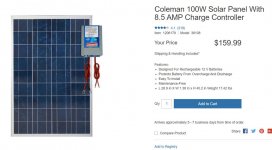
100w panel, 10a charge controller and a 12v battery of some sort. Add some 12v LED lights wherever you want them.

No need for the Battery Tender, the solar charge controller will do the job and eliminate the need for an inverter. Nothing special about the wires, multi-strand copper, the longer the run the larger the guage. The Panel will probably come with some.

Thats about the simplest setup I can imagine, scale the battery and panel(s) to your needs. You probably have a battery sitting around that would do fine to begin with.
 

theoldwizard1

Well-known member
Joined
Feb 22, 2011
Messages
43,630
Location
SE MI
No need for the Battery Tender, the solar charge controller will do the job and eliminate the need for an inverter.
Maybe.

If the batteries are going to be there for long term storage, you would be better off with the inverter and the Battery Tenders. You will never get optimal charging of multiple batteries in parallel, especially if they are different sizes.
 

Git

Well-known member
Joined
May 18, 2008
Messages
6,895
Location
S Cal
I would think about going with a kit - this is from Costco

attachment.php
 

Attachments

  • TRI-395.jpg
    TRI-395.jpg
    96.6 KB · Views: 207

kbeefy

Well-known member
Joined
Sep 14, 2013
Messages
3,536
Location
Harington, Eastern Washington
Maybe.

If the batteries are going to be there for long term storage, you would be better off with the inverter and the Battery Tenders. You will never get optimal charging of multiple batteries in parallel, especially if they are different sizes.

Thats true. I suppose the next question should be how long these batteries need to be maintained? 1 month? 3 years?

I would suggest any battery left longer than a month or two should be disconnected, unless modern fuel injection and adaptive learning retention is a concern. It's really not much more difficult to disconnect a battery than hook up a maintainer. One could even install a quick disconnect for less than the price of a Tender.
 
OP
J

JOE.G

Well-known member
Joined
Feb 4, 2013
Messages
774
Location
Eastern ( Catskills ) NY
The quads and stuff are used often, but there are times one or two of them may sit for a couple months, I like to keep them hooked up to battery tenders. So i am looking to keep them charged up. This building is a bout a 100 Ft or so from the closes power source. I have a extension cord running out there currently but come spring I dont want to see this cord running there.

One of the kits above plus a Battery and an inverter is all I would need?
 
To avoid these ads, REGISTER NOW!
Joined
Mar 29, 2010
Messages
13
I run remote solar wildlife monitoring equipment in the northeast. A few things I can tell you for sure.
-At 100 feet from a power source, you can meet your needs (maintaining batteries in multiple pieces of equipment + occasional lighting) with much less frustration and long-term cost by running permanent grid power.
-Unless you have a fully unobstructed view of the southern sky, you will make far less power than you think. Even a single branch casting a shadow across the panel will dramatically reduce power produced.
-Doing this the way you suggest (running multiple battery tenders) is going to be very inefficient (you have inefficiency both in converting DC power from solar to AC--inverter--and from battery tenders themselves).
-Charging more than 2-3 batteries in parallel does not work well, even when the batteries are of the same make, model and age.
-Eastern NY makes solar a lot harder than AZ; so if somebody in AZ tells you they had success, take that with a grain of salt for your location.

Here is my real world example. Location: Pittsburg, NH
Equipment draws 1.7amps/hr 12v consistently; no inverter (with related losses)
Two 200amp solar panels
One PWM temperature compensated charge controller
Three Group 31 deep cycle batteries (100AH each), parallel

System installed mid-April.
Worked great until late October, then late fall/winter weather arrived, and low voltage cutoff triggered. For the next 3 months we had to charge batteries with a generator roughly once-weekly as solar charging was insufficient. Even on weeks with sufficient sun to run equipment, batteries were often not fully charged and thus at risk of damage from sulfation.

If you can find a Weather Underground station with solar radiation measure close to your location it can be helpful to see what to expect for sunny days. Here are mine to show just how bad winter is for solar production. (scroll down to solar)
Typical summer week: https://www.wunderground.com/dashboard/pws/KNHPITTS1/graph/2018-07-9/2018-07-9/weekly

Typical winter week: https://www.wunderground.com/dashboard/pws/KNHPITTS1/graph/2018-12-5/2018-12-5/weekly

The most simplistic solar design is probably a separate charge controller for each equipment battery, and no deep cycle battery bank or inverter. There will be days when you don't make power...maybe even entire weeks in the winter, but if all you need to do is keep fully charged batteries topped off, it will probably be sufficient. I have not done this, but somebody on one of the solar power forums probably has.

Last advice. If you decide to go solar, don't go no-name inexpensive charge controller. Low amp units from Morningstar and other companies with long history in solar are quite affordable. Protect wiring from rodents.
 

LS6 Tommy

Well-known member
Joined
Dec 27, 2013
Messages
26,162
Location
Northern NJ
To my knowledge, the best guy for setting up a solar system can most easily be reached by prayer. He did it on the first day, too. ;)

Tommy
 

tyme2par4

Well-known member
Joined
May 16, 2016
Messages
571
Location
NH
Thank you, Maybe best route is to go with Battery tender solar chargers for each battery, I will give them a call.

That would be my recommendation. No point in charging a separate battery just to maintain other batteries.
Then just find a cheap old 12V battery and a couple little 12V leds for your lighting.
 

dcg9381

Well-known member
Joined
Jun 20, 2018
Messages
12,086
Location
Austin, TX
I agree - easier to do individuals.
With a system like this - one thing to watch out for that most people don't consider is a low-voltage cut-off. That is, if your main battery drops below discharge voltage, it's disconnected from the load.

I ran a "remote" solar system like this (DC) - basically it powered a gate and wifi cameras in a location where I couldn't easily put power. After a few days, 3-4 of overcast, the battery would be discharged enough to be damaged if you didn't have low voltage protection.

Same concept would apply to running your battery tenders... Like others have said, I'd set them up as individual charge stations. Lighting is dummie-proof with solar (as long as you turn it off) - likely doesn't need low-voltage protection.
 
To avoid these ads, REGISTER NOW!
Top Bottom