I run remote solar wildlife monitoring equipment in the northeast. A few things I can tell you for sure.
-At 100 feet from a power source, you can meet your needs (maintaining batteries in multiple pieces of equipment + occasional lighting) with much less frustration and long-term cost by running permanent grid power.
-Unless you have a fully unobstructed view of the southern sky, you will make far less power than you think. Even a single branch casting a shadow across the panel will dramatically reduce power produced.
-Doing this the way you suggest (running multiple battery tenders) is going to be very inefficient (you have inefficiency both in converting DC power from solar to AC--inverter--and from battery tenders themselves).
-Charging more than 2-3 batteries in parallel does not work well, even when the batteries are of the same make, model and age.
-Eastern NY makes solar a lot harder than AZ; so if somebody in AZ tells you they had success, take that with a grain of salt for your location.
Here is my real world example. Location: Pittsburg, NH
Equipment draws 1.7amps/hr 12v consistently; no inverter (with related losses)
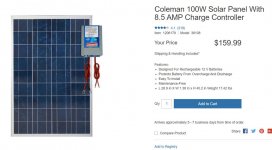
Two 200amp solar panels
One PWM temperature compensated charge controller
Three Group 31 deep cycle batteries (100AH each), parallel
System installed mid-April.
Worked great until late October, then late fall/winter weather arrived, and low voltage cutoff triggered. For the next 3 months we had to charge batteries with a generator roughly once-weekly as solar charging was insufficient. Even on weeks with sufficient sun to run equipment, batteries were often not fully charged and thus at risk of damage from sulfation.
If you can find a Weather Underground station with solar radiation measure close to your location it can be helpful to see what to expect for sunny days. Here are mine to show just how bad winter is for solar production. (scroll down to solar)
Typical summer week:
https://www.wunderground.com/dashboard/pws/KNHPITTS1/graph/2018-07-9/2018-07-9/weekly
Typical winter week:
https://www.wunderground.com/dashboard/pws/KNHPITTS1/graph/2018-12-5/2018-12-5/weekly
The most simplistic solar design is probably a separate charge controller for each equipment battery, and no deep cycle battery bank or inverter. There will be days when you don't make power...maybe even entire weeks in the winter, but if all you need to do is keep fully charged batteries topped off, it will probably be sufficient. I have not done this, but somebody on one of the solar power forums probably has.
Last advice. If you decide to go solar, don't go no-name inexpensive charge controller. Low amp units from Morningstar and other companies with long history in solar are quite affordable. Protect wiring from rodents.